Primary vs. Secondary Life Insurance Beneficiaries: Which Is Right for You?
When purchasing a life insurance policy, selecting your primary and secondary beneficiaries is one of the most critical decisions you will make. A primary beneficiary is first in line to receive the tax-free death benefit, while a seco...
When purchasing a life insurance policy, selecting your primary and secondary beneficiaries is one of the most critical decisions you will make. A primary beneficiary is first in line to receive the tax-free death benefit, while a secondary beneficiary (also known as a contingent beneficiary) acts as a safety net, receiving the payout only if the primary beneficiary passes away before you or disclaims the proceeds.
Contents
Selecting between primary and secondary beneficiaries is not an "either/or" choice—you should almost always name both. Structuring these designations properly ensures your life insurance death benefit reaches your intended heirs quickly, avoids lengthy probate court proceedings, and aligns with your broader financial plan.
Understanding Beneficiary Designations in Life Insurance
A life insurance beneficiary is the individual, trust, legal entity, or charity designated by the policy owner to receive the policy proceeds upon the insured person's death. Beneficiary designations carry binding legal authority. Under standard insurance law across most jurisdictions, a life insurance contract functions as a non-probate transfer. This means the insurer pays proceeds directly to the designated parties according to the policy contract, regardless of instructions contained in a will or testament.
Because life insurance bypasses probate when a valid beneficiary is named, the money transfers quickly and remains exempt from the public court records associated with estate settlement. However, if your primary beneficiary is unable or unwilling to accept the proceeds—and you have not named a secondary beneficiary—the contract fails to name a living recipient. In that situation, the insurance company defaults to paying the money directly to your estate, where it becomes subject to probate delays, court fees, and potential claims from creditors.
Note: The information in this guide is for educational purposes and does not constitute formal legal, tax, or financial advice. Beneficiary regulations and tax implications can vary by state and jurisdiction. Consult an estate planning attorney or licensed financial professional regarding your specific situation.
What Is a Primary Beneficiary?
A primary beneficiary is the party holding first rights to the proceeds of your life insurance policy upon your death. As long as your primary beneficiary survives you and is legally eligible to receive the funds, they will receive 100% of the allocated death benefit.
Characteristics of Primary Beneficiaries
- First Priority: They receive the benefit before any secondary or tertiary beneficiaries gain access to funds.
- Multiple Allocation: You can name a single individual (such as a spouse) or divide the primary payout among multiple people, charities, or trusts.
- Percentage Allocation: If you name multiple primary beneficiaries, you must assign a specific percentage of the total benefit to each person, totaling exactly 100%. For example, you might designate a spouse to receive 60% and two adult children to receive 20% each.
- Disbursement Conditions: If a primary beneficiary is alive when the insured dies, secondary beneficiaries receive nothing from the policy.
Common Choices for Primary Beneficiaries
- Spouses or Domestic Partners: Frequently chosen to replace income, pay off a mortgage, or maintain household living standards.
- Revocable or Irrevocable Trusts: Utilized when policyholders want precise legal control over how and when money is distributed to heirs, particularly for minor children or beneficiaries with special needs.
- Adult Children: Selected when secondary financial support or asset transfers are intended directly for offspring.
- Charitable Organizations: Named by policyholders seeking to support a cause or philanthropic institution.
What Is a Secondary (Contingent) Beneficiary?
A secondary beneficiary—frequently referred to by life insurance companies as a contingent beneficiary—serves as the legal backup to your primary beneficiary. A secondary beneficiary has no claim to the insurance benefit while any primary beneficiary is living and eligible to claim the payout.
Triggers for Secondary Beneficiary Payouts
A secondary beneficiary receives the death benefit under three primary legal conditions:
- Pre-Decease: The primary beneficiary dies before the insured person.
- Simultaneous Death: The insured and the primary beneficiary die in a common accident or within a short window (often 30 to 120 days, depending on policy terms and state laws governed by statutes like the Uniform Simultaneous Death Act).
- Legal Disclaimer: The primary beneficiary formally disclaims (refuses) the insurance proceeds for personal, legal, or estate tax reasons.
Like primary designations, you can name multiple secondary beneficiaries and split their collective benefit into percentages totaling 100%. If all primary beneficiaries pass away before you, the insurance carrier transfers the full policy payout to the secondary beneficiaries according to your designated ratios.
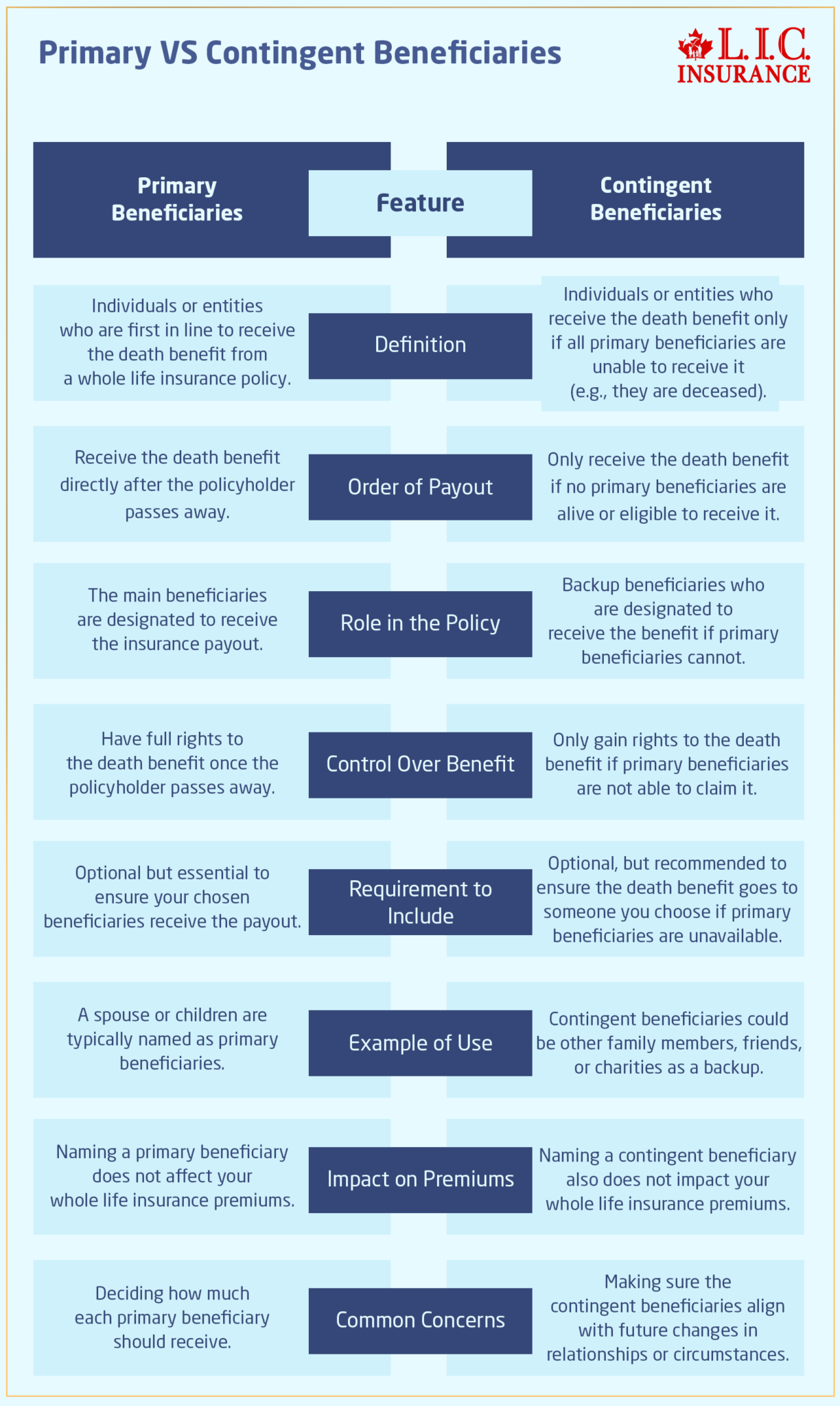
Primary vs. Secondary Beneficiaries: Key Differences Compared
Understanding the structural differences between primary and secondary designations helps you build an estate plan that anticipates unforeseen circumstances.
| Feature | Primary Beneficiary | Secondary (Contingent) Beneficiary |
|---|---|---|
| Claim Priority | First priority to policy proceeds upon insured's death. | Second priority; receives funds only if primary cannot inherit. |
| Payout Condition | Receives benefit if alive at the time of the insured's passing. | Receives benefit if all primary beneficiaries pre-decease the insured or disclaim funds. |
| Role in Policy | Core recipient of life insurance protection. | Financial safety net and contingent protection layer. |
| Right to Funds | Claims 100% of benefit assigned to them while living. | Receives 0% as long as a living primary beneficiary accepts the payout. |
| Impact of Omission | If omitted, policy defaults directly to secondary beneficiaries or estate. | If omitted and primary dies first, proceeds default to probate court/estate. |
| Percentage Ratios | Assigned percentages must total 100% across all primary nominees. | Assigned percentages must total 100% across all secondary nominees. |
Why You Need Both Primary and Secondary Beneficiaries
Choosing between a primary and a secondary beneficiary is not a decision where you pick one over the other. To maintain a complete financial safety net, every policyholder should establish both. Relying solely on a primary beneficiary leaves your financial plan vulnerable to unexpected life events.
Avoiding the Probate Trap
If you name your spouse as your sole primary beneficiary and fail to name a secondary beneficiary, what happens if both of you are involved in a fatal accident? If your spouse pre-deceases you—even by a matter of minutes—there is no surviving primary beneficiary to receive the payout.
Without a designated secondary beneficiary, the life insurance company cannot disburse funds to an individual. The proceeds automatically fall into your legal estate. Once funds enter probate:
- Legal Delays: Heirs may wait six months to over a year for probate court approval before receiving money.
- Court Fees and Expenses: Legal expenses, administrative filings, and probate fees reduce the final inheritance amount.
- Creditor Claims: In many jurisdictions, life insurance paid directly to a named beneficiary is protected from debts and personal creditors. Once proceeds flow into the deceased's estate, creditors can file claims against the funds to settle unpaid debts before any remaining money passes to your heirs.
- Public Record: Probate proceedings are public. Anyone can look up the value of your estate and the identity of your legal heirs.
By designating secondary beneficiaries, you preserve the non-probate status of your life insurance policy, guaranteeing that funds bypass court intervention and transfer directly to your intended secondary recipients.
Structuring Multi-Generational Payouts: Per Stirpes vs. Per Capita
When designating multiple primary or secondary beneficiaries—such as adult children—you must understand how insurance carriers handle payouts if one beneficiary pre-deceases you. Insurers typically require you to choose between two structural distribution methods: Per Stirpes or Per Capita.
PER STIRPES DISTRIBUTION (By Branch) Insured passes away -> Primary Child A (Deceased) & Primary Child B (Living) | | +--> 50% to Child A's Children +--> 50% to Child B (Grandchildren) PER CAPITA DISTRIBUTION (By Head) Insured passes away -> Primary Child A (Deceased) & Primary Child B (Living) | +--> 100% to Child B
Per Stirpes ("By the Branch")
Under a Per Stirpes designation, if a named beneficiary pre-deceases you, their share of the death benefit automatically passes down to their surviving lineal descendants (their children/your grandchildren).
- Example: You name your two adult children, Alex and Taylor, as equal 50% primary beneficiaries under a Per Stirpes election. If Alex passes away before you, leaving behind two children, Alex's 50% share will be split equally between Alex's two children (25% each). Taylor still receives their original 50% share.
Per Capita ("By Head")
Under a Per Capita designation, if a named beneficiary pre-deceases you, their share is divided equally among the remaining surviving beneficiaries named in that tier. The deceased beneficiary's children receive nothing.
- Example: Using the same scenario above, if Alex passes away before you under a Per Capita election, Alex's 50% share is redistributed to the surviving primary beneficiary, Taylor. Taylor receives 100% of the policy proceeds, and Alex's children receive zero.
Specifying Per Stirpes or Per Capita on your beneficiary designation form clarifies your intent and prevents family disputes.
Common Mistakes to Avoid When Naming Beneficiaries
Formulating your beneficiary designations requires careful legal attention. Minor errors on administrative forms can lead to frozen payouts, unintended tax obligations, or family litigation.
1. Naming Minor Children Directly
Life insurance companies will not pay out substantial death benefits directly to minor children (typically anyone under 18 or 21, depending on state law). If a minor is named as a primary or secondary beneficiary without a legal arrangement:
- The court will appoint a legal guardian to manage the money until the child reaches the age of majority, incurring significant legal expenses.
- Upon turning 18 or 21, the child receives the entire sum in cash with no financial oversight or restrictions.
Better Solution: Establish a trust for the benefit of the minor and name the trust as the beneficiary, or name an adult custodian under your state's Uniform Transfers to Minors Act (UTMA) or Uniform Gifts to Minors Act (UGMA).
2. Designating "My Estate" as Beneficiary
Intentional or accidental designation of your legal estate as a primary or secondary beneficiary strips away the natural tax and liability advantages of life insurance. It subjects proceeds to probate court, creditor claims, and estate administration fees.
3. Neglecting Community Property Laws
If you reside in a community property state (such as California, Texas, Washington, or Arizona), income earned during marriage is considered joint property. If you purchase a life insurance policy using marital income, your spouse may hold a statutory legal claim to at least 50% of the policy proceeds—even if you name someone else as the primary beneficiary. Naming a non-spouse primary beneficiary in a community property state without a signed, written spousal waiver can result in the insurer invalidating the designation or legal disputes following death.
4. Failing to Update Beneficiary Forms After Life Events
Life insurance beneficiary forms override terms established in a written will. If you divorce your spouse but forget to update your life insurance beneficiary designation form, your ex-spouse may legally receive the policy payout depending on state revocation statutes.
Review your primary and secondary beneficiary choices whenever major life changes occur:
- Marriage or divorce
- Birth or adoption of children
- Death of a named beneficiary
- Significant changes in state property laws or personal wealth
How to Set Up and Update Your Life Insurance Beneficiaries
Updating your primary and secondary beneficiaries is straightforward and can be completed online or through physical change forms provided by your insurance carrier.
Step-by-Step Beneficiary Assignment Process
- Gather Accurate Identification Information: Insurance companies require complete legal details to verify beneficiaries and prevent fraud. Gather the legal names, Social Security numbers (or Taxpayer Identification Numbers), dates of birth, current addresses, and relationship to the insured for all individuals or entities.
- Determine Percentage Allocations: Decide how much each beneficiary will receive. Verify that primary allocations equal exactly 100%, and secondary allocations equal exactly 100%.
- Choose Distribution Mechanics: Explicitly state whether the policy should distribute funds using Per Stirpes or Per Capita mechanics if a named individual pre-deceases you.
- Complete the Change of Beneficiary Form: Submit the updated designation form through your insurer’s digital portal or submit a signed paper document to the carrier's administrative office.
- Confirm Revocable Status: Ensure designations are classified as revocable unless you have a specific legal requirement (such as a divorce decree or business buy-sell agreement) compelling an irrevocable designation. Revocable designations allow you to modify beneficiaries anytime without needing the beneficiary's consent.
- Store Written Confirmation: Keep a copy of the carrier's written confirmation alongside your original policy documents and estate planning files.
Frequently Asked Questions
Can a secondary beneficiary receive part of the payout if the primary beneficiary is still alive?
No. A secondary beneficiary has no claim to life insurance funds while any primary beneficiary is alive and eligible to receive the benefit. Secondary beneficiaries only receive proceeds if all primary beneficiaries are deceased, disclaim their inheritance, or cannot legally accept the payout.
What happens if both primary and secondary beneficiaries die before the insured?
If all named primary and secondary beneficiaries pre-decease the policyholder and no updated designations were filed, the policy defaults to having no living beneficiary. The insurance company pays the death benefit directly to the policyholder's legal estate, forcing the funds into probate court subject to delays and potential creditor claims.
Is a secondary beneficiary the same as a contingent beneficiary?
Yes. The terms "secondary beneficiary" and "contingent beneficiary" are used interchangeably by life insurance companies, financial planners, and estate attorneys. Both terms describe the party designated to receive the death benefit if the primary beneficiary cannot receive it.
How do revocable and irrevocable beneficiary designations differ?
A revocable beneficiary designation allows the policy owner to change or remove the beneficiary at any time without asking permission or giving notice. An irrevocable beneficiary designation confers legal rights to the beneficiary; the policy owner cannot change the beneficiary, alter allocation percentages, or surrender the policy without the written consent of the irrevocable beneficiary.
Does a will override a life insurance beneficiary designation?
No. Life insurance policies are contractual agreements that pass assets outside of probate. The beneficiary designation form on file with the life insurance company takes legal precedence over instructions written in a will. If a will names one person as the recipient of life insurance, but the insurance form names a different individual, the carrier will pay the proceeds to the person listed on the insurance form.
Practical Recommendation for Policyholders
Protecting your family's financial future requires setting up both primary and secondary beneficiaries. Rather than treating this as a choice between options, view primary and secondary designations as a two-tiered system designed to protect your estate.
To maintain an effective life insurance policy:
- Name a Primary Beneficiary: Designate your immediate dependent, spouse, or a trust designed for family asset management.
- Always Name a Secondary Beneficiary: Name secondary beneficiaries (such as adult children, siblings, or trusted legal entities) to ensure that funds never fall back into probate court if the primary beneficiary pre-deceases you.
- Schedule an Annual Review: Inspect your beneficiary designations every 12 months or immediately following major life events like marriages, divorces, births, or deaths. Contact your life insurance carrier or financial advisor to request a copy of your current beneficiary records and update them as needed.
Image Gallery