The 2004 Nimitz Tic Tac Incident: A Comprehensive Analysis of the Navy Pilot UFO Encounter
In November 2004, pilots from the USS Nimitz Carrier Strike Group encountered an Unidentified Aerial Phenomenon (UAP) off the coast of Southern California. Known as the "Tic Tac" incident, it involved Commander David Fravor and Lieuten...
In November 2004, pilots from the USS Nimitz Carrier Strike Group encountered an Unidentified Aerial Phenomenon (UAP) off the coast of Southern California. Known as the "Tic Tac" incident, it involved Commander David Fravor and Lieutenant Commander Alex Dietrich witnessing a wingless, white craft performing maneuvers that defied known laws of physics and current aerospace capabilities.
Contents
The Chronology of the November 2004 Encounter
The events of November 2004 did not begin with a visual sighting, but with persistent radar anomalies tracked by the USS Princeton, a Ticonderoga-class guided-missile cruiser equipped with the advanced AN/SPY-1B radar system. For several days prior to the primary intercept, Senior Chief Kevin Day and other radar operators observed multiple "Unidentified Aerial Phenomena" (UAP) appearing on radar at altitudes above 80,000 feet. These objects would descend rapidly to 20,000 feet and hover before dropping straight down to just above the ocean surface or accelerating back into the upper atmosphere.
On November 14, 2004, during a routine training exercise, the USS Princeton directed two F/A-18F Super Hornets—piloted by Commander David Fravor (CO of VFA-41 "Black Aces") and Lieutenant Commander Alex Dietrich—to investigate one of these "real-world" tracks. The pilots were diverted from their training mission to intercept an object located at what was termed the "merge plot," the point where the jets and the radar target would occupy the same geographical space.
Upon arriving at the coordinates, the pilots initially saw a disturbance in the water—a churning, circular patch of white water about the size of a Boeing 737. Hovering just above this disturbance was a smooth, solid white object, approximately 40 feet long, shaped like a large "Tic Tac" breath mint. It had no visible wings, rotors, windows, or means of propulsion.
Eyewitness Testimony: Commander David Fravor and Lt. Cmdr. Alex Dietrich
The Nimitz encounter is uniquely significant because it relies on the testimony of highly trained observers whose primary job is the identification of aerial threats. Commander David Fravor and Lieutenant Commander Alex Dietrich have provided consistent, detailed accounts of the encounter in the years following its 2017 public disclosure.
Fravor describes the object’s movement as "erratic," noting that it mirrored his movements as he attempted to descend and get a closer look. When Fravor began a circular descent toward the object, the Tic Tac began to climb, meeting him halfway in a "mirroring" maneuver. As Fravor attempted to close the distance for a visual identification, the object suddenly accelerated with such velocity that it disappeared from sight in less than two seconds.
Dietrich, watching from a higher altitude, confirmed the sighting, describing the object's movement as "joyous" yet unsettling because of its lack of inertia. Both pilots reported that the craft did not produce a sonic boom despite its apparent supersonic acceleration, nor did it leave a wake or exhaust trail. This lack of "flight signatures"—the heat and turbulence typically associated with propulsion—remains one of the most baffling aspects of the case.
Technical Specifications and Observed Capabilities
The "Tic Tac" UAP exhibited what the Department of Defense now categorizes as the "Five Observables." These characteristics distinguish UAPs from conventional human-made aircraft or natural phenomena.
Instantaneous Acceleration
The object was tracked on radar moving from a hover to hypersonic speeds almost instantly. According to data analysis by the Scientific Coalition for UAP Studies (SCU), the object would have had to endure thousands of G-forces—forces that would liquefy a human pilot and tear any known airframe apart.
Hypersonic Velocities Without Signatures
The craft reached speeds estimated in excess of Mach 15 (over 11,000 mph). At these speeds, conventional aircraft generate immense friction and heat, yet the Tic Tac showed no thermal signature on the ATFLIR (Advanced Targeting Forward Looking Infrared) pods that later tracked it.
Low Observability
While the pilots saw the object visually, it appeared to have sophisticated jamming capabilities. Later that day, when a second flight of Super Hornets (led by Lt. Cmdr. Chad Underwood) attempted to lock onto the object using the ATFLIR pod, the radar system showed signs of active "jamming" and "strobing," indicating the object was aware of and capable of countering military-grade sensor systems.
Trans-medium Travel
The white water disturbance observed by Fravor suggested the object was interacting with the ocean. Radar data from the USS Princeton suggested these objects were frequently moving from space to the atmosphere and potentially into the water, a capability known as trans-medium travel that currently has no human equivalent.
| Feature | F/A-18F Super Hornet (2004) | "Tic Tac" UAP (2004) |
|---|---|---|
| Propulsion | Twin F414-GE-400 turbofans | Unknown (No visible exhaust/intake) |
| Max Speed | Mach 1.8 | Estimated Mach 15+ |
| Flight Surfaces | Wings, rudders, elevators | None (Smooth, cylindrical) |
| G-Force Limit | Approx. 9G (Airframe/Pilot limit) | Estimated 100G - 1,000G+ |
| Radar Signature | Variable (Reduced but detectable) | Active jamming / "Ghosting" on radar |
The "FLIR1" Video and Sensor Corroboration
The Nimitz incident is not merely an eyewitness account; it is a multi-sensor event. After Fravor and Dietrich returned to the carrier, another pilot, Lieutenant Commander Chad Underwood, took off with a functional ATFLIR pod specifically to find the object Fravor had described.
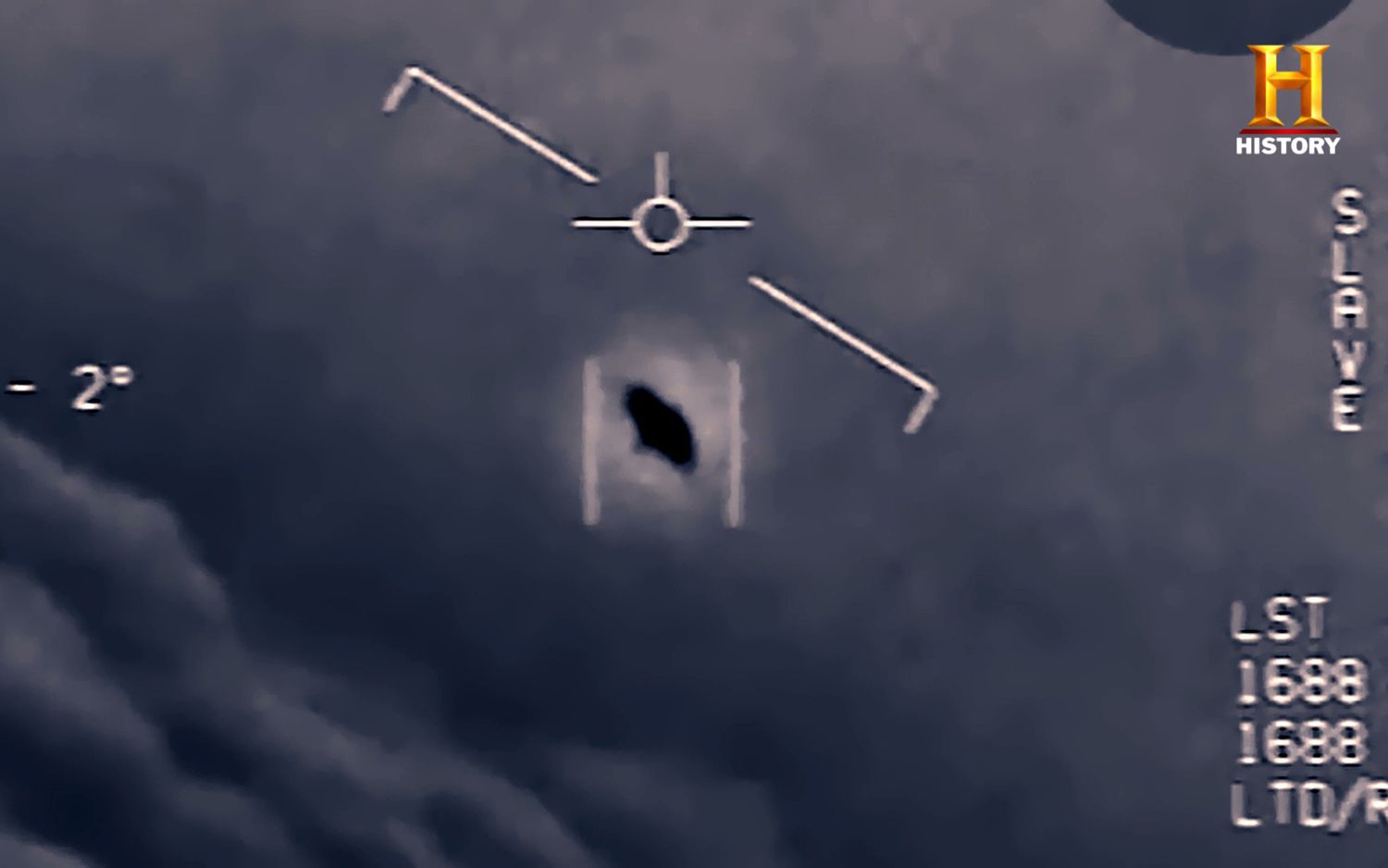
Underwood successfully filmed the object. This footage, now famously known as "FLIR1," was one of the three videos officially released by the Pentagon in 2020. In the video, the object is seen as a dark pill-shaped silhouette (in "Black Hot" mode) hovering at 20,000 feet. When the sensor attempts to lock onto it, the craft suddenly darts to the left at a speed that exceeds the camera’s ability to track it.
The corroboration between the USS Princeton’s SPY-1 radar, the E-2 Hawkeye surveillance aircraft, the F/A-18 radar systems, the ATFLIR sensor, and the visual accounts of four pilots makes this encounter the "gold standard" for UAP investigations as of 2026.
Official Investigations and Government Disclosure
For over a decade, the Nimitz encounter remained largely classified or ignored within the Department of Defense. It wasn't until 2017, through the efforts of the Advanced Aerospace Threat Identification Program (AATIP) and whistleblower Luis Elizondo, that the story broke in The New York Times.
In the years following, the U.S. government has shifted its stance from denial to active investigation:
- 2020 Pentagon Confirmation: The Department of Defense officially released the Nimitz footage, acknowledging the objects were "unidentified."
- 2021 ODNI Report: The Office of the Director of National Intelligence released an assessment stating that UAPs represent a potential threat to flight safety and national security.
- 2023 Congressional Testimony: Commander David Fravor testified under oath before the House Oversight Committee, reiterating that the technology he witnessed was "far superior" to anything human beings possessed at the time or were likely to develop for decades.
- The Role of AARO (2024-2026): The All-domain Anomaly Resolution Office (AARO) continues to analyze the 2004 data using updated AI-driven forensic tools to determine if the object was a breakthrough technology from a foreign adversary or something else entirely.
Skeptical Inquiries and Alternative Explanations
Despite the compelling evidence, several skeptical theories have been proposed to explain the 2004 encounter.
Sensor Malfunction: Some analysts suggest that the movement on the FLIR video could be an artifact of the camera's gimbal system or a "glitch" in the radar. However, this fails to account for the simultaneous visual sightings by four pilots in two different aircraft.
Secret U.S. Technology: Another theory suggests the Tic Tac was a highly classified "black project" drone. Commander Fravor has argued against this, noting that such a test would likely not be conducted in the middle of a live-fire training range where a mid-air collision could occur, and that the technology shown was not just an incremental improvement, but a "physics-defying" leap.
Atmospheric Phenomena: Rare atmospheric conditions can occasionally create "radar ghosts," but they do not appear as solid white objects to pilots or behave with the intelligent, reactive maneuvering described by the VFA-41 crews.
Frequently Asked Questions
What was the specific location of the 2004 Navy UFO sighting?
The encounter occurred approximately 60 to 100 miles southwest of San Diego, California, near San Clemente Island. This area serves as a primary training range for the Navy’s carrier strike groups.
Did the Navy pilots try to shoot at the Tic Tac?
No. The pilots were on a training mission and were not armed with live ordnance. Furthermore, Commander Fravor reported that the object's speed and maneuvers made it impossible to maintain a weapon "lock" or even a consistent visual fix for long enough to engage, had they been armed.
Has the "Tic Tac" been seen since 2004?
Yes. Similar objects have been reported by Navy pilots on the East Coast between 2014 and 2015 (the USS Roosevelt encounters) and by various military and commercial pilots through 2026. The 2004 incident, however, remains the most thoroughly documented due to the sheer number of sensors that tracked it.
Was there any physical evidence left behind?
Beyond the digital sensor data and video footage, no physical debris was recovered. The object did not crash, and it did not drop any material. The only "physical" interaction was the disturbance in the water, which vanished shortly after the object accelerated away.
Is the 2004 Tic Tac incident considered "aliens"?
The official government position as of 2026 remains "unidentified." While the objects demonstrate technology that does not match known human capabilities, officials avoid the term "extra-terrestrial" in favor of "Unidentified Aerial Phenomena" (UAP) or "Anomalous Health Incidents" (AHI) in some related contexts, focusing on the data rather than speculation about the origin.
Next Steps for Researchers and Enthusiasts
To understand the full scope of the 2004 encounter, it is recommended to review the official reports from the Scientific Coalition for UAP Studies (SCU), which provides a 200-page forensic analysis of the flight physics. Additionally, tracking the annual reports from the All-domain Anomaly Resolution Office (AARO) through the Department of Defense website provides the most current legislative and scientific updates on how the U.S. military interprets these encounters in 2026.
Image Gallery