The Best Auto Vacuum for Pet Hair in Your Home: 2026 Performance Guide
Finding the best auto vacuum for pet hair in your home requires balancing suction power, brush roll technology, and advanced AI navigation to handle the unique challenges of shedding. In 2026, top-tier models like the Roborock S-Series...
Finding the best auto vacuum for pet hair in your home requires balancing suction power, brush roll technology, and advanced AI navigation to handle the unique challenges of shedding. In 2026, top-tier models like the Roborock S-Series and iRobot Roomba J-Series lead the market by combining 12,000+ Pa suction with specialized anti-tangle systems.
Contents
Pet owners face a constant battle against fur, dander, and tracked-in debris. Unlike standard dust, pet hair is fibrous, prone to static cling, and notoriously difficult to extract from carpet fibers. If left unmanaged, it can clog standard vacuum intake ports and wrap around traditional bristle brushes, leading to motor strain and decreased efficiency. Fortunately, the landscape of autonomous cleaning has evolved significantly by 2026, offering solutions that not only pick up hair but also manage it effectively within the machine.
Key Features of High-Performance Pet Hair Vacuums
When evaluating an automated vacuum for a home with pets, three primary technical specifications dictate success: suction pressure, brush roll geometry, and filtration quality. In the current 2026 market, these features have reached a level of sophistication that allows for nearly hands-free operation even in multi-pet households.
Suction Power and Airflow Dynamics
Suction is measured in Pascals (Pa). While a standard robot vacuum might offer 3,000 to 5,000 Pa, a dedicated pet-focused model in 2026 should ideally exceed 8,000 Pa, with flagship models reaching up to 15,000 Pa. High suction is critical for "lifting" hair that has been stepped into carpet piles. However, suction alone is insufficient; the vacuum must maintain high airflow even as the dustbin fills. Many modern units utilize "cyclonic" separation within the robot itself to ensure that pet hair does not immediately block the filters.
Anti-Tangle Brush Roll Systems
The "tangle" is the traditional enemy of the robot vacuum. Older models used nylon bristles that pet hair would weave into, requiring the owner to manually cut the hair away with a blade. By 2026, the best auto vacuums for pet hair utilize one of two technologies:
- Dual Rubber Rollers: Pioneered by iRobot, these counter-rotating rollers use rubber treads to "grab" hair and pull it into the suction path. Because they lack bristles, hair has nothing to wrap around.
- Active Cutting Modules: Some 2026 models from brands like Dreame and Roborock feature internal blades or specialized combs that automatically slice long hair into smaller segments before they reach the dustbin, preventing the dreaded "hair ring" around the brush axle.
HEPA Filtration and Dander Management
Pet hair often carries dander and allergens. To truly clean a home, a vacuum must capture particles as small as 0.3 microns. True HEPA (High-Efficiency Particulate Air) filtration is essential. In 2026, premium auto vacuums often include a pre-filter designed specifically to catch large clumps of fur, protecting the more delicate HEPA media from premature clogging. This ensures that the air exhausted back into your living room is cleaner than the air the vacuum took in.
Top 2026 Recommendations for Pet Owners
The following table summarizes the leading automated vacuums currently available in 2026 that are specifically engineered for high-volume pet hair removal.
| Model | Suction Power | Brush Technology | Obstacle Avoidance | Best For |
|---|---|---|---|---|
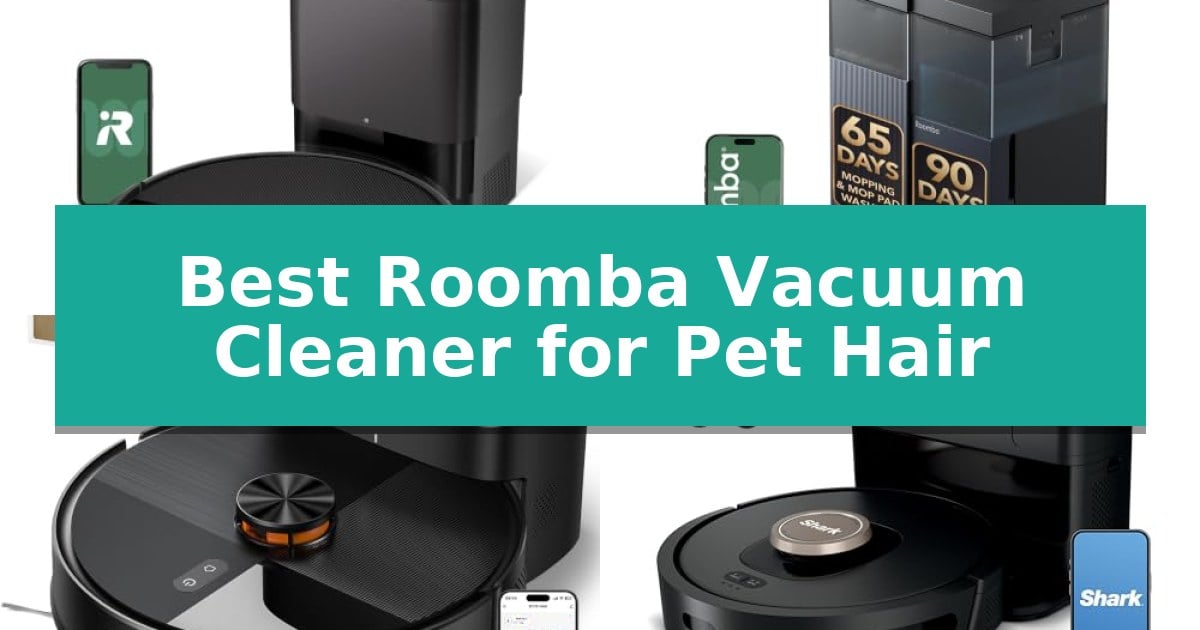
| Roborock S9 MaxV Ultra | 12,000 Pa | DuoRoller Riser (All-Rubber) | Reactive AI 3.0 (RGB/3D) | Large homes with thick carpets |
| iRobot Roomba J10+ | High (Proprietary) | Dual Multi-Surface Rubber | PrecisionVision (Pet Promise) | Homes with frequent "pet accidents" |
| Shark PowerDetect Self-Empty | 9,000 Pa | PowerFins HairPro | LiDAR + Infrared | Budget-conscious households |
| Dreame L30s Ultra | 11,500 Pa | MopExtend + TriCut Brush | AI Action (Dual Laser) | Multi-surface with heavy shedding |
| Ecovacs Deebot X5 Pro | 12,800 Pa | ZeroTangle 2.0 | AIVI 3D 2.0 | Households with long-haired breeds |
Navigating the Challenges of Pet Messes
A common concern for pet owners is the "poopocalypse"—a situation where a robot vacuum encounters solid pet waste and spreads it across the entire floor. In 2026, navigation technology has matured to address this specific risk.
AI-Powered Obstacle Avoidance
The best auto vacuums now use a combination of LiDAR (Light Detection and Ranging), structured 3D light, and RGB cameras. These sensors are processed by on-board neural networks trained on thousands of images of pet waste, toys, and water bowls. This allows the vacuum to identify a mess in real-time and maintain a "buffer zone" of several inches to prevent contact. iRobot continues to offer its "Pet Owner Official Promise" (P.O.O.P.), which guarantees a replacement unit if the vacuum fails to avoid solid pet waste.
Handling Liquid Messes and Paw Prints
While most pet vacuums are "dry only," the 2026 trend toward "Ultra" or "Combo" docks has introduced advanced mopping. Models like the Dreame L30s or Roborock S9 MaxV feature dual-spinning mops that can scrub away dried muddy paw prints. These systems are now smart enough to detect when they are on carpet and will automatically lift the mop pads by 10-20mm to prevent wetting the rug while they continue to vacuum pet hair.
Maintenance and Long-Term Performance
An automated vacuum is only "automatic" if the maintenance requirements are low. For pet owners, this is particularly important because the volume of debris is much higher than in pet-free homes.
The Role of Self-Emptying Bases
A self-emptying base is no longer a luxury for pet owners; it is a necessity. Pet hair is voluminous and will fill a small on-board robot bin (usually 300ml to 450ml) in a single session. A self-emptying station uses a high-powered motor to suck the hair out of the robot and into a larger bag (usually 2.5L to 4L). In 2026, these stations have improved airflow paths to prevent the hair from "bridging" or getting stuck at the entrance of the bag.
Maintenance Checklist for Pet Households
To keep your auto vacuum running at peak performance, follow these manufacturer-recommended steps:
- Weekly: Check the side brushes for hair wrap around the base. Even if the main roller is tangle-free, side brushes often still use bristles.
- Bi-Weekly: Clean the sensors and the camera lens with a microfiber cloth. Pet hair and dander can create a "fog" over the sensors, leading to navigation errors.
- Monthly: Wash the pre-filter and inspect the HEPA filter. If your pet sheds heavily, you may need to replace the HEPA filter every 2–3 months rather than the standard 6 months.
- Quarterly: Check the wheels for hair that may have migrated into the axle, which can cause the vacuum to "limp" or move in circles.
Carpet vs. Hard Floors: Which Vacuum Wins?
The "best" vacuum depends heavily on the surface area of your home. Hard floors (hardwood, tile, laminate) are relatively easy for most robots, as the hair sits on the surface. In these environments, a vacuum with a high-quality side brush and medium suction is sufficient.
However, carpets are a different story. Pet hair becomes mechanically "locked" into the loops or cut piles of a rug. For homes with significant carpeting, you must prioritize Agitation. This is where the dual rubber rollers mentioned previously excel. They create a "vibration" effect that shakes the hair loose from the carpet fibers, allowing the suction to take over. If you have high-pile rugs, ensure the vacuum you choose has "Carpet Boost" technology, which automatically ramps up the suction to its maximum setting the moment it detects a change in surface density.
Addressing Common Concerns (FAQ)
How do auto vacuums handle long pet hair versus short hair?
Short hair (like that from a Beagle or Lab) acts like tiny needles that "stitch" into fabrics, requiring high suction to pull out. Long hair (like that from a Golden Retriever or Maine Coon) is more prone to wrapping around rollers. For long hair, prioritize a vacuum with an active cutting system or dual-rubber rollers. For short hair, prioritize maximum Pascal (Pa) suction.
Will the vacuum's noise scare my pets?
Most 2026 models include a "Quiet Mode" that operates at roughly 50–55 decibels, which is quieter than a standard conversation. However, the self-emptying process at the dock is much louder (often 75+ dB) for about 15 seconds. Many apps now allow you to "Do Not Disturb" schedule the self-empty so it doesn't startle your pets while they are sleeping or while you are away.
Can a robot vacuum replace a traditional upright vacuum for pet hair?
In 2026, a flagship robot vacuum can handle 90–95% of daily maintenance. However, it cannot reach deep into the crevices of upholstered furniture or clean stairs. It is recommended to use the auto vacuum daily to keep the "fur floor" from accumulating, and use a handheld or upright vacuum once a week for "detail" cleaning in corners and on furniture.
Are these vacuums safe for use around water bowls?
Yes, provided the vacuum has advanced AI navigation. You can set "No-Go Zones" or "Virtual Walls" in the companion app to ensure the robot never bumps into a water bowl. Modern AI-enabled cameras can also recognize a bowl and automatically avoid it without manual programming.
How long do the batteries last in 2026 models?
Battery technology has stabilized, with most premium models offering 180 to 240 minutes of runtime. This is usually enough to clean a 2,000-square-foot home on a single charge. If the battery runs low, almost all units will "Charge and Resume," returning to the dock to power up before finishing the job exactly where they left off.
Final Recommendation: Selecting Your Solution
Choosing the best auto vacuum for pet hair in your home ultimately depends on your specific environment. If your priority is avoiding messes and reliable navigation, the iRobot Roomba J10+ remains the industry gold standard due to its sophisticated object recognition and rubber brush design. For those with large, carpeted areas and heavy shedders, the Roborock S9 MaxV Ultra offers the raw suction power and maintenance-free docking station required to keep up with high volumes of fur.
Regardless of the model, ensure you select a unit with a self-emptying base and HEPA filtration to maximize the health benefits and convenience of automated cleaning in a pet-friendly household.
Image Gallery