Completing the New York Statement of Net Worth Online Form in 2026
The New York Statement of Net Worth is a mandatory financial disclosure document used in matrimonial actions, specifically contested divorces. In 2026, the official online form (Form UD-13) serves as the primary instrument for parties...
The New York Statement of Net Worth is a mandatory financial disclosure document used in matrimonial actions, specifically contested divorces. In 2026, the official online form (Form UD-13) serves as the primary instrument for parties to disclose their income, expenses, assets, and liabilities under oath, ensuring an equitable distribution of marital property and fair determination of support.
Contents
Understanding the Purpose of the New York Statement of Net Worth
In the landscape of New York matrimonial law, transparency is not a suggestion; it is a statutory requirement. Under Domestic Relations Law § 236, both parties in a divorce proceeding must provide a full and complete disclosure of their financial status. The Statement of Net Worth is the vehicle for this disclosure.
Whether you are seeking spousal maintenance (alimony), child support, or a division of marital assets, this document provides the court with a snapshot of your economic reality. As of 2026, the New York Unified Court System continues to prioritize electronic filing, making the online version of this form more accessible yet equally demanding in its complexity.
The form is significant because it is signed under the penalty of perjury. Inaccuracies, whether intentional or negligent, can lead to severe legal consequences, including the preclusion of evidence, monetary sanctions, or an unfavorable inference regarding your financial claims. Therefore, approaching the online form with meticulous attention to detail is paramount for any litigant.
Where to Find the Official Online Form
While many third-party websites offer templates, the only authoritative source is the New York State Unified Court System website.
- Official Court Website: Navigate to the "Forms" section of the NYCOURTS.GOV portal. Look specifically for "Matrimonial Forms" and the "Contested Divorce Manual."
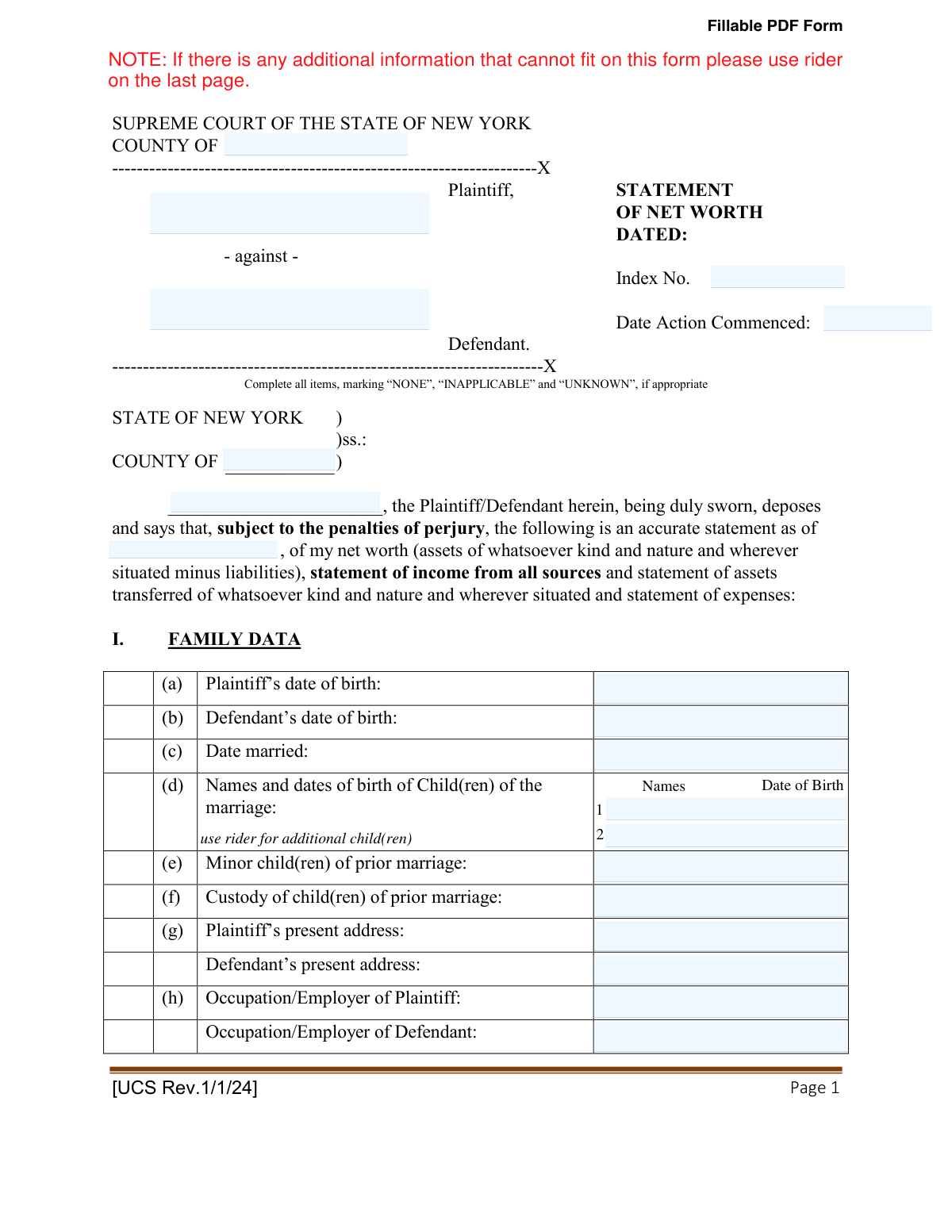
- Form UD-13: This is the specific designation for the Statement of Net Worth. In 2026, it is available as a fillable PDF that can be completed digitally, saved, and eventually uploaded to the New York State Courts Electronic Filing (NYSCEF) system.
- DIY Divorce Programs: For unrepresented litigants, the court provides "DIY (Do-It-Yourself)" programs that guide users through a series of questions to generate the form automatically. However, this is typically reserved for simpler, uncontested matters.
Essential Preparation: Documents Needed for the Online Form
You cannot complete the Statement of Net Worth accurately from memory. Before opening the online form, gather the following documentation for the last three to five years to ensure every entry matches your financial records:
- Income Verification: W-2 forms, 1099s, K-1s, and recent pay stubs.
- Tax Returns: Complete federal and state returns, including all schedules.
- Banking Records: Statements for checking, savings, and money market accounts.
- Investment Accounts: Statements for brokerage accounts, IRAs, 401(k)s, and 403(b)s.
- Real Estate: Recent appraisals, mortgage statements, and property tax bills.
- Liabilities: Credit card statements, personal loan agreements, and student loan balances.
- Business Interests: If you own a business, you will need profit and loss statements and balance sheets.
Section-by-Section Guide to the Statement of Net Worth
The 2026 version of the form is divided into several critical sections. Each requires specific data points that must be calculated consistently.
I. Family Data
This section identifies the parties and any children of the marriage. It includes dates of birth, social security numbers (which are often redacted in public filings), and the date of the marriage. It also asks for the date the action was commenced, which is vital as it often serves as the "cut-off" date for valuing certain assets.
II. Expenses
This is frequently the most time-consuming section. It requires you to categorize your monthly expenses across several domains:
- Housing: Mortgage, rent, property taxes, and insurance.
- Utilities: Electricity, gas, water, internet, and mobile phone services.
- Food and Personal: Groceries, dining out, clothing, and grooming.
- Transportation: Car payments, fuel, insurance, and public transit costs.
- Children: Tuition, extracurricular activities, and childcare.
Expert Tip: When completing the online form, distinguish between "Current Expenses" and "Estimated Future Expenses." If you have moved out of the marital residence, your current expenses may look very different from what you anticipate needing post-divorce.
III. Income
You must list all sources of income, not just your primary salary. This includes:
- Bonuses and commissions.
- Dividends and interest.
- Rental income.
- Social Security or disability benefits.
- Trust income.
In 2026, the court looks closely at "perks" or "in-kind" income provided by employers, such as company cars or reimbursed meals, as these can be imputed as income for support purposes.
IV. Assets
This section requires a comprehensive list of everything you own, either individually or jointly.
- Real Estate: List the address and the current fair market value.
- Financial Accounts: List the institution and the account number (usually last four digits).
- Personal Property: Significant items like jewelry, art, and furniture.
- Pensions and Retirement: Even if you cannot access the funds today, their present value is considered a marital asset.
V. Liabilities
List all debts, including the creditor's name, the reason for the debt, and the current balance. This is crucial for determining the "Net" in Net Worth.
| Section Category | Key Data Required | Typical Documentation |
|---|---|---|
| Income | Gross/Net Monthly Pay | Pay stubs, W-2, 1099 |
| Fixed Expenses | Rent/Mortgage, Taxes | Statements, Lease Agreement |
| Variable Expenses | Food, Entertainment | Bank/Credit Card Statements |
| Assets | Bank Balances, Home Value | Appraisals, Bank Statements |
| Liabilities | Credit Cards, Loans | Recent billing statements |
| Insurance | Life, Health, Auto | Policy Declaration pages |
Navigating the Online Filing Process (NYSCEF)
In 2026, the physical delivery of paper forms is largely obsolete in New York's Supreme Courts. Once the online form is completed and signed before a notary public (which can also be done via authorized remote notarization in NY), it must be uploaded to the New York State Courts Electronic Filing (NYSCEF) system.
- Account Creation: Your attorney will typically handle this. If you are self-represented, you must create a "Pro Se" account on the NYSCEF portal.
- PDF/A Format: Ensure the document is saved in a PDF/A format, which is the standard for long-term archiving in the New York court system.
- Redaction: Before uploading, ensure that sensitive information—such as full social security numbers or minor children's full names—is redacted according to 22 NYCRR 202.5(e).
- Service: Once filed online, the system automatically notifies the other party’s counsel, satisfying the legal requirement for service of the financial disclosure.
Common Pitfalls to Avoid
When using the online form, several errors frequently trigger delays or legal challenges:
- Mathematical Inconsistency: If your listed expenses significantly exceed your listed income without a corresponding increase in debt or depletion of assets, the court may suspect "lifestyle/income" discrepancies.
- Missing "Non-Marital" Property: Many litigants fail to list separate property (assets owned before the marriage or inherited during the marriage). Even if you believe an asset is yours alone, it must be disclosed and labeled as "separate" on the form.
- Failure to Update: A Statement of Net Worth is a "living" document. If your financial situation changes significantly during the litigation (e.g., job loss or a large inheritance), you are required to file an updated version.
- Incomplete Insurance Data: Section VI requires details on life and health insurance. This is often overlooked but is essential for securing child support or maintenance payments.
The Role of the Preliminary Conference
After the Statement of Net Worth is filed, the court will schedule a Preliminary Conference (PC). In 2026, many of these conferences are held virtually via Microsoft Teams. The judge or court attorney-referee will use your filed Statement of Net Worth to identify "issues in dispute."
If one party’s statement is incomplete, the court may issue a "discovery order," compelling the production of further tax returns, credit card statements, or even forensic audits of business interests. Having a clean, accurate online form at the outset prevents these costly and time-consuming escalations.
Frequently Asked Questions
Is the Statement of Net Worth required for an uncontested divorce?
Generally, yes. While the requirements can be less stringent in a truly uncontested "no-fault" divorce where both parties have reached a full agreement, New York law still requires a basic financial disclosure (the "Sworn Statement of Removal of Barriers to Remarriage" and a "Maintenance Guidelines Worksheet" are also involved). However, Form UD-13 is most strictly enforced in contested cases.
Can I use a digital signature on the online form?
As of 2026, New York allows for electronic signatures on many court documents, but the Statement of Net Worth must be notarized. You can use a digital signature if it is performed through a platform that complies with the New York State Notary Law regarding remote online notarization (RON).
What happens if I make a mistake on the form?
If you discover an error after filing, you should file an "Amended Statement of Net Worth" as soon as possible. Minor clerical errors are common, but significant omissions can be viewed as an attempt to hide assets, which may lead to your spouse being awarded a higher percentage of the marital estate.
How do I value my house on the form?
You should use a professional appraisal or a recent Comparative Market Analysis (CMA) from a real estate agent. Do not simply use the "Zestimate" or the tax-assessed value, as these are often inaccurate and can be easily challenged in court.
Is my Statement of Net Worth public record?
Matrimonial records in New York are generally confidential and not open to public inspection under Domestic Relations Law § 235. Only the parties, their attorneys, and court personnel have access to the filed Statement of Net Worth.
Final Recommendation
Completing the New York Statement of Net Worth online form is a significant legal undertaking that dictates the trajectory of your divorce. The most effective approach in 2026 is to treat the form as a comprehensive audit of your life. Prioritize accuracy over speed. If you find the "Expenses" section or the "Asset Valuation" sections overwhelming, consider consulting with a Certified Divorce Financial Analyst (CDFA) or a matrimonial attorney to ensure your filing is both compliant and strategic.
Image Gallery