Achieving the Best Hardwood Flooring Installation: Standards and Best Practices
The best hardwood flooring installation results from a combination of rigorous subfloor preparation, precise moisture acclimation, and the selection of the correct fastening method for the specific wood species. Achieving a professiona...
The best hardwood flooring installation results from a combination of rigorous subfloor preparation, precise moisture acclimation, and the selection of the correct fastening method for the specific wood species. Achieving a professional-grade finish requires strict adherence to manufacturer specifications and industry standards set by the National Wood Flooring Association (NWFA) to ensure structural integrity and long-term aesthetic stability.
Contents
Understanding the Foundation: Subfloor Preparation
The longevity of any hardwood floor is dictated by the quality of the subfloor. Before a single board is laid, the surface must be clean, flat, and structurally sound. For wood subfloors—typically plywood or oriented strand board (OSB)—the moisture content must be tested. The variance between the subfloor and the hardwood flooring should generally not exceed 4% for strip flooring (less than 3 inches wide) or 2% for plank flooring (3 inches or wider).
If the subfloor is concrete, it must be fully cured and dry. Installing wood over "green" or damp concrete without a proper vapor barrier will result in cupping, crowning, or eventual adhesive failure. In 2026, many installers utilize liquid-applied moisture barriers or high-performance underlayment mats that provide both sound dampening and a moisture-retardant layer, significantly reducing the risk of installation-related failures.
The Critical Role of Acclimation
Acclimation is the process of allowing wood flooring to adjust its moisture content to the environment of the installation site. Skipping this step is the most common cause of flooring failure. Wood is hygroscopic, meaning it constantly gains or loses moisture based on the surrounding relative humidity and temperature.
To perform the best installation, use a moisture meter to measure the moisture content of both the flooring and the subfloor. The wood should remain in the room where it will be installed for as long as the manufacturer mandates—often 48 to 72 hours—or until the boards reach an equilibrium moisture content (EMC) that matches the indoor climate. Do not store wood in a garage or basement; it must be in the conditioned space where it will eventually live.
Selection of Installation Methods
The "best" method depends heavily on the type of hardwood being installed: solid versus engineered, and tongue-and-groove versus click-lock.
Nail-Down and Staple-Down
This is the traditional standard for solid hardwood. Using a flooring nailer, the installer drives fasteners through the tongue of the board at a 45-degree angle. This secures the board to the wooden subfloor while hiding the fastener head. Proper spacing—typically 8 to 10 inches apart—is essential to prevent squeaking over time.
Glue-Down
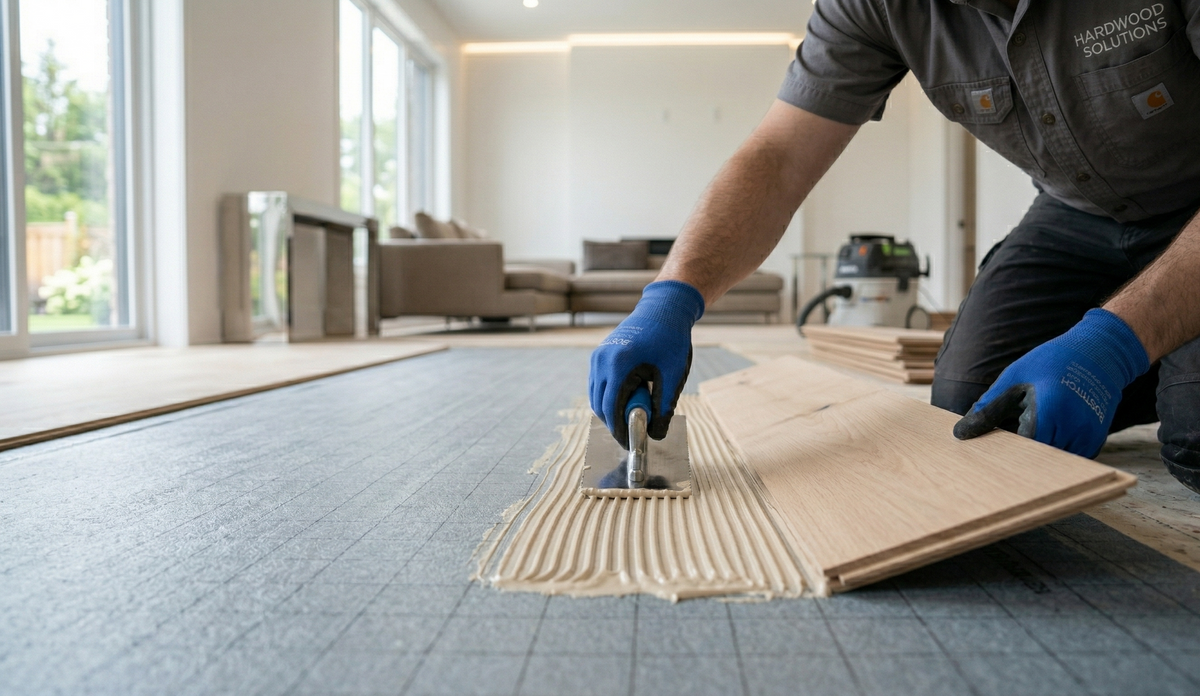
Required for most engineered hardwood installations and necessary when installing over concrete slabs. High-quality urethane-based adhesives are standard, as they provide a strong bond while remaining flexible enough to allow for the natural seasonal expansion and contraction of the wood.
Floating Floor
Common for click-lock engineered wood. The boards are not attached to the subfloor but rather snap together to form a single, unified surface. This method is the most forgiving for DIYers but requires a high-quality underlayment to prevent the "hollow" sound often associated with unattached flooring.
Comparison of Installation Methods
| Method | Primary Material | Best For | Complexity |
|---|---|---|---|
| Nail-Down | Solid Hardwood | Wood Subfloors | Moderate |
| Staple-Down | Solid/Engineered | Wood Subfloors | Moderate |
| Glue-Down | Engineered | Concrete Slabs | High |
| Floating | Click-Lock Engineered | All Subfloors | Low |
Managing Expansion Gaps
Wood will naturally expand and contract as humidity levels change throughout the year. If you install wood too tightly against a wall, it will eventually buckle, creating "tents" in the middle of the room. Always leave an expansion gap around the perimeter of the room, typically equivalent to the thickness of the flooring material (usually 3/8 to 5/8 of an inch). This gap is subsequently hidden by the baseboard and shoe molding, allowing the floor to breathe without damaging the structure.
Layout and Staggering
A professional installation is marked by a visually pleasing layout. Avoid "H-joints" or "stair-stepping" patterns, where board ends align in a distracting, predictable sequence. Instead, mix boards from different bundles to blend natural color variations and ensure that end-joints are staggered by at least 6 inches from one row to the next. This not only improves aesthetics but also distributes the physical tension across the floor more evenly, preventing weak points in the surface.
Common Installation Mistakes to Avoid
- Ignoring Moisture Levels: Failing to use a moisture meter is a primary error. Always document the readings before starting.
- Poor Subfloor Leveling: If the subfloor has low spots, the wood will eventually collapse into those gaps, leading to a bouncy floor and loose fasteners. Use self-leveling compounds to correct dips greater than 3/16 inch over a 10-foot span.
- Improper Fastener Depth: If the nailer is not set to the correct depth, it can crack the tongue of the board or fail to pull the board tight against the previous row, creating gaps.
- Neglecting Acclimation: Installing wood straight from the delivery truck into a home environment often leads to significant gaps in the winter when the air is dry.
Maintaining the Installation
Once the flooring is installed, the immediate focus should be on cleaning and protection. Use felt pads on all furniture legs to prevent scratching. If the finish is site-applied (as opposed to pre-finished), ensure it is allowed to cure fully based on the manufacturer’s instructions before moving heavy furniture back into the room. Maintaining a constant indoor humidity level between 35% and 55% will prolong the life of the floor and keep the installation stable for decades.
Frequently Asked Questions
How long should wood flooring sit in a house before installation? While some manufacturers recommend 48 hours, the true "best" answer is that the wood should stay in the home until its moisture content is within the manufacturer's specified range of the subfloor's moisture content. This may take longer in high-humidity climates.
Can I install hardwood flooring in a basement? You can, but you must use engineered hardwood rather than solid hardwood. Engineered wood is more dimensionally stable and less prone to warping due to the higher moisture levels typically found in below-grade environments.
What is the best way to clean a newly installed hardwood floor? Use a pH-neutral cleaner recommended by the flooring manufacturer. Avoid excess water or steam mops, as moisture is the enemy of wood flooring and can penetrate the seams, leading to warping.
Why is my new floor squeaking? Squeaking usually occurs when the subfloor is not properly secured or when there is movement between the boards and the subfloor. Using proper, full-length fasteners and ensuring the subfloor is screwed down tightly to the joists during preparation usually prevents this.
Is professional installation worth the extra cost? For high-end or exotic species, professional installation is recommended. Professionals have the specialized equipment—such as flooring nailers, high-capacity moisture meters, and dust-collection systems—that ensures the warranty remains intact and the results are long-lasting.
Final Recommendation
To ensure the best outcome, begin your project by verifying your subfloor conditions and choosing the right material for your specific climate and foundation type. If you are hiring a professional, request proof of their experience with the specific species of wood you have selected, and ensure they follow the National Wood Flooring Association (NWFA) installation guidelines. A successful installation is a long-term investment in your home’s value and comfort.
Image Gallery