Hawaii Mortgage Loan Rates in 2026: A Comprehensive Guide to Financing Paradise
In 2026, Hawaii mortgage loan rates are influenced by a combination of national monetary policy and unique local market dynamics. Borrowers can expect rates to fluctuate based on credit scores, loan types, and property locations across...
In 2026, Hawaii mortgage loan rates are influenced by a combination of national monetary policy and unique local market dynamics. Borrowers can expect rates to fluctuate based on credit scores, loan types, and property locations across the islands, with specialized products like VA and Jumbo loans playing a critical role in the local economy.
Contents
Securing a mortgage in Hawaii requires a nuanced understanding of how the "Aloha State" differs from the continental U.S. real estate market. As of 2026, the housing market remains resilient, but the cost of borrowing is a primary concern for residents and investors alike. Whether you are looking to purchase a primary residence in Honolulu or a vacation home on the Big Island, understanding the intricacies of interest rate movements and loan availability is essential for financial planning.
The Economic Drivers of Hawaii Mortgage Rates in 2026
The interest rates offered by Hawaii lenders do not exist in a vacuum. They are primarily tethered to the 10-year Treasury yield and the Federal Reserve's federal funds rate. However, Hawaii often experiences a slight variance from national averages, sometimes referred to as the "Hawaii Premium" or "Island Adjustment."
National vs. Local Influence
While national benchmarks set the floor for interest rates, local competition among Hawaii’s robust credit unions and community banks often creates a unique pricing environment. In 2026, localized liquidity—the amount of capital local banks have available to lend—can result in Hawaii rates being 0.125% to 0.250% higher or lower than the national average at any given time.
Inflation and Monetary Policy
By 2026, the aggressive inflationary pressures seen in the early 2020s have largely been addressed, leading to a more stabilized, though higher-than-historical-minimum, rate environment. Borrowers should monitor the Federal Open Market Committee (FOMC) statements, as any hint of rate hikes or cuts immediately impacts the secondary mortgage market, where most Hawaii loans are packaged and sold.
Understanding Hawaii’s Loan Limits and Product Types
Hawaii is consistently classified as a high-cost area by the Federal Housing Finance Agency (FHFA). This designation is crucial because it dictates the "conforming loan limits"—the maximum loan amount that Fannie Mae and Freddie Mac will guarantee.
Conforming vs. Jumbo Loans
In most of Hawaii’s counties (Honolulu, Maui, Kauai, and Hawaii County), the conforming loan limits are significantly higher than the national baseline.
- Conforming Loans: These offer the most competitive rates and require a lower down payment (often as low as 3% for first-time buyers).
- Jumbo Loans: If your loan amount exceeds the high-cost conforming limit, you move into Jumbo territory. In 2026, Jumbo rates in Hawaii can occasionally be lower than conforming rates because lenders hold these loans on their own books and want to attract high-net-worth borrowers.
VA Loans: The Hawaii Powerhouse
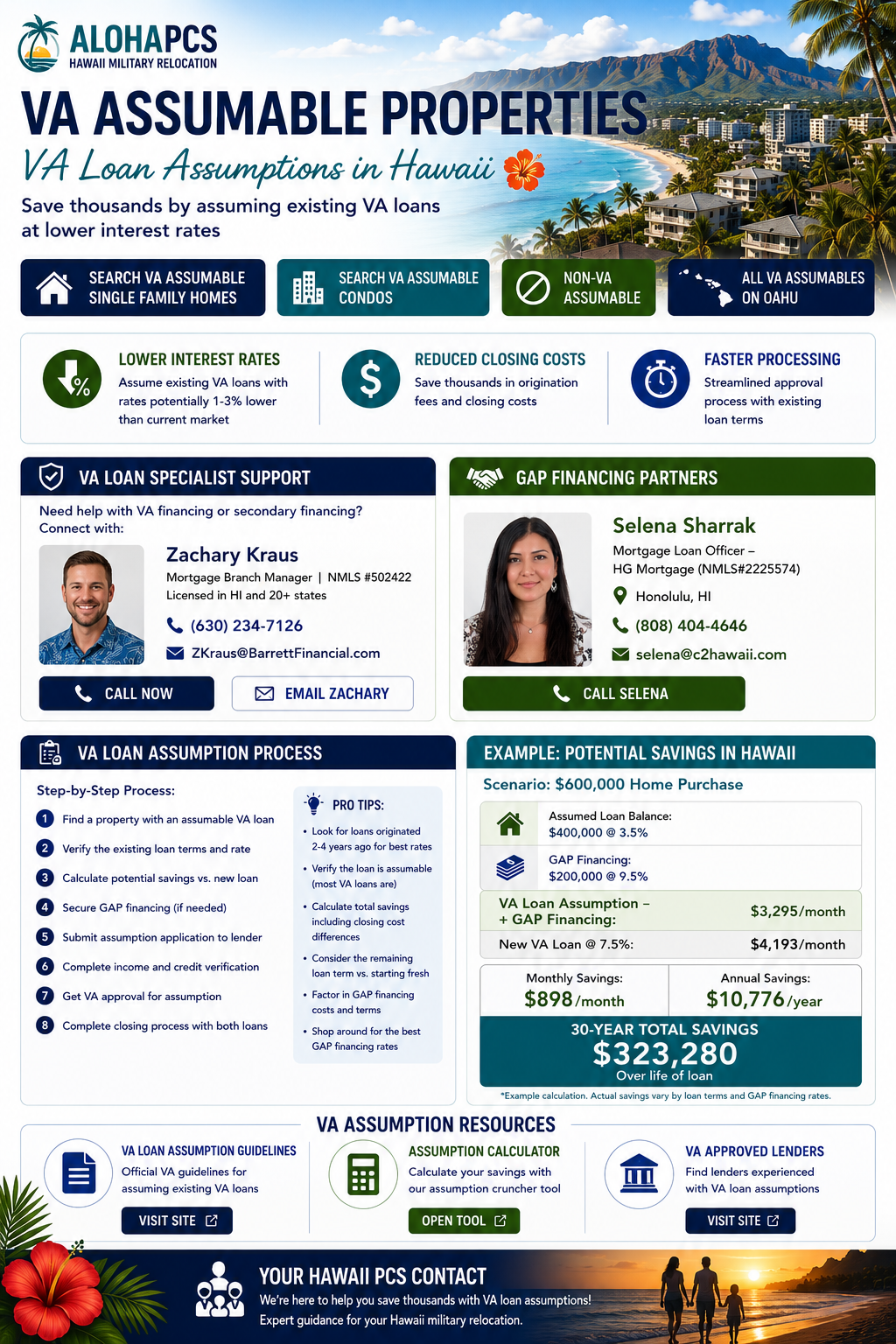
Due to the massive military presence in Hawaii (including Pearl Harbor-Hickam and Kaneohe Bay), VA loans are arguably the most popular financing vehicle in the state. VA loan rates in Hawaii are typically the lowest available, and they offer the distinct advantage of $0 down payment and no private mortgage insurance (PMI), which is a significant relief given Hawaii’s high median home prices.
Comparing Hawaii Mortgage Loan Rates by Product (2026 Estimates)
The following table provides a snapshot of the typical rate structures for various mortgage products available in Hawaii for the 2026 calendar year. These figures assume a borrower with a "Good" to "Excellent" credit score (740+).
| Loan Type | Typical Term | Estimated Rate Range | Best For |
|---|---|---|---|
| 30-Year Fixed | 360 Months | 5.75% – 6.50% | Long-term stability and predictable payments. |
| 15-Year Fixed | 180 Months | 5.00% – 5.50% | Minimizing total interest paid over time. |
| VA 30-Year Fixed | 360 Months | 5.25% – 5.85% | Eligible Veterans and active-duty service members. |
| 5/1 ARM | Variable | 5.50% – 6.00% | Short-term ownership or expected refinancing. |
| Jumbo Loan | 360 Months | 6.00% – 6.75% | High-value luxury properties exceeding limits. |
Rates are illustrative of 2026 market conditions and vary by lender, points paid, and specific borrower profile.
The Impact of Property Type on Your Rate
In Hawaii, the type of property you intend to buy can change your interest rate and your ability to secure financing altogether.
Fee Simple vs. Leasehold
Most properties in the U.S. are Fee Simple, meaning you own the land and the structure. However, Hawaii has a significant number of Leasehold properties, where you own the structure but lease the land from a landowner (often a large estate or trust).
- Lenders are much stricter with Leasehold properties.
- The remaining term of the lease must typically exceed the length of the mortgage by at least 5 to 10 years.
- Interest rates for Leasehold properties are often higher to compensate for the increased risk.
Condotels and Non-Warrantable Condos
Hawaii's tourism-driven economy means many buildings are "Condotels" (condominiums operated like hotels). These are considered "non-warrantable" by Fannie Mae and Freddie Mac. To finance these in 2026, you will likely need a local Hawaii bank that offers portfolio lending, and you should expect an interest rate premium of 0.50% to 1.00% above standard residential rates.
Closing Costs and Fees Specific to Hawaii
When calculating the true cost of your mortgage loan rate, you must account for Hawaii's specific closing costs. On average, Hawaii closing costs range from 2% to 5% of the purchase price.
- Conveyance Tax: This is a tax on the transfer of real property. The rate increases based on the purchase price and whether the buyer is eligible for a homeowner’s exemption.
- Title and Escrow Fees: Hawaii uses escrow companies to handle the closing process. These fees are typically split between the buyer and seller but can be a significant upfront cost.
- Hurricane Insurance: Unlike the mainland, Hawaii lenders require hurricane insurance in addition to standard hazard insurance. This does not change your interest rate directly, but it significantly increases your monthly "PITI" (Principal, Interest, Taxes, and Insurance) payment.
Strategies to Secure the Best Rate in 2026
To obtain the most competitive Hawaii mortgage loan rates, borrowers should follow a structured approach tailored to the 2026 financial landscape.
- Improve Your Credit Tier: The difference between a 680 and a 760 credit score can result in a 0.75% difference in your interest rate. In a state where the median home price often exceeds $1 million, that 0.75% represents hundreds of thousands of dollars in interest over the life of the loan.
- Shop Local: National online lenders often struggle with Hawaii's unique property laws (like the aforementioned Leasehold issues). Local institutions like Bank of Hawaii, First Hawaiian Bank, and Central Pacific Bank often have specialized knowledge and localized "portfolio" products that national lenders cannot match.
- Consider "Buying Down" the Rate: In 2026, many Hawaii buyers are using "discount points" to lower their permanent interest rate. One point equals 1% of the loan amount and typically lowers the rate by 0.25%.
- Check for State-Specific Programs: The Hawaii Housing Finance and Development Corporation (HHFDC) occasionally offers programs or assists with mortgage credit certificates (MCC) that can provide tax credits to offset interest costs for lower-to-moderate-income families.
Frequently Asked Questions
What credit score do I need for a mortgage in Hawaii in 2026?
Most lenders require a minimum credit score of 620 for conventional loans and 580 for FHA loans. However, to access the best Hawaii mortgage loan rates, you generally need a score of 740 or higher. Hawaii's high property values mean lenders are often more conservative with credit requirements to mitigate risk.
Are mortgage rates higher on the Neighbor Islands?
Generally, no. Interest rates for standard residential properties are typically the same across Oahu, Maui, Kauai, and the Big Island. However, properties in remote or "lava zone" areas (specifically Lava Zones 1 and 2 on the Big Island) may face higher rates or difficulty securing traditional financing due to insurance challenges.
Can I get a VA loan for a condo in Hawaii?
Yes, but the condo complex must be VA-approved. Because so many residents in Hawaii utilize VA benefits, many condo associations keep their VA approval current. If a complex is not approved, your lender may be able to request a "spot approval," though this can lengthen the closing process.
How does the "Lava Zone" affect my mortgage rate?
While the lava zone designation doesn't directly change the interest rate, it affects your ability to get a loan. Lenders will not fund a loan without lava insurance in high-risk zones. If you can find a lender willing to fund in Lava Zones 1 or 2, they may charge a higher rate or require a larger down payment due to the collateral risk.
Should I choose a fixed-rate or adjustable-rate mortgage (ARM) in 2026?
If you plan to stay in your home for more than 7–10 years, a fixed-rate mortgage is usually safer. However, because Hawaii real estate is often a stepping stone or an investment, a 5/1 or 7/1 ARM might be attractive if it offers a significantly lower introductory rate and you plan to sell or refinance before the adjustment period begins.
Summary and Next Steps
Navigating Hawaii mortgage loan rates in 2026 requires a balance of national economic awareness and local expertise. The high cost of entry into the Hawaii market makes even small fluctuations in interest rates highly impactful on monthly affordability.
Recommended Action: Before you begin touring homes, obtain a "Pre-Approval" from at least one local Hawaii lender and one national lender to compare the APR (Annual Percentage Rate) and closing cost estimates. Ensure you disclose the specific type of property (e.g., Condo vs. Single Family) and land tenure (Fee Simple vs. Leasehold) to get an accurate rate quote.
Image Gallery