Is Bankruptcy Worth It in Sacramento? A Comprehensive Financial and Legal Guide
Filing for bankruptcy in Sacramento is worth it if your dischargeable unsecured debt exceeds your annual disposable income, you face impending wage garnishment or foreclosure, and your assets can be fully protected under California’s g...
Filing for bankruptcy in Sacramento is worth it if your dischargeable unsecured debt exceeds your annual disposable income, you face impending wage garnishment or foreclosure, and your assets can be fully protected under California’s generous exemption laws. For residents burdened by overwhelming medical bills, credit card balances, or personal loans, bankruptcy provides an immediate automatic stay against collections and a fresh financial start.
Contents
Disclaimer: The following information is for educational purposes and does not constitute formal legal or financial advice. Bankruptcy laws and exemption amounts are subject to change. Consult a licensed California bankruptcy attorney regarding your specific situation.
Evaluating the Financial Math: When Is Bankruptcy Worth It?
Determining whether bankruptcy makes economic sense requires comparing your total dischargeable debt against your net income, monthly living expenses, and local cost-of-living realities in the Sacramento region. With Sacramento’s housing costs and living expenses remaining well above national averages, allocating hundreds of dollars each month toward high-interest credit card debt often prevents residents from building emergency savings or funding retirement.
Bankruptcy is generally considered financially worthwhile when:
- Unsecured debt exceeds 50% of annual income: If your credit cards, personal loans, and medical bills total more than half of your annual gross income and cannot be paid off within three to five years under a strict budget, structured debt discharge is often the most efficient recovery path.
- Minimum payments consume essential budget categories: When debt servicing forces you to compromise on housing costs, utilities, healthcare, or groceries, debt relief becomes a structural necessity rather than a financial preference.
- Collection actions are imminent: If you face scheduled wage garnishments, bank levies, or lawsuits in Sacramento County Superior Court, filing bankruptcy halts all enforcement actions instantly through the federal automatic stay (11 U.S.C. § 362).
- You are paying high interest without reducing principal: Paying minimums on unsecured credit cards at 20% to 30% APR means the balance barely declines over time. Bankruptcy eliminates or restructures these debts directly.
Conversely, bankruptcy may not be worth it if your debt is relatively small (e.g., under $10,000) and could be resolved through targeted budgeting or informal creditor negotiation, or if the vast majority of your debt consists of non-dischargeable obligations such as recent tax debts, domestic support obligations (child support and alimony), or student loans.
Chapter 7 vs. Chapter 13 Bankruptcy in Sacramento
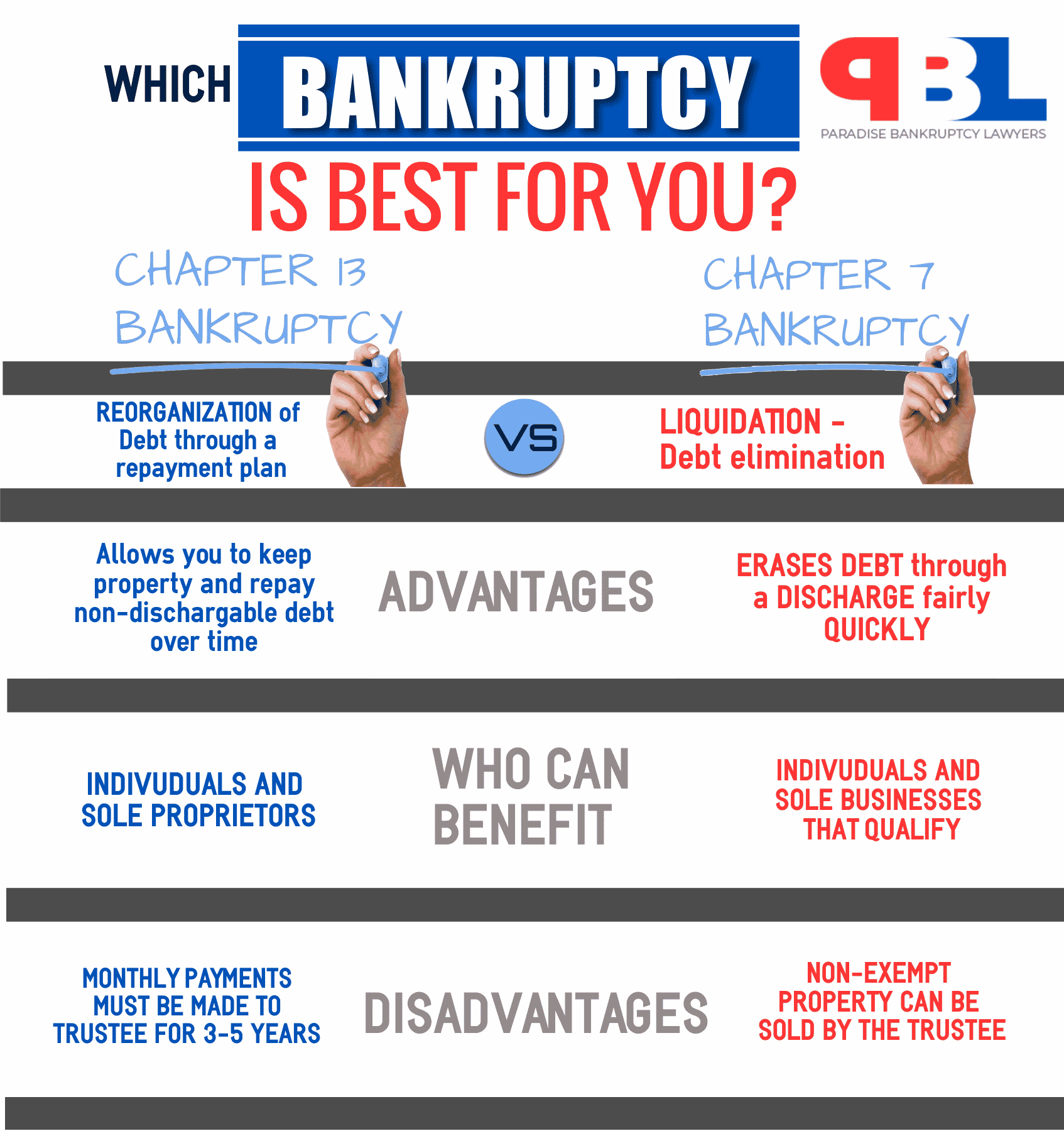
Choosing between Chapter 7 and Chapter 13 depends on your household income, the types of debt you hold, and whether you are trying to cure defaults on secured property, such as a mortgage on a home in Sacramento County.
- Evaluate Financial Hardship
- Pass California Means Test?
- Yes: Chapter 7 Bankruptcy
- Liquidation of non-exempt assets
- Full discharge in ~3-4 months
- Must meet income limits
- No: Chapter 13 Bankruptcy
- 3-to-5-year repayment plan
- Cures mortgage arrearages
- Restructures secured debts
- Yes: Chapter 7 Bankruptcy
Chapter 7: Liquidation and Direct Discharge
Chapter 7 bankruptcy is designed for low-to-moderate-income individuals with minimal equity in non-exempt assets. It is a liquidation bankruptcy, meaning a court-appointed trustee can sell non-exempt assets to satisfy creditors. However, because California provides robust asset exemptions, most Sacramento Chapter 7 filers retain all of their personal property in what is termed a "no-asset" case.
- Timeline: Most Chapter 7 cases in Sacramento wrap up within three to four months from the filing date.
- Qualification: You must pass the Means Test, which compares your household's average monthly income over the prior six months against the median income for a household of similar size in California.
- Primary Benefit: Complete discharge of eligible unsecured debts (credit cards, medical bills, payday loans, unsecured personal lines of credit) without a repayment plan.
Chapter 13: Reorganization and Wage Earner Plans
Chapter 13 bankruptcy is a reorganization process designed for individuals who earn too much to qualify for Chapter 7, or who are facing foreclosure or repossession and need time to catch up on missed payments.
- Timeline: A court-approved repayment plan lasts between 36 and 60 months (three to five years).
- Mechanics: You submit a single monthly payment to the Chapter 13 Standing Trustee in the Sacramento Division, who distributes the funds to creditors based on statutory priorities.
- Primary Benefit: Halts foreclosure sales on your primary residence, allowing you to cure mortgage arrears over time while keeping your home. It can also strip off junior liens (such as a second mortgage) if the home's market value has dropped below the balance of the primary mortgage.
Protecting Your Sacramento Assets: California’s Dual Exemption Systems
One of the primary concerns for local debtors is whether filing for bankruptcy will require forfeiting property, such as a vehicle, home equity, or savings. California is unique because it opted out of federal bankruptcy exemptions, but created two distinct state exemption schemes under the California Code of Civil Procedure (CCP).
Filers must choose between System 1 (CCP § 704) and System 2 (CCP § 703). You cannot mix and match exemptions between the two systems.
- Choose California Exemption System
- System 1 (CCP § 704)
- Focus: Significant Home Equity
- Homestead Exemption: $300k-$600k+
- Protects primary real property
- System 2 (CCP § 703)
- Focus: Renters / High Liquid Assets
- Wildcard Exemption: High flex value
- Protects cash, stock, general items
- System 1 (CCP § 704)
System 1 (CCP § 704) – Designed for Homeowners
System 1 is generally selected by individuals who own real property in Sacramento, Elk Grove, Roseville, or surrounding communities and have substantial home equity.
Under California Assembly Bill 1885 (CCP § 704.730), the California homestead exemption adjusts annually for inflation based on the Consumer Price Index (CPI). The exemption equals the prior year's countywide median sale price for single-family homes, capped between a statutory floor of $300,000 and a statutory ceiling of $600,000 (adjusted for inflation). Because median home prices across Sacramento County generally sit within this bracket, homeowners can frequently protect substantial equity in their primary residence from Chapter 7 liquidation.
However, System 1 offers relatively limited protections for personal property, vehicles, and bank accounts if you do not hold significant home equity.
System 2 (CCP § 703) – Designed for Renters and Non-Homeowners
System 2 (CCP § 703.140(b)) is typically the preferred choice for renters or homeowners with little to no home equity.
- Wildcard Exemption: System 2 features a flexible "wildcard" provision. If you do not utilize the full homestead exemption offered under System 2, you can apply the unused portion (along with the standard wildcard baseline) to protect any asset—including cash in bank accounts, stock holdings, tax refunds, or high-value motor vehicles.
- Personal Property Protections: System 2 also offers explicit exemption allocations for motor vehicles, jewelry, tools of the trade, and household goods.
Local Court Procedures: What to Expect in Sacramento
Bankruptcy filings in Sacramento are administered by the United States Bankruptcy Court for the Eastern District of California (Sacramento Division), located at the Robert T. Matsui United States Courthouse (501 I Street, Sacramento, CA 95814).
- Credit Counseling Course
- Completed through an approved agency within 180 days before filing.
- Petition & Schedules Filed
- Submitted to U.S. Bankruptcy Court, Eastern District of California.
- Automatic Stay immediately goes into effect.
- Meeting of Creditors (§ 341 Hearing)
- Held ~30 to 45 days after filing. Trustee reviews assets and financial data.
- Debtor Education Course
- Completed post-filing to fulfill mandatory financial management rules.
- Final Discharge Order
- Issued by the Court (~3-4 months post-filing for Ch 7; 3-5 years for Ch 13).
Key Procedural Requirements:
- Mandatory Credit Counseling: Before filing your petition, you must complete an initial credit counseling course from an agency approved by the U.S. Trustee's Office.
- Filing the Petition and Schedules: You or your legal counsel submit the petition, schedule of assets and liabilities, income and expense declarations, and statement of financial affairs to the Eastern District Bankruptcy Court.
- 341 Meeting of Creditors: Approximately 30 to 45 days after filing, you must attend a mandatory 341 Meeting of Creditors. While creditors rarely attend standard consumer cases, the appointed Bankruptcy Trustee conducts a short examination under oath to verify the accuracy of your financial filings and tax returns.
- Debtor Education Course: Prior to receiving a discharge, you must complete a second financial education course covering budgeting, debt management, and post-bankruptcy financial recovery.
Costs, Attorney Fees, and Financial Trade-Offs
Filing bankruptcy requires an upfront financial commitment, which often creates an initial paradox for individuals already in financial distress. However, when contrasted against thousands of dollars in compound interest or wage garnishments, the long-term savings are usually substantial.
Court Filing Fees
- Chapter 7 Filing Fee: $338 court fee.
- Chapter 13 Filing Fee: $313 court fee.
- Fee Waivers and Payment Plans: If your household income is below 150% of the federal poverty guidelines, you can apply to have the Chapter 7 court filing fee waived. Alternatively, the court may allow payment of the filing fee in installments.
Attorney Fees in Sacramento
Attorney fees for bankruptcy cases in Sacramento vary based on the complexity of the case:
- Chapter 7: Typically ranges between $1,500 and $2,800 in straightforward consumer cases.
- Chapter 13: Often governed by "rights and responsibilities" agreements (commonly referred to as "no-look" or guidelines fees) established by the Eastern District of California Bankruptcy Court. A portion of Chapter 13 attorney fees is frequently rolled into the 3-to-5-year repayment plan rather than required entirely upfront.
Long-Term Credit Impact
A Chapter 7 filing remains on your credit report for up to 10 years from the filing date, while a completed Chapter 13 remains for 7 years. However, many filers see their credit scores begin to recover within 12 to 24 months after discharge, as the elimination of heavy debt-to-income ratios allows them to responsibly rebuild credit using secured cards or auto loans.
Strategic Comparison: Bankruptcy vs. Debt Relief Alternatives
Before choosing bankruptcy, evaluate how it compares against alternative debt-resolution strategies available in California.
| Feature / Criteria | Chapter 7 Bankruptcy | Chapter 13 Bankruptcy | Credit Counseling / DMP | Debt Settlement |
|---|---|---|---|---|
| Primary Mechanism | Total court discharge of debt | Court-supervised repayment | Fixed payment plan via agency | Negotiated lump-sum payouts |
| Typical Duration | 3 to 4 months | 36 to 60 months | 36 to 60 months | 24 to 48 months |
| Legal Protection | Federal Automatic Stay | Federal Automatic Stay | None (informal agreement) | None (lawsuits still possible) |
| Impact on Home Equity | Protected via CCP § 704/703 | Protected; cures arrearages | Unaffected | Unaffected |
| Tax Consequences | Discharged debt is not taxable | Discharged debt is not taxable | No debt forgiven; interest reduced | Forgiven debt treated as taxable income (IRS Form 1099-C) |
| Credit Impact | 10-year notation | 7-year notation | Minor temporary impact | Severe damage during default |
Frequently Asked Questions
Can I keep my car if I file for bankruptcy in Sacramento?
Yes, in most cases. If you are current on your car loans, you can generally retain your vehicle by signing a reaffirmation agreement or continuing timely payments under Chapter 7 or Chapter 13. If you own the vehicle outright, you must ensure the equity is fully covered under California’s motor vehicle exemption or wildcard exemption (CCP § 703 or CCP § 704).
Will my employer find out if I file for bankruptcy?
Bankruptcy filings are public records, but courts do not directly notify employers about a filing. The primary exception occurs in Chapter 13 cases, where the bankruptcy court may issue a payroll order to deduct your monthly Chapter 13 plan payment directly from your wages. Additionally, California law prohibits employers from terminating or discriminating against employees solely because they filed for bankruptcy protection (11 U.S.C. § 525).
Does bankruptcy eliminate past-due taxes or student loans?
Most student loans and recent income tax debts are non-dischargeable in bankruptcy. However, older tax liabilities may qualify for discharge if they meet strict IRS criteria (e.g., the tax return was due at least three years prior, filed at least two years prior, and assessed at least 240 days before bankruptcy). For student loans, debtors must file a separate adversary proceeding and demonstrate that repaying the loans would impose an "undue hardship."
How does the California homestead exemption work if I bought my house recently?
While California’s homestead exemption protects significant home equity under CCP § 704.730, federal bankruptcy law imposes a 1,215-day (roughly 3.3 years) residency requirement under 11 U.S.C. § 522(p). If you acquired your home within 1215 days of filing, your homestead exemption under federal law limits may be capped, regardless of California state limits.
Can I file bankruptcy without my spouse in California?
Yes. An individual can file for bankruptcy without their spouse. However, because California is a community property state, all community property and community debts are brought into the bankruptcy estate. Debts incurred during the marriage by either spouse are generally considered community debts, meaning a non-filing spouse may still receive protection for marital assets, though strategic legal advice is recommended.
Actionable Next Steps
If you are considering bankruptcy in Sacramento, follow these practical steps to evaluate your options:
- Gather Financial Records: Collect your last two years of federal and state tax returns, six months of pay stubs or income documentation, current bank statements, and a comprehensive list of all outstanding debts.
- Calculate Your Equity: Estimate the current market value of your real estate, vehicles, and liquid assets, subtracting any outstanding mortgage or lien balances to determine your net equity.
- Evaluate Exemption Systems: Compare whether California System 1 (CCP § 704) or System 2 (CCP § 703) provides better protection for your specific asset mix.
- Schedule an Initial Attorney Consultation: Consult a qualified bankruptcy attorney licensed by the State Bar of California who regularly practices in the United States Bankruptcy Court for the Eastern District of California. Most offer initial consultations to review your eligibility under the Means Test and map out an asset-protection strategy.
Image Gallery