Why Crypto Is a Digital Asset: Core Mechanics, Classification, and Legal Frameworks
Cryptocurrency is classified as a digital asset because it represents a unit of value or contractual right recorded electronically on a distributed ledger. Unlike physical cash or tangible property, its existence, transferability, and...
Cryptocurrency is classified as a digital asset because it represents a unit of value or contractual right recorded electronically on a distributed ledger. Unlike physical cash or tangible property, its existence, transferability, and ownership rely on public-key cryptography, decentralized consensus mechanisms, and digital network protocol rules rather than physical forms or traditional central registries.
Contents
Defining Digital Assets in the Modern Financial System
To understand why crypto is a digital asset, it is essential to establish what constitutes an asset in modern financial and legal contexts. Broadly defined, an asset is any resource controlled by an entity from which future economic benefits are expected to flow. A digital asset, specifically, is a non-tangible asset created, stored, and transferred electronically that carries identifiable value or usage rights.
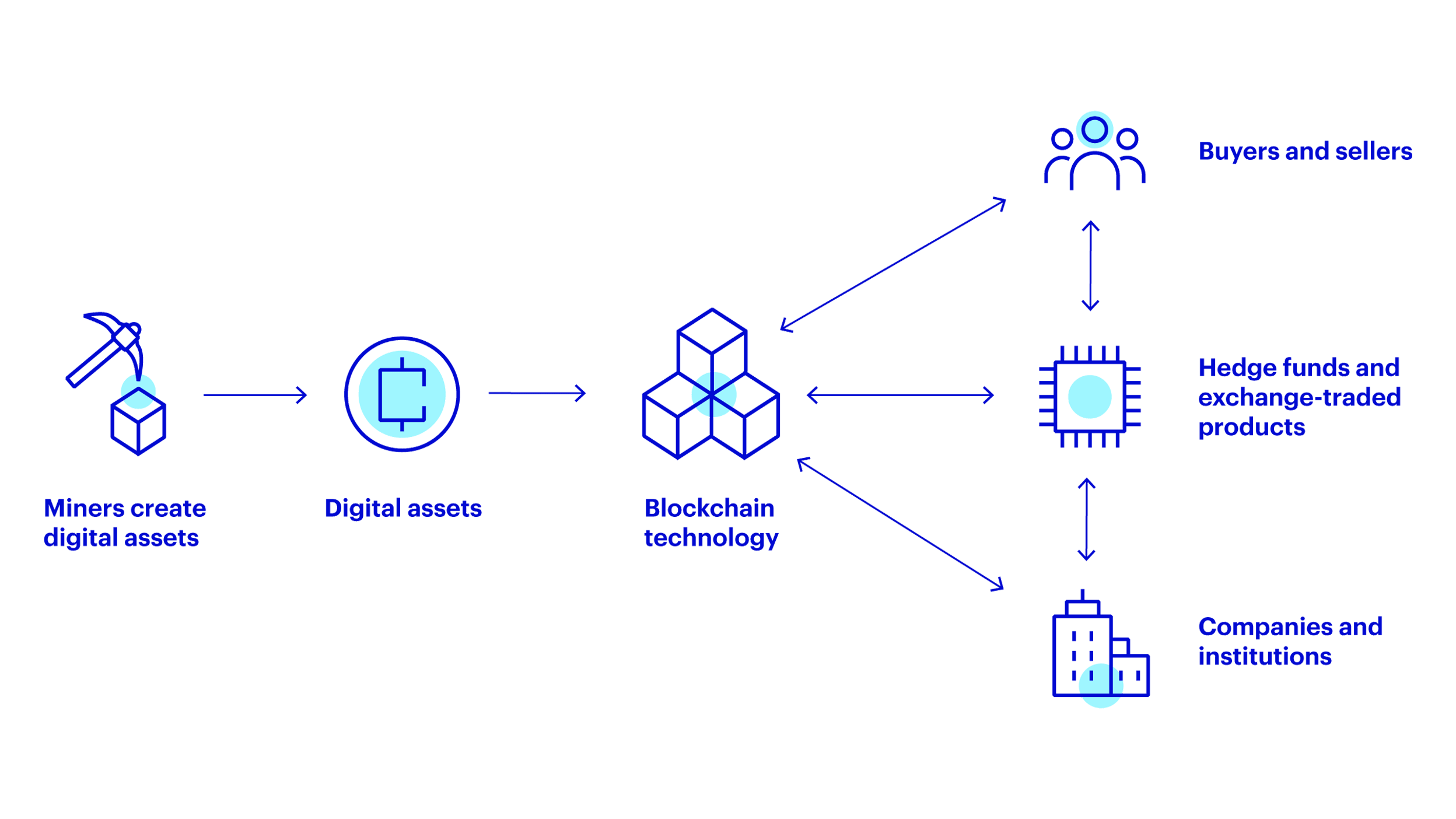
Cryptocurrencies meet these criteria through software protocols. Rather than relying on paper currency certificates or central bank vault deposits, cryptocurrencies exist as transactional state entries across a network of computers. The underlying architecture ensures that these entries cannot be double-spent, altered, or deleted without network consensus.
The classification of crypto as a digital asset spans several key characteristics:
- Scarcity and Programmatic Supply: Most cryptocurrencies enforce deterministic supply schedules written into code. Bitcoin, for example, caps its total issuance at 21 million units, mimicking the finite nature of physical commodities like gold.
- Direct Ownership and Portability: Ownership is defined by access to cryptographic private keys rather than identity verification in a centralized bank database. Anyone holding the private key exerts exclusive control over the movement of those assets.
- Divisibility and Transferability: Cryptocurrencies can be divided into micro-fractional units (such as Satoshis on the Bitcoin network), enabling granular payments across international borders without traditional clearing houses.
Technical Foundations: How Cryptography and Distributed Ledgers Create Value
The digital nature of cryptocurrency differs from centralized electronic money, such as digital bank account balances. Standard electronic banking relies on centralized databases maintained by commercial institutions, where an entry represents a claim against that institution. Cryptocurrency functions as a self-sustaining asset class through a combination of asymmetric cryptography and distributed consensus mechanisms.
Asymmetric Cryptography and Private Key Ownership
At the core of crypto assets is public-key cryptography. Every digital wallet consists of a pair of mathematical keys: a public key (which acts as a public address for receiving transfers) and a private key (which functions as a secret digital signature to authorize outgoing transactions).
When an individual conducts a transaction, their wallet signs the message with the private key. Network nodes verify the signature using the corresponding public key without ever exposing the private key itself. This mathematical proof guarantees that only the legitimate owner can initiate a valid asset transfer.
Distributed Consensus and Immutable Recordkeeping
Digital files in traditional computing can be copied infinitely without degrading the original file. This challenge, known in computer science as the "double-spending problem," prevented purely digital money from functioning without a trusted middleman for decades.
Cryptocurrencies resolve this through distributed consensus protocols, such as Proof-of-Work (PoW) or Proof-of-Stake (PoS). Thousands of independent validation nodes maintain identical copies of the blockchain ledger. When a batch of transactions is submitted, nodes validate the digital signatures and computational rules before adding the block to the historical chain. Once confirmed, the transaction history becomes practically immutable, giving the digital asset verifiable scarcity and permanent record of ownership.
The Taxonomy of Crypto Digital Assets
The broad umbrella of digital assets includes various instrument types, each serving distinct technical, economic, and operational functions. Treating all cryptocurrencies as identical payment tools obscures how different tokens function within global capital markets.
- Crypto Digital Assets
- Layer-1 / Native Currency Tokens (BTC, ETH, SOL)
- Stablecoins (USDT, USDC)
- Utility & Governance Tokens (UNI, LINK, AAVE)
- Tokenized Real-World Assets (RWA / Debt)
1. Layer-1 Native Cryptocurrencies
Native cryptocurrencies serve as the foundational monetary units of independent blockchains. Examples include Bitcoin (BTC), Ethereum (ETH), and Solana (SOL). They pay for network transaction fees (gas), incentivize node operators to secure the network, and function as native stores of value within their respective software ecosystems.
2. Stablecoins
Stablecoins are digital assets designed to maintain a stable value relative to a reference asset, typically a fiat currency like the U.S. Dollar or Euro. Fiat-backed stablecoins reserve physical fiat or short-term treasury bills with custodians, issuing digital tokens on-chain representing a 1:1 redemption claim. They serve as primary liquidity bridges and payment instruments across decentralized networks.
3. Utility and Governance Tokens
Utility tokens provide access to specific services built on decentralized applications (dApps). Governance tokens, meanwhile, grant holders voting power over network upgrades, fee allocations, or protocol parameter adjustments. Unlike native currencies, these tokens are typically issued as smart contracts on top of existing Layer-1 networks.
4. Tokenized Real-World Assets (RWAs)
Tokenized RWAs represent digital claims on traditional off-chain financial assets, such as U.S. Treasury bills, real estate equity, corporate bonds, or physical commodities like gold. By issuing these assets on a blockchain, issuers achieve 24/7 settlement capabilities, automated compliance through smart contracts, and fractionalized ownership.
Global Regulatory Frameworks and Legal Classifications
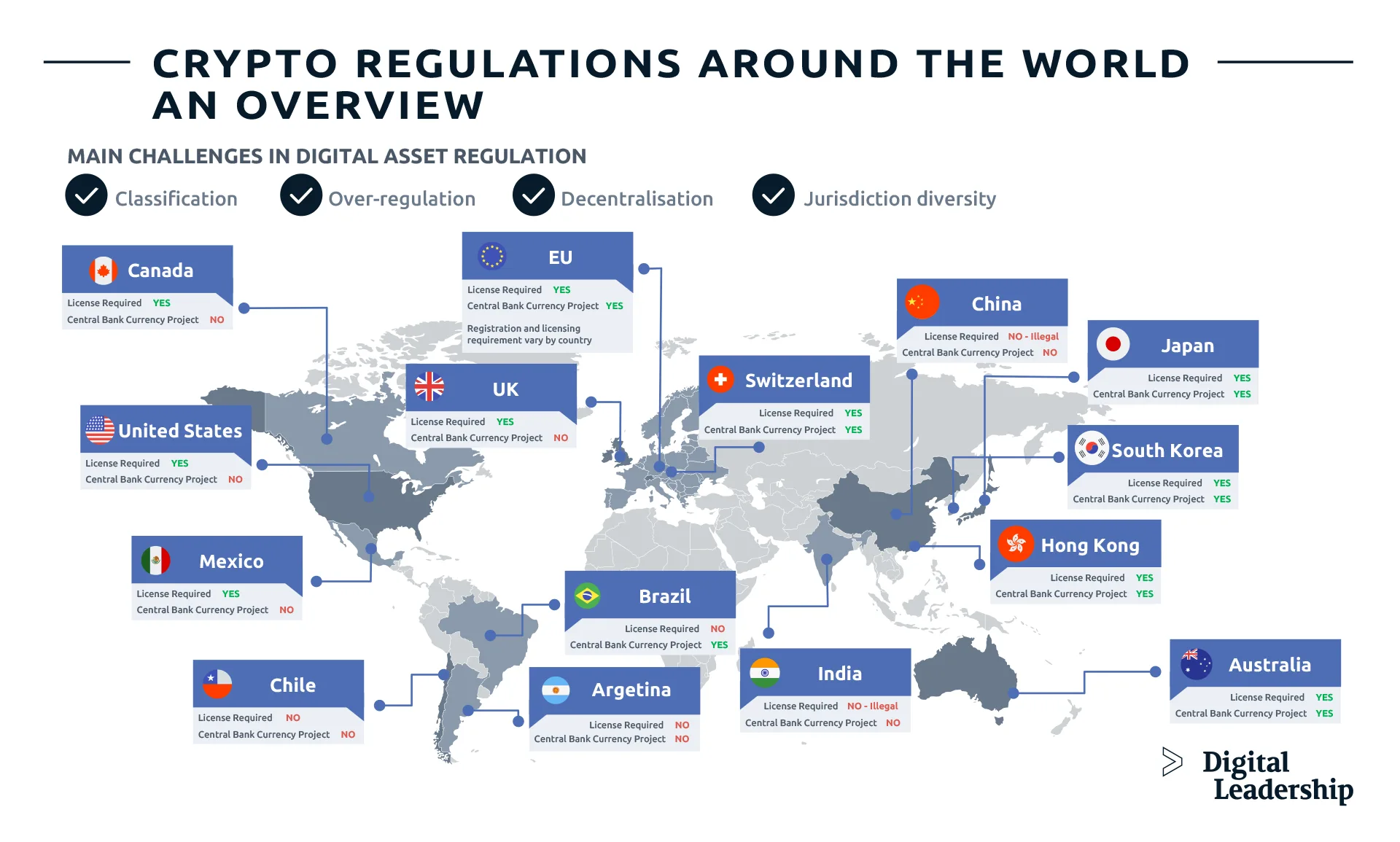
As digital assets have expanded into institutional capital markets, legal frameworks worldwide have evolved to establish explicit regulatory boundaries. Global regulators generally avoid treating crypto as a single entity class, instead assessing individual tokens based on their economic realities and operational structures.
United States: SEC and CFTC Jurisdictional Split
In the United States, regulatory classification hinges primarily on whether a digital asset behaves as a security or a commodity:
- Securities and Exchange Commission (SEC): Applies the Howey Test—a legal framework derived from the 1946 Supreme Court case SEC v. W.J. Howey Co. Under this standard, an asset is deemed an investment contract (security) if it involves an investment of money in a common enterprise with a reasonable expectation of profits derived from the entrepreneurial or managerial efforts of others.
- Commodity Futures Trading Commission (CFTC): Classifies fully decentralized digital assets, such as Bitcoin, as digital commodities under the Commodity Exchange Act. This distinction removes them from equity-style registration requirements, subjecting spot and derivative trading to market-integrity oversight instead.
European Union: Markets in Crypto-Assets (MiCA)
The European Union introduced the Markets in Crypto-Assets (MiCA) regulation, establishing unified statutory definitions across all EU member states. MiCA divides digital assets into three clear regulatory tiers:
- Asset-Referenced Tokens (ARTs): Tokens that aim to maintain a stable value by referencing multiple fiat currencies, commodities, or other crypto assets.
- Electronic Money Tokens (EMTs): Digital assets that reference a single fiat currency, functioning as digital surrogates for electronic money.
- Other Crypto-Assets: A broad category covering utility tokens and general decentralized cryptocurrencies not classified as ARTs or EMTs.
MiCA imposes strict governance, reserve auditing, and disclosure standards on asset issuers and Crypto Asset Service Providers (CASPs), creating a unified regulatory baseline for institutional market participants.
Comparing Digital Assets to Traditional Asset Classes
Understanding crypto's unique position in finance requires contrasting its property rights, settlement times, and operational mechanics against conventional asset classes.
| Feature / Property | Crypto / Digital Assets | Traditional Equities | Physical Commodities (Gold) | Fiat Currency |
|---|---|---|---|---|
| Primary Underlying Value | Protocol utility, consensus network demand, governance rights | Corporate revenue, dividends, net asset value | Physical industrial and ornamental utility | Sovereign guarantee, tax collection backstop |
| Settlement Time | Near-instantaneous (seconds to minutes) | T+1 standard (varies by market jurisdiction) | T+1 to T+3 physical delivery | Instantaneous (cash) to 1–3 business days (wire) |
| Custody Mechanism | Cryptographic private keys (Self or Custodial) | Brokerage accounts, central depositories | Vault storage, physical possession | Commercial bank deposits, physical cash |
| Trading Availability | 24/7/365 global continuous access | Fixed exchange operating hours | Derivative market hours, physical spot limits | Interbank settlement hours |
| Programmability | Fully programmable via smart contracts | Limited (requires traditional legal escrow) | Non-programmable | Low (restricted to bank API integrations) |
| Auditability | Publicly verifiable via ledger explorers | Quarterly/Annual audited financial reports | Physical assay and vault inspection | Central bank balance sheet disclosures |
Custody Models and Financial Ownership Mechanics
Because cryptocurrencies are digital assets governed by code, the legal concept of ownership is directly tied to key management. Unlike traditional equities held through a custodial chain of broker-dealers and central depositories, digital asset holders can choose between two main custody paradigms:
- Digital Asset Custody
- Self-Custody Model (Non-Custodial Keys)
- Hardware Wallets
- MPC Key Management
- Direct On-Chain Execution
- Institutional Custodial Model
- Qualified Custodians
- Bankruptcy-Remote Isolation
- Institutional Insurance Coverage
- Self-Custody Model (Non-Custodial Keys)
Self-Custody (Non-Custodial)
In a self-custody arrangement, the owner retains direct control of the private keys using hardware security modules (HSM), paper back-ups, or Multi-Party Computation (MPC) software.
- Advantages: Complete immunity from third-party counterparty risk, direct network participation, and uncensorable transaction execution.
- Risks: Irreversible loss of assets if keys are misplaced, stolen, or improperly backed up, with no central administrator available to reset passwords.
Qualified Custody (Custodial)
Institutional investors typically utilize regulated third-party custodians. These entities hold digital assets on behalf of clients using cold storage infrastructure, multi-signature authentication protocols, and institutional insurance policies.
- Advantages: Institutional compliance, operational redundancy, protection against internal key mismanagement, and integration with traditional fund accounting.
- Risks: Exposure to counterparty risk, custodial insolvency, and administrative withdrawal delays during emergency freezes or system maintenance.
Operational Risks and Common Pitfalls
While digital assets offer capital efficiency and auditability, their technical characteristics introduce distinct operational risks that market participants must navigate carefully.
1. Smart Contract Vulnerabilities
Tokens built on programmable blockchains rely on code execution. If a smart contract contains logic flaws, reentrancy vulnerabilities, or unverified admin keys, malicious actors can exploit the contract to drain deposited funds. Audits by independent security firms mitigate, but do not eliminate, this risk.
2. Irreversibility of Distributed Transactions
Unlike traditional credit card transactions or bank wires, blockchain settlement is final once confirmed by network consensus. If an asset is sent to an incorrect digital wallet address or an unverified smart contract, there is no central entity capable of reversing the transaction or issuing a chargeback.
3. Key Loss and Key Theft
Phishing campaigns, unauthorized software access, and insecure seed-phrase storage remain primary vectors for loss in digital asset markets. Securing digital assets requires strict operational security, such as utilizing hardware wallets, implementing hardware-based multi-factor authentication (MFA), and separating cold storage reserves from active trading capital.
Frequently Asked Questions
What makes a cryptocurrency a digital asset rather than just digital cash?
While digital cash functions primarily as a medium of exchange, a digital asset encompasses a broader spectrum of financial capabilities. Cryptocurrencies can represent fractional ownership, governance rights, access to decentralized computing services, or automated smart-contract capabilities, giving them multi-faceted asset characteristics beyond basic currency functions.
Are all digital assets classified as securities under law?
No. Financial regulators classify digital assets based on their functional attributes and launch mechanisms. Decentralized assets with no central issuer or profit-sharing expectation, such as Bitcoin, are generally regulated as digital commodities. Assets distributed to raise capital for a centralized development team, however, frequently fall under securities laws.
How does a digital asset retain value if it has no physical form?
Value is determined by market demand, computational security, scarcity, and utility rather than physical presence. Cryptocurrencies derive value from their network effects, programmatic scarcity guarantees, ability to execute trustless global transactions, and utility within specialized software protocols.
What is the difference between a native coin and a token?
A native coin (such as Bitcoin or Ether) operates on its own independent Layer-1 blockchain ledger and is primarily used to settle transaction fees and secure the underlying network. A token (such as an ERC-20 token) is built on top of an existing blockchain using smart contracts and usually represents specific protocol utility, stablecoin liabilities, or governance voting rights.
Can digital assets be frozen or confiscated by central authorities?
It depends on the architecture of the specific digital asset and how it is held. Assets stored in self-custodial wallets on decentralized networks cannot be directly frozen on-chain by external third parties. However, centralized stablecoin issuers retain smart-contract functionality to blacklist specific addresses, and regulated custodians can freeze client accounts pursuant to court orders.
Practical Recommendations for Managing Digital Assets
Whether interacting with digital assets as an retail user or an institutional participant, maintaining rigorous operational standards is essential:
- Categorize Assets by Regulatory and Risk Profile: Differentiate between native digital commodities (e.g., BTC), functional utility tokens, and fiat-backed stablecoins. Understand the legal protections and risk factors associated with each category.
- Match Custody Architecture to Operational Scale: Utilize non-custodial hardware wallets or MPC key management for self-sovereign control over long-term holdings. For corporate reserves or managed investment funds, partner with regulated qualified custodians operating with bankruptcy-remote account structures.
- Verify Contract Deployments and Audits: Prior to deploying capital into decentralized protocols or new digital asset smart contracts, verify that the underlying software code has undergone multiple independent security audits and possesses verified source code on public block explorers.
- Implement Formal Key Management Protocols: Maintain offline, geographically distributed backups of seed phrases and key management shares. Never enter private keys or recovery phrases into unverified software interfaces or internet-connected storage locations.
Image Gallery