Mutexes vs Semaphores: Understanding Low-Level Concurrency Control
When designing multi-threaded operating systems or high-performance concurrent applications, developers must manage shared resources carefully to prevent data corruption, race conditions, and deadlocks. Mutexes and semaphores are funda...
When designing multi-threaded operating systems or high-performance concurrent applications, developers must manage shared resources carefully to prevent data corruption, race conditions, and deadlocks. Mutexes and semaphores are fundamental synchronization primitives provided by operating system kernels and threading libraries to control access to shared memory or hardware peripherals. Although both mechanisms regulate how concurrent threads interact with critical sections of code, they are built with entirely different conceptual models, ownership rules, and performance profiles. Selecting the correct primitive dictates whether an application scales smoothly across multiple processor cores or suffers from priority inversions and synchronization overhead.
Contents
Foundations of Concurrency and Critical Sections
To understand why synchronization primitives like mutexes and semaphores exist, one must first examine the nature of concurrent execution. In modern multi-core processors, multiple threads run simultaneously, executing instructions independently while sharing a common address space. A critical section is a segment of code that accesses a shared resource—such as a global variable, a database connection, a hardware register, or a data structure—which cannot be safely modified by more than one thread at a time.
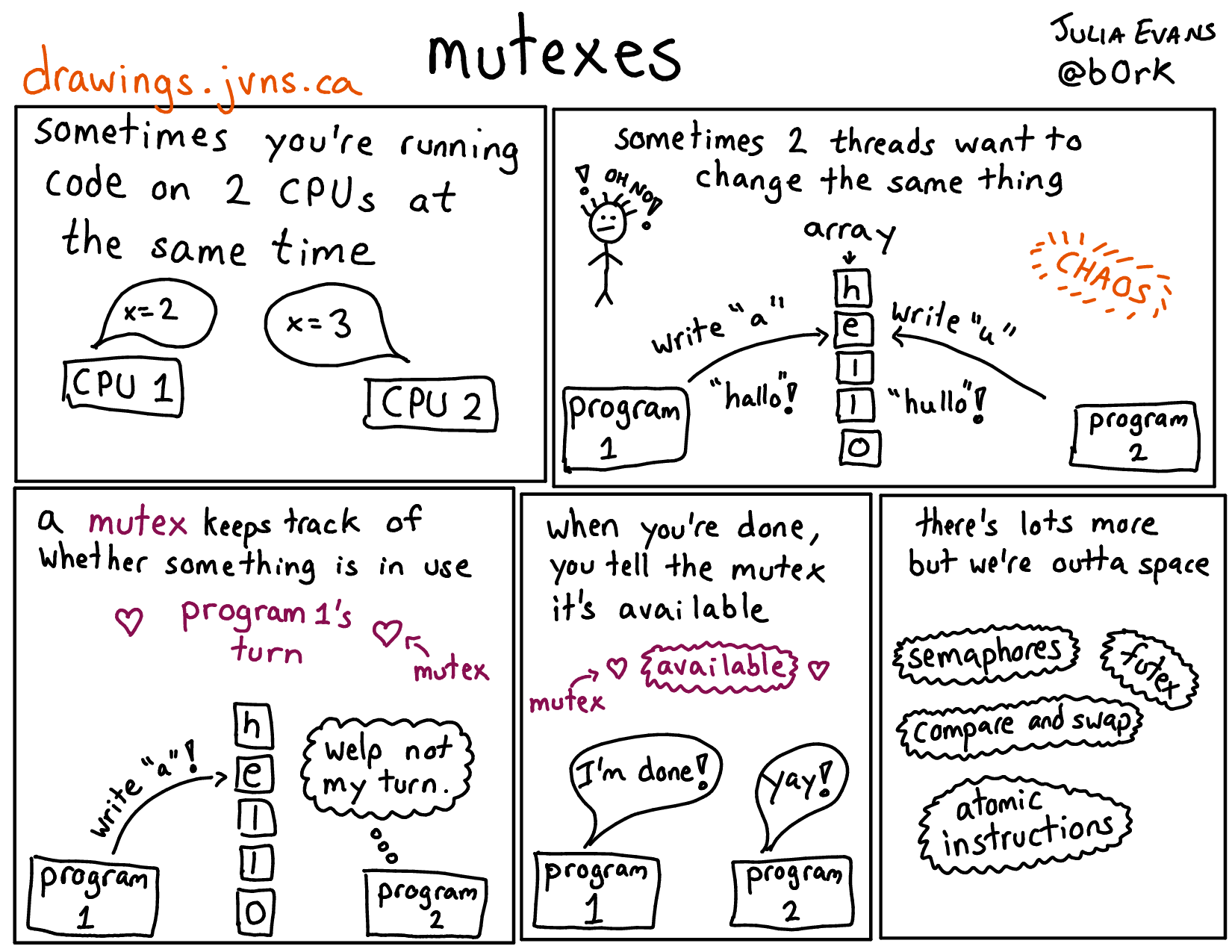
If two threads attempt to read and write to the same memory location simultaneously without coordination, a race condition occurs. The final state of the data becomes unpredictable, depending entirely on the non-deterministic scheduling of the CPU scheduler. Synchronization primitives act as gatekeepers, enforcing mutual exclusion or signaling coordination so that threads enter critical sections in an orderly, predictable manner.
However, enforcing synchronization introduces costs. Thread blocking, context switching, and kernel transitions consume CPU cycles. Therefore, choosing between a mutex and a semaphore requires balancing correctness, throughput, and determinism.
What is a Mutex?
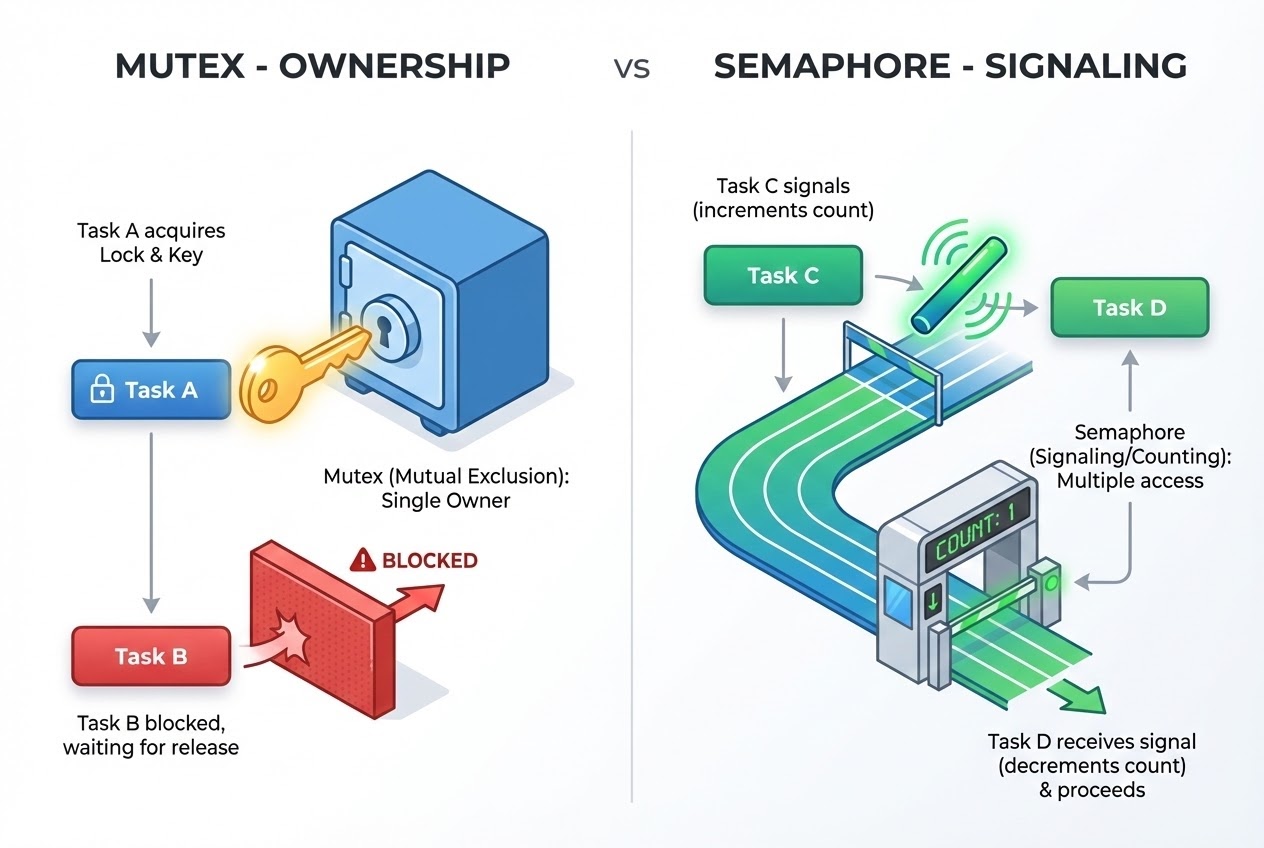
A mutex (short for mutual exclusion object) is a locking mechanism designed specifically to enforce exclusive access to a single shared resource or critical section. Think of a mutex as a key to a private room: only one person can hold the key at any given time.
Ownership and Locking Mechanics
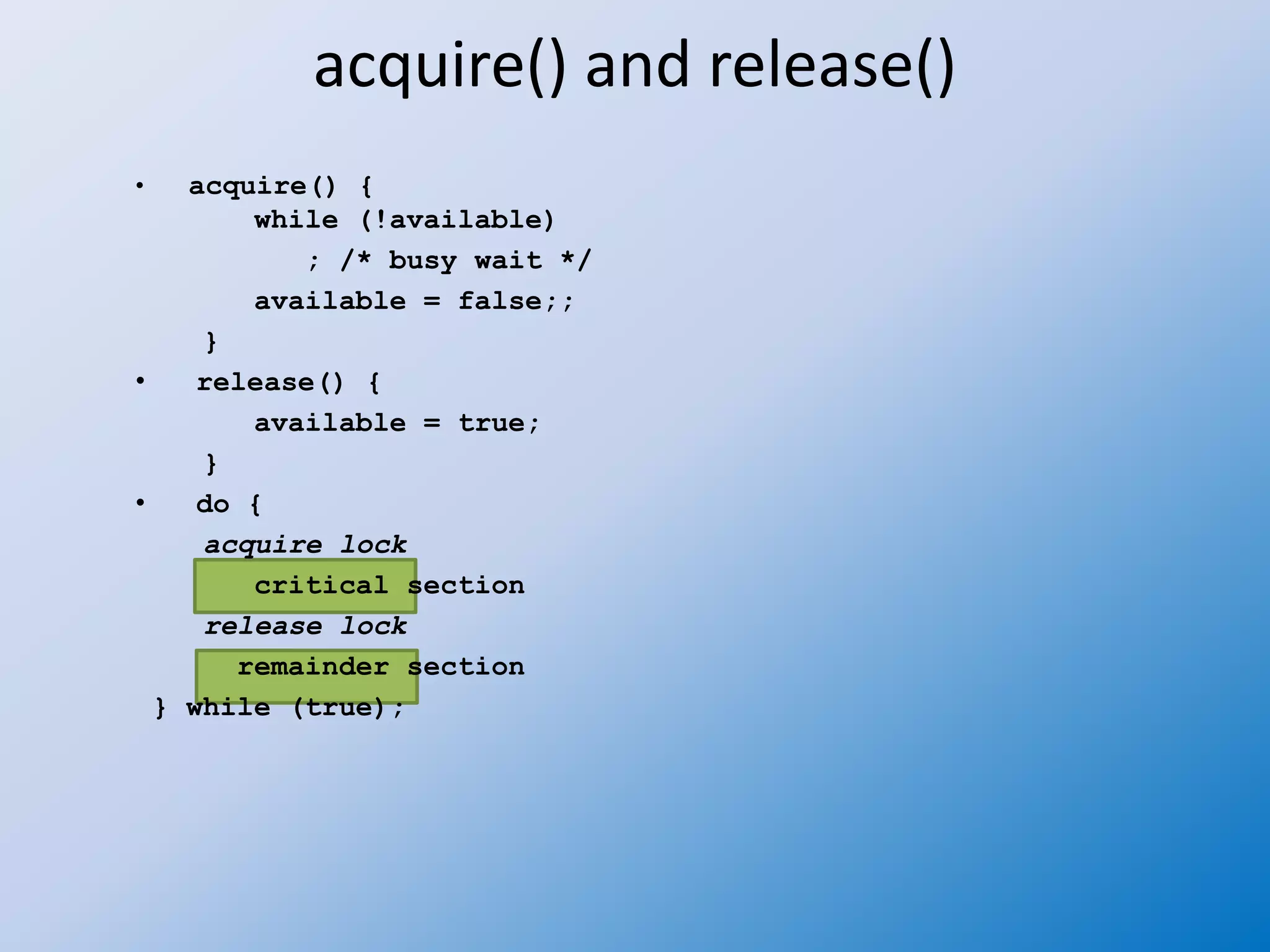
The defining characteristic of a mutex is the concept of ownership. The thread that successfully locks (acquires) a mutex is the only thread permitted to unlock (release) it. When a thread requests a mutex that is currently held by another thread, the operating system kernel typically puts the requesting thread to sleep, removing it from the CPU run queue until the mutex becomes available. This blocking mechanism prevents busy-waiting (spinning), thereby conserving CPU power.
[Thread A] ---> Acquires Mutex ---> Enters Critical Section ---> Releases Mutex | [Thread B] ---> Requests Mutex ---> Blocks (Goes to Sleep) <----------+
Types of Mutexes
Operating systems and threading libraries implement several specialized variants of mutexes to handle specific performance and safety requirements:
- Fast Mutex (Standard): The simplest implementation. If a thread attempts to acquire an already locked mutex, it blocks immediately. It does not handle recursive locking.
- Recursive Mutex: Allows the same thread to lock the mutex multiple times without deadlocking itself. The mutex keeps an internal acquisition counter; the thread must release the mutex an equal number of times before another thread can acquire it.
- Error-Checking Mutex: Returns an explicit error code if a thread attempts to unlock a mutex it does not own or attempts to re-lock a mutex it already holds, aiding in debugging.
What is a Semaphore?
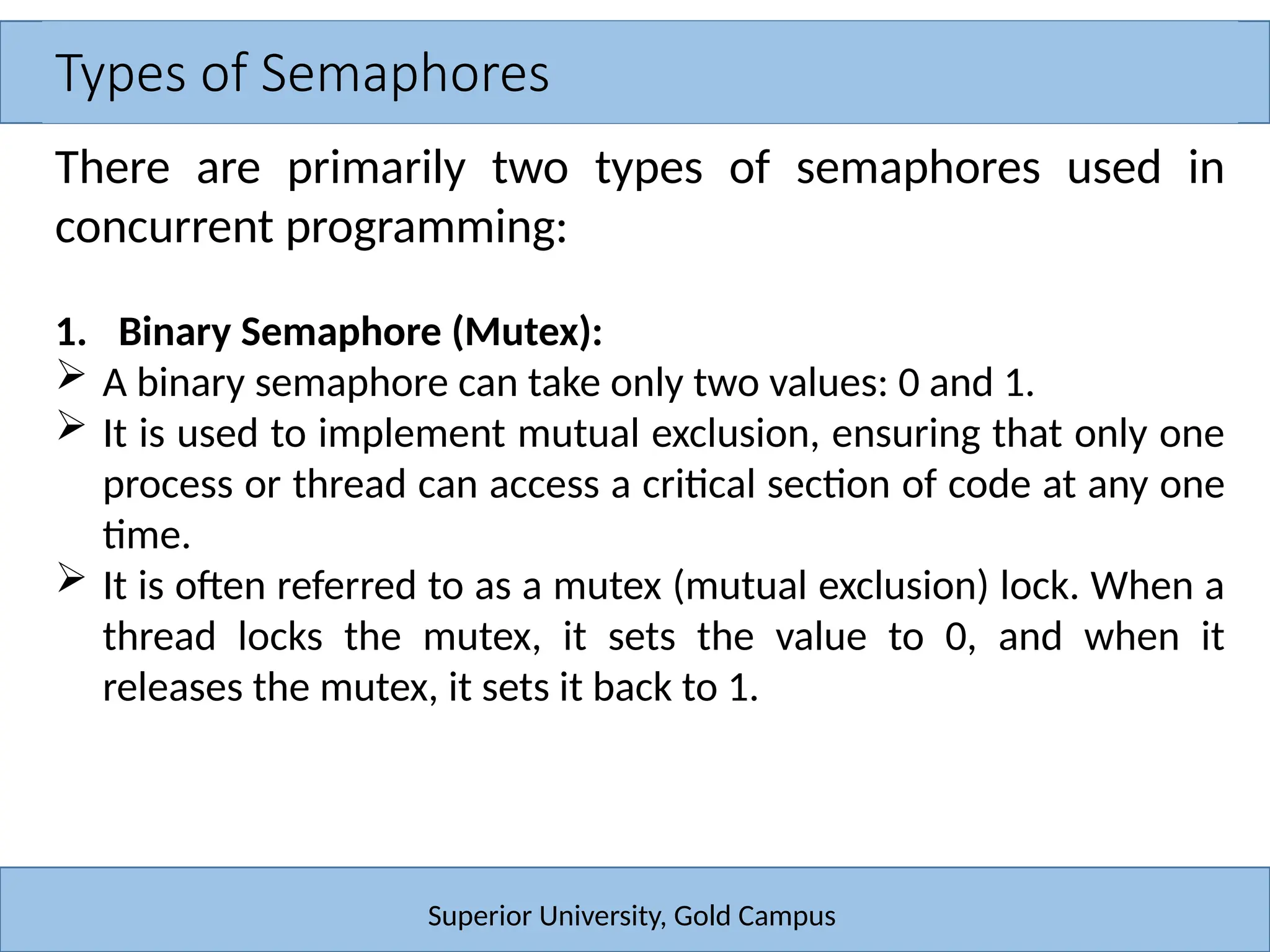
A semaphore is a signaling mechanism introduced by Edsger Dijkstra in 1965. Rather than acting as a lock with an owner, a semaphore is an integer variable protected by atomic operations that restricts or allows access to a pool of identical resources.
Signaling and Counting Mechanics
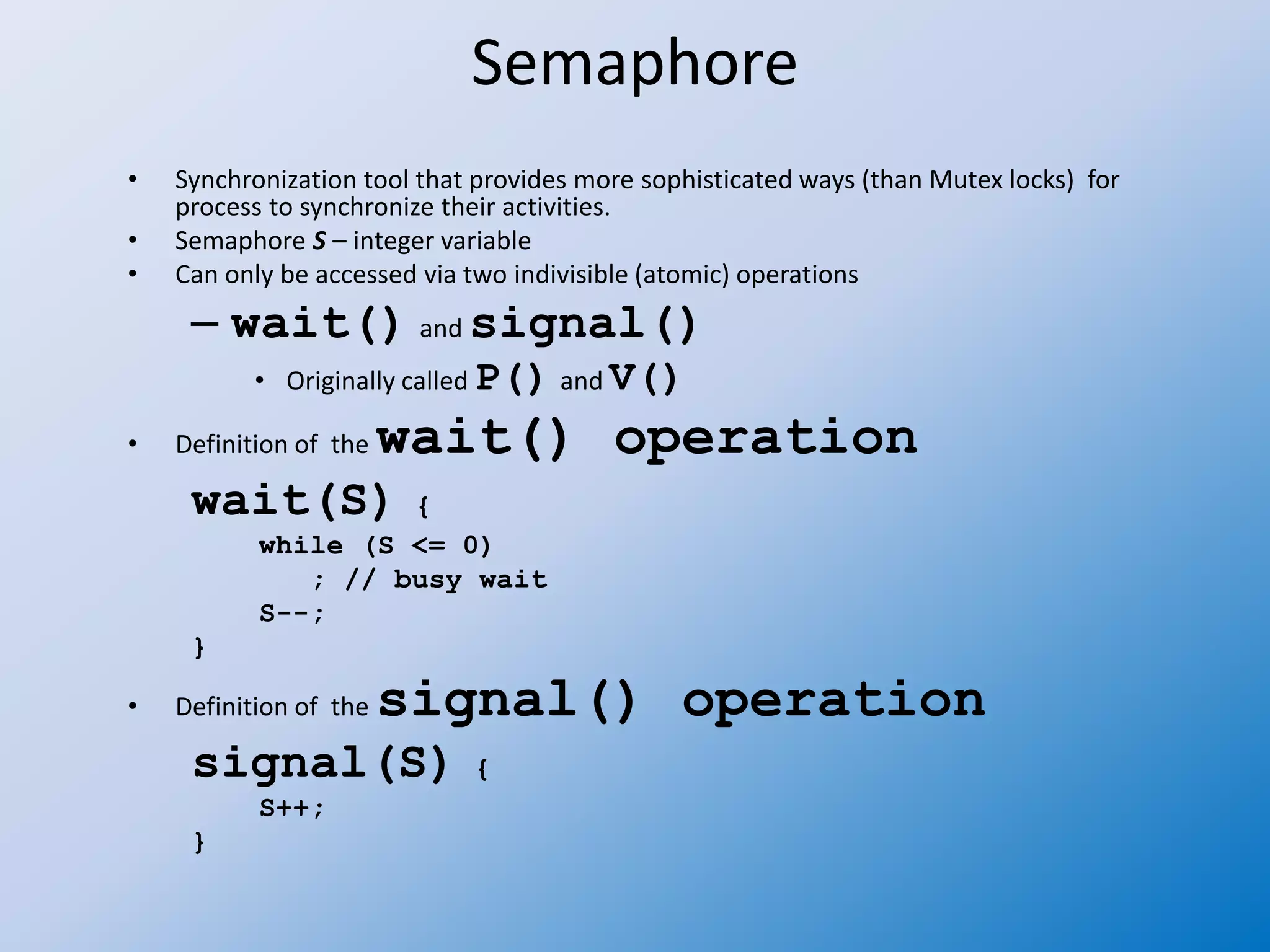
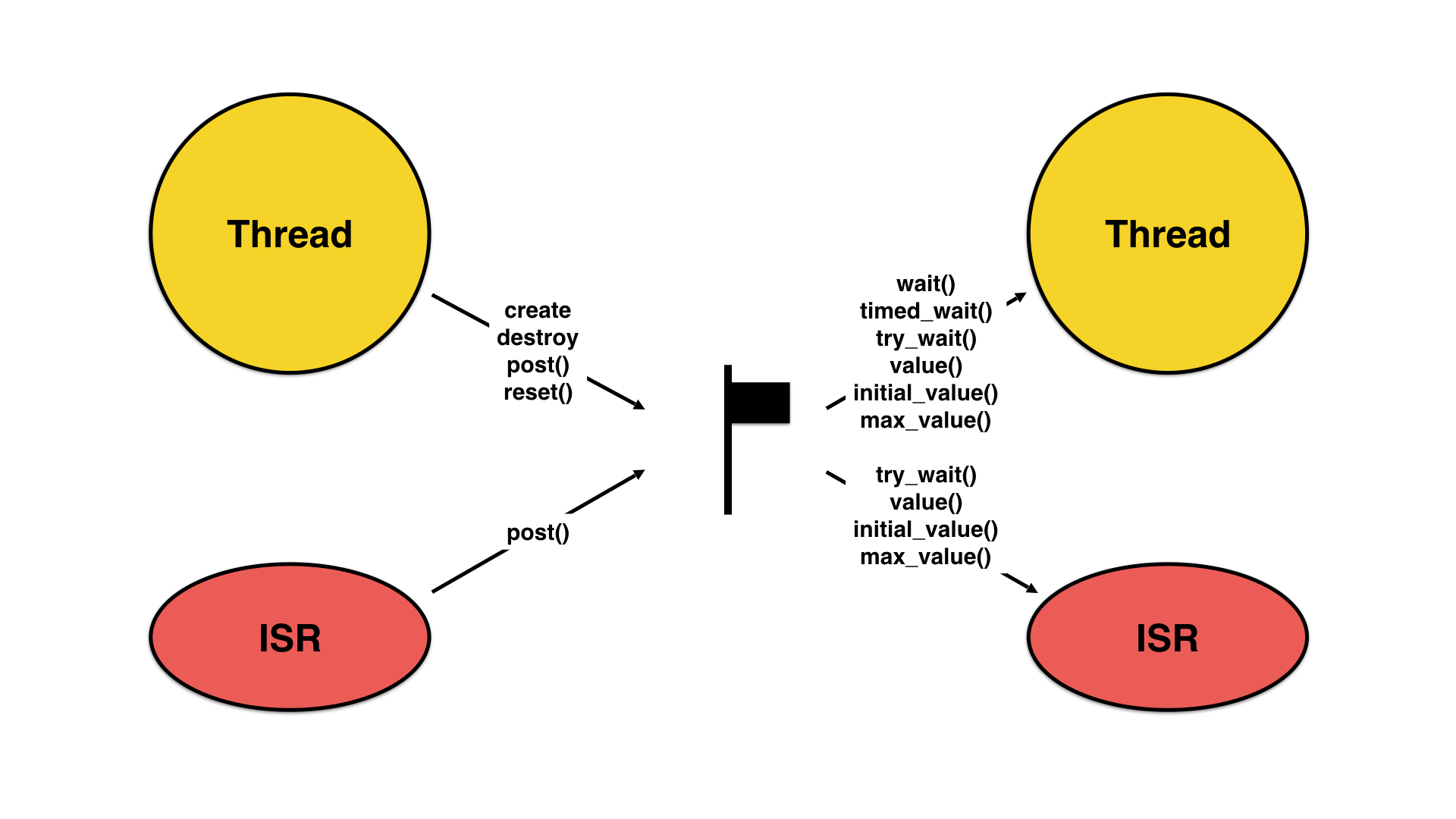
A semaphore maintains an internal counter initialized to a specific value. It supports two primary atomic operations, traditionally known in computer science as P (from the Dutch probeer, meaning to test, also called wait or down) and V (from verhoog, meaning to increment, also called signal or up).
- Wait (Decrement): When a thread calls
wait(), the semaphore's counter is decreased by one. If the counter drops below zero, the calling thread is blocked until another thread increments the counter. - Signal (Increment): When a thread calls
signal(), the semaphore's counter is increased by one. If there are blocked threads waiting on the semaphore, one of them is awakened.
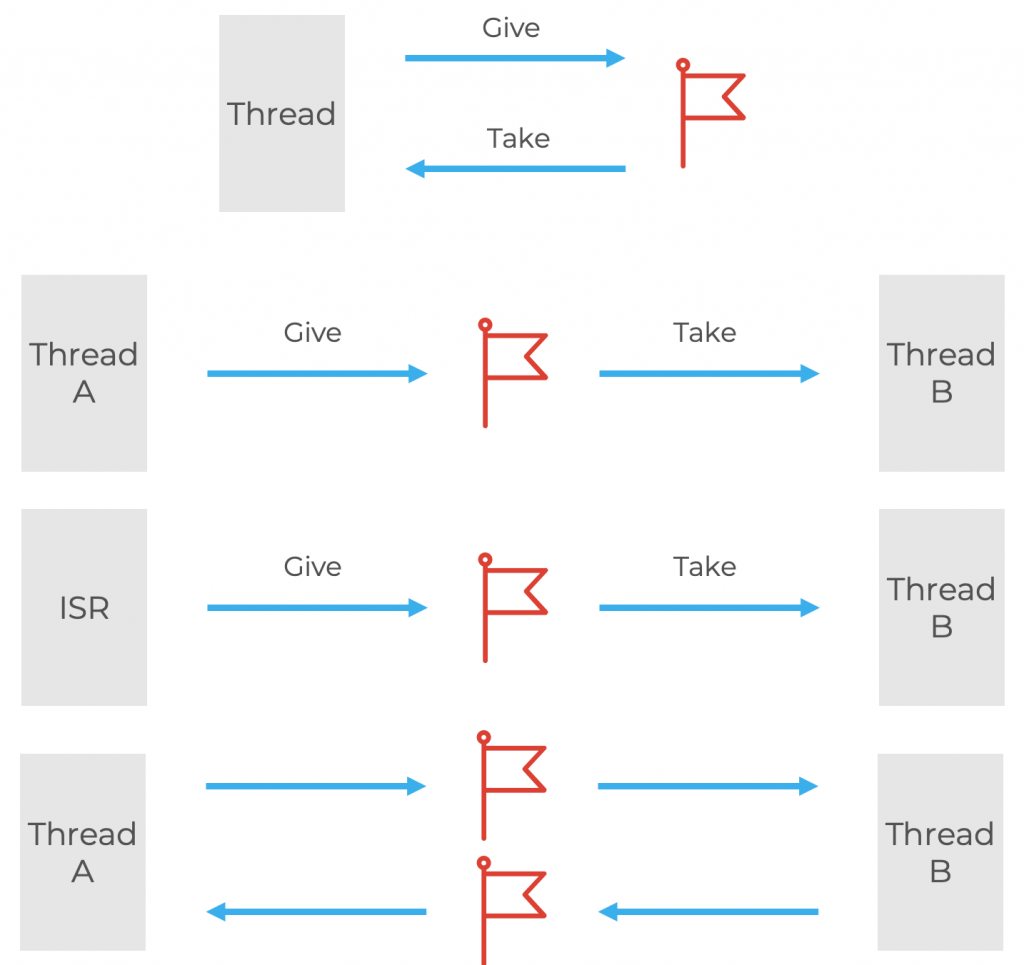
Unlike a mutex, a semaphore has no concept of ownership. Any thread can call signal(), regardless of which thread previously called wait(). This makes semaphores exceptionally flexible for signaling events between unrelated threads or managing a finite pool of resources, such as database connection pools or buffer slots in a circular queue.
Binary Semaphores vs. Counting Semaphores
Semaphores generally fall into two categories based on their initial counter values:
- Binary Semaphore: Initialized to a maximum value of 1. It restricts access to a single resource, functioning similarly to a mutex. However, because binary semaphores lack ownership rules, they can introduce subtle bugs if misused for mutual exclusion.
- Counting Semaphore: Initialized to a value greater than 1 ($N$). It manages a resource pool containing $N$ identical units. Threads can acquire access as long as the counter remains positive.
Key Differences: Mutexes vs. Semaphores
Comparing mutexes and semaphores highlights fundamental divergences in design philosophy. While both control concurrent access, their underlying rules dictate entirely different use cases.
| Feature | Mutex | Semaphore |
|---|---|---|
| Primary Purpose | Mutual exclusion (protecting a single critical section). | Signaling and resource counting (managing access to a pool). |
| Ownership | Strict ownership. Only the locking thread can unlock. | No ownership. Any thread can signal or wait. |
| State Space | Binary (Locked or Unlocked). | Integer counter (0, 1, 2, ..., N). |
| Reentrancy | Supported in specific variants (Recursive Mutex). | Not applicable; counter tracks availability, not nesting. |
| Inter-Process Use | Supported via shared memory (Process-shared mutexes). | Widely supported for cross-process synchronization. |
| Safety Risk | Deadlocks if locking order is inconsistent. | Race conditions, signal loss, or chaotic resource exhaustion if mismanaged. |
Common Use Cases and Scenarios
Knowing the theoretical differences is only half the battle; real-world engineering requires matching the primitive to the architectural challenge.
When to Use a Mutex
- Protecting State Modifications: When multiple threads update a shared data structure, such as a hash map, a cache, or a counter, a mutex ensures that intermediate, inconsistent states are never exposed to other threads.
- Thread-Safe Singleton Initialization: Ensuring that an expensive resource or configuration object is instantiated exactly once across a multi-threaded environment.
- File Access Serialization: Preventing interleaved write operations when multiple worker threads attempt to write logs or configuration data to the same file descriptor.
When to Use a Semaphore
- Producer-Consumer Pipelines: Coordinating bounded buffers where producer threads push items into a queue and consumer threads remove them. Two semaphores are typically employed: one counting empty slots and one counting filled slots.
- Rate Limiting and Connection Pools: Restricting the number of concurrent connections permitted to access a restricted network service or database server.
- Cross-Thread Event Notification: Signaling a worker thread that a specific task is ready for processing without establishing a strict locking relationship.
Common Pitfalls and Troubleshooting
Improper synchronization leads to catastrophic software failures that are notoriously difficult to reproduce and debug.
Deadlocks
A deadlock occurs when two or more threads are permanently blocked, waiting for each other to release resources. For example, Thread 1 holds Mutex A and requests Mutex B, while Thread 2 holds Mutex B and requests Mutex A. Neither thread can proceed.
Prevention Strategy: Establish a strict global locking hierarchy. Always acquire locks in the exact same order across all threads. Alternatively, use timeout-based lock acquisition methods or lock-free data structures where appropriate.
Priority Inversion
In real-time operating systems (RTOS), priority inversion occurs when a low-priority thread holds a mutex, is preempted by a medium-priority thread, and prevents a high-priority thread from acquiring the mutex. The high-priority thread is effectively blocked by the medium-priority thread.
Mitigation: Modern kernels implement priority inheritance, temporarily elevating the priority of the thread holding the mutex to match the highest-priority thread waiting for it.
Using Semaphores as Mutexes
A common anti-pattern is using a binary semaphore for mutual exclusion. Because semaphores lack ownership, a thread can unlock a semaphore it never locked. This breaks encapsulation, obscures code readability, and bypasses safety checks that prevent accidental double-unlocks or privilege escalation bugs. Always default to a mutex for mutual exclusion.
Frequently Asked Questions
Can a mutex be released by a different thread than the one that acquired it?
No. Mutexes enforce strict ownership rules. Only the thread that successfully locked the mutex is authorized to unlock it. Attempting to unlock a mutex from a different thread results in undefined behavior or runtime errors, depending on the operating system's API implementation.
What is the difference between a binary semaphore and a mutex?
While both restrict access to a single resource, a mutex has the concept of thread ownership, whereas a binary semaphore does not. Mutexes include safety features like recursive locking and priority inheritance protocols, making them ideal for mutual exclusion. Semaphores are signaling tools meant for event notification and coordination.
Can semaphores be used across different processes?
Yes. Both mutexes and semaphores can be configured as process-shared primitives, allowing independent operating system processes to synchronize access to shared memory segments or memory-mapped files.
Why do semaphores use wait and signal instead of lock and unlock?
The terminology reflects their theoretical origins in computer science. Semaphores are mathematical signaling variables rather than locks. The terms wait (or P) and signal (or V) describe the act of decrementing the counter to wait for a resource and incrementing it to signal availability to other processes.
Is spinning ever better than blocking with a mutex?
In ultra-low-latency environments where critical sections execute in fewer instructions than a kernel context switch requires, spinlocks are sometimes used instead of mutexes. A spinlock continuously polls the lock state in a CPU loop. However, spinlocks waste CPU cycles if the lock is held for long durations, making standard blocking mutexes the safer default for general application development.
Conclusion
Choosing between mutexes and semaphores comes down to understanding the exact nature of the concurrency problem at hand. If the objective is to protect a shared variable or critical section so that only one thread accesses it at a time, a mutex provides the necessary ownership, safety guarantees, and reentrancy options. If the objective is to coordinate execution flow, signal events, or manage a finite pool of identical resources among multiple independent threads, a semaphore provides the required counting and signaling flexibility. Respecting the ownership boundaries of mutexes and the signaling model of semaphores ensures robust, high-performance, and deadlock-free concurrent software design.
Image Gallery