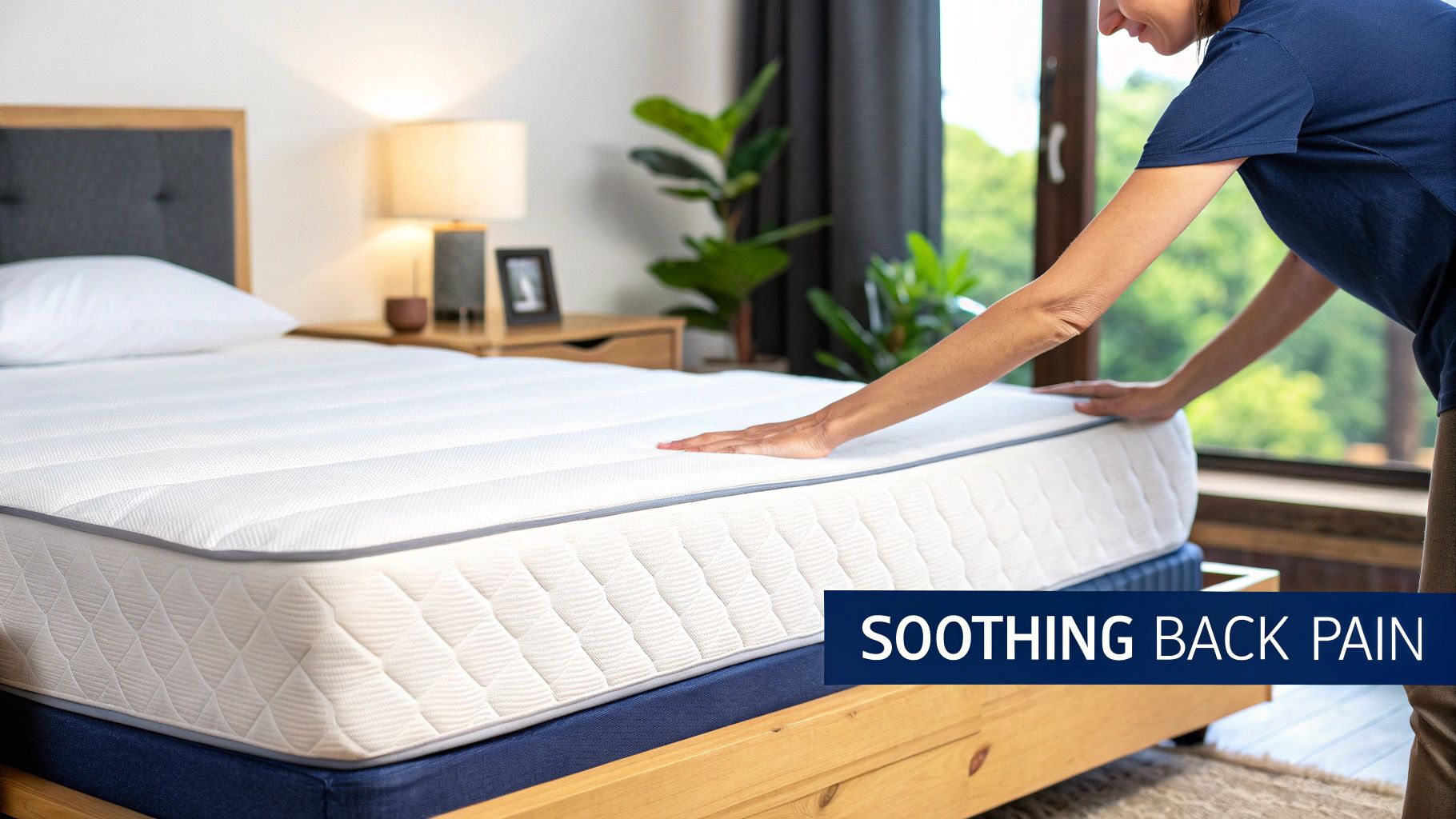
The Comprehensive Mattress Topper Guide for Back Pain Relief
A mattress topper alleviates back pain by altering the surface firmness of an existing sleep setup, promoting neutral spinal alignment, and redistributing body weight to relieve concentrated pressure points. Back sleepers generally ach...
A mattress topper alleviates back pain by altering the surface firmness of an existing sleep setup, promoting neutral spinal alignment, and redistributing body weight to relieve concentrated pressure points. Back sleepers generally achieve optimal lumbar support with a 2- to 3-inch medium-firm latex or high-density memory foam topper, whereas side sleepers typically require a 3- to 4-inch contouring topper to cushion hips and shoulders without displacing the spine.
Contents
Medical Disclaimer: This guide provides technical information on sleep surfaces and spinal alignment. It is not a substitute for professional medical advice, diagnosis, or treatment. Always consult a qualified healthcare provider or physical therapist regarding persistent spinal pain or underlying medical conditions.
Understanding How Mattress Toppers Relieve Back Pain
Back pain during sleep or upon waking usually stems from poor spinal alignment or excessive localized pressure on joint structures. When a sleep surface is either too hard or too soft, the natural s-curve of the human spine—comprising the cervical, thoracic, and lumbar regions—is compromised.
- Correct Alignment (Neutral Spine):
- [Head] - [Thoracic Curve] - [Lumbar Curve] - [Pelvis]
- Result: Straight horizontal line
- Improper Alignment (Surface Too Soft):
- [Head] and [Pelvis] elevated above [Sagging Lumbar/Torso]
- Result: "Hammock" effect causing lumbar strain
- Improper Alignment (Surface Too Firm):
- [Head] - [Shoulders Raised] - [Hips Raised]
- Result: Unsupported lumbar gap (Lumbar suspended in air)
A mattress topper acts as an ergonomic buffer between the body and the primary mattress. It modifies two fundamental mechanical properties of your sleeping surface:
- Surface Conformity (Pressure Relief): High-conformity materials yield beneath high-pressure areas such as the trochanteric region (hips) and the scapulae (shoulder blades). By broadening the contact area across the body, peak contact pressure drops, decreasing muscle guarding and localized tension.
- Support Resistance (Spinal Neutrality): Underneath the initial cushioning layer, a resilient topper provides upward force to prevent heavy anatomical regions (the pelvis and chest) from sinking too far. This preserves sagittal balance—keeping the spine in a horizontal line when sleeping on the side, or maintaining its natural inward curve (lordosis) when sleeping on the back.
Adding a topper cannot repair a structural collapse inside an underlying mattress. However, when paired with a structurally sound base mattress, the correct topper re-establishes an optimal balance between pressure mitigation and structural lift.
Evaluating Topper Materials for Spinal Health
The material composition of a topper dictates its response rate, durability, thermal regulation, and structural support. Three primary material categories dominate ergonomic applications for back pain relief.
Viscoelastic Memory Foam
Viscoelastic polyurethane foam reacts to both weight and body temperature. Under pressure, it softens and moulds precisely to the contours of the body, distributing weight across a wider surface area.
- Mechanics for Back Pain: Memory foam excels at removing pressure points around hips and shoulders. By letting these bony prominences sink into the material, it allows the lower back to rest naturally against the foam, filling the lumbar gap for back sleepers.
- Limitations: Low-density memory foam can lose its structural integrity quickly, leading to pelvic sinkage and lumbar hyperextension. Additionally, traditional memory foam can trap body heat, which may increase nighttime movement and interrupt restorative sleep. Look for open-cell or gel-infused formulations to mitigate heat retention.
Dunlop and Talalay Latex
Natural latex is manufactured from rubber tree sap (Hevea brasiliensis) using either the Dunlop or Talalay process. Dunlop latex produces a denser, firmer base material, whereas Talalay latex yields a lighter, more uniform cell structure with enhanced buoyancy.
- Mechanics for Back Pain: Unlike memory foam, latex offers immediate responsiveness and "push-back" (high elasticity). It supports the spine by pushing up against body weight while cushioning joints. This stops the hips from sinking too far into the bed, making it easier to change positions without straining the lower back muscles.
- Limitations: High-density natural latex toppers carry a higher upfront cost and are heavier to maneuver than synthetic foam alternatives.
High-Resilience (HR) Polyurethane Foam
High-Resilience polyfoam features a random cell structure that provides strong support and high elasticity. It acts as a middle ground between the deep sinking feel of memory foam and the buoyant lift of latex.
- Mechanics for Back Pain: HR polyfoam offers a stable surface for individuals who need targeted lumbar support without a "trapped" feeling. It preserves consistent surface firmness across fluctuating room temperatures.
- Limitations: Lower-grade polyfoams (standard conventional polyurethane) breakdown rapidly under daily body weight, leading to body impressions that can worsen back alignment over time.
Key Technical Specifications: Density, Thickness, and ILD
Evaluating a topper requires analyzing its technical specifications rather than relying on subjective softness ratings. Three critical measurements dictate how a topper performs under body weight.
1. Foam Density (lbs/cu. ft. or kg/m³)
Density measures the mass of material per unit volume. It is the single most accurate indicator of durability, support capability, and resistance to sagging.
- Low Density (< 3.0 lbs/ft³ for memory foam; < 3.5 lbs/ft³ for latex): Soft initial feel, but breaks down quickly under body weight. Not recommended for chronic back pain.
- Medium Density (3.0 to 4.5 lbs/ft³ for foam; 3.5 to 4.5 lbs/ft³ for latex): Provides balanced support and pressure relief for average-weight individuals (130–230 lbs).
- High Density (> 4.5 lbs/ft³ for foam; > 4.5 lbs/ft³ for latex): Highly durable, offers superior structural lift, and prevents heavy anatomical regions from bottoming out. Highly recommended for heavy individuals or severe lumbar instability.
2. Indentation Load Deflection (ILD)
ILD (also measured as Indentation Force Deflection, or IFD) quantifies surface firmness. It measures the force in pounds required to compress a 4-inch sample of foam by 25% over a 50-square-inch area.
- Soft (14 – 20 ILD): Yields easily. Suitable only for lightweight side sleepers under 130 lbs who require deep pressure relief for shoulders.
- Medium (21 – 30 ILD): Standard targeted firmness for back sleepers and side sleepers of average weight. Provides pressure relief while maintaining core alignment.
- Firm (31 – 40+ ILD): Offers high structural resistance. Ideal for stomach sleepers, heavier individuals (> 230 lbs), or those needing to firm up an overly soft base mattress.
3. Material Thickness
Thickness determines how deeply your body can sink into the topper before engaging the underlying mattress layer.
2-Inch Topper: Surface adjustment only; minimizes sinkage; ideal for stomach/back
3-Inch Topper: Optimal balance; cradles joints while retaining firm core support
4-Inch Topper: Maximum contouring; deep sinkage; requires high density to support
2 Inches: Provides subtle surface adjustment. Best for back sleepers or individuals who simply need to firm up or slightly soften their current surface without drastically altering spinal tilt.
3 Inches: The industry benchmark for back pain intervention. Allows enough depth for side sleepers' shoulders and hips to sink in, while offering enough thickness to support back sleepers' lumbar region.
4 Inches: Delivers maximum contouring. Recommended primarily for side sleepers with sharp pressure point pain, or individuals with a high body mass index (BMI). Caution is required: if a 4-inch topper has a low ILD, it can cause the pelvis to sink too deep, exacerbating back pain.
Matching Topper Profiles to Sleep Positions and Pain Locations
Ergonomic needs vary based on individual sleeping position and the specific region of the spine experiencing discomfort.
Lower Back Pain (Lumbar Strain and Disc Herniation)
Lumbar issues require strict maintenance of the spine's natural inward curve. If the lower back sags downward (hyperlordosis flattening), intervertebral discs experience uneven compression.
- Side Sleepers: Require a 3-inch medium (20–26 ILD) memory foam or Dunlop latex topper. This cradles the pelvis and shoulders, maintaining a straight horizontal line along the spine.
- Back Sleepers: Require a 2- to 3-inch medium-firm (26–32 ILD) latex or high-density memory foam topper. This fills the void between the mattress surface and the lumbar curve, preventing the lower back muscles from straining to support the spine throughout the night.
- Stomach Sleepers: Require a 1.5- to 2-inch firm (32–38 ILD) firm foam or Dunlop latex topper. Soft toppers cause the pelvis to sink into the bed, arching the lower back into lumbar hyperextension and stressing the facet joints.
Upper Back, Shoulder, and Neck Pain (Thoracic Spine)
Upper back strain is often linked to elevated shoulder pressure that forces the thoracic spine to twist or curve laterally.
- Recommended Profile: A 3-inch soft-to-medium (18–24 ILD) viscoelastic topper. This allows the broad shoulder structure of side sleepers to sink deep enough to align the thoracic vertebrae with the cervical spine (neck).
- Pillow Interaction: Ensure the head pillow height (loft) matches the sinkage of the topper. If a new topper allows the shoulders to sink deeper into the surface, lower your pillow height to maintain proper cervical alignment.
Sciatica and Hip Joint Pressure
Sciatica involves irritation of the sciatic nerve, often aggravated by pressure on the piriformis muscle or hips, or by spinal rotation during sleep.
- Recommended Profile: A 3- to 4-inch high-density (4.0+ lbs/ft³) memory foam or Talalay latex topper with a medium firmness. Deep pressure relief around the trochanter reduces direct force on the sciatic nerve path, while steady surface support prevents the upper leg from falling forward and twisting the lumbar spine.
Comparison Matrix: Mattress Topper Materials for Back Support
The following empirical baseline compares standard topper materials across technical metrics relevant to spinal health:
| Material Type | Typical Density Range | Common ILD Range | Pressure Relief Rating | Support & Lift Rating | Expected Lifespan | Primary Recommendation |
|---|---|---|---|---|---|---|
| High-Density Memory Foam | 4.0 – 5.5 lbs/ft³ | 12 – 22 (Soft to Medium) | Exceptional | Moderate | 4 – 6 Years | Lumbar pressure points & side sleepers |
| Low-Density Memory Foam | 2.0 – 2.8 lbs/ft³ | 10 – 16 (Soft) | Fair (Initial) | Poor | 1 – 2 Years | Temporary soft cover; Not recommended for pain |
| Dunlop Natural Latex | 4.5 – 5.5 lbs/ft³ | 26 – 38 (Medium-Firm) | Good | Exceptional | 8 – 10+ Years | Back/stomach sleepers & heavy body weights |
| Talalay Natural Latex | 3.0 – 4.0 lbs/ft³ | 16 – 28 (Soft to Medium) | Excellent | High | 6 – 8 Years | Side/combination sleepers needing buoyant support |
| High-Resilience Polyfoam | 2.5 – 3.0 lbs/ft³ | 24 – 32 (Medium to Firm) | Moderate | High | 3 – 5 Years | Budget-friendly firming layer for back sleepers |
Diagnostic Guidelines: When a Topper Will Not Fix Back Pain
A mattress topper is designed to modify the surface feel of a structural support system—it cannot fix a failing foundation. Purchasing a topper will not resolve back pain under the following conditions:
1. Structural Sagging in the Base Mattress
If your existing mattress has visible body indentations deeper than 1.5 inches, or if its inner spring coils/core foam layers have lost their structural integrity, placing a topper over it will fail.
- Topper Layer: Flexes into existing dip
- Sagging Mattress Core: Unstable, depressed structural layer
The topper will simply conform to the contour of the impression beneath it, resulting in the same pelvic sinkage and spinal alignment issues. The base mattress must be replaced.
2. Broken or Insufficient Bed Frame Support
A flexible or sagging bed frame, broken center support beam, or bowed slatted foundation (slats spaced wider than 3 inches apart) causes the entire mattress assembly to drop in the center. Inspect your bed frame and foundation before buying a topper for back pain.
Frequently Asked Questions
1. Is a hard or soft mattress topper better for back pain?
Neither extreme is ideal. A surface that is too hard creates hollow gaps beneath natural body curves (such as the lumbar spine), forcing back muscles to stay contracted all night. A surface that is too soft allows the pelvis to sink deep into the bed, throwing the spine out of alignment. Most individuals with back pain benefit from a medium to medium-firm topper (22–32 ILD) that offers contouring pressure relief alongside strong structural support.
2. Can a mattress topper cause back pain if chosen incorrectly?
Yes. Installing a thick, low-density, or overly soft topper can cause the hips to sink beneath the plane of the knees and shoulders. This induces lumbar hyperextension in back sleepers and lateral spinal twisting in side sleepers. Conversely, an excessively firm topper can create severe pressure points on the hips and shoulders, driving the spine out of alignment and straining the upper and lower back muscles.
3. How thick should a mattress topper be for lower back pain?
A 3-inch topper is generally the ideal thickness for lower back pain. It provides enough depth to cushion skeletal hips and shoulders while offering sufficient structural elevation to keep the lumbar spine neutral. A 2-inch topper is better suited for minor firmness adjustments on an already supportive bed, while a 4-inch topper should generally be reserved for side sleepers with severe shoulder or hip pressure points.
4. How long does a high-density memory foam or latex topper last?
A high-density latex topper (above 4.5 lbs/ft³) typically lasts 8 to 10 years without significant degradation in support. High-density viscoelastic memory foam (4.0 to 5.5 lbs/ft³) generally lasts 4 to 6 years. Low-density polyurethane or budget memory foam toppers often break down within 1 to 2 years, leading to recurring back pain as support degrades.
5. Will a mattress topper fix a sagging mattress?
No. A mattress topper conforms to the shape of the surface beneath it. If the base mattress has a structural dip or sagging core, the topper will follow that same impression within a few nights of use, preserving the underlying poor spinal alignment. Sagging mattresses must be replaced rather than topped.
Action Plan for Spinal Alignment Relief
To select and set up the right mattress topper for back pain relief, follow these steps:
- Inspect Your Existing Base Mattress: Strip all bedding and lay a straight edge (such as a broomstick) flat across your mattress surface. If you identify body impressions deeper than 1.5 inches, replace the mattress instead of buying a topper.
- Determine Your Sleeping Profile:
- Side Sleepers: Choose a 3-inch topper, Medium ILD (20–26), Density > 4.0 lbs/ft³.
- Back Sleepers: Choose a 2- to 3-inch topper, Medium-Firm ILD (26–32), Density > 4.0 lbs/ft³.
- Stomach Sleepers: Choose a 1.5- to 2-inch topper, Firm ILD (32–38), Density > 4.5 lbs/ft³.
- Verify Technical Material Specs: Confirm explicit material specifications with the retailer. Avoid products that do not publish density ratings (in lbs/cu. ft.) or firmness indicators (in ILD).
- Adjust Pillow Loft: Once the topper is installed, re-check your cervical spine alignment. Update your pillow height so your neck remains in a neutral horizontal alignment with your newly supported spine.
Image Gallery