How to Play Bass Notes for Beginners: A Complete Technical Guide
To play bass notes, you must coordinate your plucking hand to strike a string while your fretting hand presses that same string against a specific fret on the neck. Mastery involves understanding the fretboard layout, maintaining prope...
To play bass notes, you must coordinate your plucking hand to strike a string while your fretting hand presses that same string against a specific fret on the neck. Mastery involves understanding the fretboard layout, maintaining proper hand posture to prevent injury, and utilizing muting techniques to ensure only one note rings at a time.
Contents
Understanding the Bass Guitar Foundation
Before striking your first note, you must understand the instrument's physical layout. The standard bass guitar typically has four strings, tuned from lowest pitch (thickest string) to highest pitch (thinnest string): E, A, D, and G. In the musical landscape of 2026, while five and six-string basses are common in professional session work, the four-string remains the pedagogical gold standard for beginners due to its manageable neck width and straightforward interval logic.
Each metal strip running across the fingerboard is called a fret. When you press a string down behind a fret, you effectively shorten the vibrating length of the string, which raises the pitch. On a bass, each fret represents a "half-step" or "semitone." This is the smallest interval in Western music. Understanding this geometric relationship is essential because it allows you to visualize the fretboard as a grid of mathematical increments rather than a random collection of sounds.
The "nut" is the white or black piece at the top of the neck where the strings transition to the headstock. Playing a string without pressing any frets is called playing an "open note." These open notes serve as your primary reference points for tuning and finding other notes across the neck.
Prerequisites: Tuning and Posture
You cannot produce a clean bass note if the instrument is not ergonomically positioned. Whether sitting or standing, the neck of the bass should be angled slightly upward, never perfectly horizontal. This angle reduces the strain on your fretting wrist. If you are sitting, the "waist" of the bass should rest on your right leg (for right-handed players), or you may adopt the classical position by resting it on the left leg to allow for a more vertical neck.
Tuning is the most critical technical prerequisite. Even with perfect finger placement, an out-of-tune bass will produce incorrect notes. Use a reliable digital chromatic tuner or a mobile tuning app to ensure your strings are at the following standard frequencies:
- E1: 41.20 Hz
- A1: 55.00 Hz
- D2: 73.42 Hz
- G2: 98.00 Hz
Fender’s online tuner provides a stable reference for those without dedicated hardware. Once tuned, you are ready to engage the physics of the instrument.
The Plucking Technique: Engaging the String
The plucking hand (typically the right hand for right-handers) is responsible for the "attack" and the volume of the note. Most beginners start with fingerstyle playing, using the index and middle fingers.
The Anchor Point
Stability is key to accuracy. Most bassists rest their thumb on the edge of the neck pickup or the side of the E string. This "anchor" provides a leverage point, allowing your fingers to move with precision. As you move to higher strings (D and G), you can move your thumb down to rest on the A string—a technique known as the "moving anchor"—which also helps mute the lower strings.
The "Walking" Motion
To play notes efficiently, you must alternate between your index (i) and middle (m) fingers. This is often called "walking" on the strings. When you pluck, do not pull the string away from the body of the bass. Instead, draw your finger across the string so it comes to rest on the string immediately above it. This is called a rest stroke. It produces a full, warm tone and naturally mutes the adjacent string.
Dynamics and Consistency
The goal for a beginner is to make the index and middle fingers sound identical. Beginners often find their middle finger is naturally weaker or strikes at a different angle. Practice plucking the open E string repeatedly, focusing on a consistent volume and tone. In the modern production environment of 2026, dynamic consistency is what separates amateur tracks from professional-grade bass lines.
The Fretting Technique: Precision and Pressure
While the right hand creates the sound, the left hand (fretting hand) determines the pitch. Beginners often struggle with "fret buzz," a rattling sound caused by improper finger placement.
Finger Placement
To play a clear note, place your fingertip just behind the fret wire, not directly on top of it. Pressing on the wire mutes the note, while pressing too far back in the middle of the fret requires excessive force and often causes buzzing. By placing your finger near the metal fret, you use the least amount of pressure to get a clean, ringing tone.
The "C" Shape and Thumb Position
Your fretting hand should maintain a relaxed "C" shape. Your thumb should rest against the back of the neck, roughly opposite your middle finger. Avoid "baseball-batting" the neck—where the thumb wraps over the top—as this limits the reach of your fingers and increases the risk of carpal tunnel strain over long sessions.
Using All Four Fingers
Beginners frequently rely only on their index and middle fingers for fretting. To play bass notes effectively, you must develop the "one finger per fret" rule. If your index finger is on the 3rd fret, your middle should cover the 4th, the ring the 5th, and the pinky the 6th. This layout minimizes hand movement and allows for faster, more fluid transitions between notes.
Essential Bass Note Reference Table
The following table maps the notes on the first five frets of a standard 4-string bass. This area is known as "first position" and is where the majority of beginner bass lines are played.
| String | Open | 1st Fret | 2nd Fret | 3rd Fret | 4th Fret | 5th Fret |
|---|---|---|---|---|---|---|
| G (Highest) | G | G# / Ab | A | A# / Bb | B | C |
| D | D | D# / Eb | E | F | F# / Gb | G |
| A | A | A# / Bb | B | C | C# / Db | D |
| E (Lowest) | E | F | F# / Gb | G | G# / Ab | A |
Note: The 5th fret of any string (except the G) produces the same note as the next open string. For example, the 5th fret on the E string is an A, which matches the open A string.
Muting: The Secret to Professional Bass Notes
On a bass guitar, the large strings vibrate sympathetically. If you play a note on the G string, the E string may begin to vibrate on its own, creating a muddy, discordant "rumble." Learning to play notes includes learning how to not play others.
- Left-Hand Muting: Use the undersides of your fretting fingers to lightly touch the strings you aren't playing. This keeps them silent.
- Right-Hand Muting: Use your thumb (resting on lower strings) and the fingers that aren't currently plucking to dampen vibration.
Muting is often the most overlooked skill by beginners, but it is technically what defines the "bass" sound—clean, punchy, and rhythmically defined. You can find deep dives into these physics-based techniques at StudyBass, which remains a premier resource for technical fundamentals.
Reading Bass Tablature (Tabs)
While standard notation is valuable, most beginners learn to play notes using Tablature. Tabs are a visual representation of the four strings.
- The top line represents the G string.
- The bottom line represents the E string.
- Numbers on the lines indicate which fret to press.
For example, if you see a "3" on the bottom line, you place your finger on the 3rd fret of the E string (which is a G note) and pluck it. Tablature allows you to start playing recognizable songs almost immediately, which builds the necessary calluses and finger strength required for more advanced theory.
Common Mistakes to Avoid
- Pressing Too Hard: You don't need to death-grip the neck. Press only hard enough to make the note ring. Excessive pressure leads to fatigue and can actually pull the note sharp (slightly higher than it should be).
- Flying Fingers: When beginners fret a note with their index finger, their other fingers often curl up or fly away from the fretboard. Keep your fingers hovering close to the strings to minimize the distance they have to travel for the next note.
- Ignoring the Metronome: Bass is a rhythmic instrument. Playing a "perfect" note at the wrong time is technically a mistake. Always practice with a metronome or a drum loop. Resources like MusicTheory.net offer tools to help synchronize your note-playing with rhythmic intervals.
Frequently Asked Questions
Why does my bass note sound like a rattle or buzz?
Fret buzz usually occurs because the string isn't being pressed firmly enough or your finger is too far back from the fret wire. Check that your finger is positioned just behind the metal fret. If the buzzing persists despite good technique, your bass may need a "setup"—a professional adjustment of the neck curvature and string height (action).
Do I need to use a pick to play bass notes?
While fingerstyle is traditional for beginners, using a pick (plectrum) is a valid technical choice used in rock, metal, and punk. Picking provides a sharper "attack" and more treble. If you choose to use a pick, hold it between your thumb and index finger and use alternate picking (downstrokes and upstrokes) for efficiency.
How do I know which note is which on the fretboard?
The easiest way is to memorize the "musical alphabet": A, A#, B, C, C#, D, D#, E, F, F#, G, G#. Note that there are no sharps/flats between B and C, or between E and F. By knowing your open strings and applying the half-step rule (one fret = one step in the alphabet), you can calculate any note on the neck.
How long does it take to play bass notes cleanly?
Most beginners can produce clear individual notes within their first hour of practice. However, moving between notes smoothly (legato) and developing the finger strength to sustain notes typically takes 2 to 4 weeks of daily 15-minute practice sessions. Calluses on your fingertips will also begin to form during this period, making playing more comfortable.
Can I play bass notes on a regular guitar?
While a standard guitar has E, A, D, and G strings, the bass guitar is an octave lower and has a much longer scale length. You can practice the logic of the notes on a guitar, but the physical technique—specifically the spacing of the frets and the tension of the strings—is significantly different.
Practical Recommendation for Next Actions
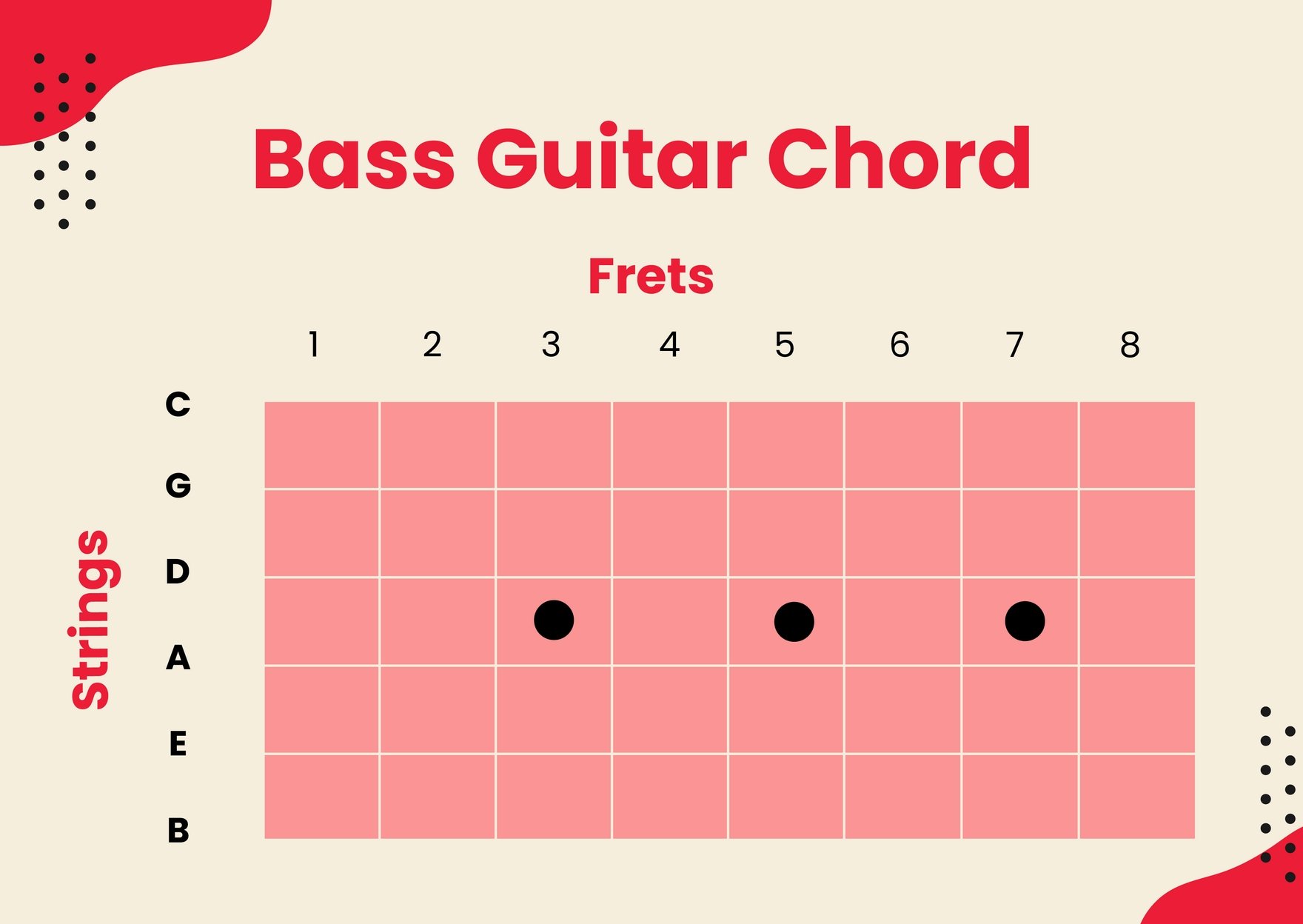
To move beyond single notes, your next step should be practicing the Major Scale in one octave. Start on the 3rd fret of the A string (the note C). Follow the pattern: 3rd fret (C), 5th fret (D) on the A string; then 2nd (E), 3rd (F), 5th (G) on the D string; and finally 2nd (A), 4th (B), 5th (C) on the G string.
This pattern introduces you to the geometric "shapes" that form the basis of all bass lines. Combine this with a slow metronome set to 60 BPM (beats per minute), playing one note per beat. Consistency is more important than speed in these early stages; focus on the clarity of the note and the silence of the strings you aren't playing.
Image Gallery