How PCR is Done: A Deep Dive into the Science and Method of DNA Amplification
PCR (Polymerase Chain Reaction) is performed by mixing a DNA template, specific primers, nucleotides, and a heat-stable DNA polymerase in a buffered solution, then subjecting the mixture to repeated temperature cycles. These cycles of...
PCR (Polymerase Chain Reaction) is performed by mixing a DNA template, specific primers, nucleotides, and a heat-stable DNA polymerase in a buffered solution, then subjecting the mixture to repeated temperature cycles. These cycles of denaturation, annealing, and extension exponentially copy the target DNA sequence, transforming a trace sample into a million-fold concentration suitable for medical, forensic, or research analysis.
Contents
The invention of PCR by Kary Mullis in 1983 revolutionized molecular biology, eventually earning a Nobel Prize. As of 2026, the technique remains the "gold standard" for genetic analysis, having evolved from a laborious manual process into a highly automated, high-throughput cornerstone of modern biotechnology. Understanding how PCR is done requires an appreciation for both the chemistry of the reagents and the precision of the hardware that facilitates the reaction.
The Essential Reagents: The Ingredients of Amplification
Before the thermal cycling begins, a reaction "master mix" must be carefully prepared. The success of a PCR run depends heavily on the quality and concentration of these components.
1. The DNA Template
The template is the sample containing the target sequence you wish to amplify. In clinical settings, this might be DNA extracted from a patient’s blood, saliva, or a nasal swab. In environmental science, it could be DNA filtered from soil or water. The purity of the template is critical; contaminants like proteins, salts, or organic solvents (e.g., ethanol or phenol from the extraction process) can inhibit the polymerase enzyme and lead to a failed reaction.
2. DNA Polymerase (The Engine)
The most common enzyme used is Taq polymerase, originally isolated from the thermophilic bacterium Thermus aquaticus. Because this bacterium lives in hot springs, its enzymes are evolved to remain stable at temperatures near boiling. This heat stability is vital because the PCR process involves a 95°C step that would destroy standard human or bacterial enzymes. In 2026, many labs use "High-Fidelity" polymerases, which have proofreading capabilities to ensure the copied DNA is 100% accurate to the original.
3. Primers (The Map)
Primers are short, synthetic strands of single-stranded DNA (usually 18–25 nucleotides long) that are complementary to the sequences flanking the target region. You need two: a forward primer and a reverse primer. They provide a starting point for the DNA polymerase, which can only add nucleotides to an existing strand of DNA. Primer design is the most technical part of preparing a PCR; they must have similar melting temperatures ($T_m$) and must not bind to each other (forming "primer dimers").
4. Deoxynucleotide Triphosphates (dNTPs)
These are the "bricks" used to build the new DNA strands. The four basic building blocks—A, T, C, and G—are added to the reaction in equal concentrations. As the polymerase moves along the template, it grabs the matching dNTP from the solution and attaches it to the growing chain.
5. Buffer and Cofactors
The reaction takes place in a specialized buffer that maintains the optimal pH (usually around 8.3 to 9.0) for the enzyme. Additionally, Magnesium ions ($Mg^{2+}$), usually added as $MgCl_2$, are essential cofactors. The polymerase requires these ions to function; however, too much magnesium can lead to non-specific amplification (copying the wrong DNA), while too little can result in a low yield.
The Three Pillars of the PCR Cycle
Once the reagents are loaded into a microcentrifuge tube (often 20–50 microliters in volume), the tube is placed in a thermal cycler. This machine is programmed to transition between specific temperatures with extreme precision. Most PCR protocols involve 25 to 40 cycles of the following three steps.
Step 1: Denaturation (94°C – 98°C)
The double-stranded DNA template must be separated into two single strands. DNA is held together by hydrogen bonds between the base pairs. Heating the solution to approximately 95°C provides enough kinetic energy to break these bonds, "melting" the DNA. This step usually lasts 15 to 30 seconds. If the DNA is particularly rich in Guanine and Cytosine (G-C bonds are stronger than A-T bonds), higher temperatures or longer times may be required.
Step 2: Annealing (50°C – 65°C)
The temperature is lowered to allow the primers to bind (anneal) to their complementary sequences on the single-stranded DNA. The specific temperature is calculated based on the primers’ sequence; it must be low enough for the primers to stick but high enough to prevent them from sticking to the wrong places. This step is the "specificity gate" of the reaction.
Step 3: Extension (72°C)
The temperature is raised to the optimal working temperature for Taq polymerase. The enzyme binds to the primer-template complex and begins synthesizing the new DNA strand in the 5' to 3' direction. The speed of Taq polymerase is roughly 1,000 base pairs per minute. Therefore, if the target sequence is 500 base pairs long, the extension step might only take 30 seconds.
Exponential Growth: The Math of PCR
The power of PCR lies in its exponential nature. Because each cycle doubles the number of target DNA molecules, the growth follows the formula $2^n$, where $n$ is the number of cycles.
- After 1 cycle: 2 copies
- After 10 cycles: 1,024 copies
- After 20 cycles: ~1,048,576 copies
- After 30 cycles: Over 1 billion copies
By the time the machine finishes its 35th cycle, a single molecule of DNA has been amplified into a quantity large enough to be seen on an agarose gel or sequenced for medical diagnosis.
Hardware and Instrumentation in 2026
The thermal cycler (or thermocycler) has evolved significantly. While early machines used water baths or air-cooling, 2026-era instruments utilize Peltier blocks. These use the thermoelectric effect to rapidly heat and cool the samples, allowing for "fast PCR" protocols that can complete 40 cycles in under 20 minutes.
Advanced labs now frequently use Digital PCR (dPCR) or Real-time PCR (qPCR). In qPCR, fluorescent dyes or probes are added to the mix, allowing a sensor to measure the DNA concentration after every single cycle. This eliminates the need for post-PCR analysis and allows for the quantification of how much DNA was present in the original sample—a vital feature for measuring "viral load" in infectious diseases.
| Feature | Standard PCR | Real-Time PCR (qPCR) | Digital PCR (dPCR) |
|---|---|---|---|
| Primary Goal | Amplification for later use | Quantification of DNA | Absolute Quantification |
| Detection Method | Gel Electrophoresis | Fluorescence per cycle | Partitioning into droplets |
| Sensitivity | Moderate | High | Ultra-High |
| Speed | 1.5 - 3 hours | 30 - 90 minutes | 2 - 4 hours |
| 2026 Status | Basic research/cloning | Standard clinical diagnostic | Rare mutation detection |
Troubleshooting and Quality Control
PCR is a sensitive technique, and even a single molecule of "stray" DNA can contaminate a reaction. To ensure accuracy, laboratories follow strict protocols:
- The Negative Control: A tube containing all reagents except the template DNA (usually replaced with sterile water). If DNA shows up in this tube, the reagents are contaminated.
- The Positive Control: A tube with a known DNA sample that is guaranteed to amplify. If this fails, it indicates a problem with the master mix or the thermal cycler.
- Physical Separation: In modern facilities, the "pre-PCR" area (where reagents are mixed) is physically separated from the "post-PCR" area (where amplified DNA is handled) to prevent aerosols from the finished reaction from drifting back into new samples.
Common failures often involve non-specific binding, where the primers stick to sequences that look "close enough" to the target but aren't quite right. This results in "smearing" or multiple bands on an analysis gel. To fix this, scientists often use a "Hot Start" PCR, where the polymerase is chemically inactivated until the first denaturation step, preventing it from extending primers that might have bound incorrectly while the tube was sitting on ice.
Practical Recommendations for Successful PCR
For those performing PCR in a laboratory setting, the following best practices are essential for reproducible results:
- Pipetting Precision: PCR involves microliter volumes. Calibrated pipettes and aerosol-resistant tips are non-negotiable.
- Primer Storage: Keep primers in a concentrated "stock" solution at -20°C and create smaller "working" aliquots to avoid repeated freeze-thaw cycles, which degrade the DNA.
- Template Quality: Use a high-quality extraction kit. Residual detergents or salts can inhibit Taq polymerase significantly.
- Annealing Temp Optimization: If a reaction fails, perform a "gradient PCR" where the machine tests several different annealing temperatures simultaneously to find the "sweet spot" for your specific primers.
Frequently Asked Questions
How long does it take to do PCR? A standard PCR run typically takes between 60 and 150 minutes. However, with "Fast PCR" reagents and modern thermal cyclers available in 2026, some diagnostic protocols can be completed in as little as 15 to 30 minutes. The time depends largely on the length of the DNA fragment being copied.
Why do we use Taq polymerase instead of human DNA polymerase? Human DNA polymerase functions at 37°C and would be permanently denatured (destroyed) at the 95°C temperature required to separate DNA strands. Taq polymerase, being from a heat-loving bacterium, survives these high temperatures, allowing the reaction to proceed through multiple cycles without adding new enzymes.
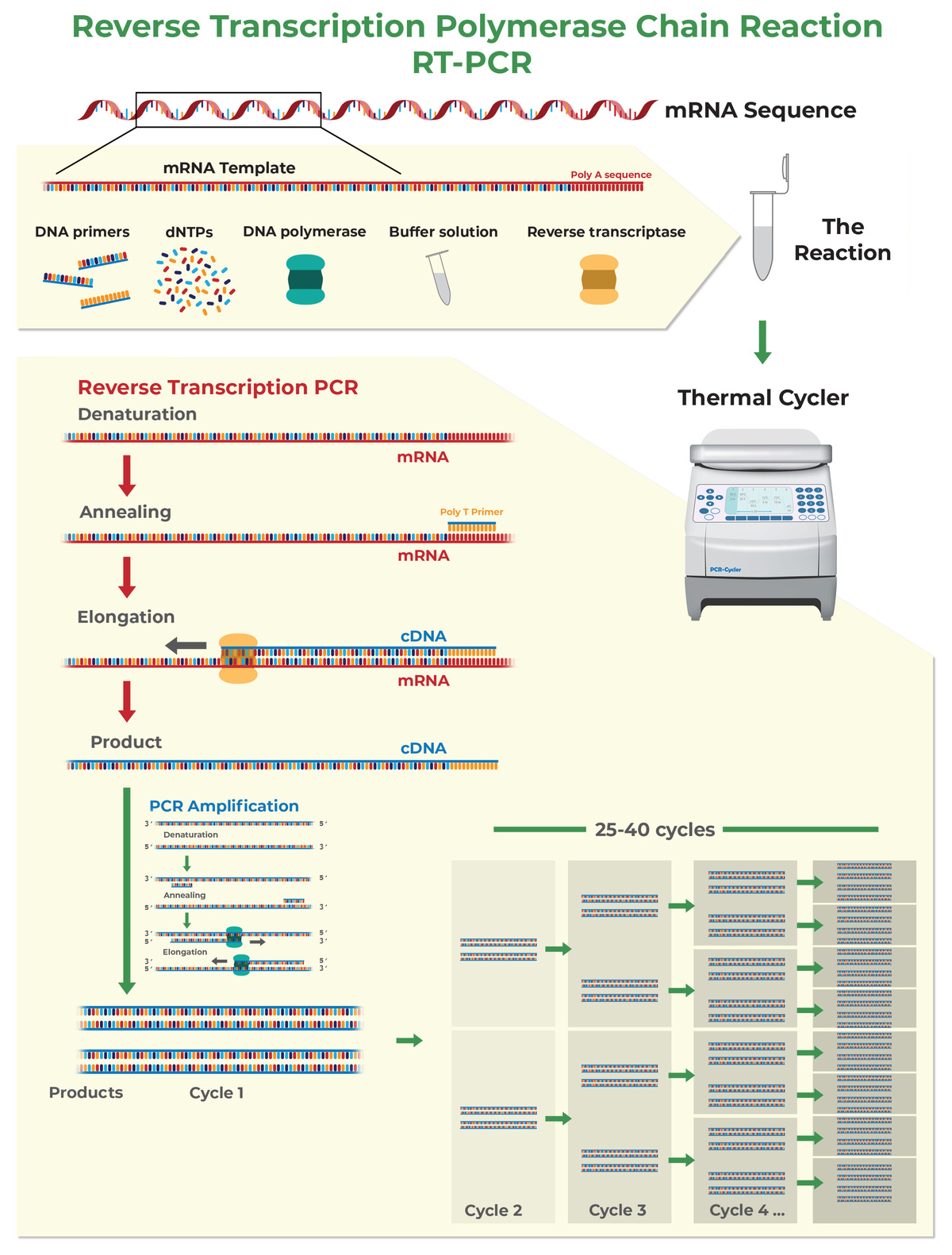
What is the difference between PCR and RT-PCR? PCR amplifies DNA. RT-PCR (Reverse Transcription PCR) is used when the starting material is RNA (like the genome of certain viruses). An enzyme called Reverse Transcriptase first converts the RNA into "complementary DNA" (cDNA), which is then amplified using standard PCR methods.
Can PCR be done at home? While "garage biology" setups exist, PCR requires precise temperature control and a sterile environment. Small, portable PCR machines are used in 2026 for field research and point-of-care diagnostics, but they still require specialized reagents and trained handling to prevent contamination and ensure accurate results.
What causes a "false positive" in PCR? The most common cause of a false positive is cross-contamination. Because PCR is so sensitive, a microscopic droplet of DNA from a previous successful reaction can find its way into a new sample, leading to amplification even if the original patient sample was negative.
For further technical specifications on polymerase variants and buffer optimizations, researchers often refer to the National Human Genome Research Institute for updated standards in genomic methodologies.
Image Gallery