What Netskope Provides for Enterprises: A Comprehensive Guide to SASE and Data Security
Netskope provides a unified, cloud-native security platform known as Netskope One, which delivers Secure Access Service Edge (SASE) capabilities to protect enterprise data and users. By integrating Cloud Access Security Broker (CASB),...
Netskope provides a unified, cloud-native security platform known as Netskope One, which delivers Secure Access Service Edge (SASE) capabilities to protect enterprise data and users. By integrating Cloud Access Security Broker (CASB), Secure Web Gateway (SWG), and Zero Trust Network Access (ZTNA) into a single architecture, Netskope enables organizations to secure hybrid work environments, govern "shadow IT," and prevent data loss across web, SaaS, and private applications.
Contents
The Evolution of the Enterprise Security Perimeter
For decades, enterprise security relied on the "castle-and-moat" strategy, where firewalls protected a centralized corporate network. However, by 2026, the traditional perimeter has effectively vanished. As enterprises have migrated to multi-cloud environments and adopted permanent hybrid work models, the majority of data traffic now bypasses the corporate data center entirely.
Netskope addresses this shift by moving security to the "edge"—closer to the user and the data. Instead of backhauling traffic to a central location, which introduces latency and degrades user experience, Netskope provides security services via its global private network, NewEdge. This allows enterprises to enforce consistent security policies regardless of whether a user is in a corporate office, a home office, or a coffee shop.
The platform is designed to solve three primary challenges for the modern enterprise:
- Visibility: Seeing what users are doing in thousands of different cloud applications.
- Data Protection: Ensuring sensitive information (PII, IP, financial records) does not leave the managed environment.
- Threat Protection: Blocking malware, ransomware, and phishing attacks that originate in the cloud or on the web.
Netskope One: The Unified SASE Architecture
In 2026, Netskope’s primary offering is organized under the Netskope One platform. This is a converged infrastructure that eliminates the need for "swivel-chair" management—where security teams must jump between different consoles for web security, cloud security, and remote access.
Next-Gen Secure Web Gateway (SWG)
Traditional SWGs were built to block malicious URLs. Netskope’s Next-Gen SWG goes further by understanding the context of the traffic. It distinguishes between a user logging into a personal Gmail account versus a corporate one. It inspects encrypted traffic (SSL/TLS) at scale without the performance bottlenecks associated with legacy appliances. This is critical because over 90% of enterprise web traffic is now encrypted, and a significant portion of threats are hidden within those encrypted streams.
Cloud Access Security Broker (CASB)
As a pioneer in the CASB space, Netskope provides deep visibility into thousands of SaaS applications. It categorizes these apps based on their risk level, allowing IT departments to permit the use of productive tools while blocking high-risk alternatives.
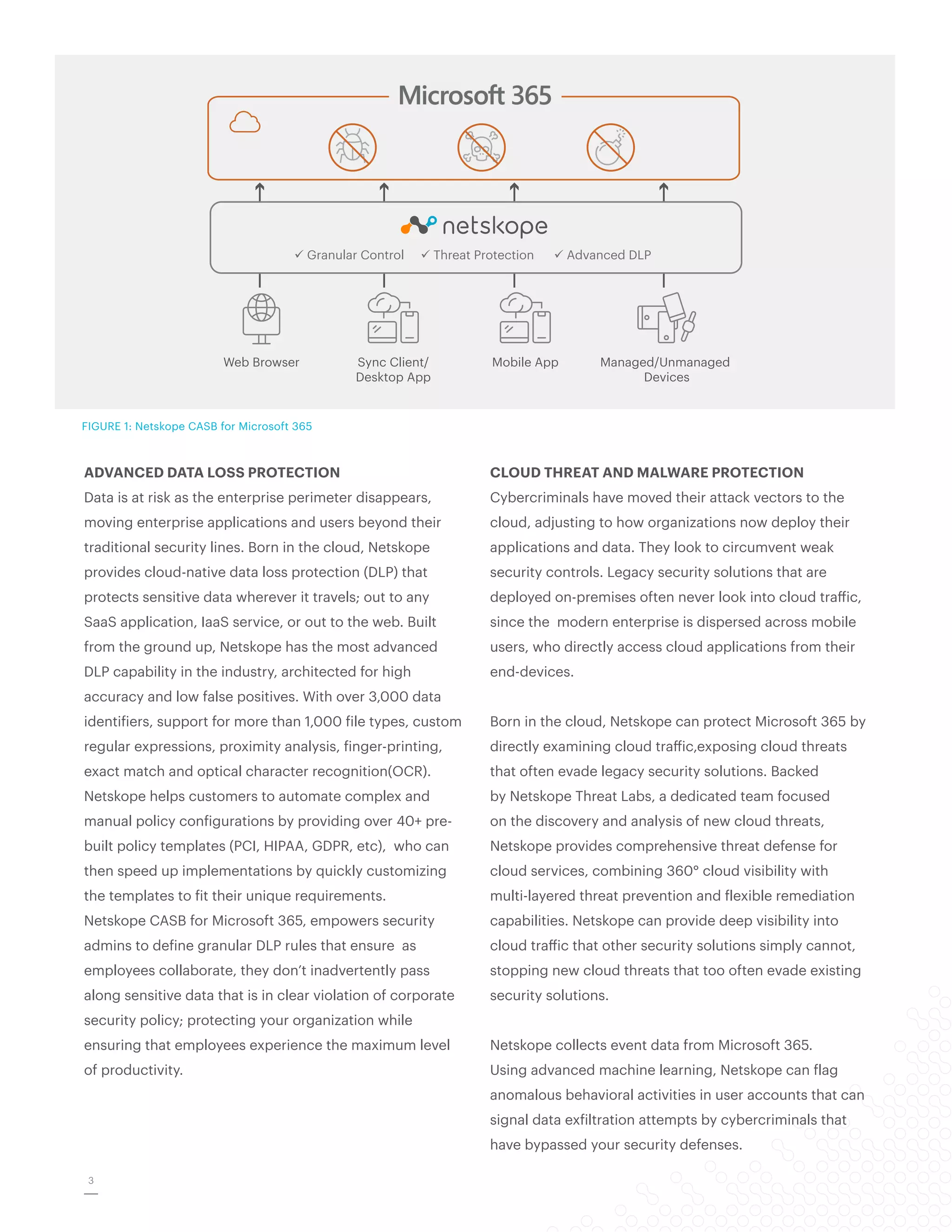
- API-based Protection: For managed apps like Microsoft 365, Google Workspace, and Salesforce, Netskope uses APIs to scan data at rest, identifying sensitive files that may be over-shared or exposed to the public internet.
- Inline Protection: For unmanaged or "shadow IT" apps, Netskope acts as a proxy, enforcing real-time policies such as "Allow download, but block upload of sensitive files."
Zero Trust Network Access (ZTNA)
Netskope ZTNA, often referred to as Netskope Private Access (NPA), replaces legacy VPNs. Unlike a VPN, which grants a user broad access to a network segment, ZTNA grants access only to specific applications based on the user's identity and the security posture of their device. If a device is infected with malware or lacks the latest patches, Netskope can automatically restrict access to sensitive internal applications until the issue is resolved.
Advanced Data Loss Prevention (DLP) Capabilities
The most significant differentiator for Netskope in the enterprise market is its Data Loss Prevention (DLP) engine. While many vendors offer basic DLP, Netskope’s engine is integrated across the entire platform, applying the same data protection rules to web traffic, cloud apps, and private data centers.
By 2026, Netskope has refined its DLP through several advanced technologies:
- Exact Data Matching (EDM): This allows enterprises to upload fingerprints of their actual databases (e.g., a list of 1 million customer account numbers). Netskope can then detect when those exact numbers are being moved, reducing false positives to near zero.
- Optical Character Recognition (OCR): Netskope can "read" text inside images, such as screenshots of sensitive documents or photos of ID cards, which are often used to bypass traditional text-based filters.
- Artificial Intelligence and Machine Learning (SkopeAI): Netskope uses AI to categorize documents automatically. It can recognize a legal contract, a medical record, or source code even if the file hasn't been specifically tagged by an administrator.
Infrastructure and Performance: The NewEdge Network
A common concern with cloud-based security is latency. If every packet of data must travel to a security cloud before reaching its destination, users may experience sluggish performance. Netskope mitigates this through NewEdge, one of the world’s largest and highest-performing security private clouds.
Unlike competitors who rely on public cloud providers (like AWS or Azure) to host their security services, Netskope owns and operates its own data centers globally. This infrastructure allows Netskope to have direct peering relationships with major internet service providers (ISPs) and cloud providers like Microsoft, Google, and Amazon. For the enterprise, this means security is applied in milliseconds, often resulting in a faster experience than an unfiltered direct-to-internet connection because of optimized routing.
Securing the AI-Driven Enterprise
By 2026, the use of Generative AI (GenAI) tools like ChatGPT and specialized enterprise LLMs has become ubiquitous. Netskope provides specific governance for these tools, a capability known as AI Application Governance.
Enterprises use Netskope to:
- Monitor AI Usage: Identify which AI tools employees are using.
- Prevent Data Leaks to AI: Automatically block the submission of corporate source code or customer data into public AI prompts.
- Ensure Compliance: Enforce "Acceptable Use Policies" for AI, ensuring that employees are not using AI tools that violate regional data residency laws or industry regulations.
Implementation and Operational Comparison
For enterprise decision-makers, understanding how Netskope compares to traditional hardware-based or first-generation cloud security is essential.
| Feature | Legacy Hardware (Firewalls/VPNs) | First-Gen Cloud Security | Netskope One (2026) |
|---|---|---|---|
| Traffic Inspection | Limited to data center traffic | Basic URL and file scanning | Deep contextual and AI-driven inspection |
| User Experience | High latency (Hairpinning) | Variable (Public Cloud) | Low latency (Private NewEdge Cloud) |
| Data Protection | Perimeter-based only | Disconnected silos | Unified DLP across Web, SaaS, & Private |
| Zero Trust | Network-level access (All or nothing) | Basic identity checks | Continuous adaptive risk assessment |
| Management | Multiple consoles/appliances | Fragmented cloud consoles | Single-pane-of-glass management |
| Scalability | Manual hardware upgrades | Elastic, but often limited by POPs | Hyperscale global private network |
Use Cases for the Modern Enterprise
1. Securing the Hybrid Workforce
Enterprises use Netskope to provide a seamless security experience for employees who move between the office and home. The Netskope client (a lightweight agent) stays active regardless of location, ensuring that security policies follow the user, not the network.
2. Mergers and Acquisitions (M&A)
During an M&A event, integrating two different corporate networks is traditionally a multi-month project fraught with security risks. Netskope simplifies this by allowing the parent company to grant the acquired employees access to specific applications via ZTNA without needing to merge the underlying network infrastructures.
3. Regulatory Compliance (GDPR, HIPAA, CCPA)
Netskope helps enterprises meet stringent data privacy requirements by providing granular control over where data is stored and who can access it. Its "Sovereign Cloud" options allow data to be processed within specific geographic boundaries to satisfy local residency laws.
4. Shadow IT Governance
Large enterprises often discover they are using over 1,000 cloud applications, the vast majority of which were not vetted by IT. Netskope identifies these apps and provides a "Cloud Confidence Level" (CCL) for each, helping IT managers decide which to sanction and which to block.
Technical Specifications and Deployment
Netskope is designed for flexibility in deployment, supporting various enterprise environments:
- Endpoint Client: A lightweight agent installed on Windows, macOS, Linux, iOS, and Android devices.
- Steering via GRE/IPsec: For branch offices, traffic can be tunneled directly from existing routers to the Netskope NewEdge network.
- Browser-based (Agentless): For contractors or unmanaged devices, Netskope offers a reverse-proxy mode that allows secure access to specific apps without requiring software installation.
- API Connectors: Direct integration with SaaS providers to scan data at rest and monitor administrative changes.
Frequently Asked Questions
Does Netskope replace my existing firewall?
Netskope can replace several functions of a traditional firewall, particularly those related to outbound web traffic and remote access (VPN). However, many enterprises still maintain simplified internal firewalls for local network segmentation. Netskope’s Cloud Firewall (FWaaS) can handle egress traffic for branches, further reducing hardware footprints.
How does Netskope impact internet speed?
Because Netskope operates the NewEdge private network, it often improves perceived speed for users. By peering directly with major content providers, Netskope reduces the number of "hops" a packet takes to reach its destination, often offsetting the time taken for security inspection.
Can Netskope protect against ransomware?
Yes. Netskope provides multi-layered protection against ransomware by blocking access to known malicious sites, using behavioral analysis to detect "zero-day" threats, and preventing the exfiltration of data that often precedes a ransomware encryption event.
Is Netskope only for large corporations?
While Netskope's features are built for enterprise-scale complexity, its cloud-native delivery makes it accessible to mid-market organizations that need high-level data protection but lack a massive internal security operations center (SOC).
How does Netskope handle privacy?
Netskope is designed with "privacy by design" principles. It allows administrators to mask sensitive information in logs (such as usernames or specific file names) so that security teams can monitor for threats without violating employee privacy or regional laws like GDPR.
Next Steps for Enterprise Security Teams
For organizations looking to modernize their security stack, the first step is typically a Cloud Risk Assessment. Netskope offers tools to scan current web traffic to identify existing data exposures and the extent of shadow IT usage within the environment. Following this assessment, enterprises usually begin by deploying the Next-Gen SWG or ZTNA to address their most immediate security gaps before expanding into full SASE convergence.
Image Gallery