Is Carbon Fiber Foundation Repair Worth It in Lancaster, PA?
Yes, carbon fiber foundation repair is worth the investment for Lancaster, PA homeowners dealing with minor to moderate inward wall bowing—specifically deflections under two inches. It offers a permanent, maintenance-free solution to h...
Yes, carbon fiber foundation repair is worth the investment for Lancaster, PA homeowners dealing with minor to moderate inward wall bowing—specifically deflections under two inches. It offers a permanent, maintenance-free solution to hydrostatic pressure caused by local clay-heavy soils and freeze-thaw cycles, typically costing 30% to 50% less than traditional steel beams.
Contents
Lancaster Geology and Soil Dynamics: Why Basement Walls Bow
Understanding whether carbon fiber foundation repair is right for a Lancaster home requires evaluating the local geology. Lancaster County features dense silt loams, primarily from the Hagerstown, Duffield, and Chester soil series. These soils contain high percentages of clay, giving them expansive properties.
When heavy Mid-Atlantic rainfall saturates the ground, clay-rich soil expands and increases in density. This expansion exerts intense horizontal force against basement walls—a structural phenomenon known as hydrostatic pressure.
- Saturated Clay Soil
- Pushes Horizontally
- Cinder Block Wall
- Inward Bowing/Cracking
During Pennsylvania winters, saturated soil near the surface undergoes repeated freeze-thaw cycles. As moisture freezes into ice lenses, soil volume increases by up to 9%, thrusting laterally against sub-grade masonry.
Lancaster’s architectural history also plays a major role:
- Pre-1950s Homes: Feature unreinforced stone, brick, or early concrete masonry unit (CMU) block foundations.
- Modern Subdivisions: Primarily utilize 8-inch or 10-inch hollow CMU block walls.
CMU block walls are vulnerable to lateral earth pressures because mortar joints possess high compressive strength but very low tensile strength. When hydrostatic pressure exceeds the tensile capacity of mortar, horizontal cracks open along the midpoint of the wall, causing the middle section to bow inward.
How Carbon Fiber Foundation Repair Works
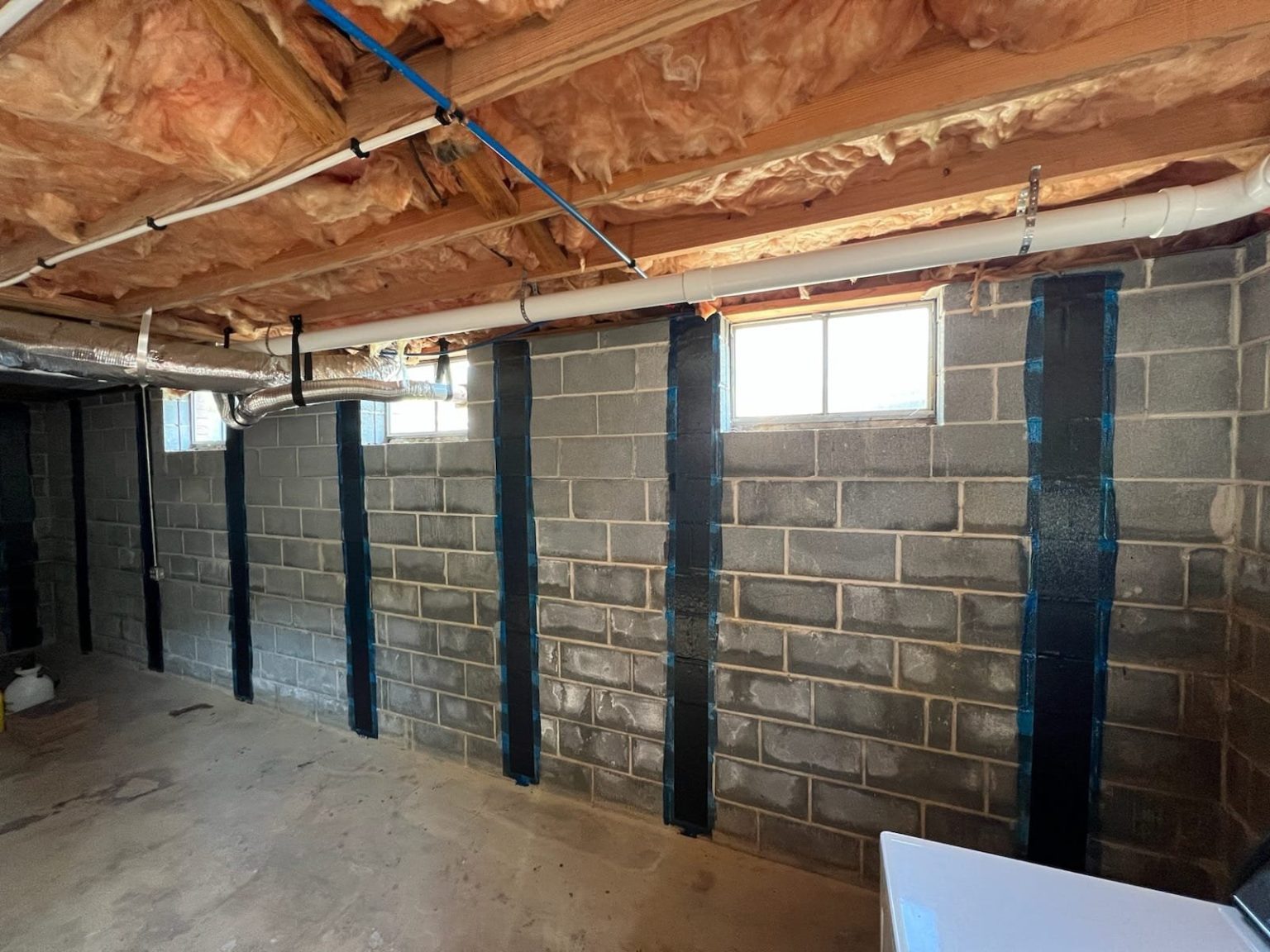
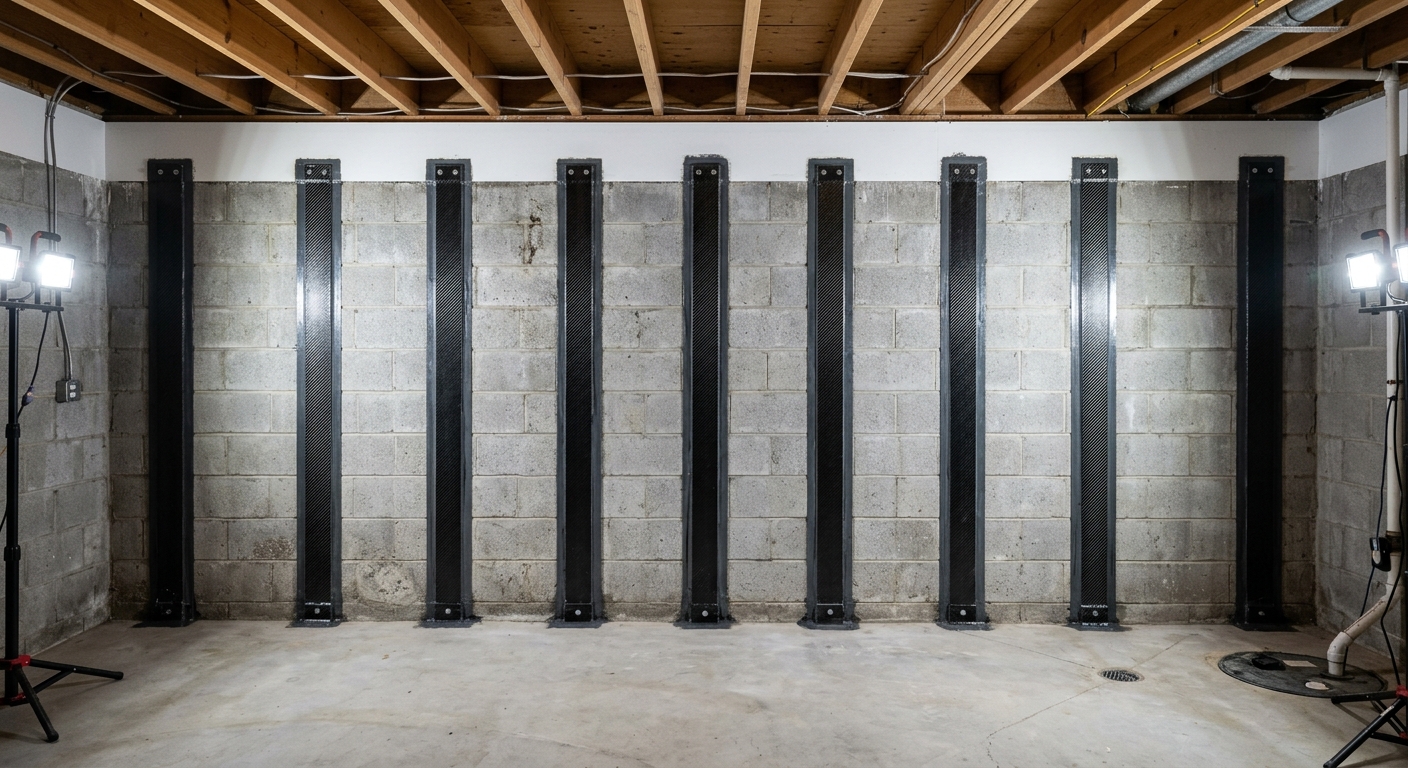
Carbon fiber reinforced polymer (CFRP) systems utilize space-age composite materials originally developed for aerospace and civil infrastructure. When applied to basement walls, CFRP acts as a high-tensile reinforcement system that locks the foundation structure in place.
- Top Anchor: Secured to rim joist / sill plate
- High-Tensile Carbon Fiber Strap Bonded with Epoxy
- Bottom Anchor: Tied to concrete slab / wall footers
The Engineering Behind Carbon Fiber Straps
Carbon fiber straps consist of thousands of continuous carbon filaments bound together. Key engineering properties include:
- Tensile Strength: High-grade carbon fiber straps exhibit a tensile strength exceeding 150,000 to 300,000 pounds per square inch (psi)—roughly 5 to 10 times stronger than structural steel.
- Modulus of Elasticity: Carbon fiber will not stretch or deform under lateral load pressures that would warp conventional metals.
- Epoxy Matrix Binding: The strap is bonded directly to cleaned masonry using structural epoxy resin. This resin penetrates the pores of concrete or CMU blocks, fusing the strap to the wall.
When horizontal soil pressure pushes against the outside of a foundation wall, the inside face of the wall experiences tensile force. Because the carbon fiber strap has virtually zero elasticity, it absorbs this tension instantly, preventing further movement.
The 2-Inch Rule: When Carbon Fiber Is (and Isn't) Worth It
Carbon fiber stabilization is extremely effective, but it is not a universal cure for all foundation damage. Structural engineers follow clear thresholds to determine suitability.
Inward Bowing Deflection (Inches):
- 0" – 2": Carbon Fiber Ideal
- 2" – 4": Beams / Tiebacks
- 4"+: Wall Replacement
Ideal Scenarios for Carbon Fiber (< 2 Inches of Bowing)
- Deflection Under 2 Inches: If a 7-foot or 8-foot basement wall bows inward by less than 2 inches (roughly 5 cm), carbon fiber straps can stabilize the structure in place.
- Horizontal Step-Cracking: Mortar joints showing horizontal separation without severe masonry displacement.
- Preventative Reinforcement: Reinforcing walls that exhibit hairline horizontal cracking before severe displacement occurs.
Unsuitable Scenarios requiring Alternative Repairs (> 2 Inches or Shearing)
- Deflection Exceeding 2 Inches: When inward bowing exceeds 2 inches, the wall's center of gravity shifts significantly. Carbon fiber stabilizes movement but cannot push a wall back to plumb. Walls with severe bow require mechanical pull-back via helical tiebacks or heavy structural steel beams.
- Base Shearing (Toe Sliding): If the lowest course of block has sheared off the concrete footing and slid inward, carbon fiber straps applied vertically cannot counteract horizontal shear forces at the floor level without specialized sill plate and floor bracket systems.
- Vertical Inward Cave-In / Structural Collapse: Severely compromised walls require exterior excavation, mechanical straightening, or complete replacement.
Carbon Fiber vs. Alternative Foundation Repair Methods
Homeowners evaluating foundation repairs in Lancaster typically compare four primary options: Carbon Fiber Straps, Steel I-Beams, Helical Tiebacks, and Total Wall Replacement.
| Feature / Criteria | Carbon Fiber Straps | Steel I-Beams | Helical Tiebacks | Full Wall Replacement |
|---|---|---|---|---|
| Ideal Inward Bowing Limit | < 2 inches | 2 to 4+ inches | 2 to 4+ inches (can pull back) | > 4 inches / Collapsed |
| Exterior Excavation Required? | No | No | Yes (minimal to moderate) | Yes (extensive) |
| Basement Space Loss | Zero (flat profile ~1/16") | 4 to 8 inches into room | Zero | Zero |
| Finishing/Framing Impact | Easy to frame over / paintable | Requires deep furring walls | Wall remains exposed during pull-back | Normal framing |
| Corrosion / Rust Risk | Non-corrosive / impervious | Subject to rust if wet | Galvanized steel resists rust | N/A |
| Average Cost per Linear Foot | $350 – $600 | $600 – $1,000 | $1,000 – $1,800 | $1,800 – $3,500+ |
Comprehensive Cost Analysis for Lancaster, PA
Cost is a major factor in determining whether carbon fiber foundation repair is worth it. Below is a realistic breakdown of typical expenses for residential properties in Lancaster County.
Total Repair Investment Comparison (30 ft Bowing Wall):
- Carbon Fiber: $4,000 - $7,000 (Best Value)
- Steel I-Beams: $7,000 - $11,000
- Tiebacks: $10,000 - $16,000
- Wall Replacement: $25,000 - $40,000+
Typical Pricing Structure
- Per Strap Installation: $400 to $800 per strap, including labor, structural epoxy, top sill-plate anchor, and bottom floor anchor.
- Standard Wall Project Cost: A typical 30-foot bowing wall requires straps spaced every 4 feet on center (roughly 6 to 8 straps total). This brings the average project cost to $4,000 – $7,000.
- Steel Beam Comparison: Installing heavy steel H-beams or I-beams on the same wall generally costs $7,000 to $11,000 due to higher material costs and intensive labor.
Return on Investment (ROI) and Real Estate Impact
Unaddressed foundation damage can reduce a home's market value by 10% to 20% and prevent buyers from securing standard conventional or FHA mortgages.
- Mortgage Inspection Clearance: Structural engineers can sign off on carbon fiber stabilization systems, clearing mortgage contingencies for home sales.
- Space Preservation: Because carbon fiber straps are virtually flush with the wall (less than 1/8 inch thick), homeowners can paint over them or build traditional 2x4 drywall framing directly against the foundation without losing square footage.
- Transferable Lifetime Warranties: Most professional installation contractors offer 25-year to transferable lifetime warranties, reassuring prospective buyers during property transfers.
Step-by-Step Carbon Fiber Installation Process
Understanding the installation steps clarifies why carbon fiber offers long-term stability without invasive excavation:
Step 1: Wall Prep
Step 2: Injection
Step 3: Anchor Mounts
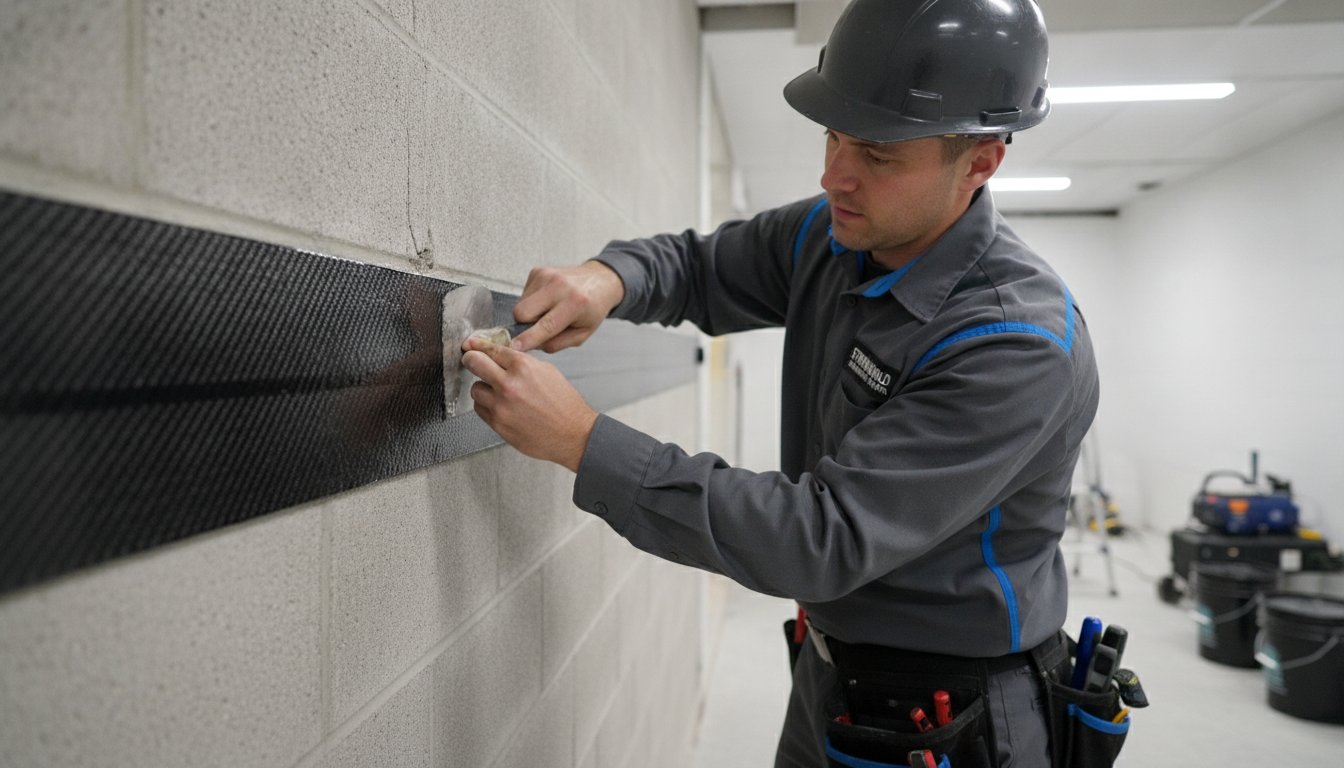
Step 4: Epoxy & Carbon Strap
Surface Preparation: Technicians use diamond-wheel grinders to remove paint, efflorescence, sealants, and loose concrete from top to bottom where straps will be positioned. Clean, raw concrete is mandatory for epoxy adhesion.
Crack Stabilization: Horizontal mortar joint cracks and vertical settlement cracks are injected with high-strength structural epoxy or expanding polyurethane grout to restore solid concrete contact.
Top and Bottom Anchor Installation: High-end systems attach carbon fiber to the top sill plate using heavy-gauge steel rim-joist brackets, and secure the base into the concrete slab or footing using engineered anchor pins.
Epoxy Saturant Application: A layer of structural epoxy matrix resin is applied to the prepared wall section.
Strap Embedding and Finishing: The carbon fiber strap is pressed into the wet epoxy, saturated thoroughly with a second coat of epoxy resin, and smooth-rolled to eliminate air pockets. Once cured, the assembly forms an impenetrable composite layer.
Key Pros and Cons Summary
Pros
- High Tensile Strength: Stronger than steel; permanently stops inward wall bowing.
- Zero Footprint: Does not project into the basement living space like 4-inch or 6-inch steel I-beams.
- No Excavation Required: All work is executed internally, protecting landscaping, patios, and driveways.
- Corrosion Resistance: Carbon fiber does not rust, rot, or degrade when exposed to moisture or ambient basement humidity.
- Cost Savings: Costs substantially less than mechanical tiebacks, wall anchors, or full wall rebuilds.
Cons
- Does Not Straighten Walls: Carbon fiber holds a wall in its current position; it will not pull a significantly bowed wall back to original plumb.
- Strict Deflection Limits: Unsuited for walls bowed more than 2 inches or walls suffering from severe base shearing without supplementary structural hardware.
- Requires Surface Preparation: Ineffective if applied over painted, crumbling, or dirty basement walls without surface grinding.
Frequently Asked Questions
Does carbon fiber foundation repair increase home resale value in Lancaster?
Yes. While structural repairs rarely raise a home's appraisal price above market peak, carbon fiber repair protects and restores lost market value. It resolves home inspection deal-breakers, allows buyers to qualify for standard mortgages, and usually includes a transferable warranty that reassures potential buyers.
Will carbon fiber straps push a bowing wall back into place?
No. Carbon fiber straps stabilize a wall in its present condition to prevent future movement. If a wall must be pulled back to plumb for structural or aesthetic reasons, contractors must execute exterior excavation combined with mechanical tiebacks or steel beam jacking systems before stabilizing.
How long do carbon fiber foundation repair straps last?
Carbon fiber composites do not rust, corrode, or degrade over time when protected from direct ultraviolet light exposure. When bonded with structural epoxy, carbon fiber repairs are engineered to last for the remaining lifetime of the structure.
How many carbon fiber straps are needed for a basement wall?
Engineering guidelines require carbon fiber straps to be placed every 4 feet on center along the bowing section of a wall. A standard 32-foot wall typically requires 7 to 8 carbon fiber straps for full structural coverage.
Will home insurance cover carbon fiber foundation repair in Pennsylvania?
Standard homeowners insurance policies in Pennsylvania generally exclude foundation damage caused by hydrostatic pressure, soil expansion, or earth movement. Insurance typically only covers foundation damage resulting from direct, sudden events like an exploding water main or vehicle collision.
Final Verdict: Is Carbon Fiber Foundation Repair Worth It?
For Lancaster homeowners dealing with early-to-moderate foundation bowing (under 2 inches of inward movement), carbon fiber repair is one of the most cost-effective and reliable structural interventions available.
It directly counters the lateral pressures generated by Lancaster's expansive clay soils and winter freeze cycles. Because it avoids heavy exterior excavation, installs quickly, and creates no spatial intrusion into living areas, carbon fiber delivers maximum structural stabilization at a lower cost than alternative structural framing or wall replacement methods.
Next Steps for Homeowners:
- Measure inward wall deflection using a 4-foot level or plumb line dropped from the floor joist to the floor.
- If bowing is less than 2 inches, schedule an evaluation with a licensed structural engineer or foundation specialist to verify top and bottom anchoring requirements.
- Verify that any quote includes wall surface grinding, crack injection, top/bottom anchor hardware, and a transferable warranty.
Image Gallery