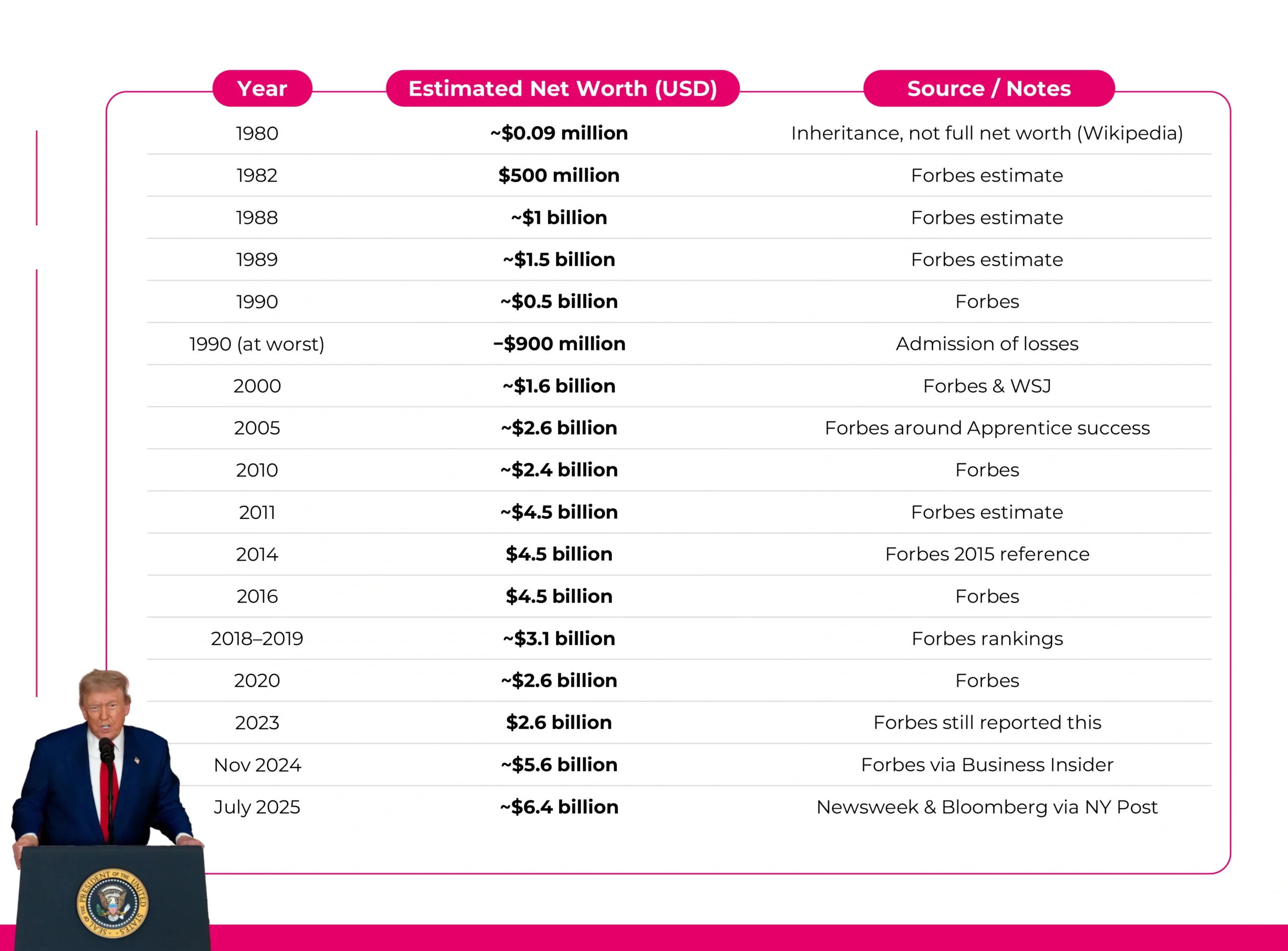
Understanding the Making of Donald Trump Net Worth and Financial Trajectory
Donald Trump’s net worth is a composite of real estate holdings, brand licensing, equity in publicly traded companies, and various cash reserves. His financial standing is fundamentally rooted in his evolution from a New York real esta...
Donald Trump’s net worth is a composite of real estate holdings, brand licensing, equity in publicly traded companies, and various cash reserves. His financial standing is fundamentally rooted in his evolution from a New York real estate developer to a global branding figure, characterized by high-leverage property acquisitions, significant exposure to market volatility, and a pivot toward media and platform-based equity in the 2020s.
Contents
The Foundation of Real Estate Development
The origin of Donald Trump’s wealth lies in the transformation of his father Fred Trump’s outer-borough residential real estate business into a Manhattan-centric commercial empire. During the 1970s and 1980s, the "making" of his primary fortune involved a pivot toward high-visibility luxury projects. By leveraging tax abatements, government subsidies, and high-profile development projects like the Grand Hyatt and Trump Tower, he established a recognizable brand identity that allowed him to secure financing for subsequent ventures.
This era of growth relied on aggressive debt utilization. Unlike institutional firms that might rely on diversified portfolios, Trump’s business model focused on singular, iconic assets where the "Trump" brand served as an intangible value-add. The appraisal of these assets has historically been a point of contention, as the valuation of premium real estate often depends on subjective factors such as location prestige, potential for future development, and brand-based price premiums.
Branding, Licensing, and Intellectual Property
Starting in the late 1980s and accelerating throughout the 1990s and 2000s, a significant component of the "making" of Donald Trump’s net worth shifted from physical construction to the monetization of his personal brand. Through the licensing of his name to hotels, golf courses, and consumer products, he generated high-margin revenue streams that required little direct capital investment in the underlying real estate.
This transition turned his name into an asset that functioned independently of the performance of any individual building. From a technical accounting standpoint, this shifted a portion of his wealth from illiquid property equity to intellectual property and service-based income. The viability of this model depended entirely on market perception; as long as the brand signaled luxury and exclusivity, licensing fees remained consistent.
The Transition to Publicly Traded Equity
In recent years, particularly leading into 2026, the composition of Donald Trump’s net worth has seen a marked shift toward publicly traded securities. This represents a significant divergence from the traditional private real estate model. Ownership stakes in media and technology companies, such as Trump Media & Technology Group (TMTG), have created a volatility profile distinct from traditional property portfolios.
These assets are subject to daily market fluctuations, regulatory filings, and investor sentiment. Unlike a physical building, which has an intrinsic utility and a predictable cap rate, equity in emerging media platforms is valued largely on growth prospects and user engagement metrics. Consequently, his net worth at any given moment in 2026 is often tethered to the closing price of these equities rather than the historical cost or replacement value of his real estate holdings.
Comparative Wealth Components
Understanding the net worth requires segmenting these assets into their respective risk and liquidity categories. The following table illustrates the conceptual shift from physical assets to market-driven financial instruments.
| Asset Category | Primary Valuation Method | Liquidity | Risk Profile |
|---|---|---|---|
| Commercial Real Estate | Income Capitalization (Cap Rate) | Low | Moderate to High |
| Brand Licensing | Royalty Percentage of Revenue | Moderate | Market Reputation |
| Marketable Securities | Public Exchange Pricing | High | High Volatility |
| Cash & Equivalents | Nominal Value | Very High | Inflation Risk |
Challenges in Valuation and Reporting
Establishing an accurate net worth for a private individual with high-profile public interests involves addressing the discrepancy between "book value" and "market value." Financial professionals and investigative journalists have long noted that valuations often differ based on whether they are prepared for tax purposes, loan applications, or public disclosures.
- Loan Applications: Assets are often appraised based on their highest and best use, taking into account potential future development or brand premiums.
- Tax Reporting: Valuations prioritize historical cost and depreciation schedules, which typically reflect lower asset values.
- Public Disclosures: These often rely on estimates of fair market value, which can be sensitive to macroeconomic trends and the liquidity of the underlying markets.
The "making" of the net worth is therefore not a single static number, but a moving target influenced by the methodology used to calculate the value of non-liquid assets.
Legal and Financial Constraints
As of 2026, financial constraints and legal obligations play a central role in the net worth narrative. Potential liabilities, including legal judgments and the ongoing costs of debt service on commercial property portfolios, act as offsets to gross asset values. For investors or analysts looking to verify current standing, it is essential to distinguish between gross asset value (the sum of all properties and holdings) and net worth (total assets minus liabilities).
Compliance with financial disclosure laws—such as those required for public officeholders or under corporate governance standards—provides a degree of transparency into liquid holdings, though these reports often use different reporting categories than private financial statements. It is important to note that financial, tax, and legal advice should always be sought from certified professionals, as these assets exist in a complex regulatory environment.
Frequently Asked Questions
What is the main source of the wealth increase in recent years? The primary driver of fluctuation in net worth recently has been the performance of publicly traded shares in media-related entities. While real estate provides a base level of value, market-based equity has introduced a new mechanism for wealth growth tied to daily investor sentiment.
How is brand licensing factored into the total valuation? Brand licensing is valued based on projected royalty streams. Accountants look at the contract terms, the historical reliability of the partner, and the projected duration of the licensing agreements to determine a present value for these income streams.
Why do reports on the net worth vary so widely? Variations occur because different sources use different methodologies. Some analysts exclude brand value entirely, while others capitalize it. Additionally, debt levels are often estimated rather than verified, leading to significant discrepancies in the "net" portion of the calculation.
Are these assets mostly liquid or illiquid? Historically, the portfolio was highly illiquid, consisting primarily of real estate. With the addition of public equity, the portfolio now contains a higher proportion of liquid assets, although lock-up periods or significant selling of shares can impact the realized value.
What impact do interest rates have on these valuations? Higher interest rates typically increase the cost of servicing commercial debt and can compress cap rates, potentially lowering the valuation of commercial real estate. Conversely, they may have a different impact on the valuation of media and tech companies, which are more sensitive to growth expectations than property income.
Recommendation
For those tracking the financial evolution of Donald Trump, the most reliable data points are found in official regulatory filings, such as those submitted to the U.S. Office of Government Ethics or SEC filings for publicly traded entities. These documents provide the most granular view of income, assets, and liabilities. For a comprehensive understanding, prioritize these primary documents over aggregate news reporting, which often simplifies complex financial structures into a single, headline-oriented figure.
Image Gallery