Understanding the Effective Annual Rate of Interest: A Comprehensive Guide
The effective annual rate of interest (EAR), also known as the annual equivalent rate (AER), is the true interest rate earned or paid on an investment or loan after accounting for the effects of compounding over a given period. Unlike...
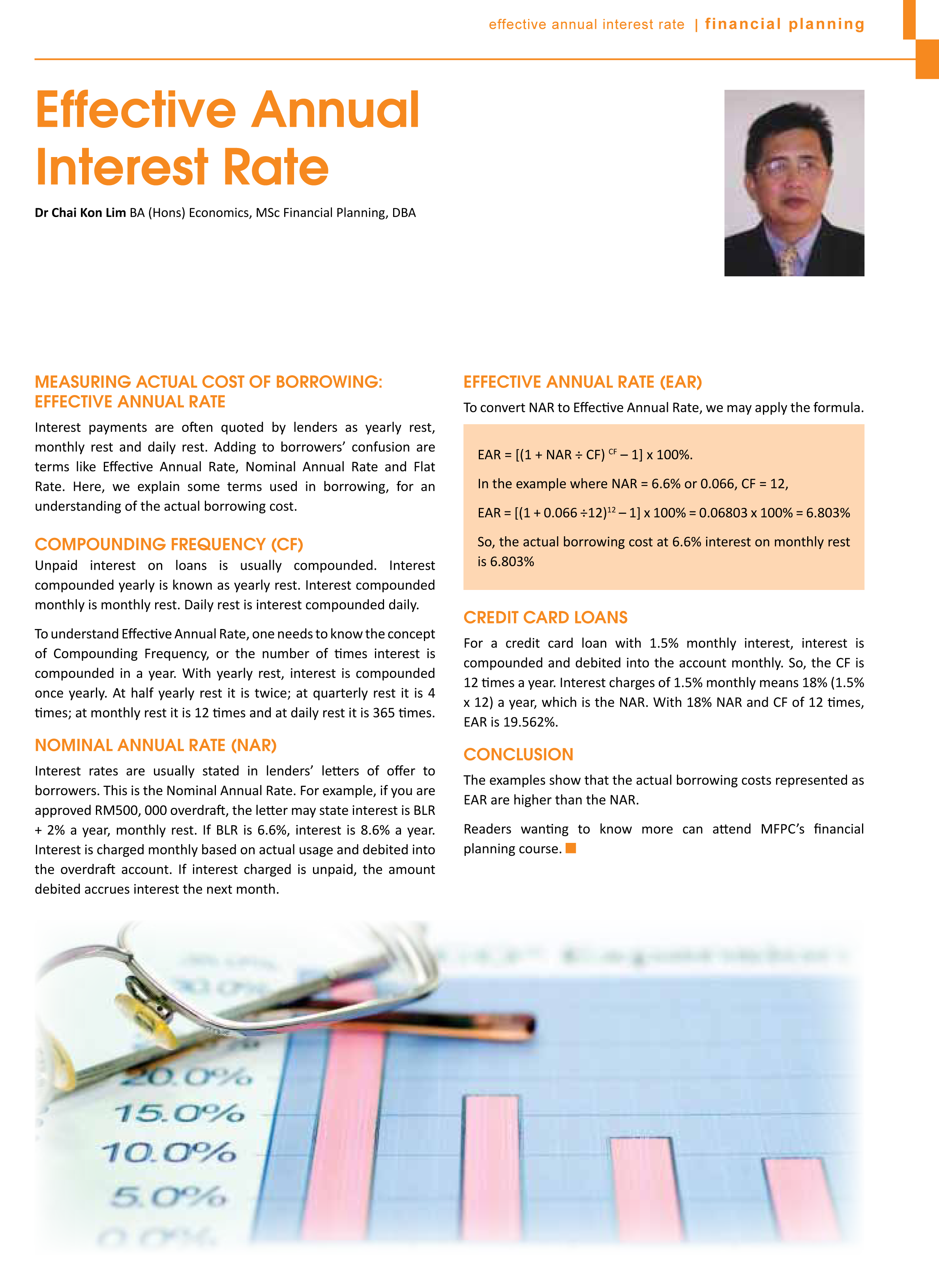
The effective annual rate of interest (EAR), also known as the annual equivalent rate (AER), is the true interest rate earned or paid on an investment or loan after accounting for the effects of compounding over a given period. Unlike the nominal interest rate, which does not reflect how often interest is calculated, the EAR provides a standardized figure that allows for accurate comparisons between financial products with different compounding frequencies.
Contents
The Distinction Between Nominal and Effective Rates
In the world of finance, confusion often arises from the difference between the nominal interest rate and the effective annual rate. The nominal rate is the stated interest rate of a loan or savings account—the figure typically advertised by financial institutions. However, this number can be misleading because it ignores the frequency of compounding.
Compounding occurs when interest is earned not only on the principal amount but also on the interest that has accumulated in previous periods. The more frequently interest is compounded (e.g., daily, monthly, or quarterly), the higher the effective return for an investor or the higher the true cost for a borrower. The EAR serves as the great equalizer, stripping away the complexity of compounding intervals to reveal the actual percentage increase in the value of an investment or debt over exactly one year.
The Mechanics of the EAR Formula
To calculate the effective annual rate, you must identify two primary variables: the nominal annual interest rate and the number of compounding periods per year. The standard formula is expressed as:
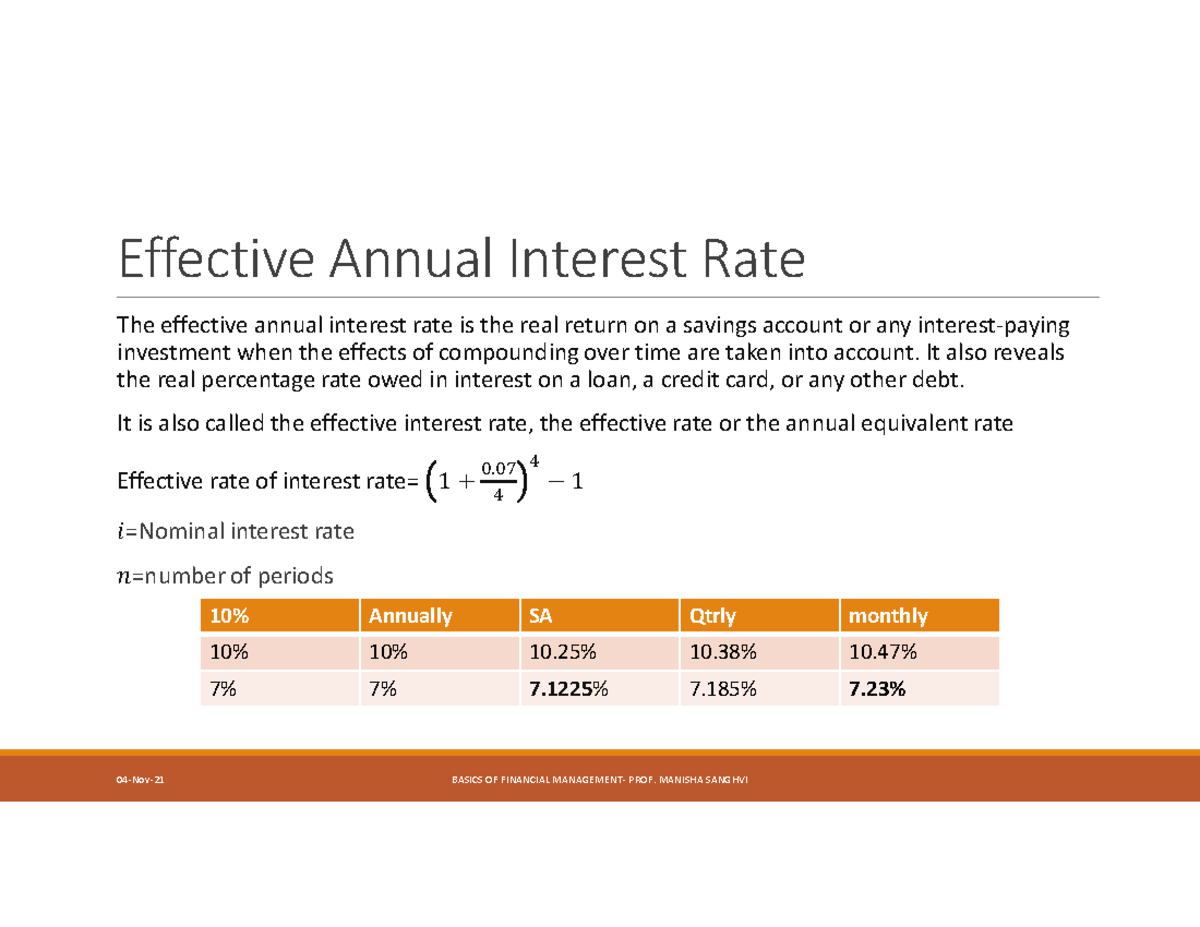
EAR = (1 + i/n)^n - 1
Where:
- i is the nominal annual interest rate (expressed as a decimal).
- n is the number of compounding periods per year.
For example, if a loan carries a nominal interest rate of 12% compounded monthly, the calculation would be:
- Convert 12% to 0.12.
- Divide 0.12 by 12 (months), resulting in 0.01.
- Add 1 to 0.01, resulting in 1.01.
- Raise 1.01 to the power of 12 (the number of periods), which equals approximately 1.1268.
- Subtract 1 to arrive at 0.1268, or an EAR of 12.68%.
This simple mathematical transformation demonstrates that a 12% nominal rate is actually costing the borrower 12.68% over the course of a year due to the effects of monthly compounding.
Why Compounding Frequency Matters
The frequency of compounding is the engine that drives the difference between nominal and effective rates. In many jurisdictions, financial institutions are legally required to disclose the EAR or AER alongside the nominal rate to prevent consumer deception.
When you are comparing two products, consider the compounding schedule as a primary factor in your decision-making process:
- Annual Compounding: The EAR is identical to the nominal rate because interest is only calculated once at the end of the year.
- Quarterly Compounding: Interest is added to the balance four times a year, meaning you earn interest on your interest three times before the year ends.
- Monthly Compounding: This is common for many retail loans and savings accounts, leading to a noticeable spread between nominal and effective rates.
- Daily Compounding: Often found in high-yield savings accounts or credit cards, this results in the most frequent compounding and, consequently, the highest divergence from the nominal rate.
Comparative Analysis Table
The following table illustrates how varying compounding frequencies impact the effective annual rate on a nominal 10% interest rate.
| Compounding Frequency | Periods per Year (n) | Nominal Rate (i) | Effective Annual Rate (EAR) |
|---|---|---|---|
| Annually | 1 | 10% | 10.00% |
| Semi-Annually | 2 | 10% | 10.25% |
| Quarterly | 4 | 10% | 10.38% |
| Monthly | 12 | 10% | 10.47% |
| Daily | 365 | 10% | 10.51% |
As shown above, the jump from annual to daily compounding increases the total interest paid or earned by over 50 basis points. For large balances or long-term debt, this variance represents a significant financial impact.
Common Applications and Practical Implications
The EAR is a vital tool for both consumers and businesses. Understanding this metric allows for better decision-making in several financial contexts:
- Investment Evaluation: When selecting between two certificates of deposit (CDs) or high-yield savings accounts, do not look at the advertised rate alone. Compare the EAR to ensure you are choosing the account that maximizes your actual yield.
- Debt Management: When taking out a mortgage, personal loan, or business credit line, focus on the EAR. A loan with a lower nominal rate but more frequent compounding might actually be more expensive than a loan with a slightly higher nominal rate that compounds less frequently.
- Capital Budgeting: Businesses use EAR to evaluate the true cost of borrowing funds for projects. It allows managers to compare financing options against the projected internal rate of return (IRR) of a potential investment.
- Consumer Protection: By observing the EAR, borrowers can avoid predatory lending practices that hide high total costs behind "low" monthly nominal rates.
Troubleshooting and Common Pitfalls
A common error in calculating EAR is confusing the compounding period with the payment period. While they often align, they are not always the same. If interest compounds daily but is only paid out monthly, the effective rate remains tethered to the daily compounding frequency.
Another pitfall is assuming that a higher nominal rate is always inferior to a lower nominal rate. Always perform the EAR calculation to compare like-for-like. If you encounter a product where the compounding period is unclear, consult the terms and conditions or the Truth in Lending disclosure document provided by the financial institution. These documents are legally required in most regions to provide the effective rate calculation clearly.
Disclaimer: This guide is provided for educational purposes only and does not constitute financial, legal, or tax advice. Interest rate structures can vary significantly by jurisdiction and product type. Always consult with a qualified financial advisor before making significant investment or borrowing decisions.
Frequently Asked Questions
Is the EAR the same as the APR? No. While the Annual Percentage Rate (APR) is a broader measure that often includes fees and other costs associated with a loan, the EAR focuses strictly on the effects of interest compounding. APR is typically the industry standard for loan disclosure, but the EAR is the standard for measuring the mathematical impact of compounding frequencies.
Does the EAR apply to credit cards? Yes. Credit card issuers often charge interest daily, which is then added to the balance. The EAR helps you understand the actual annual cost of your credit card debt, which is usually much higher than the nominal rate stated in the cardholder agreement.
How does inflation affect the EAR? The EAR measures nominal returns in currency terms. It does not account for the eroding effect of inflation. To understand your "real" return on an investment, you must subtract the expected inflation rate from your EAR, though this is a distinct financial calculation.
What is the "continuous" compounding limit? If interest were to be compounded every infinite fraction of a second, it is known as continuous compounding. In this mathematical scenario, the formula changes to EAR = e^i - 1, where 'e' is the mathematical constant approximately equal to 2.71828. This represents the absolute maximum interest return for a given nominal rate.
Next Steps for Financial Clarity
To master your personal or business finances, make it a habit to request or calculate the EAR for every interest-bearing product you use. Start by gathering the nominal rate and compounding frequency from your current account statements. Use an online calculator or the provided formula to determine the actual rate. Comparing these figures will often reveal better opportunities for saving or highlight cheaper alternatives for financing, ensuring your money works as hard as it can.
Image Gallery