What Would Happen If the Earth Was Flat? The Science of a Flat Disk World
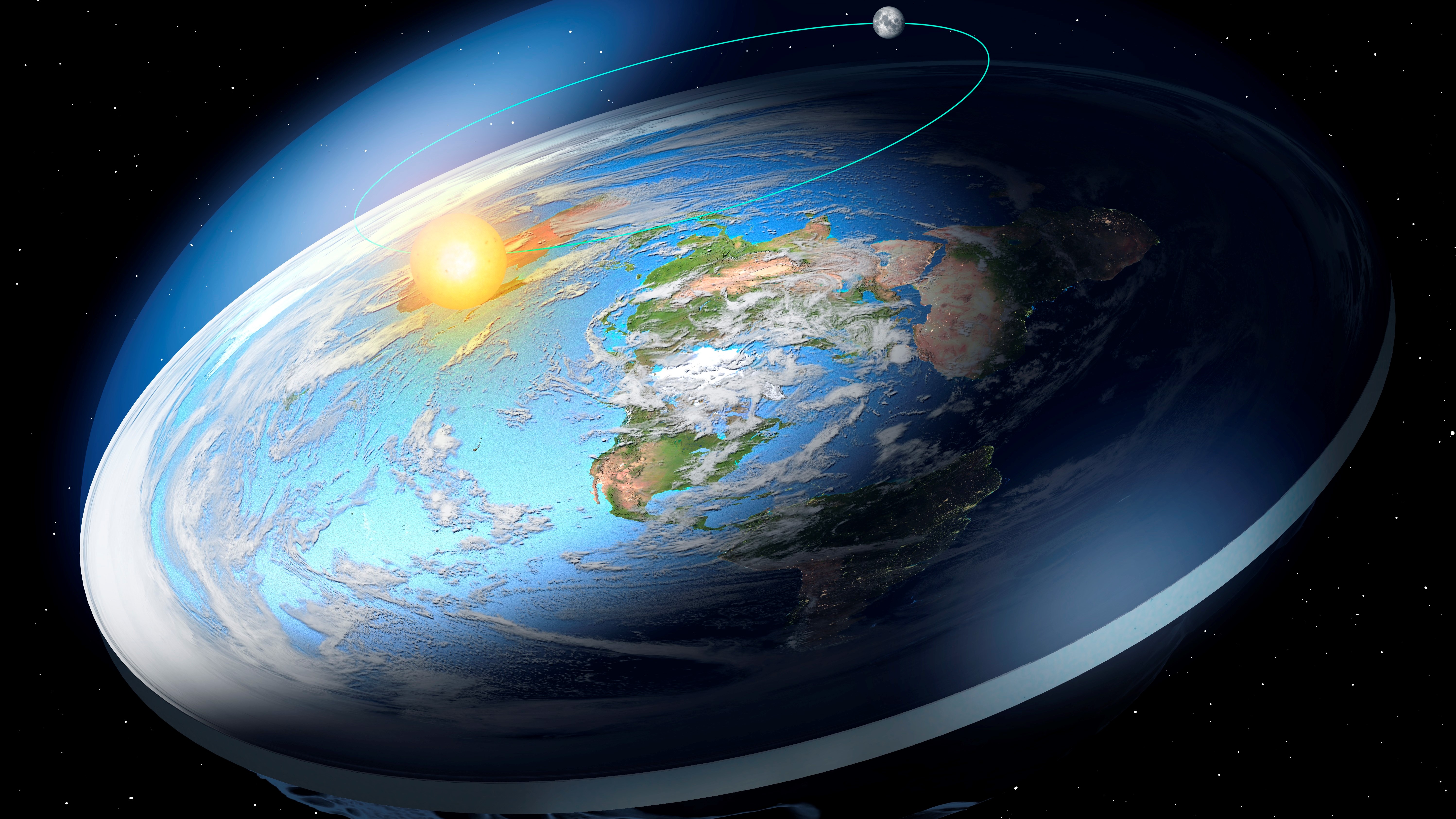
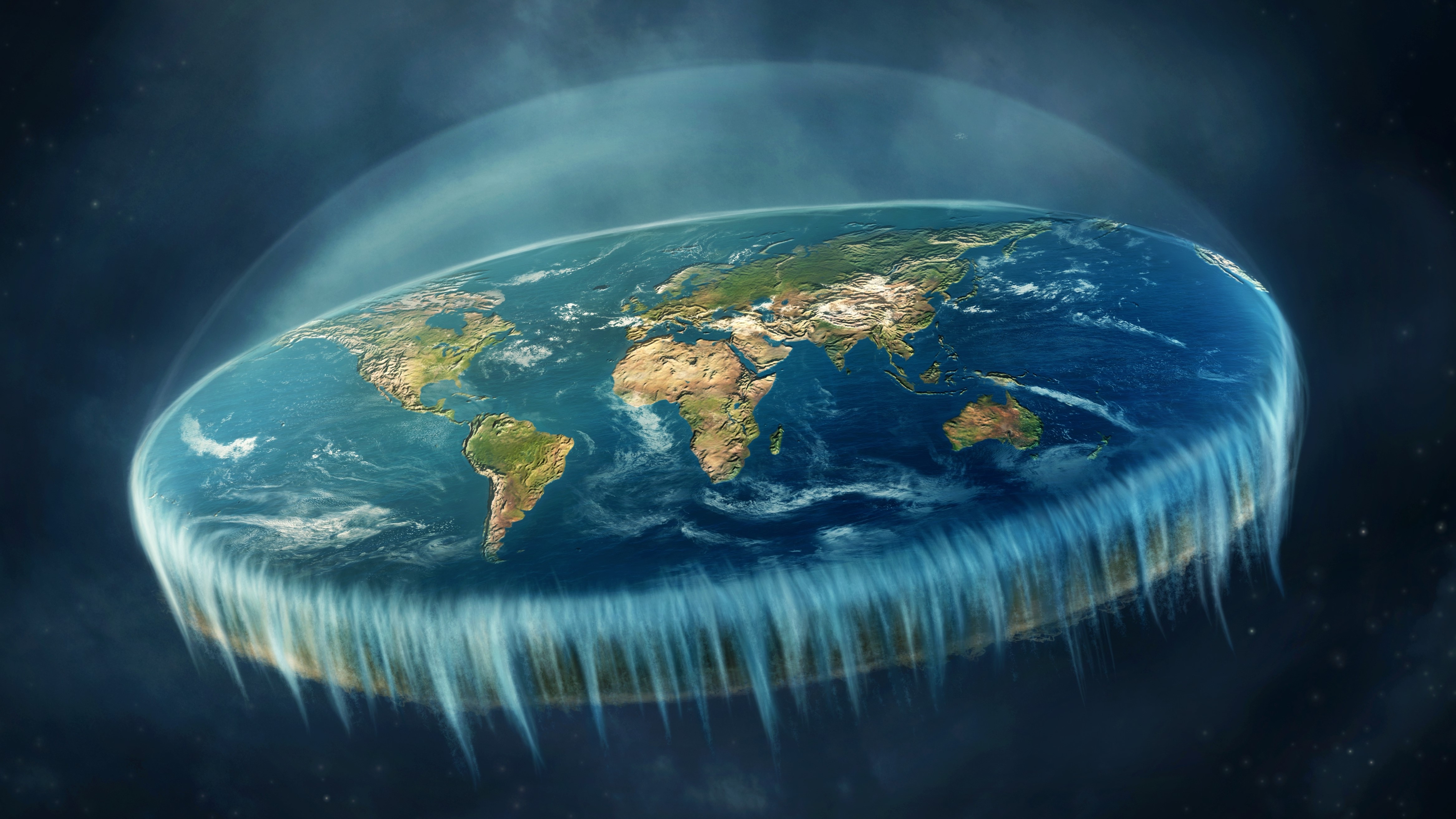
If the Earth were a flat disk rather than an oblate spheroid, the fundamental laws of physics—most notably gravity—would completely transform the planet. Instead of pulling straight downward across the surface, gravity would pull objec...
If the Earth were a flat disk rather than an oblate spheroid, the fundamental laws of physics—most notably gravity—would completely transform the planet. Instead of pulling straight downward across the surface, gravity would pull objects sideways toward the disk's center of mass, causing the atmosphere, oceans, and life to collapse into a central zone while rendering the outer edges an airless, frozen desert.
Contents
Gravity on a Flat Disk: A Sideways Pull Toward the Center
To understand what would happen on a flat Earth, one must first examine how gravity operates. Gravity is an attractive force exerted between masses, directed toward the system's center of mass. On a spherical Earth, mass is distributed symmetrically around the planet's core. Because you are standing on the surface directly above that center of mass, gravity pulls you straight down toward the ground beneath your feet, no matter where you stand on the globe.
On a flat, rigid disk, the center of mass would reside directly in the geographic center of the plane. If you stood at the exact center of this disk, gravity would pull you straight down, feeling relatively familiar. However, as you traveled away from the center toward the outer edge, the direction of gravitational pull would tilt at an increasingly sharp angle back toward the center.
Center of Disk Outer Edge of Disk | | V (Gravity pulls straight down) \ (Gravity pulls diagonally back to center)
By the time you approached the outer edge, gravity would no longer feel like a downward force. Instead, it would pull almost horizontally, dragging you back toward the middle of the disk. Walking toward the edge would feel like climbing an impossibly steep vertical mountain, even though the physical surface under your feet remained flat. Objects dropped near the edge would not fall to the ground; they would accelerate sideways across the land toward the central hub.
Hydrostatic Equilibrium: Why Large Objects Cannot Remain Flat
In planetary physics, a massive body cannot maintain a flat disk shape under its own weight. This constraint is governed by the principle of hydrostatic equilibrium, which describes the balance between an object's internal structural strength and its self-gravity.
When an astronomical body accumulates sufficient mass—typically reaching a diameter between 400 and 600 kilometers depending on its material composition—its internal gravitational pull exceeds the compressive strength of rock and ice. According to data maintained by NASA Solar System Exploration, self-gravity forces the body to deform into a shape where gravitational potential is equal across its surface: a sphere (or an oblate spheroid if rotating rapidly).
If a disk with Earth's mass (approximately $5.97 \times 10^{24}$ kilograms) were somehow created, its internal gravity would instantly overwhelm the tensile strength of the planetary crust and mantle. Within minutes, the disk would violently collapse in on itself, crushing its edges inward until it reformed a spherical shape. Maintaining a flat disk would require an impossible, exotic material with compressive strength trillions of times greater than diamond or titanium.
Atmospheric and Oceanic Collapse: The Central Super-Ocean
Fluids and gases react dynamically to gravitational gradients. On a flat Earth, the redistribution of water and air would alter planetary geography completely.
The Pooling of Planetary Oceans
Because gravity pulls liquids toward the lowest gravitational potential, all water on the surface would migrate toward the disk's center of mass. Oceans would drain away from the outer margins, flowing inward across thousands of kilometers of dry land.
This inward migration would form a single, massive, hyper-deep ocean at the center of the disk. The outer continents would be completely stripped of water, leaving dry, exposed bedrock. Meanwhile, land near the center would be submerged under hundreds of kilometers of water.
Atmospheric Pressure Gradient
The atmosphere would follow the exact same gravitational pattern as the oceans. Air molecules would accumulate densely over the central ocean, creating extreme atmospheric pressures.
- At the Disk's Center: Air density and barometric pressure would reach crushing levels, comparable to the deep ocean or the surface of Venus. High atmospheric density would trap thermal energy, turning the central region into an overheated, high-pressure pressure cooker.
- At the Disk's Edges: The atmosphere would thin out to near zero. Moving away from the center would cause the air pressure to drop below Armstrong's limit—the altitude where liquid boils at human body temperature—before fading into a hard vacuum. The outer half of the disk would exist in an environment virtually identical to the surface of the Moon or Mars.
[ Outer Edge: Vacuum ] ---> [ Mid-Disk: Thin Air ] ---> [ Center: Crushing Atmosphere & Super-Ocean ]
Loss of the Geomagnetic Field and Cosmic Radiation Exposure
Earth's survival depends heavily on its magnetic shield, known as the magnetosphere. This magnetosphere is generated deep within the planet by the geodynamo effect, driven by heat flow and rotation within liquid iron and nickel outer core layers.
Spherical Core Convection ---> Dynamo Action ---> Global Magnetosphere Shield
A flat Earth would lack a spherical, convective iron core. Without a rotating outer core surrounding a solid inner sphere, a flat disk could not generate a global magnetic dipole field. The consequences for life would be immediate and severe:
- Solar Wind Stripping: Without a magnetosphere to deflect charged particles emitted by the Sun, solar wind streams would directly bombard the upper atmosphere, gradually eroding gaseous elements into space.
- Lethal Radiation Bombardment: Cosmic rays and solar energetic particles would hit the surface unhindered. Exposure to background radiation would spike to levels incompatible with complex land-based biology.
- Auroral Disappearance: The polar light displays created by solar particles interacting with high-latitude magnetic field lines would cease to exist.
Research published through the USGS Geomagnetism Program emphasizes that planetary magnetic fields are essential for long-term atmospheric retention and protecting surface water from photo-dissociation caused by solar ultraviolet radiation.
Distorted Sunlight, Seasons, and Shadow Geometry
On a spherical Earth, day and night occur because half of the globe faces the Sun while the other half points away into space. Seasons result from the planet's $23.5^\circ$ axial tilt as it orbits the Sun, altering the angle and duration of solar irradiance across hemispheres.
Spherical Earth Solar Geometry: Sunlight rays (Parallel) ===> ( Curved Surface: Angles vary by latitude )
To recreate daytime and nighttime on a flat Earth, alternative hypotheses suggest a small, localized Sun hovering a few thousand kilometers above the disk, acting like a spotlight. However, this model directly contradicts established optical and thermodynamic laws:
- Sunlight Intensity and Shadows: On a flat Earth with a localized Sun, sunlight angles would produce shadow lengths that scale linearly with distance from the sub-solar point. However, direct measurements—first demonstrated by Eratosthenes around 240 BCE—show that shadow angles scale non-linearly based on the spherical curvature of the planet.
- Nighttime Impossibility: Light emitted from an overhead source in a vacuum spreads according to the inverse-square law. A spotlight sun hovering above a flat plane would remain visible from every location on the disk, making true darkness impossible unless an opaque physical barrier blocked the line of sight.
- Seasonal Temperature Anomalies: A flat disk would experience no variation in day length across latitudes during solstices without altering the speed, height, and path of the Sun every single day, violating the conservation of angular momentum.
Failure of Orbital Mechanics, Satellites, and GPS
Modern civilization relies heavily on artificial satellites orbiting Earth for communications, weather tracking, and global navigation systems (GPS). Orbital mechanics rely on balancing a satellite's forward velocity with the downward acceleration of gravity, keeping the object in continuous freefall around a spherical center of mass.
Stable Orbit (Sphere): Forward Motion + Downward Gravity = Continuous Circular Freefall Disk Motion (Flat Earth): Forward Motion + Lateral Gravity = Violent Trajectory Collapse
On a flat Earth, traditional orbits would be physically impossible:
- Trajectory Instability: A satellite launched near the edge of a flat disk would experience a massive horizontal gravitational pull back toward the center. Instead of maintaining a stable altitude, the satellite would be pulled laterally into a steep parabolic arc, crashing into the surface or spiraling toward the central mass.
- GPS Disruption: Global Positioning System networks require atomic clocks on satellites traveling along precisely known orbital paths. The Global Positioning System managed by the U.S. Space Force relies on high-altitude constellation geometry that requires a central gravitational point. Lateral gravity vectors on a disk would prevent stable medium-Earth orbits (MEO), rendering satellite-based positioning impossible.
- Celestial Navigation Inconsistencies: On a spherical Earth, observers in the Northern Hemisphere see Polaris near the celestial pole, while observers in the Southern Hemisphere view constellations like the Southern Cross (Crux). On a flat disk, observers across the entire surface would see the exact same celestial sphere overhead simultaneously, contradicting standard astronomical observations from observatory networks worldwide, such as the European Southern Observatory.
Physical Comparison: Round Earth vs. Flat Disk Physics
The physical behavior of a flat disk planet differs fundamentally from an oblate spheroid across key environmental, geological, and gravitational parameters:
| Physical Feature | Round Earth (Actual Spheroid) | Flat Disk Earth (Hypothetical) |
|---|---|---|
| Direction of Gravity | Perpendicular (straight down) across the entire surface | Straight down at the center; angled sideways toward the center near edges |
| Atmospheric Distribution | Uniformly wrapped around the planet by symmetric gravity | Concentrated into a dense dome at the center; vacuum at the outer rim |
| Ocean Distribution | Distributed across basins held by spherical gravity | Pooled into a massive central ocean; dry bedrock at outer margins |
| Planetary Magnetic Field | Active geodynamo generated by molten iron outer core convection | Non-existent; lack of a spherical convective dynamo core |
| Structural Stability | Stable hydrostatic equilibrium | Unstable; self-gravity would crush the disk into a sphere in minutes |
| Satellite Orbits | Stable Keplerian circular and elliptical orbits | Impossible; lateral gravity causes satellites to crash or drift |
| Vegetation Growth Direction | Plants grow straight upward (negative gravitropism) | Plants near the rim grow sideways at an angle toward the central gravitational mass |
Impact on Biological Life and Ecosystems
If the Earth suddenly converted into a flat disk while retaining its biological life, terrestrial ecosystems would collapse:
Gravitropism in Plant Life
Plants rely on specialized cells containing amyloplasts to sense gravity and direct root and stem growth, a process known as gravitropism (or geotropism). On a spherical Earth, roots grow straight down into the soil toward gravity, and stems grow straight up toward sunlight.
On a flat Earth, trees and plants growing away from the central region would grow sideways at an angle matched to the tilted vector of gravity. Forests near the rim would grow almost parallel to the flat ground, pointing their canopy toward the center of the disk.
Spherical Earth Plant Growth: Flat Earth Plant Growth (Near Rim): | (Upward Stem) / (Stem grows at an angle toward center) ===== (Ground Level) ===== (Ground Level) | (Downward Root) / (Root pulls toward center mass)
Extinction of Terrestrial Ecosystems
Due to atmospheric concentration at the center, life across the outer two-thirds of the disk would suffocate instantly as air pressure dropped below habitable thresholds. Animals and humans would suffer from rapid decompression, hypoxia, and ebullism (boiling of bodily fluids at ambient pressure).
The hyper-dense air at the central core would create an environment dominated by extreme temperatures, intense storms, and high carbon dioxide concentrations, eliminating the majority of species adapted to temperate conditions.
Frequently Asked Questions
Why doesn't gravity allow a flat planet to exist naturally?
Gravity acts equally in all directions, pulling mass toward a central point. Once a solid object exceeds roughly 600 kilometers in diameter, its self-gravity overcomes the structural strength of its materials, forcing it into a spherical shape known as hydrostatic equilibrium. A flat planet of Earth's mass cannot exist because its own gravity would immediately collapse it back into a sphere.
What would the weather be like near the outer edge of a flat Earth?
The outer edges of a flat Earth would be uninhabitable frozen wastes exposed to outer space. Because gravity would pull all atmospheric gases toward the center of the disk, the outer regions would have zero atmospheric pressure, zero air, and temperatures dropping toward absolute zero during periods lacking direct illumination.
How would shadow lengths differ on a flat Earth compared to a spherical Earth?
On a spherical Earth, shadow lengths measured at identical times across different latitudes vary non-linearly because the ground curves away beneath parallel sunlight rays. On a flat Earth illuminated by a distant Sun, shadows would remain equal in length everywhere. If illuminated by a close spotlight Sun, shadow angles would fail standard trigonometric measurements taken simultaneously across different geographic locations.
Would a flat Earth still have a magnetic field to protect against solar storms?
No. Earth's magnetic field is generated by a dynamo process involving convection currents within its liquid iron-nickel outer core, surrounding a solid inner core. A flat disk structure could not maintain the thermal dynamics or rotation required to run a geodynamo, leaving the planet exposed to lethal solar wind and cosmic radiation.
What would happen to human travel and aviation on a flat disk?
Airplanes rely on constant air density and straightforward gravitational vectors to maintain lift and altitude. Flying toward the edge of a flat disk would cause aircraft to enter increasingly thin air until wings could no longer generate lift. Furthermore, because gravity would pull aircraft backward toward the disk center, planes would require immense continuous engine thrust just to prevent being dragged backward across the sky.
Summary of Physical Realities
The hypothetical scenario of a flat Earth provides a clear demonstration of how interconnected fundamental physical forces are. Without a spherical geometry, the core processes that sustain life—uniform gravity, ocean basins, an insulating atmosphere, a magnetic shield, and stable planetary orbits—fail completely. The laws of gravitation, thermodynamics, and planetary geology dictate that a planet of Earth's mass can exist only as a sphere.
Image Gallery