Zero Percent Financing Explained: How It Works and What to Watch For
Zero percent financing is a promotional lending arrangement where the borrower pays no interest on a loan or credit balance for a specific duration. Usually offered by auto manufacturers, retailers, and credit card issuers, it allows c...
Zero percent financing is a promotional lending arrangement where the borrower pays no interest on a loan or credit balance for a specific duration. Usually offered by auto manufacturers, retailers, and credit card issuers, it allows consumers to spread the cost of a purchase over time without incurring the additional expense of interest, provided all terms and conditions are strictly met.
Contents
In the current financial landscape of 2026, zero percent financing remains one of the most powerful tools for consumers to manage cash flow. However, while "interest-free" sounds like a simple proposition, these offers are structured with specific mechanisms that benefit the lender as much as the borrower. To use these offers effectively, one must understand the difference between promotional APRs and deferred interest, the impact of credit qualifications, and the opportunity costs involved in choosing 0% over other incentives.
The Mechanics of Interest-Free Borrowing
At its core, zero percent financing is a marketing tool used to move inventory or acquire new customers. Lenders are businesses that exist to make a profit, and since they aren't making money on interest during the promotional period, the profit is derived from other areas.
In the retail and "Buy Now, Pay Later" (BNPL) space, the merchant typically pays a fee to the lender to offer interest-free terms. This "merchant discount rate" allows the store to sell more products by making them affordable on a monthly basis. In the automotive sector, 0% offers are usually provided by captive lenders—financing arms owned by the car manufacturers themselves, such as Ford Credit or Toyota Financial Services. Their goal is to sell cars, and the interest-free loan is a subsidy to encourage that sale.
0% APR vs. Deferred Interest
It is vital to distinguish between a true 0% Annual Percentage Rate (APR) and deferred interest. This distinction is often hidden in the fine print of retail store cards and furniture financing.
- 0% APR: Interest does not accrue during the promotional period. If you do not pay off the balance by the end of the term, you only begin to owe interest on the remaining balance from that date forward.
- Deferred Interest: This is a much more aggressive structure. Interest is technically calculated from the date of purchase but is waived if the balance is paid in full within the promotional window. If even $1 remains on the balance after the period expires, or if you miss a payment, the lender may charge you the full accumulated interest from the original purchase date.
The Consumer Financial Protection Bureau (CFPB) has frequently warned consumers about the "debt trap" potential of deferred interest, as it can lead to unexpected charges that erase the benefits of the original promotion.
Common Sectors Offering Zero Percent Financing
As of 2026, zero percent offers are concentrated in three primary areas of consumer finance. Each has its own set of rules and hidden considerations.
Automotive Financing
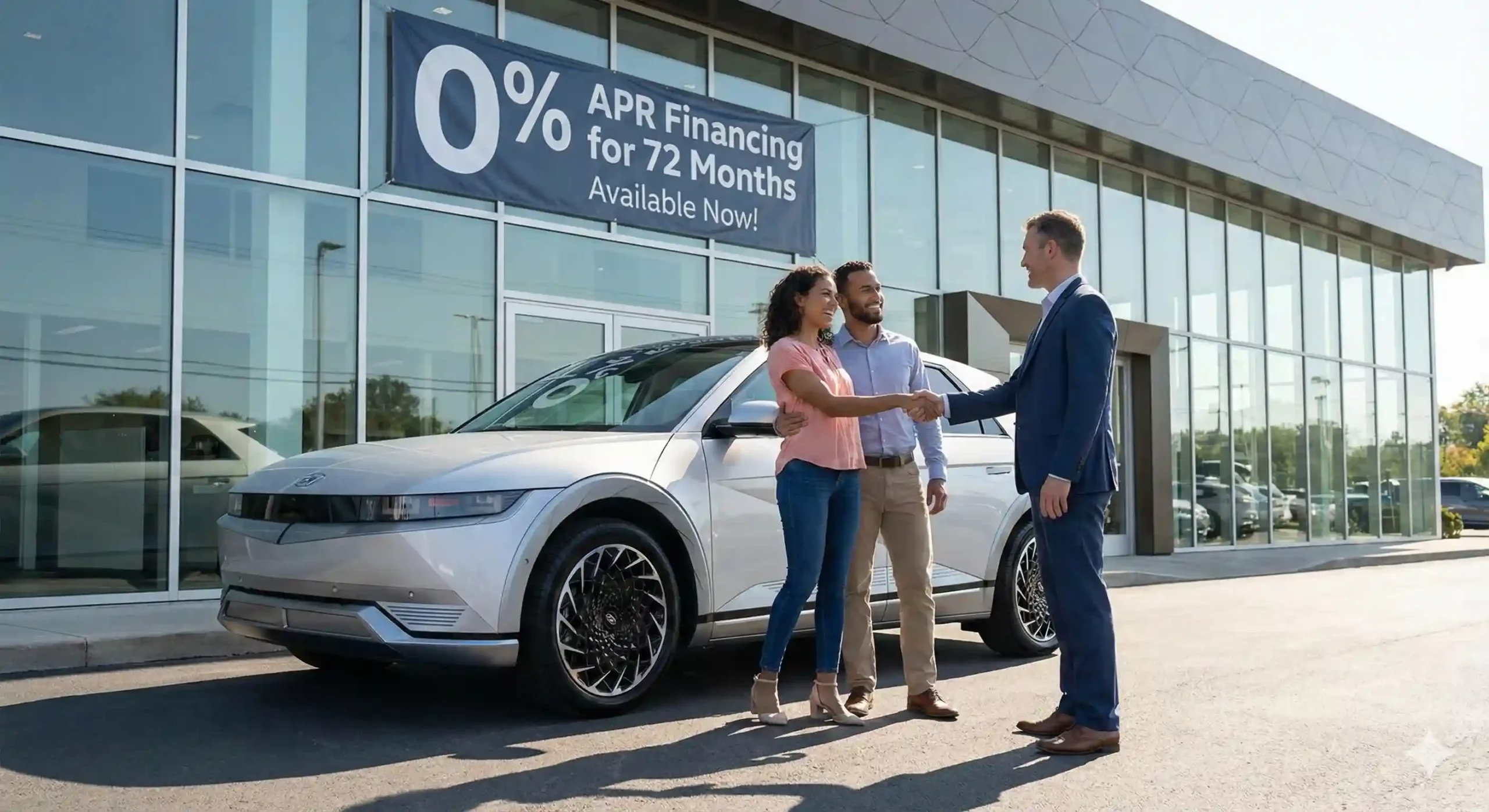
Auto manufacturers use 0% financing as a primary incentive for "Tier 1" credit applicants. These loans are usually restricted to specific models—often those the manufacturer is eager to clear off the lot. A significant trade-off in the auto industry is the choice between the 0% APR offer and a cash-back rebate. If a manufacturer offers a $3,000 rebate or 0% financing, you must calculate which saves more over the life of the loan. Often, a low-interest loan from a credit union combined with the cash rebate is mathematically superior to the 0% offer from the dealer.
Credit Cards
Credit card issuers offer 0% introductory periods on two types of transactions: new purchases and balance transfers. Purchase offers allow you to buy items today and pay them off over 12 to 21 months interest-free. Balance transfer offers allow you to move high-interest debt to a new card to pay it down faster. However, balance transfers almost always involve a transfer fee, typically ranging from 3% to 5% of the total amount moved.
Retail and BNPL
Retailers for electronics, appliances, and furniture often partner with fintech companies to offer "pay-in-four" or longer-term interest-free installments. These are highly accessible but often have the shortest repayment windows. In 2026, many of these services have moved toward transparent 0% APR models to avoid the regulatory scrutiny associated with deferred interest.
Eligibility Requirements and Qualifications
Zero percent financing is not available to everyone. It is a privilege reserved for borrowers who present the lowest risk to the lender.
- Credit Score Thresholds: Generally, a "Good" to "Excellent" credit score is required. In the 2026 lending environment, this typically means a FICO score of 740 or higher. While some lenders may offer 0% to those in the 700–739 range, the most aggressive terms are reserved for the top tier.
- Debt-to-Income (DTI) Ratio: Lenders will examine your monthly debt obligations relative to your gross income. Even with a perfect credit score, a DTI above 40% may result in a denial because the lender fears you lack the cash flow to meet the monthly payments.
- Proof of Income: For larger loans, such as those for vehicles, you will need to provide recent pay stubs or tax returns to verify that you can sustain the payments over the term.
- Down Payment Requirements: In some cases, specifically with 0% auto loans, the lender may require a larger down payment to reduce their "loan-to-value" risk.
Comparative Analysis of 0% Financing Types
| Feature | Auto Loans | Credit Cards | Retail/BNPL |
|---|---|---|---|
| Typical Duration | 36 to 72 months | 12 to 21 months | 6 weeks to 12 months |
| Primary Requirement | Excellent Credit (740+) | Good/Excellent Credit | Soft Credit Check (often) |
| Common Fees | Documentation fees | Balance transfer fees (3-5%) | Late payment fees |
| Main Catch | Forfeiting cash rebates | High APR after promo ends | Potential deferred interest |
| Impact on Credit | Hard inquiry; builds history | Utilization impact; Hard inquiry | Variable; some don't report |
Hidden Costs and Potential Pitfalls
The term "zero percent" can be deceptive if you do not account for the auxiliary costs associated with the debt.
The Opportunity Cost
In 2026, the most common hidden cost is the loss of other incentives. When you take a 0% auto loan, you are essentially "buying" that interest rate by giving up the manufacturer's cash rebate. For example, on a $40,000 car, a 0% loan over 60 months saves you about $5,300 compared to a 5% loan. However, if the manufacturer offered a $6,000 cash rebate, you would actually lose $700 by choosing the "free" financing.
The Penalty APR
Most zero percent agreements include a clause stating that if you are late on a single payment, the 0% promotion is voided immediately. Your account may then be moved to a "Penalty APR," which can be 29.99% or higher. This effectively turns a low-cost loan into an extremely expensive debt overnight.
Credit Utilization Impact
Opening a new 0% credit card and maxing it out to take advantage of the interest-free period can hurt your credit score. Credit utilization—the ratio of your balance to your limit—accounts for 30% of your FICO score. If you use $9,000 of a $10,000 limit, your score may drop significantly, even if you are making your payments on time.
How to Navigate 0% Financing in 2026
To successfully use 0% financing without falling into a debt trap, follow these strategic steps:
- Read the Schumer Box: For credit cards, the Federal Reserve requires a standardized table (the Schumer Box) that lists the APR, the duration of the promo, and any fees. Check the "Post-Promotional APR" to know what you will pay if a balance remains.
- Automate Your Payments: Set up autopay for slightly more than the minimum payment. The "minimum payment" suggested by the bank is often not enough to clear the balance before the 0% period ends. Divide the total balance by the number of promotional months to determine your true monthly requirement.
- Check for "No Interest" vs. "0% APR": If the contract says "No interest if paid in full within 12 months," it is a deferred interest plan. Treat these with extreme caution.
- Calculate the Rebate Value: Before signing an auto loan, ask the dealer for the "out-the-door" price both with the 0% offer and with the cash rebate. Use an online calculator to see which option results in a lower total cost of ownership.
Frequently Asked Questions
Does 0% financing hurt my credit score? Applying for 0% financing usually triggers a "hard inquiry," which can cause a small, temporary dip in your score. Additionally, if the financing is through a credit card, carrying a high balance relative to the card's limit can increase your credit utilization ratio, potentially lowering your score until the balance is paid down.
What happens if I don't pay off the balance in time? If it is a true 0% APR offer, you will begin paying the standard interest rate on whatever balance remains. If it is a deferred interest offer, you will be charged interest on the original total amount from the purchase date, which can result in a massive, unexpected charge.
Can I get 0% financing with a 600 credit score? It is highly unlikely. Zero percent offers are generally reserved for "prime" or "super-prime" borrowers. In 2026, lenders have tightened standards due to economic volatility; a score below 700 usually results in a standard interest rate or a denial for promotional offers.
Are there fees associated with 0% financing? Yes, though they aren't labeled as interest. Credit cards often charge balance transfer fees (3-5%). Auto loans may have higher "documentation fees" or require you to purchase specific add-ons to qualify for the rate. Retailers may charge "origination fees" or "monthly service fees" that effectively function as interest.
Is 0% financing better than paying cash? If you have the cash available, 0% financing allows you to keep your money in a high-yield savings account or investment vehicle, earning interest (the "arbitrage" strategy) while you pay off the loan. However, this only works if you are disciplined enough not to spend the cash elsewhere and have a guaranteed way to pay off the debt.
Practical Recommendation
Before accepting a 0% financing offer, determine your exact repayment strategy. Calculate the monthly payment required to hit a zero balance one month before the promotion expires. If you are choosing between an interest-free loan and a cash-back rebate on a large purchase, always run the math on the total cost over time. Use official resources like the Federal Trade Commission (FTC) to understand your rights regarding dealer financing. Zero percent financing is a powerful wealth-building tool when used to preserve capital, but it requires meticulous attention to deadlines and fine print to avoid becoming a costly burden.
Image Gallery