The Science of the Morning Routine for a Productive Day in 2026: A Comprehensive Guide
A productive morning routine is a systematic sequence of habits designed to optimize your biological rhythms, sharpen cognitive focus, and minimize decision fatigue. To achieve a productive day in 2026, your routine must prioritize neu...
A productive morning routine is a systematic sequence of habits designed to optimize your biological rhythms, sharpen cognitive focus, and minimize decision fatigue. To achieve a productive day in 2026, your routine must prioritize neurological recovery, strategic hydration, and the deliberate delay of digital stimuli to ensure peak performance during your most critical working hours.
Contents
The Biological Blueprint of an Effective Morning
Understanding the "why" behind a morning routine is as important as the "what." By 2026, chronobiology—the study of biological rhythms—has become a cornerstone of high-performance coaching. Your body does not simply "wake up" the moment your eyes open; it undergoes a complex hormonal transition from sleep-state to wake-state that dictates your energy levels for the subsequent 16 hours.
The primary driver of this transition is the circadian rhythm, an internal clock that regulates the release of cortisol and melatonin. In the early morning, your body naturally initiates a "cortisol awakening response" (CAR). This surge is designed to provide the alertness needed to begin the day. However, modern habits, such as immediately checking a smartphone, can hijack this process. When you flood your brain with external stressors (emails, news, social media) before the CAR has stabilized, you risk inducing a state of high-alert anxiety rather than calm focus.
Furthermore, the clearance of adenosine—a chemical that builds up in the brain during the day to create "sleep pressure"—is not instantaneous. If you consume caffeine the moment you wake up, you block adenosine receptors without actually clearing the chemical. This leads to the "mid-morning crash" once the caffeine wears off. A science-backed routine in 2026 emphasizes delaying caffeine for 60 to 90 minutes to allow natural adenosine clearance, ensuring sustained energy throughout the afternoon.
Prerequisite: The "Night Before" Foundation
You cannot have a productive morning without a disciplined evening. Productivity is a recursive cycle where the end of one day sets the ceiling for the next. By 2026, the concept of "sleep hygiene" has evolved into "metabolic preparation."
To ensure your morning routine is effective, you must address three specific evening prerequisites:
- Digital Sunset: Reducing blue light exposure at least 90 minutes before bed to allow natural melatonin production.
- Cognitive Offloading: Writing down the top three tasks for the following day. This prevents "open loops" in the brain—a phenomenon where the subconscious mind remains active trying to remember unfinished business, leading to restless sleep.
- The Environment Reset: Preparing your physical space, such as setting out workout clothes or cleaning the kitchen. This reduces decision fatigue in the morning, preserving your limited willpower for high-value work.
Core Pillars of a Productive Morning Routine
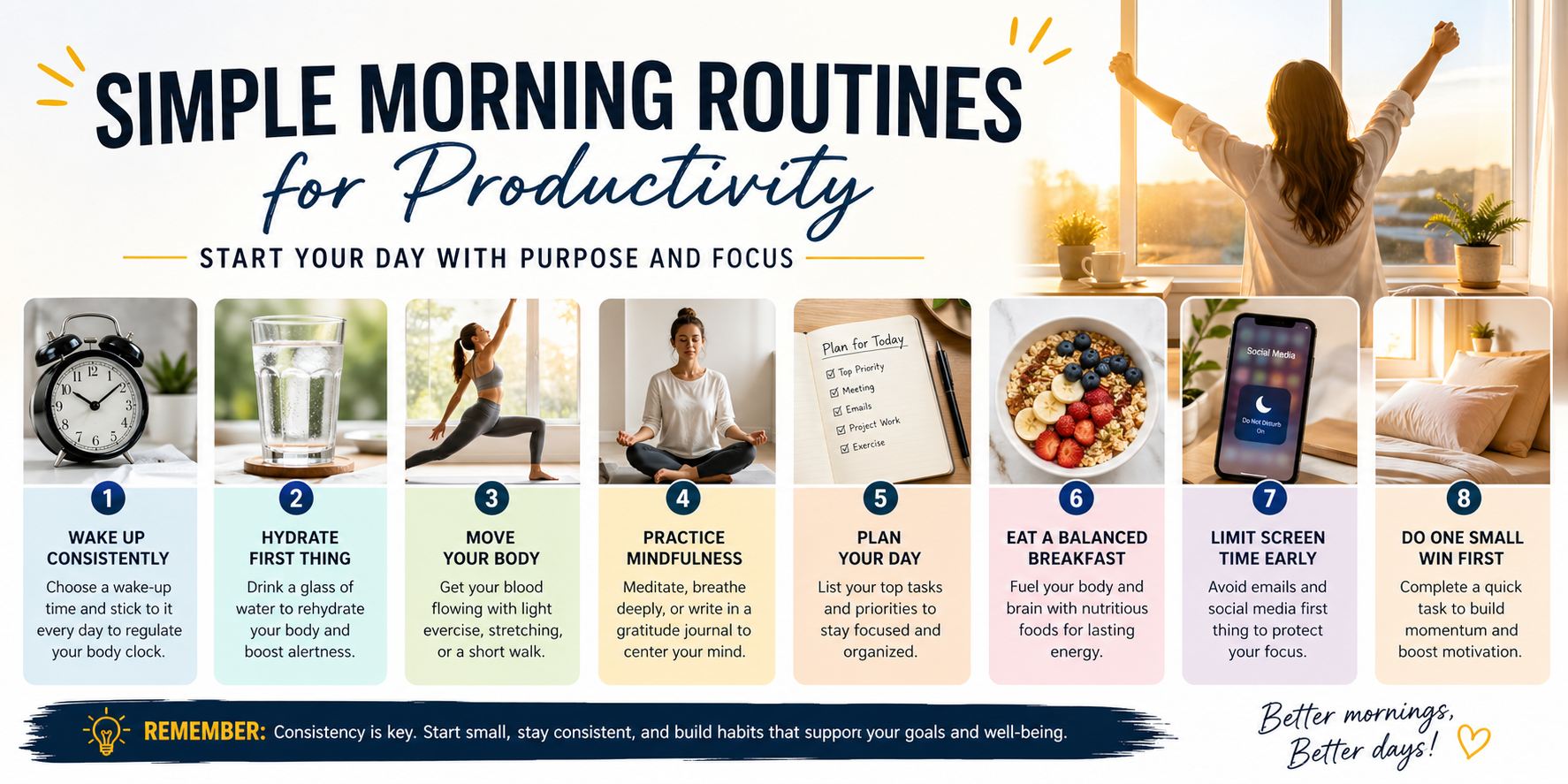
To build a routine that actually translates to a productive day, focus on these four pillars: hydration, light exposure, movement, and deep work.
1. Strategic Hydration and Metabolic Activation
During seven to eight hours of sleep, the human body loses a significant amount of water through respiration and perspiration. Waking up in a state of mild dehydration is the primary cause of "brain fog." Instead of reaching for coffee, the first action should be consuming 16 to 20 ounces of water, ideally with a pinch of mineral salt or electrolytes.
This does more than quench thirst; it kickstarts your metabolism and aids in the transport of nutrients to your brain. In 2026, nutritionists emphasize that cellular hydration is the baseline for cognitive endurance. Without it, your brain’s processing speed remains sluggish, regardless of how much caffeine you consume.
2. View Natural Light Early
One of the most powerful tools for a productive day is viewing natural sunlight within the first 30 minutes of waking. Sunlight triggers the neural circuit that controls the timing of the cortisol peak. This isn't just about "feeling good"; it's a biological trigger that sets a timer for melatonin release later that evening, essentially "programming" your sleep for the next night.
Even on overcast days, the lux (light intensity) provided by the sky is significantly higher than any indoor office lighting. If you live in an environment where natural light is unavailable in the winter, using a 10,000-lux light therapy box is a verified alternative to stimulate these same biological pathways.
3. Physical Activation and Thermal Shift
Movement is non-negotiable for mental clarity. This does not require a grueling 90-minute gym session at 5 AM. Even five to ten minutes of rhythmic movement—yoga, a brisk walk, or calisthenics—increases core body temperature and blood flow to the prefrontal cortex.
Many high-performers in 2026 also utilize cold exposure (such as a 30-second cold shower). Cold exposure triggers a significant release of norepinephrine and dopamine, which can elevate mood and focus for several hours. This "dopamine baseline" increase is more stable than the spike-and-crash associated with sugar or excessive stimulants.
4. Protecting the "Deep Work" Window
The ultimate goal of a morning routine is to transition into a state of Deep Work, a term popularized by Cal Newport. This is the ability to focus without distraction on a cognitively demanding task.
The most productive individuals in 2026 treat the first two to three hours of their workday as "sacred." This means:
- No "shallow work" (email, Slack, administrative tasks) until the first major goal is met.
- Using "Focus Modes" on devices to block all notifications.
- Tackling the "frog"—the most difficult or most avoided task—first, when cognitive resources are at their peak.
Comparison of Morning Routine Archetypes
Not every routine fits every lifestyle. Below is a comparison of three validated routine structures used by professionals in 2026.
| Feature | The Executive (High Intensity) | The Creative (Low Friction) | The Balanced Parent (Hybrid) |
|---|---|---|---|
| Wake Time | 5:00 AM - 5:30 AM | 7:30 AM - 8:00 AM | 6:00 AM - 6:30 AM |
| First Action | Cold plunge & Hydration | Journaling & Light stretch | Hydration & Quick prep |
| Tech Usage | Zero until 9:00 AM | Zero until 10:00 AM | Limited to "Logistics" |
| Movement | 45 min Strength/Cardio | 15 min Yoga/Walking | 10 min Mobility |
| Deep Work Start | 7:00 AM | 9:00 AM | 8:30 AM (Post-school drop) |
| Primary Benefit | Maximum output | High creative flow | Reduced morning stress |
Common Mistakes That Sabotage Productivity
Even with the best intentions, certain habits can invalidate the benefits of a morning routine.
The Snooze Button Trap: When you hit snooze, you force your brain back into a new sleep cycle that it cannot finish. This results in sleep inertia, a state of grogginess that can last up to four hours. It is biologically better to set your alarm for the latest possible time and get up immediately than to fragment your last hour of sleep with the snooze button.
Immediate Digital Consumption: Checking social media or news upon waking forces your brain into a reactive state. You are essentially letting the world's priorities dictate your mental space before you have had a chance to establish your own. This "reactive loops" behavior fragments your attention span, making it harder to engage in Deep Work later in the day.
Over-complication: A routine that is too long (e.g., three hours) becomes a burden rather than a tool. If your routine feels like a second job, you will eventually abandon it. The most effective routines in 2026 are modular; they can be compressed into 15 minutes on busy days or expanded to 60 minutes when time allows.
Adapting the Routine for Different Chronotypes
By 2026, we recognize that not everyone is a "morning lark." "Night owls" have a naturally delayed circadian rhythm. For these individuals, a productive "morning" routine might actually start at 10:00 AM.
The principles remain the same: light exposure, hydration, and delaying caffeine. However, forcing a natural night owl to perform deep work at 6:00 AM can be counterproductive, leading to higher levels of oxidative stress and lower cognitive output. Productivity is about alignment, not about following a specific clock time. If you are a late-riser, focus on the sequence of events rather than the time on the watch.
Frequently Asked Questions
Is coffee bad for a productive morning routine?
Coffee is a powerful ergogenic aid, but its timing is crucial. In 2026, the consensus among sleep researchers is to delay caffeine intake by at least 60-90 minutes after waking. This allows your body to naturally clear adenosine, preventing a mid-day energy crash. When you do drink it, consider pairing it with a focus-enhancing activity rather than using it to "wake up" from a state of exhaustion.
How long should a morning routine take?
A morning routine can be as short as 15 minutes or as long as 90 minutes. The duration is less important than the consistency. A 15-minute routine consisting of hydration, five minutes of sunlight, and a quick review of your daily goals is significantly more effective than a three-hour routine you only perform once a week.
What if I have children or a chaotic morning?
Focus on "micro-habits" and "habit stacking." If you cannot spend 20 minutes meditating, spend two minutes focusing on your breath while the coffee brews. If you cannot go for a run, do 20 jumping jacks while your children are getting dressed. The goal is to signal to your nervous system that you are in control of the day, even if the environment is noisy.
Should I eat breakfast immediately?
This depends on your metabolic health and goals. Many people in 2026 find that intermittent fasting or delaying breakfast until after their first block of Deep Work helps maintain mental clarity, as the body isn't diverting energy to digestion. However, if you find yourself distracted by hunger, a high-protein, low-sugar breakfast is recommended to avoid blood sugar spikes that cause lethargy.
Does the routine have to be the same on weekends?
While strict adherence isn't necessary, maintaining the core pillars (especially light exposure and wake time) within an hour of your weekday schedule helps keep your circadian rhythm stable. Large shifts in sleep patterns on weekends, known as "social jetlag," can make Monday mornings significantly harder and less productive.
Next Actions for a Productive 2026
To implement a morning routine for a productive day, do not attempt to change everything at once. Start by picking one "anchor" habit—such as drinking 20 ounces of water before touching your phone—and practice it for seven days. Once that habit is automated, layer on the next, such as getting five minutes of sunlight.
The most productive day is not the one where you do the most things, but the one where you do the right things with sustained, calm focus. By grounding your morning in biological reality and cognitive protection, you set the stage for professional excellence and personal well-being.
Image Gallery