Which Is the Best Knife Sharpener for Home Cooks?
The best knife sharpener for most home cooks in 2026 is the Work Sharp Culinary E5 Electric Kitchen Knife Sharpener, which balances ease of use with professional-grade results. For those who prefer a manual, tactile experience without...
The best knife sharpener for most home cooks in 2026 is the Work Sharp Culinary E5 Electric Kitchen Knife Sharpener, which balances ease of use with professional-grade results. For those who prefer a manual, tactile experience without the steep learning curve of whetstones, the Tumbler Rolling Knife Sharpener is the premier choice for maintaining precision 15 and 20-degree angles.
Contents
Understanding the Mechanics of a Sharp Edge
Before selecting a sharpening tool, it is essential to understand what "sharp" actually means in a culinary context. A knife’s edge is essentially two planes of steel meeting at a point called the apex. Over time, regular use against cutting boards and through food causes this apex to either fold over (rolling) or wear away (dulling).
Sharpening is the process of removing metal from the blade to create a brand-new apex. This differs from honing, which uses a ceramic or steel rod to realign a rolled edge without removing significant material. For home cooks, the "best" sharpener is one that manages this metal removal safely, consistently, and at the correct angle for their specific cutlery.
In 2026, most kitchen knives fall into two categories:
- Western-style knives: Traditionally sharpened to a 20-degree angle on each side, favoring durability and "beater" tasks.
- Asian-style or Modern Hybrid knives: Sharpened to a 15-degree angle, providing a much finer, "scalpel-like" feel that excels at precision slicing.
The Top Contender: Electric Sharpeners
Electric sharpeners are the gold standard for home cooks who prioritize efficiency and repeatable results. Unlike manual methods, these machines use motorized abrasive wheels or belts to ensure the blade is sharpened evenly from heel to tip.
Work Sharp Culinary E5
The Work Sharp E5 is unique because it uses flexible abrasive belts rather than rigid grinding wheels. This technology is a scaled-down version of what professional knife makers use. The belts conform to the shape of the blade, preventing the "recurve" damage often seen with cheaper electric sharpeners. It features built-in angle guides that take the guesswork out of the process, and a specialized "Refining" stage that uses a ceramic hone to polish the edge to a mirror finish.
Chef’sChoice Trizor XV
For cooks who have a collection of older, 20-degree German knives but want the performance of a 15-degree Japanese edge, the Chef’sChoice Trizor XV is the industry standard. It uses a three-stage process with 100% diamond abrasives. The first stage is aggressive enough to "convert" the angle of a blade, while the final stage uses flexible stropping disks to create a "Trizor" edge—a triple-bevel geometry that stays sharp longer than a standard V-edge.
The Modern Innovator: Rolling Knife Sharpeners
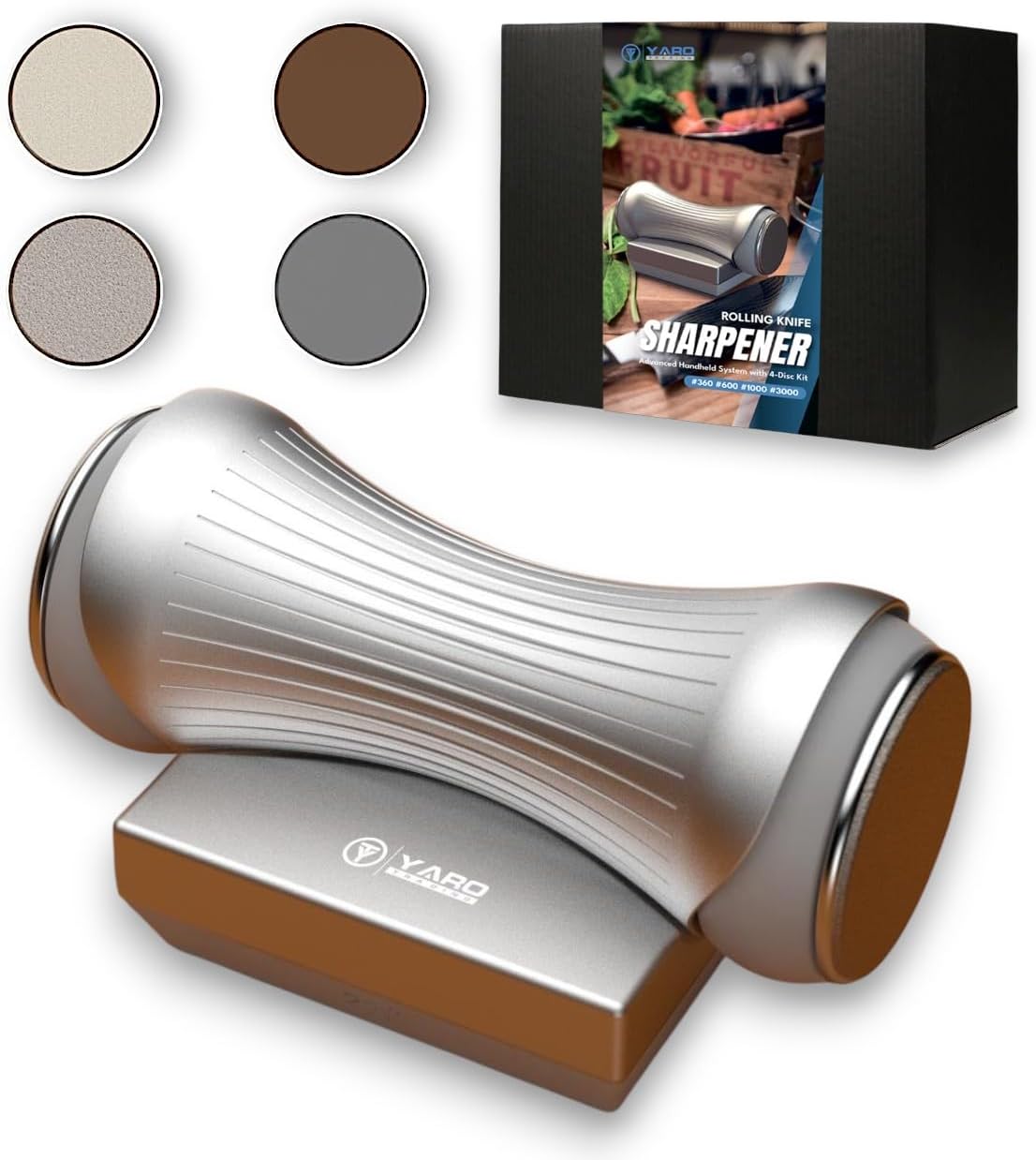
A significant shift in the 2026 market has been the rise of rolling sharpeners, such as those produced by Tumbler or Horl. These tools have become favorites for home cooks who find electric machines too bulky and whetstones too intimidating.
The system consists of two parts: a magnetic wooden block that holds the knife at a precise 15 or 20-degree angle, and a heavy rolling cylinder with a diamond disc on one end and a stainless steel or ceramic honing disc on the other.
Why they are effective for home cooks:
- Consistency: The magnetic holder ensures the angle never fluctuates, which is the most common mistake made during manual sharpening.
- Safety: The cook moves the sharpener, not the knife, significantly reducing the risk of accidental slips.
- Versatility: These systems work equally well on heavy cleavers and delicate paring knives, provided the blade height allows the roller to make contact with the edge.
The Purist’s Choice: Whetstones
For the enthusiast who views cooking as a craft, nothing replaces a high-quality whetstone. While the learning curve is steep—requiring dozens of hours to master the muscle memory of maintaining a consistent angle—the results are unmatched.
A two-grit stone, such as the King KW-65 1000/6000, is the traditional recommendation.
- 1000 Grit: This is the "sharpening" side used to establish the edge.
- 6000 Grit: This is the "polishing" side used to remove microscopic burrs and create a smooth, hair-shaving finish.
In 2026, many home cooks are opting for Splash-and-Go stones (like the Shapton Glass series). Unlike traditional whetstones, these do not require a 20-minute soak in water before use, making them far more practical for a busy kitchen environment.
Comparing Leading Sharpening Systems
The following table compares the most popular sharpening technologies available to home cooks in 2026.
| Sharpener Type | Recommended Model | Best For | Skill Level | Abrasive Material |
|---|---|---|---|---|
| Electric Belt | Work Sharp E5 | All-around kitchen use | Beginner | Flexible Belts |
| Electric Wheel | Chef’sChoice Trizor XV | Converting edge angles | Beginner | Diamond Disks |
| Rolling | Tumbler Diamond Rolling | High-end Japanese/German knives | Intermediate | Diamond & Stainless |
| Whetstone | Shapton Ha-No-Kuromaku | Culinary enthusiasts | Advanced | Ceramic/Alumina |
| Guided System | Spyderco Tri-Angle | Multi-tool & Serrated knives | Intermediate | Ceramic Rods |
| Pull-Through | KitchenIQ Edge Grip | Budget knives/Quick fix | Beginner | Carbide & Ceramic |
Key Factors to Consider Before Buying
1. Blade Material
High-carbon steel and modern "super steels" (like VG10 or CPM-S35VN) are much harder than standard stainless steel. If your knives are high-end, you must avoid cheap carbide pull-through sharpeners. Carbide is harder than steel and works by "shaving" chunks of metal off the blade, which can leave a jagged, uneven edge that degrades the knife over time.
2. Sharpening Angle
Verify if your knives are 15-degree or 20-degree. Using a 20-degree sharpener on a 15-degree Japanese knife will immediately dull the blade and ruin the factory geometry. Many modern sharpeners, like the Work Sharp E5 and the Tumbler, provide interchangeable guides for both.
3. Ease of Maintenance
A sharpener that is difficult to set up will likely gather dust in a drawer. Electric sharpeners stay on the counter or in a dedicated cabinet and are ready in seconds. Whetstones require water, a flattening stone (to keep the whetstone level), and a dedicated workspace. Home cooks should be honest about how much time they are willing to invest in the process.
Common Mistakes in Home Sharpening
- Over-sharpening: You do not need to sharpen your knives every week. For a typical home cook, a full sharpening session every 3 to 6 months is sufficient. In between, use a honing rod or a leather strop to keep the edge aligned.
- Ignoring the Bur: Whether using a stone or an electric machine, you must sharpen one side until a "burr" (a microscopic wire edge) forms on the opposite side. If you don't feel the burr, you haven't removed enough metal to reach the apex.
- Applying Too Much Pressure: Let the abrasives do the work. Excessive pressure can heat the steel, potentially ruining the "temper" (hardness) of the blade, or causing the guides to flex and create an inconsistent angle.
Frequently Asked Questions
Can I sharpen serrated bread knives with these tools?
Most standard electric and rolling sharpeners are not designed for serrated knives. To sharpen a serrated blade, you generally need a tapered ceramic rod that can fit into the individual gullets (the curves) of the serrations. Some electric models, like the Chef’sChoice Trizor XV, have a specialized final stage that can lightly polish the tips of serrations, but it is not a full sharpening solution.
Does a "pull-through" sharpener ruin knives?
"Ruin" is a strong word, but cheap pull-through sharpeners that use V-shaped tungsten carbide inserts are very aggressive. They remove a significant amount of metal and can create "micro-chipping" along the edge. They are acceptable for inexpensive "supermarket" knives but should never be used on high-quality forged cutlery.
How do I know if my knife is sharp enough?
The "paper test" remains the most reliable metric. Hold a single sheet of printer paper vertically and attempt to slice through the edge of the paper moving away from your hand. A sharp knife will bite into the paper immediately and slide through with no snagging or tearing. If the knife "slides" off the paper or crushes it, the apex is not fully formed.
Do I need a honing rod if I have a good sharpener?
Yes. Honing and sharpening are complementary. A honing rod (preferably ceramic) is used daily or weekly to straighten the edge. Think of sharpening as a "major surgery" for the knife and honing as "daily exercise." Using a ceramic rod frequently will extend the time between necessary sharpening sessions by months.
Final Recommendation: Which Should You Buy?
If you want the fastest, most reliable results with zero learning curve, purchase the Work Sharp Culinary E5. It provides the most consistent edge of any electric model on the market and is safe for nearly all kitchen knife types.
If you enjoy the process of maintenance and own expensive Japanese or custom knives, the Tumbler Rolling Sharpener is the best investment. It offers the precision of a professional guided system with a modern, aesthetically pleasing design that fits easily into a kitchen drawer.
Regardless of the tool you choose, the best sharpener is the one you will actually use. Keeping your knives sharp is not just about culinary precision—it is a primary safety measure, as a sharp knife is far less likely to slip and cause injury than a dull one.
Image Gallery