Understanding Northstar Research in the Market Landscape
Northstar research in the market landscape refers to structured, goal-oriented market intelligence methodologies designed to evaluate market dynamics, customer behavior, and competitive structures. By aligning custom qualitative and qu...
Northstar research in the market landscape refers to structured, goal-oriented market intelligence methodologies designed to evaluate market dynamics, customer behavior, and competitive structures. By aligning custom qualitative and quantitative research with a overarching "North Star" strategic framework, organizations map white-space opportunities, optimize brand positioning, and de-risk major capital investments across complex business environments.
Contents
What is Northstar Research in Market Landscape Analysis?
In strategic management and market intelligence, Northstar research represents both specialized insight consultancies (such as Northstar Research Partners) and the methodological discipline of establishing a guiding "North Star" research framework to navigate market landscapes. A market landscape study serves as a foundational assessment of a specific category, sector, or ecosystem. It evaluates competitive intensity, regulatory headwinds, shifts in consumer demands, technological disruptions, and market sizing parameters.
Organizations frequently operate in dynamic market conditions where decision-making based on intuition or fragmented data leads to costly missteps. Conducting landscape research using a North Star orientation provides an objective, empirical baseline. This process shifts focus away from isolated metrics—such as short-term campaign clicks or temporary unit sales spikes—toward structural drivers of long-term value creation, including customer lifetime value, market penetration potential, and defensible market share.
At its core, a market landscape evaluation addresses five fundamental business questions:
- Who occupies the market ecosystem? Identifying incumbents, direct competitors, indirect substitutes, and emerging category disruptors.
- How is target demand structured? Segmenting customers by behavioral patterns, psychographic drivers, demographic factors, and unmet needs.
- Where are the growth drivers? Quantifying total addressable market (TAM), serviceable addressable market (SAM), and serviceable obtainable market (SOM).
- What shapes customer decision-making? Uncovering the key purchase criteria, switching barriers, and brand perceptions across the buyer journey.
- How will the category evolve? Forecasting medium- and long-term macro trends, regulatory changes, and technological shifts.
Key Methodologies in Market Landscape Research
Executing high-impact landscape research requires blending complementary primary and secondary research methodologies. A single methodology rarely provides the comprehensive visibility needed for board-level strategic planning.
- MARKET LANDSCAPE INTELLIGENCE
- QUALITATIVE DISCOVERY
- Ethnography
- Expert IDIs
- Focus Groups
- QUANTITATIVE VALIDATION
- Conjoint Analysis
- MaxDiff Scaling
- Usage & Attitude
- SECONDARY SYNTHESIS
- Financial Reports
- Trade Databases
- Regulatory Data
- QUALITATIVE DISCOVERY
Qualitative Discovery
Qualitative techniques explore the nuanced "why" behind buyer behaviors and market shifts. Before measuring market phenomena, researchers must uncover the underlying drivers and perceptions that define the landscape.
- In-Depth Interviews (IDIs): One-on-one sessions with industry key opinion leaders (KOLs), procurement executives, channel partners, and target buyers. These interviews expose unarticulated pain points, strategic priorities, and organizational purchasing workflows.
- Digital Ethnography and Diary Studies: Longitudinal observation of target users interacting with products or services in real-world contexts, capturing organic behaviors and pain points without artificial laboratory constraints.
- Focus Groups and Co-Creation Workshops: Moderated group interactions designed to test brand perceptions, iterate on conceptual positioning, and explore category language.
Quantitative Validation
Once qualitative drivers are identified, quantitative research measures their prevalence, financial impact, and statistical relevance across representative sample populations.
- Usage and Attitude (U&A) Studies: Comprehensive quantitative surveys that establish category baseline behaviors, brand awareness (top-of-mind vs. aided), usage frequency, and channel preferences.
- Discrete Choice Modeling and Conjoint Analysis: Advanced statistical techniques used to evaluate how buyers trade off different features, pricing tiers, and brand attributes, helping organizations determine optimal product configurations.
- Maximum Difference Scaling (MaxDiff): A survey technique used to prioritize customer priorities, features, or pain points by measuring relative importance without the scaling bias common to traditional Likert scales.
Secondary Synthesis and Competitive Intelligence
Primary research must be supported by rigorous secondary data collection to validate market sizing models and macro trends.
- Financial and Regulatory Audit: Reviewing corporate SEC filings (10-K, 10-P statements), earnings call transcripts, regulatory filings, and industry association reports.
- Digital Footprint and Search Intelligence: Analyzing search volume trends, web traffic engagement metrics, patent filings, and job board posting volume to identify functional investments made by category competitors.
Step-by-Step Framework for Executing Landscape Research
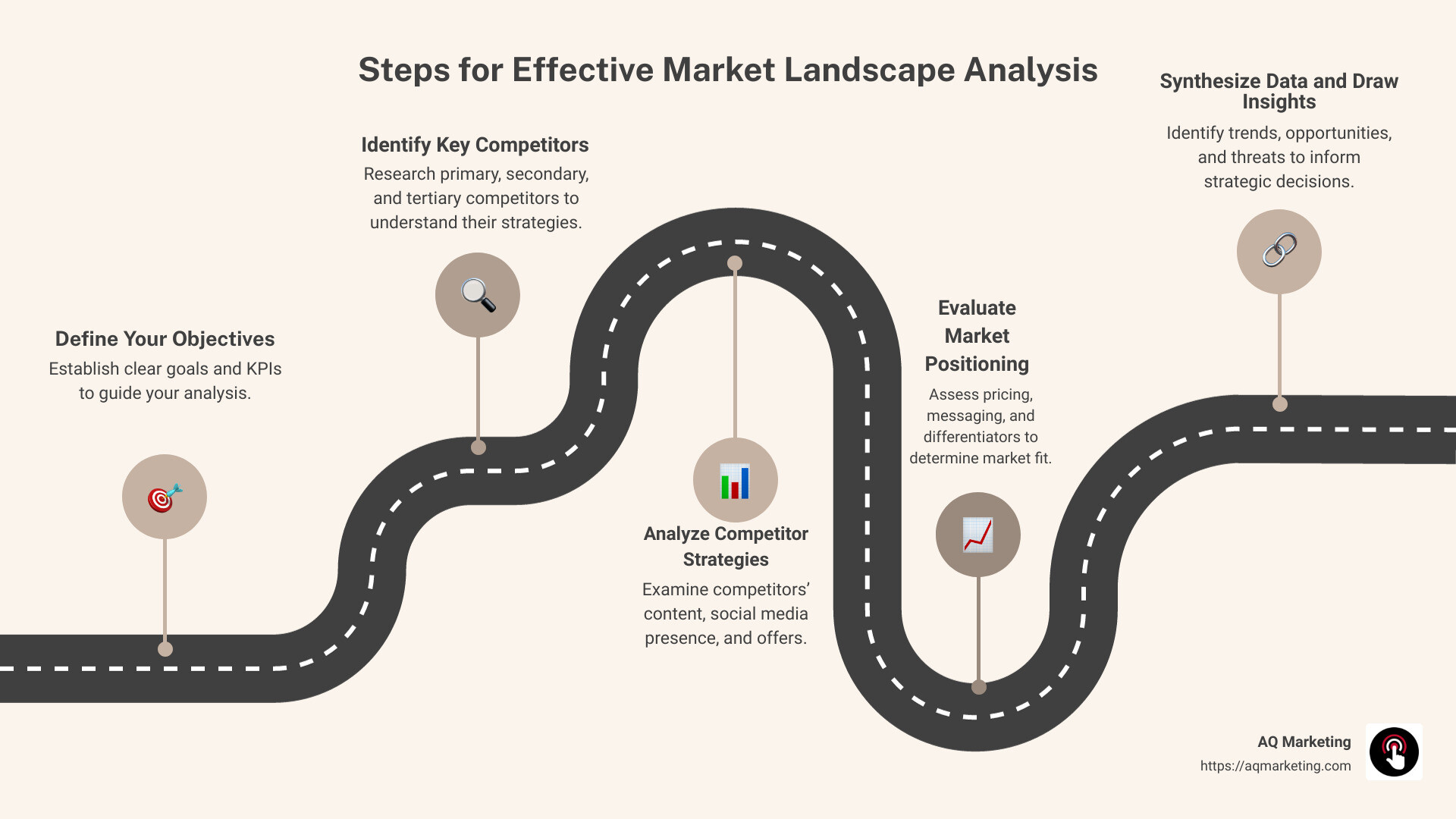
To deliver actionable strategic value, market landscape research must follow a structured implementation framework. Skipping foundational scoping steps often leads to fragmented findings that fail to support executive decision-making.
- Phase 1: Objective Scoping & KQs
- Phase 2: Competitive Mapping
- Phase 3: Qualitative Exploration
- Phase 4: Quantitative Measurement
- Phase 5: Synthesis & Strategy
Step 1: Define Strategic Objectives and Key Questions
Every research project must align with specific operational goals—such as expanding into an adjacent geographic market, evaluating a potential target for acquisition, or launching a disruptive product line. Stakeholders establish key research questions (KRQs) to establish clear boundaries for the project scope.
Step 2: Establish the Competitive Framework
Identify and categorize market participants across four specific tiers:
- Direct Competitors: Entities offering equivalent solutions to the same audience.
- Indirect Competitors: Entities providing alternative products or services that resolve the same underlying customer problem.
- Potential Entrants: Adjacent firms with the infrastructure, capital, or technology to enter the market space.
- Substitute Solutions: Non-commercial or status-quo workarounds (including manual processes or internally developed tools).
Step 3: Conduct Qualitative Exploration
Engage end users, decision-makers, and industry specialists to map the end-to-end customer journey. This phase establishes hypothesis frameworks regarding brand perception, customer friction, and emerging market demands.
Step 4: Deploy Large-Scale Quantitative Surveys
Design and launch nationally or globally representative quantitative surveys. Ensure statistical sampling meets confidence level standards (typically a 95% confidence level with a margin of error under ±3%) to enable reliable subgroup analysis across key buyer personas and geographic regions.
Step 5: Synthesize Insights and Formulate Strategy
Translate research findings into executive dashboards, positioning matrices, and growth roadmaps. The synthesis phase connects empirical data directly to strategic capital allocation, product roadmap investments, and sales enablement initiatives.
Comparative Analysis of Landscape Research Frameworks
Selecting the correct market landscape methodology depends on an organization's maturity, strategic objectives, and resource constraints. The table below outlines four primary landscape research frameworks used in business strategy.
| Framework Type | Primary Objective | Key Methodologies | Primary Data Required | Best Used For | Typical Time-to-Insight |
|---|---|---|---|---|---|
| Traditional Market Segmentation | Divide market into distinct demographic/firmographic cohorts | Large-scale quantitative surveys, cluster analysis | Demographic, firmographic, spend volume data | Mature categories with established buying patterns | 8 – 12 Weeks |
| Jobs-to-be-Done (JTBD) Landscape | Map fundamental user motivations and functional goals | Qualitative IDIs, outcome-driven innovation surveys | Behavioral workarounds, functional pain points | Early-stage innovation, disruptive product design | 6 – 10 Weeks |
| Behavioral & Attitudinal Clustering | Identify group mindsets, values, and usage patterns | Latent class analysis, factor analysis, psychographics | Survey attitudinal batteries, usage tracking | Brand repositoning, message testing, marketing campaign optimization | 8 – 10 Weeks |
| Dynamic Brand Equity & Tracking | Track relative market position, NPS, and brand strength | Longitudinal tracking, sentiment analysis | Ongoing survey panels, social media listening | Category defense, M&A monitoring, operational brand health | Continuous / Quarterly |
Strategic Benefits and Commercial ROI
High-rigor landscape research provides tangible ROI across multiple corporate functions by replacing assumptions with empirical market evidence.
- EXECUTIVE DECISION MAKING
- PRODUCT STRATEGY
- Validated Roadmaps
- Reduced Risk of Failure
- MARKETING
- Targeted Messaging
- Lower CAC
- High LTV
- M&A / CAPITAL
- Accurately Valued TAM
- Defensible Diligence
- PRODUCT STRATEGY
Product Strategy and Innovation
Product teams often build capabilities that fail to achieve commercial adoption because development priorities do not align with market demand. Landscape research provides a clear view of feature value, ensuring software and hardware engineering investments address validated, high-value customer needs.
Reduced Customer Acquisition Costs (CAC)
Understanding target segments' media consumption, information-seeking behaviors, and evaluation criteria allows marketing teams to deploy ad spend and content strategies with precision. Accurate messaging alignment reduces bounce rates, improves lead quality, and lowers CAC across digital and field channels.
M&A and Corporate Development Diligence
During merger and acquisition diligence, market landscape research validates seller claims regarding TAM size, brand loyalty, and competitive positioning. Investors rely on primary research to confirm target companies possess sustainable competitive advantages rather than temporary, non-defensible market share gains.
Common Pitfalls in Market Landscape Research
Even well-funded research projects can fail to deliver actionable strategic intelligence if common execution mistakes occur.
- Relying on Static Market Views: Treating a landscape assessment as a single, static deliverable rather than an evolving, operational database. Markets shift continuously due to technological change and macroeconomic shifts.
- Sampling Bias and Over-Indexing on Heavy Users: Surveying only existing customer bases or high-volume buyers leads to confirmation bias. Incorporating non-buyers, churned accounts, and competitor loyalists is essential to obtain a balanced market view.
- Confusing Feature Metrics with Customer Motivations: Collecting data on what features users operate without measuring why they use them leads to surface-level product iterations that miss systemic market disruptions.
- Failing to Establish Executive Ownership: Research that is isolated within research or marketing teams without executive sponsorship frequently fails to influence corporate strategy or long-term operational planning.
Frequently Asked Questions
What distinguishes Northstar market landscape research from basic competitive analysis?
Basic competitive analysis focuses primarily on existing direct competitors, their pricing models, and immediate product feature matrices. Northstar market landscape research provides a broader evaluation of the ecosystem, incorporating broader market trends, latent customer needs, regulatory dynamics, and quantitative market sizing to inform strategic direction.
How often should an enterprise update its market landscape assessment?
Enterprises in fast-moving industries (such as SaaS, fintech, or artificial intelligence) should conduct comprehensive landscape research every 18 to 24 months, supplemented by continuous quarterly signal tracking. Industries with longer development cycles (such as aerospace or pharmaceuticals) typically refresh baseline landscape research every 3 to 5 years.
What sample size is required for statistically valid landscape segmentation?
Statistically valid segmentation typically requires a minimum of 300 to 500 completed quantitative responses per target subgroup or geographic market. For global enterprise B2B studies, smaller sample sizes (100 to 200 key decision-makers) may be sufficient if the respondents represent a significant portion of market buying power.
How does Jobs-to-be-Done (JTBD) integrate with market landscape research?
JTBD shifts the focus of landscape research from demographic groupings to the underlying tasks customers are trying to accomplish. Integrating JTBD into landscape research helps identify substitute solutions and non-traditional competitors that address the same structural customer needs.
What is the typical cost and timeline for a professional market landscape study?
Comprehensive custom market landscape projects conducted by global insight firms generally range from $50,000 to over $250,000, depending on target audience accessibility, geographic scope, and sample complexity. Timelines typically span 8 to 16 weeks from project scoping to final strategic execution.
Practical Next Steps for Organizations
Organizations preparing to launch a market landscape evaluation should execute the following operational plan:
- Audit Existing Internal Data: Gather historical sales performance data, customer churn reports, Win/Loss analysis findings, and customer support logs to establish research hypotheses and prevent redundant primary data collection.
- Form a Cross-Functional Steering Committee: Assemble leadership from Product, Strategic Marketing, Sales, and Corporate Development to define key research questions and align on how research outcomes will drive capital allocation decisions.
- Select an Optimal Research Partner: Evaluate market research consultancies based on sector experience, statistical modeling capabilities, panel quality standards, and methodologies tailored to your organization's operational objectives.
Image Gallery