Navigating a Household Net Worth of 925,000: Strategies for Growth and Security
A household net worth of $925,000 in 2026 places a family in a strong financial position, typically within the top 15% to 20% of American households. While not yet in the "High Net Worth" category—usually defined as $1 million in inves...
A household net worth of $925,000 in 2026 places a family in a strong financial position, typically within the top 15% to 20% of American households. While not yet in the "High Net Worth" category—usually defined as $1 million in investable assets—this milestone represents significant "Mass Affluent" status, offering substantial stability and diverse options for retirement planning and wealth transfer.
Contents
Understanding the Landscape of a $925,000 Net Worth
As of 2026, the financial landscape has been shaped by several years of fluctuating interest rates and evolving tax codes. A net worth of $925,000 is a pivotal threshold. It is often the "bridge" period where a household transitions from the accumulation phase to the preservation and optimization phase. To manage this effectively, one must first distinguish between total net worth and investable assets.
Net worth is the sum of everything you own (assets) minus everything you owe (liabilities). At the $925,000 level, a typical household balance sheet might include:
- Primary Residence Equity: $300,000 – $450,000.
- Retirement Accounts (401k, IRA, 403b): $350,000 – $500,000.
- Liquid Savings and Taxable Brokerage: $50,000 – $100,000.
- Personal Property and Vehicles: $25,000 – $50,000.
While the "millionaire" label is just $75,000 away, the strategies required to cross that finish line involve sophisticated tax management and risk mitigation. In 2026, households at this level must be particularly wary of "lifestyle creep" and the impact of inflation on purchasing power, which has remained a consistent factor in long-term financial planning.
The Percentile Breakdown: Where You Stand in 2026
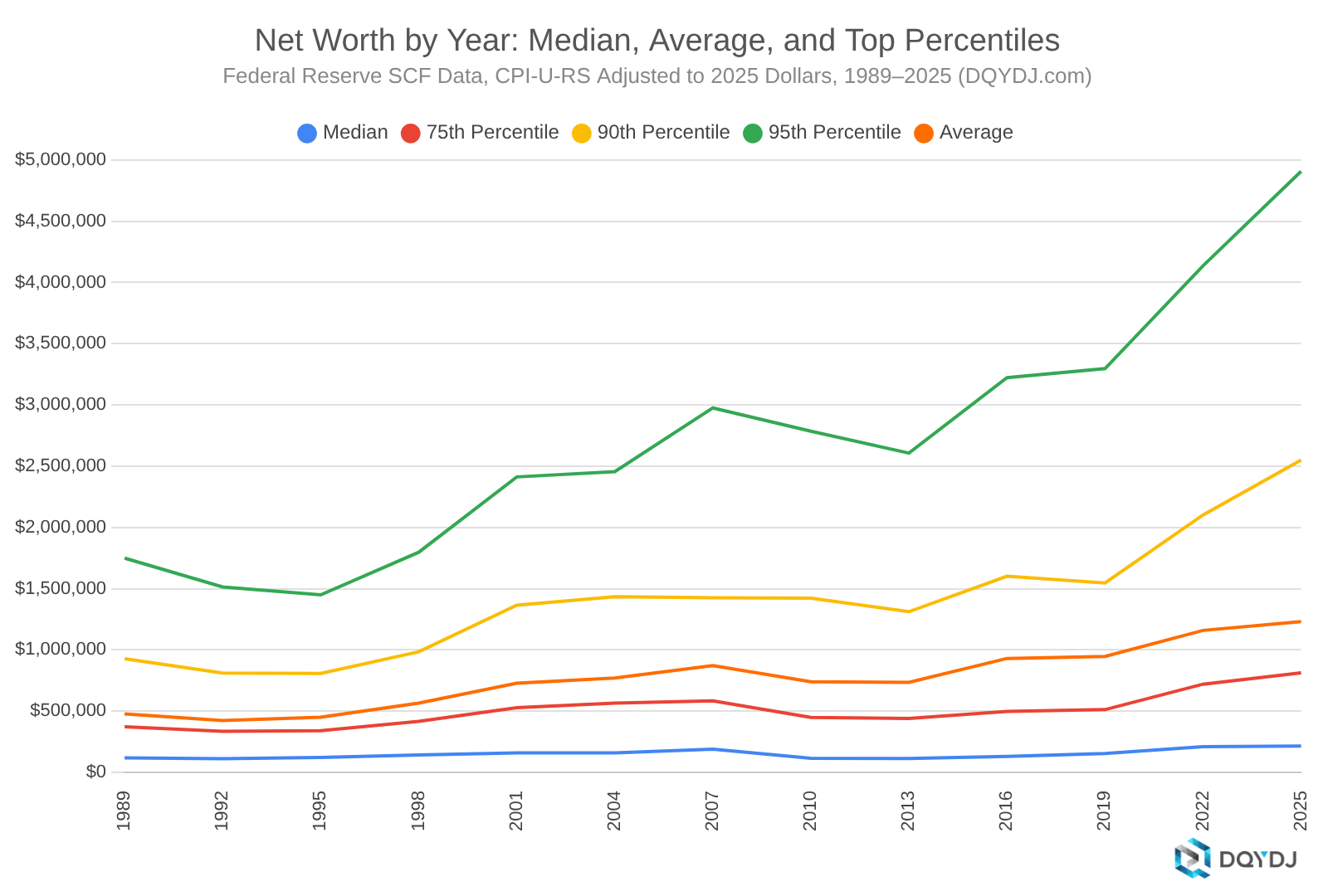
To contextualize a $925,000 net worth, it is helpful to look at demographic data. While the median net worth in the United States has seen modest growth, $925,000 remains well above the national average.
For a household headed by someone aged 45–54, $925,000 is exceptionally strong, likely placing them in the top 12% for their age bracket. However, for a household entering retirement at age 65, this figure is closer to the 75th or 80th percentile. It is a comfortable amount, but one that requires careful withdrawal strategies to ensure it lasts 30+ years in a modern economic environment.
The distinction between mean and median is crucial here. The mean (average) net worth in the U.S. is heavily skewed by the ultra-wealthy, often exceeding $1 million. The median, however, is significantly lower. Having $925,000 means your household has successfully navigated the "middle-class trap" and has enough capital to begin utilizing financial tools previously reserved for the wealthy, such as donor-advised funds or advanced tax-loss harvesting.
Strategic Asset Allocation for the Mass Affluent
When your net worth reaches $925,000, the "how" of your investments becomes as important as the "how much." Asset allocation should be dictated by your proximity to retirement and your specific liquidity needs.
Real Estate Equity vs. Liquidity
A common challenge at this wealth level is being "house rich and cash poor." If $600,000 of your $925,000 net worth is tied up in your primary residence, your actual working capital is only $325,000. In 2026, with property values stabilizing after the volatility of the early 2020s, many households are considering downsizing or utilizing Home Equity Lines of Credit (HELOCs) to rebalance their portfolios. However, maintaining a manageable debt-to-asset ratio is vital to preserving that $925,000 floor.
Tax-Advantaged Growth
Maximizing contributions to Roth 401(k)s or executing "Backdoor" Roth IRA conversions remains a primary goal for households in this bracket. Since $925,000 often coincides with peak earning years, the tax hit today may be preferable to higher taxes on withdrawals in the future. In 2026, the sunsetting of various tax provisions from previous years has made proactive tax planning essential.
Diversification Beyond Equities
At this level, households often begin looking beyond standard S&P 500 index funds. This might include:
- Dividend-Growth Stocks: To provide a passive income stream.
- Municipal Bonds: For tax-free interest income, especially relevant if the household is in a high tax bracket.
- Alternative Investments: Small allocations (5-10%) into private equity or real estate investment trusts (REITs) to reduce correlation with the stock market.
Retirement Readiness: Can You Retire on $925,000?
The feasibility of retirement with a $925,000 net worth depends heavily on your lifestyle, location, and non-portfolio income (like Social Security or a pension).
Using the 4% Rule—a standard benchmark for sustainable withdrawals—a $925,000 portfolio (assuming it is all investable) would generate approximately $37,000 per year. If $400,000 of that net worth is in home equity, the investable base drops to $525,000, yielding only $21,000 per year.
The 2026 Retirement Reality
In 2026, healthcare costs continue to be the largest "X-factor" for retirees. A household with $925,000 must account for Medicare premiums, supplemental insurance, and potential long-term care needs. For many, $925,000 is an excellent "base," but it may require supplemental income from part-time work (the "Barista FIRE" model) or a significant delay in claiming Social Security to maximize monthly payments.
| Feature | Age 35-45 (Accumulation) | Age 55-65 (Pre-Retirement) | Age 65+ (Distribution) |
|---|---|---|---|
| Primary Goal | Growth & Compounding | Risk Reduction & Catch-up | Capital Preservation |
| Housing Status | Growing Equity / Upgrading | Mortgage Near Completion | Downsizing for Liquidity |
| Investment Focus | 80/20 Equity-to-Bond | 60/40 Balanced Portfolio | 40/60 Income-Focused |
| Risk Concern | Market Volatility | Sequence of Returns Risk | Inflation & Healthcare |
| Action Step | Increase Savings Rate | Maximize Catch-up Contribs | Optimize Withdrawal Order |
Tax Optimization and Estate Planning
With a net worth approaching the $1 million mark, estate planning and tax efficiency transition from "optional" to "critical."
The Impact of the 2026 Tax Landscape
By 2026, several historical tax exemptions have shifted. Households with $925,000 should review their estate plans to ensure assets are titled correctly to avoid probate. While this level is currently well below the federal estate tax threshold, state-level inheritance taxes in certain jurisdictions can still take a significant bite out of a legacy.
Utilization of Trusts
A revocable living trust is often recommended for households at this level. It doesn't necessarily provide a tax advantage, but it ensures that the $925,000 in assets is managed according to the owner’s wishes without the delay and expense of court intervention. Furthermore, if the household has minor children or complex family dynamics, a trust provides a layer of protection that simple wills cannot.
Insurance Coverage
At $925,000, you are a "target" for litigation. A standard auto or homeowners policy may not provide sufficient liability coverage. An Umbrella Insurance Policy of $1 million to $2 million is a low-cost way (usually a few hundred dollars per year) to protect the entirety of your net worth from catastrophic legal claims.
Common Pitfalls at the $925,000 Level
Many households stall at this level or see their net worth fluctuate wildly due to a few common mistakes:
- Over-Allocation to Cash: In an environment where inflation may outpace savings account yields, keeping too much "dry powder" can erode purchasing power. A $925,000 net worth needs to stay invested to maintain its real value.
- Neglecting Fees: At this level, a 1% assets-under-management (AUM) fee amounts to $9,250 per year. If an advisor isn't providing comprehensive tax and estate planning, high fees can significantly hinder the journey to the $1 million mark.
- Ignoring the "Hidden" Liabilities: Failing to account for future tax liabilities on traditional 401(k) balances. If your $925,000 includes $500,000 in a traditional IRA, you effectively "owe" the government 15-25% of that balance in future taxes.
- Inadequate Emergency Funds: While it seems counterintuitive for a "wealthy" household, many have their $925,000 locked in illiquid assets. Maintaining 6-12 months of expenses in a high-yield savings account is still a prerequisite.
Moving from $925,000 to $1,000,000 and Beyond
Crossing the seven-figure threshold is often a psychological milestone as much as a financial one. To move from $925,000 to over $1 million, focus on the following:
- Expense Auditing: Even small reductions in recurring expenses, when redirected into a brokerage account, can close the $75,000 gap faster than market returns alone.
- Asset Location: Ensure that high-growth assets are in tax-free accounts (Roth) and income-producing assets (bonds/REITs) are in tax-deferred accounts (Traditional IRA) to minimize the annual tax drag.
- Rebalancing: If recent market gains have pushed your equity allocation too high, rebalance back to your target to protect your $925,000 floor from a potential market correction.
Frequently Asked Questions
Is $925,000 considered "rich" in 2026?
"Rich" is subjective, but statistically, a $925,000 net worth is very high compared to the average household. You are likely in the top 15% of the population. However, in high-cost-of-living (HCOL) areas like San Francisco or New York, this may be considered "middle class" due to the high cost of housing and services.
How much of my $925,000 should be in cash?
Generally, you should keep 3 to 6 months of living expenses in cash. For a household with this net worth, that typically ranges from $30,000 to $60,000. Keeping more than $100,000 in cash may lead to "cash drag," where your money loses value relative to inflation.
Should I pay off my mortgage if my net worth is $925,000?
This depends on your mortgage interest rate. If your rate is below 4%, you are likely better off keeping the mortgage and investing your extra capital in the market, which historically returns 7-10% over the long term. If your rate is higher or you are nearing retirement, the psychological and cash-flow benefits of a paid-off home may outweigh the mathematical advantages of investing.
Does $925,000 include my car and jewelry?
Yes, net worth includes all assets, including vehicles, home furnishings, and collectibles. However, for financial planning purposes, it is often better to focus on "tangible net worth" or "investable assets," which excludes personal property that you wouldn't sell to fund your lifestyle or retirement.
What is the biggest risk to a $925,000 net worth?
In 2026, the biggest risks are inflation and healthcare costs. If inflation remains higher than historical averages, the "real" value of your $925,000 will decrease over time. Additionally, a single major medical event without proper insurance can quickly deplete a six-figure portfolio.
Next Steps for Your Household
If your net worth has reached $925,000, your immediate priority should be a comprehensive financial audit. Verify your asset allocation, ensure your estate plan is current for 2026 laws, and evaluate your insurance coverage. Transitioning your mindset from "growth at all costs" to "strategic optimization" will ensure that this significant milestone serves as a permanent foundation for your family’s future.
Image Gallery