Why Online Textile Courses Work for Career Changers
Online textile courses offer career changers flexible, industry-aligned training that bridges non-textile backgrounds with specialized technical knowledge. By combining self-paced learning, digital CAD software training, material scien...
Online textile courses offer career changers flexible, industry-aligned training that bridges non-textile backgrounds with specialized technical knowledge. By combining self-paced learning, digital CAD software training, material science modules, and portfolio-building projects, these programs allow working professionals to transition into textile design, sourcing, and development without taking a sabbatical or pursuing an expensive four-year degree.
Contents
The Shift in Textile Industry Hiring and Education
The global textile, apparel, and materials sector has undergone a structural transformation driven by digital design workflows, supply chain traceability requirements, and sustainable material innovation. Traditionally, entering textile design, surface pattern design, or technical material sourcing required a multi-year, residential university degree focused on manual loom operation and physical studio dye work.
However, modern textile manufacturing relies heavily on digital sampling, computer-aided design (CAD) software, virtual prototyping, and global vendor coordination. This operational shift has opened doors for non-traditional entrants. Industry employers increasingly prioritize practical software proficiency, material science comprehension, and portfolio quality over where a candidate completed their coursework.
For career changers—professionals transitioning from graphic design, marketing, project management, fine arts, or engineering—online textile courses provide a targeted, cost-effective avenue to gain high-demand industry skills. Rather than spending years reviewing general humanities or foundational art concepts, specialized online programs allow learners to focus immediately on commercial textile applications.
Core Reasons Online Textile Courses Deliver Success for Career Changers
Career transitions carry financial, logistical, and professional risk. Online textile programs mitigate these obstacles while equipping students with practical capabilities that align with modern commercial requirements.
1. Flexible Learning Without Immediate Career Disruption
Transitioning careers often requires maintaining full-time employment for financial stability. Specialized online textile programs utilize asynchronous course delivery, allowing students to study fiber properties, loom mechanics, or digital repeating pattern math during evenings and weekends.
This model removes geographical constraints. Professionals living outside major textile hubs can enroll in top-tier programs offered by international universities or specialized technical institutions without relocating. Learners progress through dense technical subjects—such as yarn count calculations or dye chemistry—at their own pacing, rewatching demonstrations and reviewing technical diagrams as needed.
2. Industry Standard Software Mastery Over Manual Tools
While traditional academic textile programs spent significant semesters teaching manual hand-weaving and physical screen printing, the modern commercial textile sector operates primarily on digital platforms. Online textile courses emphasize digital competencies from the outset, using industry-standard tools including:
- Adobe Illustrator & Photoshop: Used for surface pattern design, vector motif creation, and technical specification (tech pack) development.
- Specialized Textile CAD (e.g., NedGraphics, Pointcarré): Applied to woven, jacquard, and print repeat setups, ensuring patterns conform to industrial machinery parameters.
- 3D Garment and Fabric Simulation (e.g., CLO 3D, Browzwear): Utilized for virtual sampling, drape analysis, and reducing physical prototyping waste.
| Traditional University Model | Modern Online Textile Course Model |
|---|---|
| Heavy physical studio focus | Digital CAD & 3D prototyping |
| Full-time campus commitment | Asynchronous, flexible pace |
| High tuition & relocation | Modular, focused curriculum |
| General education requirements | Direct portfolio development |
3. Material Science and Supply Chain Literacy
Textiles are not merely visual designs; they are physical materials engineered for performance, durability, and safety. Comprehensive online textile courses bridge the gap between creative visual skill and technical material execution.
Students receive thorough instruction in:
- Fiber Classification: Differentiating natural fibers (cotton, linen, wool, silk) from synthetic (polyester, nylon) and regenerated cellulosic fibers (viscose, lyocell, modal).
- Yarn Construction: Understanding twist directions, denier, ply count, and spun versus filament yarns.
- Fabric Structures: Analyzing plain weaves, twills, satins, circular knits, and non-woven structures.
- Testing & Compliance: Learning standard physical test procedures for tensile strength, colorfastness, abrasion resistance (Martindale/Wyzenbeek), and regulatory standards such as REACH or TSCA.
Understanding these technical parameters prevents career changers from creating designs that are aesthetically pleasing but structurally unfeasible or financially impractical to manufacture.
4. Direct Project-Based Portfolio Development
In the commercial textile industry, a candidate's portfolio is their primary credential. Employers and freelance clients look for proof that an applicant understands repeat balance, colorway variations, structural specifications, and end-use suitability (such as upholstery vs. apparel).
Online textile programs structure their assignments around commercial briefs. Students create complete collections featuring hero prints, coordinating patterns, woven structural callouts, and factory-ready spec sheets. Upon course completion, learners hold a professional portfolio that demonstrates practical readiness directly to hiring managers.
Mapping Transferable Skills to Textile Roles
Career changers rarely start from zero. The most successful transitions occur when professionals combine their existing skill sets with specialized textile education. Online courses help students identify and leverage these core competencies.
| Background Field | Transferable Skills | Target Textile Specialization | Primary Online Modules Needed |
|---|---|---|---|
| Graphic Design | Layout, typography, color theory, vector software | Surface Pattern Designer, Print Developer | Repeat patterns, textile substrates, digital printing tech |
| Chemical Engineering | Laboratory methods, polymer science, data analysis | Textile Technologist, Sustainable Dye Specialist | Fiber chemistry, finish application, compliance testing |
| Project Management | Vendor management, scheduling, budgeting | Textile Sourcing Manager, Supply Chain Coordinator | Mill operations, fabric costing, international logistics |
| Interior Design | Spatial planning, client management, aesthetic curation | Contract & Residential Textile Developer | High-traffic upholstery, fire ratings, woven structures |
| Fine Arts / Painting | Illustration, mark-making, hand technique | Studio Print Designer, Trend Forecaster | Digitizing hand art, repeat conversion, seasonal mapping |
By identifying where previous professional experience intersects with textile production, career changers can target specialized niches within the industry rather than competing solely for entry-level generalist positions.
Comparing Learning Pathways for Career Changers
Evaluating educational options requires balancing financial cost, time commitment, and targeted career outcomes. The table below outlines how specialized online textile courses compare against traditional academic degrees and self-directed study.
| Evaluation Metric | Specialized Online Textile Course | Four-Year University Degree | Unstructured Self-Study |
|---|---|---|---|
| Average Timeframe | 3 to 12 months | 2 to 4 years | Variable (often inefficient) |
| Financial Investment | Low to Moderate ($500 – $4,000) | Very High ($30,000 – $100,000+) | Low ($50 – $300 for books/tools) |
| Flexibility | High (Asynchronous learning) | Low (Fixed schedule, campus presence) | Maximum (Self-guided) |
| Curriculum Focus | Industry-targeted technical skills | Broad academic & general education | Fragmented & unverified |
| Software Instruction | Intensive (CAD, vector repeats, 3D) | Varies by institution | Self-taught via scattered tutorials |
| Feedback Mechanism | Professional instructor review | In-person critiques | None or public forum feedback |
| Portfolio Outcome | Targeted commercial portfolio | Multi-subject academic portfolio | Ad-hoc personal projects |
Step-by-Step Transition Roadmap for Prospective Students
Transitioning into textiles requires a structured approach to ensure time and financial resources yield tangible career outcomes.
Step 1: Define Your Specific Industry Niche
The textile sector is vast. Before selecting a course, determine your target focus:
- Apparel Textiles: Focuses on drape, stretch, hand-feel, trend forecasting, and seasonal color stories.
- Home & Interior Textiles: Prioritizes heavy-weight wovens, abrasion resistance, lightfastness, and large-scale repeat designs for bedding, curtains, and upholstery.
- Technical & Industrial Textiles: Focuses on performance fabrics, moisture-wicking properties, flame retardancy, and composite materials for automotive, medical, or outerwear use.
Step 2: Select a Course with Verified Technical Content
Ensure your chosen online course covers both creative design and technical production fundamentals. Look for curricula that explicitly cover software instruction (Adobe Illustrator pattern tools, CAD software), fabric construction theory, repeat types (drop-repeat, block-repeat), and factory communication tools (tech packs).
Step 3: Build a Practical Physical-Digital Studio Space
While course delivery is digital, textiles remain a physical medium. Assemble a dedicated home study studio equipped with:
- Physical Swatch Library: Obtain fabric swatch books (such as standardized cotton or synthetic reference collections) to learn tactile identification.
- Basic Identification Tools: A 10x thread counter (pick glass), a digital micrometer for fabric thickness, and a handheld burn-test kit for fiber identification.
- Hardware & Software: A calibrated monitor to ensure accurate color display, a digital drawing tablet, and updated design software.
Recommended Setup for Online Textile Students:
- Calibrated Monitor / Digital Drawing Tablet
- Design Software (CAD/Vector)
- Physical Swatch Kit + 10x Pick Glass
- Technical Spec Sheet Output
Step 4: Execute Brief-Driven Portfolio Projects
Avoid creating disjointed artwork. Structure your portfolio projects as complete commercial presentations:
- Market Brief: State the target market, price point, and end product (e.g., sustainable activewear for outdoor apparel).
- Concept & Color Board: Establish seasonal color palettes using standardized color systems (such as Pantone TPG/TCX).
- Pattern/Fabric Collection: Include 1 main hero print, 2-3 supporting coordinates, and structural fabric callouts.
- Technical Package: Detail pattern repeat dimensions, fabric weight (GSM), fiber content, printing method (digital, screen, rotary), and colorway specs.
Overcoming Common Challenges in Online Textile Education
While online textile courses offer significant advantages, remote learning presents specific practical challenges that require proactive strategies.
Addressing the Loss of Tactile Feedback
The primary challenge of learning textiles online is the inability to feel fabrics physically during a lecture. Online programs compensate by incorporating standardized physical swatch books into their required course materials. Students analyze physical swatches corresponding to digital lessons, conducting tactile evaluations, stretch recovery tests, and burn tests at home while following along with video instruction.
Building Professional Networks Remotely
Traditional campus environments provide natural networking opportunities with peers and alumni. Online learners must intentionally cultivate industry relationships. Effective strategies include:
- Joining professional trade organizations such as the American Association of Textile Chemists and Colorists (AATCC) or the Textile Institute.
- Participating actively in course-exclusive community forums, peer review sessions, and instructor office hours.
- Attending regional industry trade shows (such as Premiere Vision, Texworld, or Heimtextil) to meet suppliers, mills, and studios in person.
Frequently Asked Questions
Can I really learn textile design online without a formal art degree?
Yes. Modern textile design relies heavily on technical software mastery, spatial reasoning, understanding repeat math, and material knowledge—skills that can be fully acquired through structured online training. Hiring managers prioritize portfolio quality and technical accuracy over a formal fine art diploma.
What hardware and software do I need before starting an online textile course?
Most online courses require a computer capable of running graphic design software smoothly (at least 16GB RAM recommended), a graphics tablet for drawing, and subscriptions to standard design software like Adobe Creative Cloud. A calibrated monitor is also highly recommended to ensure color accuracy across screens and print output.
How long does it take to complete a career transition into textiles using online courses?
Most focused online programs take between 3 and 12 months to complete on a part-time basis. Depending on your prior background and time dedication, building a full commercial portfolio and securing an entry-level or freelance position typically takes between 6 and 18 months total.
Are online textile certificates respected by commercial employers?
Employers evaluate candidates primarily on portfolio quality, technical knowledge (such as factory spec preparation), and software proficiency. While the certificate demonstrates commitment, your digital portfolio and your ability to speak accurately about fiber properties, dye methods, and repeat parameters during technical interviews are what secure job offers.
What is the difference between surface pattern design and textile technology?
Surface pattern design focuses on visual aesthetics, artwork creation, colorways, and pattern repeats applied to fabrics. Textile technology focuses on material science, fiber engineering, yarn structure, dye chemistry, and performance testing. Many online courses allow you to focus on one stream or study a blend of both.
Strategic Recommendations for Career Changers
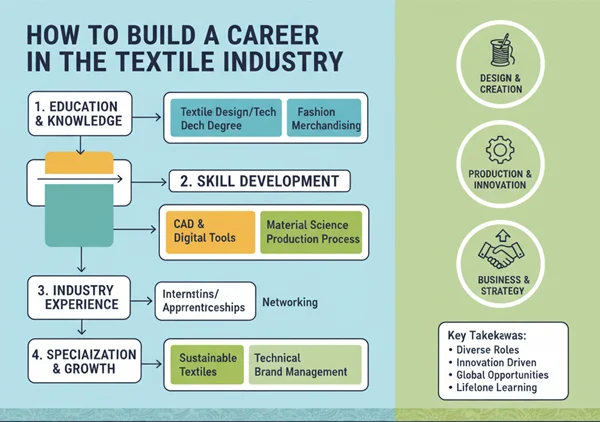
If you are ready to transition into the textile industry through online education, execute the following steps to maximize your investment:
- Audit Your Current Skill Set: Identify transferable competencies from your present career (e.g., project management, chemical processing, graphic layout) and target textile roles that build upon those strengths.
- Select Industry-Aligned Education: Choose online courses that provide instructor feedback, physical swatch integration, and technical software training rather than purely video-based self-study tutorials.
- Invest in Physical Swatches: Purchase standard industry textile swatch kits alongside your digital course to ensure your physical material knowledge keeps pace with your visual design skills.
- Prioritize Portfolio Utility: Focus your course assignments on technical commercial briefs containing factory specifications, repeat dimensions, and end-use considerations rather than isolated decorative illustrations.
By combining self-paced technical education with targeted portfolio development, career changers can bypass traditional educational barriers and successfully transition into dynamic roles within the global textile sector.
Image Gallery