Understanding Intrastate Commercial Auto Insurance Requirements in Illinois
Intrastate commercial auto insurance in Illinois requires businesses operating vehicles exclusively within state borders to carry specific liability coverages mandated by the Illinois Secretary of State, the Illinois Commerce Commissio...
Intrastate commercial auto insurance in Illinois requires businesses operating vehicles exclusively within state borders to carry specific liability coverages mandated by the Illinois Secretary of State, the Illinois Commerce Commission (ICC), and the Illinois Department of Transportation (IDOT). Coverage minimums range from basic statutory limits to $750,000 or $5,000,000 depending on vehicle weight, cargo, and passenger capacity.
Contents
Disclaimer
This article provides general informational guidance regarding commercial motor vehicle insurance rules in Illinois. Insurance regulations, state statutes, and administrative rules change periodically. Business owners should consult the Illinois Commerce Commission (ICC), the Illinois Department of Transportation (IDOT), or a licensed commercial insurance agent to verify exact filing and limit requirements for their specific operational profile.
What Distinguishes Intrastate from Interstate Commercial Motor Vehicle Operations in Illinois?
Understanding the regulatory boundary between intrastate and interstate commerce is the critical first step in structuring a compliant commercial auto insurance policy in Illinois. The legal definition of your route determines which government bodies hold jurisdiction over your operations, what financial responsibility filings you must maintain, and what baseline coverage limits your business must purchase.
An intrastate commercial operation occurs when a vehicle, driver, and cargo or passengers originate, travel, and complete their journey entirely within the boundaries of the State of Illinois. Even if a shipment travels hundreds of miles—such as a freight haul from Cairo in Southern Illinois to Rockford in Northern Illinois—it remains strictly intrastate as long as the vehicle does not cross state lines and the cargo did not originate outside Illinois as part of a continuous interstate movement.
Conversely, an interstate operation involves crossing state lines or transporting freight or passengers that are part of a multi-state supply chain. For instance, if a delivery van picks up goods at a warehouse in Chicago and delivers them to Hammond, Indiana, that movement falls under federal jurisdiction. Federal rules administered by the Federal Motor Carrier Safety Administration (FMCSA) immediately apply.
In Illinois, intrastate motor carriers are primary governed by state entities:
- The Illinois Commerce Commission (ICC): Regulates intrastate motor carriers of property and household goods for hire, establishing rules for operating authority, safety, and financial responsibility filings.
- The Illinois Department of Transportation (IDOT): Enforces commercial motor vehicle safety standards, weight restrictions, and safety testing mandates across state highways.
- The Illinois Secretary of State (SOS): Manages basic motor vehicle registrations, titling, and mandatory minimum personal and commercial auto insurance compliance under the Illinois Vehicle Code (625 ILCS 5).
Businesses operating exclusively within Illinois often enjoy streamlined regulatory processes compared to interstate carriers, but they must still comply with rigorous financial responsibility laws designed to protect the public from severe accidents involving heavy equipment.
Mandatory Minimum Liability Coverage Requirements in Illinois
Illinois imposes tiered financial responsibility mandates on commercial vehicles based on three primary metrics: Gross Vehicle Weight Rating (GVWR), use case (for-hire vs. private carrier), and type of load (general freight, passengers, or hazardous materials).
1. Basic State Minimum Auto Liability (Light Commercial Vehicles)
For light-duty commercial vehicles (such as company cars, small service vans, or pickup trucks with a GVWR of 10,000 pounds or less) that are not operating as regulated motor carriers of property for hire, Illinois statutory minimum liability limits match standard auto requirements under 625 ILCS 5/7-601:
- $25,000 for bodily injury or death of one person in an accident.
- $50,000 for total bodily injury or death per accident involving two or more persons.
- $20,000 for injury to or destruction of property of others in an accident.
While these statutory minimums fulfill basic vehicle registration laws, they are rarely sufficient for commercial enterprises. Most commercial lenders, contracts, and risk managers require a minimum $1,000,000 Combined Single Limit (CSL) policy to protect corporate assets against severe injury claims.
2. Intrastate Freight Carriers (GVWR Over 10,000 to 18,000+ lbs)
When a commercial vehicle crosses into heavy-vehicle territory or operates as a for-hire motor carrier regulated by the ICC, liability limits increase significantly to align with safety expectations:
- For-Hire Freight Carriers (Non-Hazardous): Property carriers operating intrastate with vehicles exceeding 10,000 pounds GVWR generally must carry a minimum of $750,000 Combined Single Limit (CSL) in auto liability coverage.
- Heavy Intrastate Vehicles: Vehicles with a GVWR of 18,001 pounds or more operating intrastate must register for an intrastate Illinois USDOT number via IDOT and maintain appropriate public liability protection.
3. Passenger-Carrying Vehicles
Transporting people carries significantly higher risk exposures. Illinois enforces strict financial responsibility tiers based on vehicle seating capacity:
- 1 to 8 Passengers (For-Hire Taxicabs, Livery, Small Shuttles): Generally subject to municipal licensing mandates and state thresholds, typically requiring $250,000/$500,000/$50,000 or a minimum $500,000 Combined Single Limit.
- 9 to 15 Passengers: Intrastate passenger carriers operating vehicles designed to transport 9 to 15 passengers (including the driver) for compensation must maintain at least $1,500,000 in liability coverage.
- 16 or More Passengers: Buses, large shuttles, and motor coaches designed to carry 16 or more passengers require a minimum of $5,000,000 in liability coverage.
4. Hazardous Materials (Hazmat) Transportation
Carriers transporting hazardous substances intrastate within Illinois must carry specialized liability coverage matching federal environmental safety tiers:
- $1,000,000 CSL: For transport of oil, certain hazardous waste materials, and specific non-bulk hazardous commodities.
- $5,000,000 CSL: For transport of high-risk hazardous materials in cargo tanks, portable tanks, or hopper-type vehicles with capacities exceeding 3,500 gallons, or any transport of Division 1.1, 1.2, or 1.3 explosives, poison gas, or radioactive materials.
Detailed Coverage Breakdown: Mandatory vs. Recommended Policies
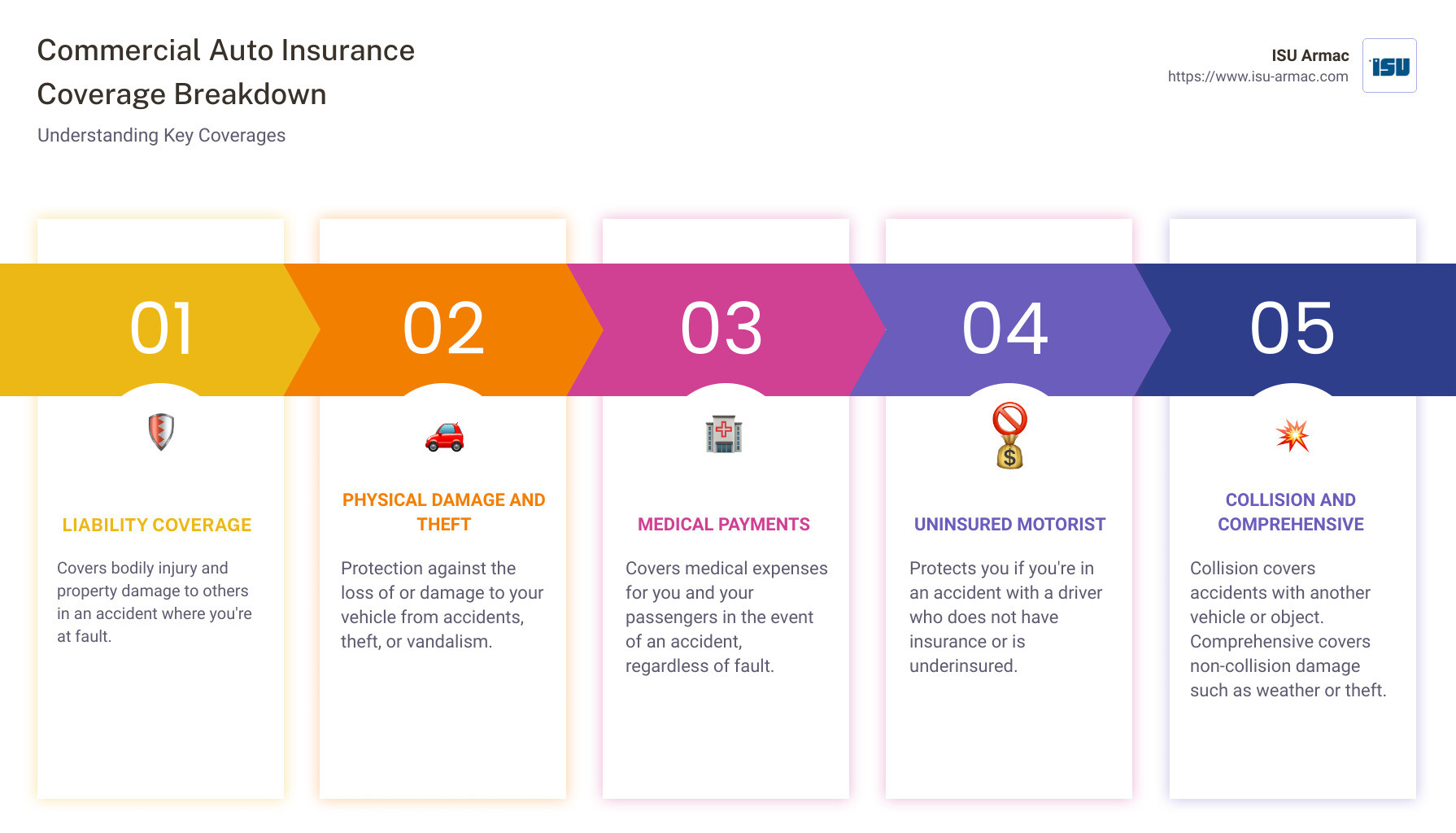
A compliant commercial auto policy in Illinois consists of multiple distinct coverage types. While state regulators focus primarily on public liability to protect third parties, fleet owners must assemble comprehensive protection to safeguard physical assets and operational continuity.
- Illinois Commercial Auto Coverage
- Mandatory Public Protection
- Auto Liability (CSL)
- Form E State Filing
- Uninsured Motorist (UM)
- First-Party & Property
- Collision Coverage
- Comprehensive Coverage
- Motor Truck Cargo
- Hired & Non-Owned Auto
- Mandatory Public Protection
Primary Auto Liability Coverage
Primary liability insurance covers bodily injury and property damage for which your business or drivers are legally held responsible following a motor vehicle collision. In Illinois commercial policies, this is typically written as a Combined Single Limit (CSL), which applies one total dollar amount (e.g., $1,000,000) to all injury and property damage claims arising from a single accident, rather than split limits.
Physical Damage Coverage (Collision & Comprehensive)
State law does not mandate physical damage coverage for your own vehicles, but commercial lenders and leasing companies almost universally require it:
- Collision Coverage: Pays for damage to your insured vehicle resulting from a collision with another vehicle or object, or a vehicle rollover.
- Comprehensive Coverage: Pays for vehicle loss or damage resulting from non-collision events, including theft, vandalism, fire, weather damage (such as hail or windstorms common in the Midwest), or collisions with animals.
Motor Truck Cargo Insurance
For-hire carriers transporting property owned by third parties need motor truck cargo insurance. While the ICC regulates household goods movers under strict tariff and insurance rules requiring cargo filings (Form H), standard freight carriers carry cargo insurance to fulfill shipper contract terms. Coverage limits typically range from $50,000 to $250,000 depending on the nature and value of the transported goods.
Uninsured / Underinsured Motorist Coverage (UM/UIM)
Under Illinois law (625 ILCS 5/7-203), commercial policies must include Uninsured Motorist (UM) coverage for bodily injury equal to the statutory minimum liability limits ($25,000/$50,000), unless rejected in writing where permitted by statute. This protects your drivers if they are struck by an uninsured or hit-and-run motorist while operating a company vehicle.
Hired and Non-Owned Auto Liability (HNOA)
If your business requires employees to drive their personal vehicles for business errands (such as going to the bank, visiting clients, or delivering paperwork) or if your business rents vehicles, standard commercial liability may not cover those movements. Hired and Non-Owned Auto (HNOA) endorsement fills this gap by extending your commercial liability protection to secondary vehicles used on behalf of the company.
Key Regulatory Filings and State Oversight Bodies
Operating an intrastate commercial vehicle fleet in Illinois involves active compliance monitoring through official state filings. Insurance policies are verified by state agencies through standardized certificates submitted directly by insurance carriers.
The Form E Filing (Certificate of Financial Responsibility)
For carriers requiring intrastate operating authority through the Illinois Commerce Commission (ICC), simply purchasing an insurance policy is insufficient. The insurer must execute and file a Form E (Uniform Motor Carrier Bodily Injury and Property Damage Liability Certificate of Insurance) directly with the ICC.
- Purpose: Proves to state regulators that the carrier maintains continuous mandatory public liability insurance.
- Cancellation Rule: An insurer cannot cancel a policy backed by a Form E filing without providing 30 days advance written notice to the ICC. If coverage lapses, the ICC automatically suspends the carrier’s operating authority.
Illinois Commerce Commission (ICC) Motor Carrier Authority
Intrastate for-hire property carriers and household goods movers must apply for operating authority through the ICC’s Transportation Division. Operating without active ICC authority and required insurance filings can result in civil penalties, vehicle impoundment, and cease-and-desist orders.
Illinois USDOT Number (IDOT Mandate)
Illinois requires intrastate commercial carriers operating vehicles over 18,000 lbs GVWR (or transporting hazardous materials / passengers) to register for a USDOT Number designated strictly for intrastate operations. This allows IDOT and the Illinois State Police Commercial Vehicle Section to monitor carrier safety ratings, roadside inspection records, and crash histories.
Illinois Intrastate Insurance & Filing Requirements Summary
The table below outlines coverage minimums and mandatory filings across common intrastate commercial vehicle categories in Illinois:
| Operational Category | Vehicle Weight / Seating | Minimum Auto Liability Limit | Mandatory State Filings | Primary Regulatory Agency |
|---|---|---|---|---|
| Private Fleet (Service/Trades) | $\le$ 10,000 lbs GVWR | $25,000 / $50,000 / $20,000 (Statutory) | Standard Insurance Card | IL Secretary of State |
| Private Heavy Commercial | 10,001 to 18,000 lbs GVWR | $750,000 CSL (Recommended) | IL USDOT Registration | IDOT / SOS |
| For-Hire Freight (Intrastate) | > 10,000 lbs GVWR | $750,000 Combined Single Limit | Form E, ICC Authority | ICC / IDOT |
| Household Goods Movers | Any Commercial GVWR | $750,000 CSL + Cargo | Form E, Form H, ICC License | ICC |
| Small Passenger Carrier | 9 to 15 Passengers | $1,500,000 Combined Single Limit | Form E, Passenger Authority | ICC / IDOT |
| Large Bus / Charter | 16+ Passengers | $5,000,000 Combined Single Limit | Form E, Safety Certificate | ICC / IDOT |
| Hazmat (Bulk / Explosives) | Any Commercial Vehicle | $5,000,000 Combined Single Limit | Form E, Hazmat Permit | IDOT / ICC / ISP |
Common Compliance Pitfalls and Cost Factors for Illinois Carriers
Navigating Illinois commercial auto insurance requires avoiding operational errors that can jeopardize coverage or trigger regulatory fines.
1. Misclassifying Personal vs. Commercial Use
Small business owners often operate pickup trucks or vans under personal auto policies while using them for trade activities, such as carrying tools, delivering products, or pulling work trailers. Personal auto policies in Illinois contain explicit commercial use exclusions. If an accident occurs while performing business operations, the insurer may deny claims entirely, exposing the business owner to personal liability.
2. Allowing Form E Filings to Lapse
Because the ICC requires 30 days notice for Form E cancellations, changing insurance carriers requires careful coordination. If your old policy is canceled before your new insurer successfully submits a replacement Form E filing to the ICC, your operating authority will be suspended immediately. Driving during an authority suspension leads to heavy fines during roadside inspections by the Illinois State Police.
3. Key Underwriting Factors Affecting Premiums in Illinois
Insurance carriers calculate commercial auto premiums in Illinois using specific localized parameters:
- Territory & Radius: Operating primarily within high-density urban areas like the Chicago Metropolitan Area (Cook, DuPage, and Lake Counties) results in higher premiums than operating exclusively downstate due to traffic density, litigation frequency, and collision statistics.
- Motor Vehicle Records (MVRs): Illinois insurers strictly evaluate driver qualification files. Drivers with major violations (such as DUI, reckless driving, or speeding 15+ mph over the limit) significantly increase fleet surcharges.
- Gross Vehicle Weight (GVW): Heavier vehicles cause more kinetic damage in collisions, raising bodily injury loss reserves and premium bases proportionally.
- Loss History (Loss Runs): Insurers evaluate 3 to 5 years of commercial loss runs. Unfavorable loss ratios lead to severe renewal rate hikes or non-renewals.
Step-by-Step Guide to Securing Compliant Illinois Intrastate Coverage
To establish compliant commercial auto insurance while minimizing premium costs, business operators should follow a structured deployment strategy.
- STEP 1: Define Operational Profile & Vehicle Weights
- STEP 2: Secure Intrastate Authority & IL USDOT (ICC/IDOT)
- STEP 3: Bind Policy with Licensed Commercial Agent
- STEP 4: Confirm Form E / Form H Submissions to ICC
- STEP 5: Issue Cab Cards & Maintain Safety Records
Step 1: Inventory Fleet and Establish Operational Profile
Catalog every vehicle intended for business use. Document the VIN, Gross Vehicle Weight Rating (GVWR), primary garaging address, driving radius, and intended cargo type. Determine whether operations are strictly private (moving your own equipment) or for-hire (transporting goods or people for compensation).
Step 2: Obtain Necessary Registration and Authority
- For intrastate vehicles over 18,000 lbs GVWR, apply for your intrastate USDOT number through the IDOT portal.
- For-hire property carriers must register with the ICC to secure an intrastate motor carrier license (ILCC authority).
Step 3: Work with a Dedicated Commercial Insurance Broker
Partner with an insurance broker licensed in Illinois who specializes in commercial transportation. Request quote structures that include required state filings (Form E, Form H, or BMC-91X if dual-certifying) and ensure policy limits meet or exceed both statutory minimums and contractual customer requirements.
Step 4: Verify Electronic State Filings
Do not place vehicles on the road until your insurer confirms that the Form E certificate has been officially filed and accepted by the ICC Transportation Division. Keep hard copies of your policy, certificate of insurance, and ICC authority documentation in every vehicle cab.
Step 5: Implement Ongoing Driver & Safety Controls
Maintain compliant Driver Qualification (DQ) files for every commercial driver. Regularly pull Illinois MVR reports, enforce strict cell phone and anti-distraction policies in accordance with Illinois traffic law, and maintain vehicle maintenance logs to satisfy IDOT safety inspection standards.
Frequently Asked Questions
Do I need a USDOT number if I only drive commercially inside Illinois?
Yes, if your commercial vehicle has a GVWR of 18,001 pounds or more, transports 9 or more passengers for hire, or hauls hazardous materials requiring safety placards. Illinois law mandates an intrastate USDOT registration administered in cooperation with IDOT, even if you never cross state lines.
What happens if an insurer cancels my Form E filing in Illinois?
The insurer is required by law to give the ICC 30 days advance notice before terminating a Form E filing. During this 30-day window, you must secure a replacement policy and have your new insurer file a new Form E. If no filing is received by the expiration date, the ICC automatically revokes your operating authority.
Is motor truck cargo insurance mandatory for all commercial trucks in Illinois?
State regulatory mandates strictly require cargo filings (Form H) for licensed household goods movers. While general freight carriers are not legally required by the ICC to hold cargo insurance, almost all commercial shippers and freight brokers require carriers to carry at least $100,000 in cargo coverage before tendering loads.
Can I use a personal auto policy for my sole proprietorship business in Illinois?
Only if your vehicle usage qualifies as minor commuting or non-commercial travel. If you transport tools, goods, employees, or tow commercial trailers, standard personal auto policies exclude coverage for business-related claims. Operating a commercial venture on a personal auto policy risks complete claim denials following an accident.
What is the difference between split liability limits and a Combined Single Limit (CSL)?
Split limits divide coverage into maximum payouts per person for bodily injury, total bodily injury per accident, and property damage (e.g., $25,000/$50,000/$20,000). A Combined Single Limit (CSL) sets one overall limit (such as $750,000 or $1,000,000) that pays out for any combination of bodily injury and property damage expenses arising from one accident. Commercial policies overwhelmingly utilize CSL structures.
Practical Action Plan for Illinois Fleet Operators
To ensure continuous regulatory compliance and protect your business against financial loss, audit your intrastate insurance program annually:
- Audit Fleet Classifications: Review all registered vehicles to ensure GVWR classifications match current operating weights and attached trailer configurations.
- Review Intrastate Filings: Confirm with your insurance agent that active Form E certificates are on record with the Illinois Commerce Commission.
- Inspect Driver Files: Pull annual motor vehicle records for all drivers operating company equipment to catch license suspensions or violations early.
- Evaluate Umbrella Limits: Consider adding a Commercial Umbrella or Excess Liability policy (typically $1,000,000 to $5,000,000) to protect your business against catastrophic nuclear verdicts in high-exposure metropolitan corridors like Cook and Collar counties.
Image Gallery