The Market Cap for Life Insurance Explained
Market capitalization, or "market cap," in the life insurance industry represents the total market value of a publicly traded insurance company’s outstanding shares of stock. It is calculated by multiplying the current share price by t...
Market capitalization, or "market cap," in the life insurance industry represents the total market value of a publicly traded insurance company’s outstanding shares of stock. It is calculated by multiplying the current share price by the total number of shares outstanding, providing a snapshot of the company's size, equity value, and perceived stability in the global financial market.
Contents
While market cap is a universal metric across all sectors, its application within the life insurance industry is unique. Unlike tech companies valued on rapid growth or retail companies valued on inventory turnover, life insurers are valued based on their ability to manage long-term liabilities, maintain massive investment portfolios, and adhere to strict regulatory capital requirements. Understanding market cap is essential for both investors looking for dividends and policyholders seeking to gauge the financial endurance of their coverage provider.
Defining Market Cap in the Context of Life Insurance
The formula for market cap is straightforward: Current Share Price × Total Number of Outstanding Shares = Market Capitalization. However, the components that drive these numbers in the life insurance sector are complex.
The Role of Share Price
In the insurance world, the share price is heavily influenced by interest rate environments. Life insurance companies collect premiums and invest them—primarily in fixed-income securities—to ensure they can pay out future claims. When interest rates rise, the projected income from these investments often increases, potentially driving the share price higher. Conversely, in a low-interest-rate environment, margins are squeezed, which can suppress the market cap.
Shares Outstanding
This includes all shares held by institutional investors, company insiders, and retail shareholders. Insurance companies frequently engage in share buybacks or new issuances to manage their capital position. A company that aggressively buys back its own shares is often signaling that it believes its market cap does not fully reflect its intrinsic value, whereas a new issuance might be used to fund an acquisition or bolster reserves.
The Hierarchy of Market Cap Tiers
The life insurance market is divided into tiers that help categorize risk and stability. As of 2026, the landscape remains dominated by "Mega-cap" and "Large-cap" entities that operate across multiple continents.
- Mega-Cap (Over $100 Billion): These are the global giants. They often operate as financial conglomerates, offering life insurance, annuities, and asset management. Their market cap reflects a "too big to fail" status and deep diversification.
- Large-Cap ($10 Billion – $100 Billion): This tier includes well-known national and international brands. They offer high liquidity for investors and are generally considered stable "Blue Chip" stocks.
- Mid-Cap ($2 Billion – $10 Billion): Often regional players or specialized insurers. These companies may have higher growth potential but carry more volatility than their larger counterparts.
- Small-Cap (Under $2 Billion): Typically niche insurers or tech-heavy "InsurTech" firms. While their market caps are lower, they represent the front line of industry innovation.
Why Market Cap Matters to Policyholders and Investors
It is a common misconception that market cap is only relevant to Wall Street. For a life insurance policyholder, the market cap of their provider serves as an indirect indicator of financial health.
Security and Longevity
Life insurance is a multi-decadal commitment. A company with a multi-billion dollar market cap usually has the institutional "weight" to weather economic downturns. While market cap is not the same as a solvency ratio or a credit rating from agencies like A.M. Best or S&P Global, a high market cap generally correlates with the ability to access capital markets quickly if additional liquidity is needed to pay claims.
Dividend Reliability
Many life insurance stocks are staples in income-focused portfolios. Large-cap insurers often use their steady cash flows to pay consistent dividends. Investors look at the market cap to understand the "yield" (dividend per share divided by share price). A stable market cap suggests that the company is not over-leveraged and can maintain its payouts to shareholders without jeopardizing its obligations to policyholders.
Market Cap vs. Assets Under Management (AUM)
A critical distinction in the insurance sector is the difference between what a company is "worth" (market cap) and the amount of money it "manages" (Assets Under Management).
Life insurance companies often have AUM that is significantly higher than their market cap. For example, a company might have a market cap of $50 billion but manage over $500 billion in assets. This is because the AUM includes the premiums paid by policyholders, which are technically liabilities for the company (since they must eventually be paid out as death benefits or annuity payments). The market cap represents only the equity value—the value that belongs to the shareholders after all liabilities are accounted for.
Key Factors Influencing Insurance Market Caps in 2026
As we navigate 2026, several industry-specific factors are exerting unique pressure on the market caps of life insurance providers.
- Macroeconomic Interest Rates: The transition away from the "lower-for-longer" rate era of the early 2020s has fundamentally reshaped valuations. Insurers with large blocks of legacy business have seen their market caps expand as their reinvestment rates improved.
- Regulatory Capital Requirements: Global standards like Solvency II in Europe and Risk-Based Capital (RBC) in the United States dictate how much cash an insurer must keep on hand. Stricter regulations can lower a market cap by limiting the amount of cash a company can return to shareholders.
- InsurTech Integration: Companies that have successfully integrated AI into underwriting and claims processing often enjoy a "tech premium" in their valuation. Investors are willing to pay more for a company that can lower its operational expense ratio.
- Demographic Shifts: The "Great Wealth Transfer" and the aging Boomer population mean that life insurers are seeing a massive shift from "accumulation" products (selling policies) to "decumulation" products (paying out annuities). Market caps reflect how well a company is managing this transition.
Top Global Life Insurers by Estimated Market Cap (2026 Perspective)
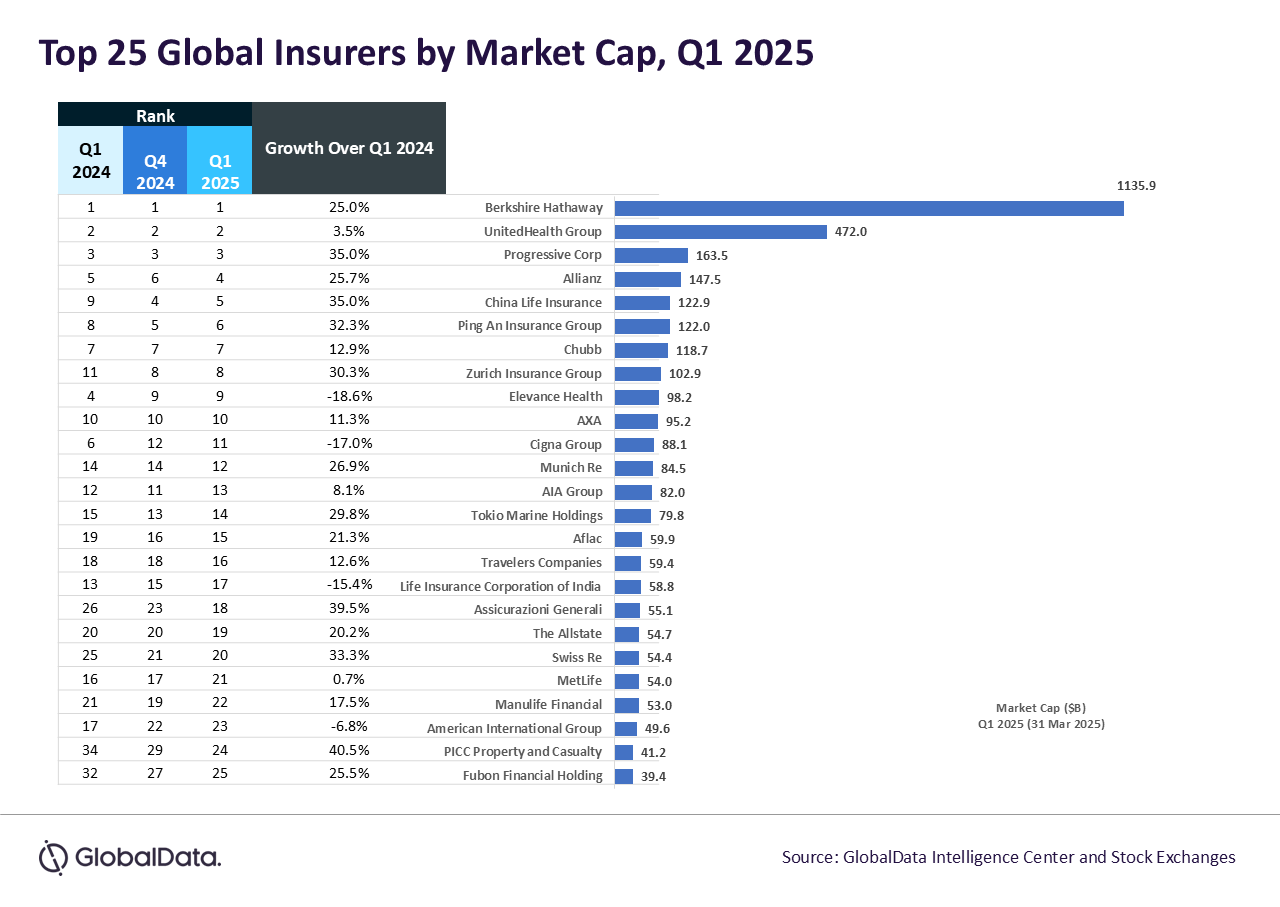
The following table outlines the approximate market capitalization and primary market focus of leading publicly traded life insurance entities.
| Company Name | Primary Headquarters | Approx. Market Cap (USD) | Primary Focus Area |
|---|---|---|---|
| Ping An Insurance | China | $145 Billion | Integrated Financial Services |
| Allianz SE | Germany | $110 Billion | Life, Health, and Asset Management |
| MetLife, Inc. | USA | $65 Billion | Employee Benefits & Global Life |
| Prudential Financial | USA | $48 Billion | Retirement & Life Insurance |
| AXA SA | France | $75 Billion | Global Life & Property/Casualty |
| Manulife Financial | Canada | $42 Billion | Wealth Management & Life |
| China Life | China | $95 Billion | Individual & Group Life |
Note: Market capitalization values fluctuate daily based on stock market performance. These figures represent general 2026 valuation tiers.
The Limitation of Market Cap: Mutual Companies
One of the most important things to understand when "explaining" market cap for life insurance is that many of the world's largest and most stable insurers do not have a market cap.
These are known as Mutual Insurance Companies. Companies like Northwestern Mutual, New York Life, and MassMutual are owned by their policyholders rather than outside shareholders. Because they do not trade on public stock exchanges, they have no share price and, therefore, no market cap.
When comparing providers, you cannot use market cap as a universal yardstick. For mutual companies, you must instead look at:
- Total Surplus: The amount of capital held above and beyond what is needed to pay claims.
- Operating Gain: Essentially the "profit" generated by the company's activities.
- Policyholder Dividends: The portion of surplus returned to those who hold policies.
How to Evaluate a Life Insurer Using Market Cap
If you are considering investing in a life insurance stock or choosing a provider, market cap should be part of a broader "Fundamental Analysis."
- Price-to-Book Ratio (P/B): In insurance, the "book value" is the net asset value of the company. If the market cap is lower than the book value (a P/B ratio below 1.0), the market may be skeptical of the company's asset quality or future earnings.
- Dividend Yield: Compare the dividend payouts of large-cap insurers. A high yield backed by a massive market cap is often a sign of a mature, cash-flow-positive business.
- Market Cap Stability: Look at how the market cap has trended over five years. Extreme volatility in a life insurance market cap is often a red flag, as this industry is built on the premise of predictable, long-term stability.
Frequently Asked Questions
Does a larger market cap mean my life insurance policy is safer?
Not necessarily, but there is a strong correlation. A large market cap indicates that the global investment community has confidence in the company’s valuation and future. However, for actual safety, you should check the company's "Financial Strength Rating" from agencies like A.M. Best or Fitch Ratings. These agencies look at the insurer's ability to pay claims, which is a different metric than its stock market value.
Why do some small-cap life insurance companies have high stock prices?
Stock price alone does not determine market cap. A company could have a high share price of $500 but only 1 million shares outstanding (Market Cap: $500 million). Another could have a $50 share price with 100 million shares outstanding (Market Cap: $5 billion). The market cap is the true measure of the company's total size, regardless of the individual share price.
How do interest rates affect the market cap of life insurance companies?
Interest rates are the "engine" of life insurance profitability. Most insurers invest in bonds. When interest rates rise, the yield on those bonds increases, leading to higher earnings. Higher earnings generally lead to a higher share price, which increases the market cap. Conversely, if rates drop unexpectedly, market caps in the sector often shrink.
Can a life insurance company’s market cap disappear?
If a company is acquired by another firm, its individual market cap disappears as it is absorbed into the parent company. If a company goes bankrupt (which is rare in the highly regulated life insurance industry), the market cap can drop to zero. In such cases, state guaranty associations usually step in to protect policyholders, though shareholders typically lose their investment.
Is market cap the same as "Enterprise Value" (EV)?
No. Market cap only counts the value of the equity (shares). Enterprise Value is a more comprehensive measure that takes the market cap, adds the company's total debt, and subtracts its cash and cash equivalents. For insurers, market cap is the more common metric for quick comparisons, while EV is used for deeper acquisition analysis.
Practical Recommendation: Using Market Cap Data
When evaluating "the market cap for life insurance explained," use the metric as a tool for scope and stability, not as a sole indicator of quality. If you are an investor, target Large-cap insurers for stability and dividends, but keep an eye on P/B ratios to ensure you aren't overpaying. If you are a policyholder, use market cap to ensure your provider is a major, liquid player in the financial ecosystem, but always verify their "Financial Strength Rating" through an independent rating agency. This dual-layered approach ensures that you are protected by both the market's valuation and the company's actual ability to fulfill its promises decades into the future.
Image Gallery