Why the History of the FFA Creed Matters: Understanding Our Agricultural Identity
The history of the FFA Creed matters because it documents the evolution of the American agricultural identity from a traditional production-based trade into a diverse, global science. By tracing its revisions, members understand how th...
The history of the FFA Creed matters because it documents the evolution of the American agricultural identity from a traditional production-based trade into a diverse, global science. By tracing its revisions, members understand how the National FFA Organization adapted its core values to include every aspect of the modern food system.
Contents
The Foundation of a Movement: The Origin of the FFA Creed
To understand why the history of the FFA Creed matters, one must look back to the early 20th century, a time when vocational agriculture was beginning to take root in American high schools. In 1928, the Future Farmers of America was established in Kansas City, Missouri. However, the organization lacked a unified statement of belief that could bind its members together across state lines.
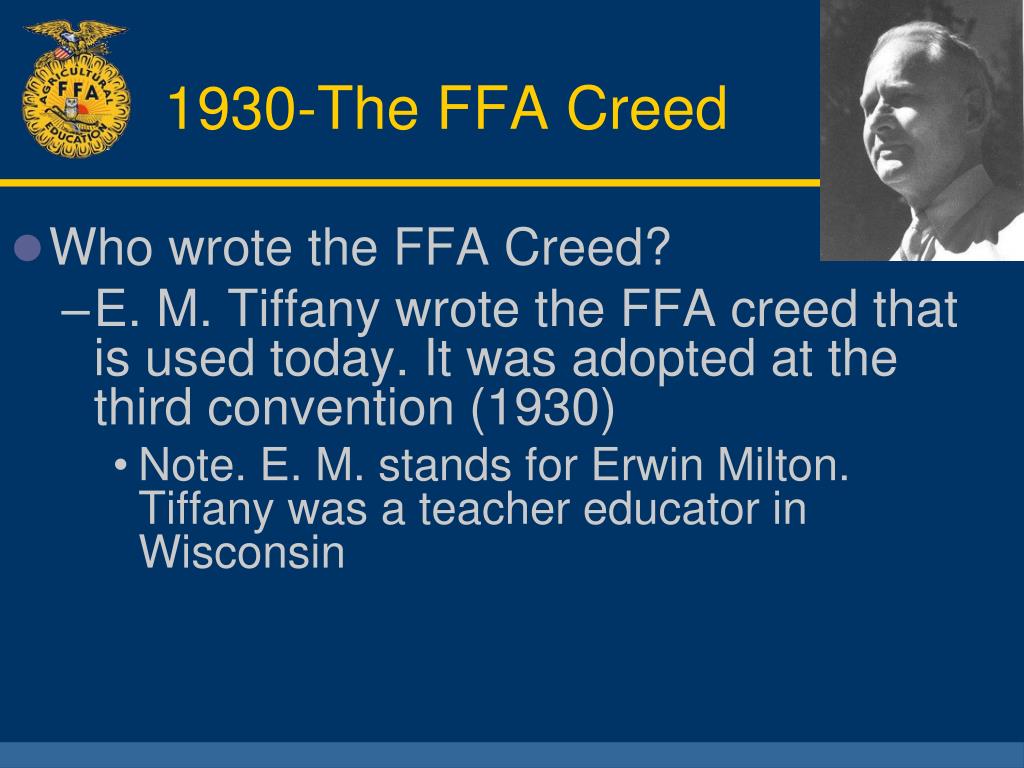
The Creed was written by Erwin Milton (E.M.) Tiffany, a professor of agricultural education at the University of Wisconsin-Madison. Tiffany did not write the text as a formal mandate but rather as a reflection of the dignity he saw in the agricultural way of life. In 1930, at the 3rd National FFA Convention, his words were officially adopted as the FFA Creed.
The history of this adoption is significant because it represents the first time the organization codified its philosophy. For nearly a century, these five paragraphs have served as the "North Star" for millions of students. Understanding that the Creed began as a personal tribute to the industry helps modern members realize that their own passion for agriculture is part of a century-long tradition of advocacy and belief.
Reflecting the Shift from Farming to Agriculture
One of the most critical reasons the history of the Creed matters is the way it reflects the broadening scope of the industry. Historically, the Creed focused heavily on the physical act of "farming." However, as the 20th century progressed, the industry transformed into a complex network of science, technology, business, and communications.
At the 63rd National FFA Convention in 1990, the word "farming" was changed to "agriculture" in several places, and "the farm" became "agricultural pursuits." This was not a minor linguistic tweak; it was a fundamental shift in how the organization viewed itself and its members. By studying this historical change, current members recognize that whether they are pursuing careers in drone technology, food chemistry, or international trade, they are just as much "Future Farmers" as those who work behind a plow.
The history of these revisions teaches us that the FFA is an organization that values its heritage but is not shackled by it. It demonstrates a willingness to evolve to remain relevant to a changing world. In 2026, this lesson is more vital than ever as agriculture faces new challenges in sustainability and food security.
The Cultural Context of the 1965 Revision
The history of the Creed also intersects with major social shifts in the United States. In 1965, the FFA underwent a significant revision of the Creed during the same era that the organization merged with the New Farmers of America (NFA), the organization for African American agriculture students.
While the 1965 revision focused largely on streamlining the language, the historical timing underscores a period of growth and integration. Understanding the Creed’s history allows us to see how the organization began to move toward a more inclusive definition of who an agriculturalist could be. It serves as a reminder that the "better days through better ways" mentioned in the first paragraph applies to all people, regardless of background, who seek to contribute to the industry.
The Creed Speaking CDE: A Rite of Passage
The history of the Creed is also the history of the Creed Speaking Career Development Event (CDE). For decades, this competition has been the primary way first-year members (Greenhands) engage with the organization’s values.
The CDE requires a student to recite the Creed from memory and then answer three questions regarding its meaning. The history of this event matters because it highlights the organization’s commitment to communication and critical thinking. When a student stands before a panel of judges in 2026, they are participating in a tradition that has built the confidence of thousands of leaders before them, including CEOs, governors, and scientists.
The persistence of this event reinforces the idea that some values are timeless. While the world of 1930 is vastly different from the world of 2026, the need for "leadership from ourselves and respect from others" remains constant.
Comparing the Evolutionary Milestones of the FFA Creed
The following table outlines the key historical shifts in the Creed's development, illustrating how the language has been refined to meet the needs of each generation.
| Year | Key Event | Major Linguistic or Philosophical Shift | Impact on Membership |
|---|---|---|---|
| 1928 | FFA Founded | No official creed; early members used various state-specific mottos. | Lack of a unified national identity. |
| 1930 | 3rd National Convention | Adoption of E.M. Tiffany’s text as the official FFA Creed. | Established a core philosophy for all members. |
| 1965 | 38th National Convention | Revisions to modernize sentence structure and terminology. | Refined the message for a post-WWII generation. |
| 1990 | 63rd National Convention | Changed "farming" to "agriculture" and "farm" to "agricultural pursuits." | Explicitly included non-production agriculture careers. |
| 2026 | Modern Application | Continued use as the foundational text for the Greenhand degree. | Bridges the gap between heritage and future technology. |
Why "I Believe" Still Carries Weight in 2026
Every paragraph of the FFA Creed begins with the words "I believe." In the context of 2026, the history of these two words is more relevant than ever. In an era of rapid information and shifting priorities, having a stable set of beliefs provides a necessary foundation for personal and professional growth.
- Paragraph One: Focuses on the past and future. Understanding its history helps us appreciate that the "achievements won by the present and past generations" are the building blocks of today’s technological wonders.
- Paragraph Two: Discusses the "joys and discomforts of agricultural life." Historically, this referred to physical labor; today, it also refers to the stress of global markets and the complexities of environmental stewardship.
- Paragraph Three: Emphasizes leadership and respect. The history of this section reminds us that the FFA was always intended to produce leaders, not just laborers.
- Paragraph Four: Addresses the "less dependence on begging and more power in bargaining." This phrase has historical roots in the cooperative movements of the early 20th century and remains a powerful statement on economic self-sufficiency.
- Paragraph Five: Concludes with a commitment to the "best traditions of our national life." This is a call to service that has motivated generations of FFA members to give back to their communities.
The Author’s Intent: E.M. Tiffany’s Vision
One often overlooked reason why the history of the Creed matters is the humility of its author. E.M. Tiffany famously said that he didn't care much for the fame of having written it; he cared only that the words inspired students to take pride in their work.
By studying the history of the man behind the words, members learn that leadership is not about personal glory but about the impact of one's contributions. Tiffany’s background as an educator at a land-grant university also connects the Creed to the broader history of agricultural education and research in the United States, linking FFA members to a vast academic and professional network.
Practical Engagement: How to Study the Creed Today
For those looking to deepen their understanding of why the history of the FFA Creed matters, practical engagement is key. It is not enough to simply memorize the words; one must analyze the "why" behind the phrasing.
- Compare Versions: Look at the original 1930 text alongside the current version. Note the specific words that have changed and discuss why those changes were necessary for the time.
- Interview Alumni: Talk to FFA alumni who were members before the 1990 revision. Ask them how the change from "farming" to "agriculture" changed their perception of the organization.
- Reflect on Career Goals: Take each "I believe" statement and apply it to a modern career path, such as biotechnology or agricultural communications.
- Participate in the CDE: Even if you are not a competitor, watch a Creed Speaking event. Observe how different students interpret the history and emotion behind the words.
FAQ
Who wrote the FFA Creed? The FFA Creed was written by E.M. Tiffany in 1928. He was a professor of agricultural education at the University of Wisconsin-Madison and a strong advocate for vocational training.
When was the Creed officially adopted? The Creed was officially adopted at the 3rd National FFA Convention in Kansas City, Missouri, in 1930.
Why was "farming" changed to "agriculture" in the 1990 revision? The change was made to reflect the diversity of the industry. Agriculture encompasses more than just production farming; it includes agribusiness, science, research, and technology, and the organization wanted to ensure all members felt included.
How many times has the FFA Creed been revised? The Creed has undergone two major sets of revisions: once at the 38th National Convention in 1965 and again at the 63rd National Convention in 1990.
Why is the Creed important for modern FFA members in 2026? It provides a sense of continuity and identity. In a rapidly changing world, the Creed offers a set of core values—leadership, hard work, and service—that remain relevant regardless of how much technology changes the industry.
Next Steps for FFA Members and Educators
To truly honor the history of the FFA Creed, members should focus on its application in their daily lives. For educators, this means teaching the Creed not just as a memorization task, but as a historical document that reflects the growth of the American spirit.
The best next action for any FFA member is to select one phrase from the Creed—such as "exert an influence in my home and community"—and turn it into a tangible project or service goal for the year 2026. By doing so, you move the Creed from a historical artifact into a living, breathing part of your personal legacy.
Image Gallery