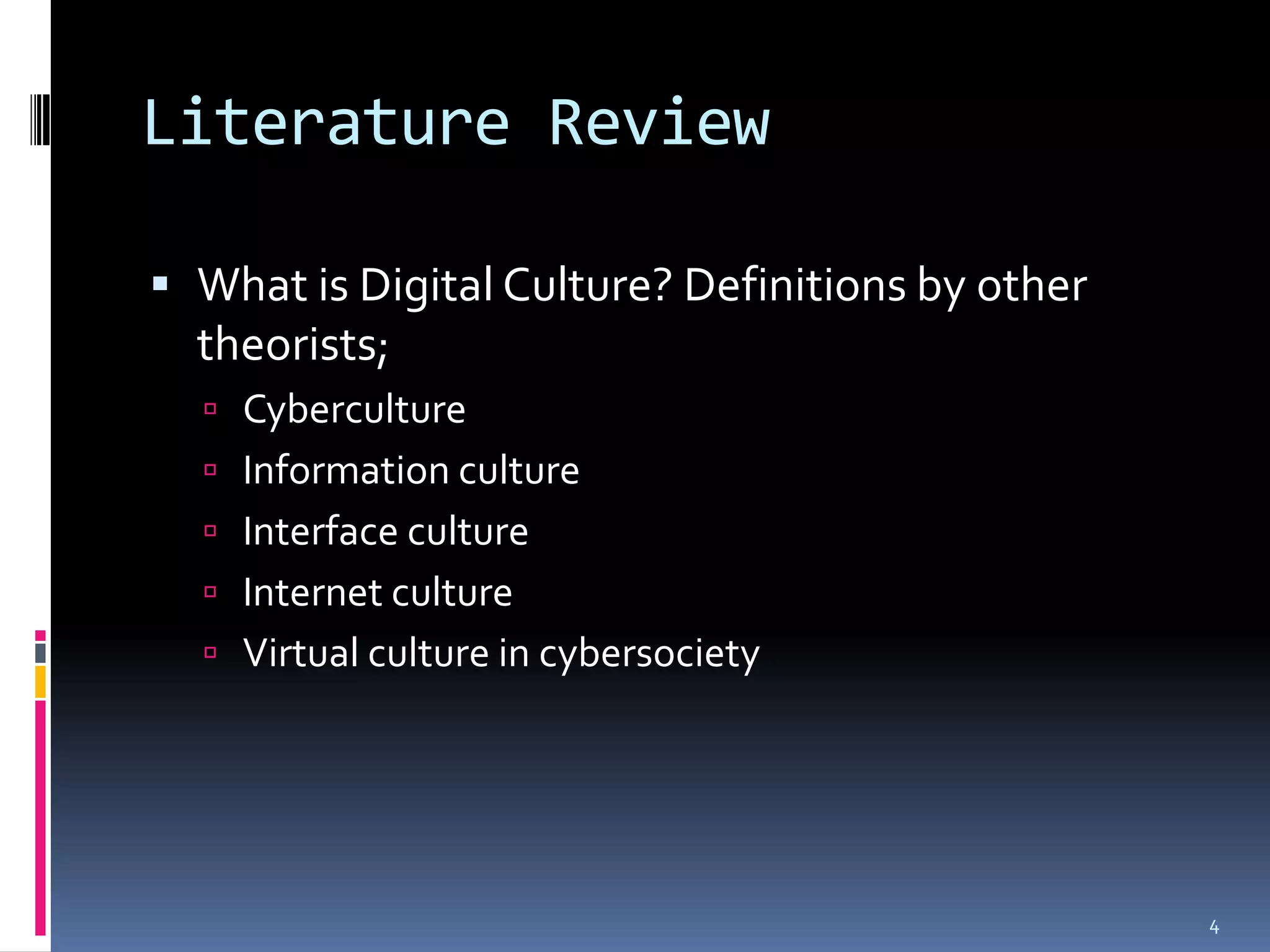
Understanding the Defining Traits and Characteristics of Digital Culture
Digital culture refers to the values, behaviors, practices, and social structures shaped by the widespread adoption of digital technologies. Its defining characteristics include real-time hyperconnectivity, participatory content creati...
Digital culture refers to the values, behaviors, practices, and social structures shaped by the widespread adoption of digital technologies. Its defining characteristics include real-time hyperconnectivity, participatory content creation, decentralized social networks, data-driven algorithmic curation, rapid cultural velocity, and fluid digital identities. Together, these traits reframe how humans communicate, learn, work, and build community.
Contents
Defining Digital Culture in the Modern Era
Digital culture is not merely the study of computing hardware or software applications; it is the broader sociological shift that occurs when digital technologies become the primary infrastructure for human interaction. First formalized by media theorists and sociologists analyzing the emergence of networked computing, digital culture describes how everyday norms, language, artifacts, and institutions adapt to electronic, interconnected environments.
In traditional media culture—dominated by print, radio, and broadcast television—information flowed primarily in a top-down, one-to-many architecture. Gatekeepers such as publishers, broadcast networks, and institutional authorities regulated the speed and distribution of content. Conversely, digital culture operates on a many-to-many, networked architecture. Information creation and exchange are distributed across global nodes, dramatically altering how authority is recognized, how information circulates, and how communities assemble.
Understanding digital culture requires evaluating both its technical foundations (such as cloud infrastructure, high-speed connectivity, and automated algorithms) and its human manifestations (such as online communities, viral communication, and remote collaboration practices).
Core Traits and Characteristics of Digital Culture
While digital technology evolves continuously, several foundational traits define digital culture across social, professional, and civic spheres.
1. Hyperconnectivity and Instantaneous Interaction
Hyperconnectivity is the state of continuous, multi-channel engagement enabled by ubiquitous mobile devices, high-speed networks, and cloud infrastructure. In a hyperconnected digital culture, communication is no longer bound by geographical distance or delayed transmission cycles.
- Asynchronous and Synchronous Blending: Communication spans real-time video conferencing and instant messaging alongside asynchronous project platforms and forums, allowing interaction to persist across time zones.
- Continuous Availability: The boundary between "online" and "offline" states has largely dissolved, creating expectations for immediate feedback, rapid customer service responses, and constant news updates.
- Globalized Micro-Communities: Individuals connect around specialized interests across national borders, forming subcultures that bypass local geographical constraints.
2. Participatory Culture and Co-Creation
Media theorist Henry Jenkins popularized the term "participatory culture" to describe environments with low barriers to artistic expression and civic engagement, strong support for creating and sharing creations, and informal mentorship. Digital culture transforms passive consumers into active creators—often termed "prosumers."
- User-Generated Content (UGC): Text, video, code, and digital art are routinely produced by individual users rather than centralized studios or publishing houses.
- Remix Culture and Meme Dynamics: Cultural artifacts are constantly reused, sampled, modified, and redistributed. Internet memes, open-source software forks, and video mashups exemplify this collaborative iteration.
- Collective Intelligence: Knowledge production relies on decentralized peer collaboration, visible in open platforms like Wikipedia, open-source repositories on GitHub, and community-driven Q&A forums.
3. Networked Decentralization and Disintermediation
Digital culture inherently pushes back against traditional organizational hierarchies. By leveraging distributed networks, individuals can publish, trade, organize, and collaborate without traditional institutional gatekeepers.
- Flattened Organizational Structures: Within enterprises, digital tools democratize access to executive communications, allowing employees at all levels to share ideas and challenge decisions directly.
- Disintermediation: Direct-to-creator platforms, peer-to-peer marketplaces, and decentralized finance protocols bypass traditional brokers, talent agencies, and financial intermediaries.
- Fluid Group Formation: Online coalitions, social movements, and professional working groups can assemble rapidly around shared objectives and disperse just as quickly when those objectives change.
4. Datafication and Algorithmic Curation
Datafication refers to the process of transforming physical human actions, behaviors, and social interactions into quantified data points. In digital culture, human experiences are continually converted into metrics that drive automated decision-making engines.
[User Interactions] ---> [Data Streams] ---> [Algorithmic Processing] ---> [Personalized Feeds & Curation]
- Personalized Experiences: Search engines, streaming services, and social platforms use recommendation systems to customize news, entertainment, and advertising to individual preferences.
- Echo Chambers and Filter Bubbles: Automated curation tends to reinforce existing user preferences, creating self-contained information ecosystems that can deepen social polarization.
- Quantified Self and Metric Awareness: Individuals and organizations monitor performance using engagement metrics, view counts, step totals, and productivity analytics, altering behavior to optimize output.
5. High Cultural Velocity and Ephemerality
Digital culture moves at an unprecedented speed. The lifecycle of trends, public discourse, and media viral events has compressed from months or years into days or hours.
- Rapid Trend Lifecycles: Topics trend, peak, and disappear in short cycles, requiring brand strategists, media creators, and public relations teams to act with immediate agility.
- Ephemeral Media: Platforms featuring temporary posts, stories, and disappearing messages emphasize real-time authenticity over long-term archiving, modifying how individuals archive personal history.
- Continuous Iteration: Software, cultural norms, and linguistic slang undergo constant software-like updates rather than periodic fixed releases.
6. Convergence of Physical and Virtual Identity
In digital culture, personal and organizational identity is distributed across physical and virtual domains. Digital identities are no longer detached secondary profiles; they carry significant real-world social, professional, and legal standing.
- Phygital Presence: Physical activities are recorded, shared, and enhanced by digital layers such as augmented reality, digital ticketing, and virtual identity verification.
- Identity Multiplicity: Users often maintain distinct public, professional, anonymous, or pseudonymous identities across different digital environments.
- Reputational Persistence: Digital footprints—comprising public posts, search history, and recorded interactions—persist over time, making reputation management a key concern for individuals and organizations.
Comparative Breakdown: Traditional Culture vs. Digital Culture
To clearly distinguish how digital culture alters social and organizational structures, the following table compares key characteristics across critical functional areas.
| Functional Dimension | Traditional Culture | Digital Culture |
|---|---|---|
| Information Flow | One-to-many, broadcast-driven, heavily moderated by institutional gatekeepers. | Many-to-many, networked, user-curated, and driven by algorithmic routing. |
| Content Production | Professionalized, high-cost, centralized within studios and publishers. | Democratized, low-cost creation, driven by user-generated and co-created media. |
| Pace & Velocity | Slow, structured release cycles (daily newspapers, monthly journals). | Continuous, real-time updates with short, highly variable trend lifecycles. |
| Organizational Hierarchy | Rigid, top-down command structures with clear formal boundaries. | Networked, matrixed, decentralized, with fluid and project-based structures. |
| Identity & Presence | Tied primarily to physical geography, face-to-face contact, and paper records. | Blended physical/virtual, multi-platform, verified via digital credentials and media footprints. |
| Authority & Trust | Institutional credentials, official titles, and formal peer review. | Peer validation, social proof, dynamic reputation metrics, and open-source auditability. |
Organizational and Social Impacts of Digital Culture
The characteristics of digital culture profoundly reshape how enterprise organizations operate and how civic societies function.
Enterprise and Workplace Transformation
Modern businesses do not merely use digital tools; they operate within digital workplace cultures. Organizations that adapt successfully to digital culture prioritize transparency, asynchronous communication, and data-informed decision-making.
- Shift to Asynchronous Collaboration: Teams rely on continuous documentation tools, structured task boards, and recorded video messaging, reducing the dependency on synchronous physical meetings.
- Data-Informed Experimentation: Product teams use A/B testing, real-time telemetry, and direct customer usage metrics to refine products iteratively rather than relying solely on executive intuition.
- Managing Digital Fatigue: Continuous connectivity presents organizational risks, including worker burnout, digital distraction, and blurred boundaries between professional availability and personal rest. Leading organizations institute operational guidelines regarding response expectations and notification windows.
Civic Society and Information Ecosystems
At a societal level, digital culture alters public discourse, political mobilization, and information literacy standards.
- Democratized Citizen Journalism: Eyewitnesses record and broadcast news events in real time, bypassing traditional state or corporate news outlets to provide unmediated perspectives.
- Information Overload and Misinformation: The vast volume of unverified media makes critical evaluation challenging. Digital culture necessitates heightened media literacy to identify synthetic media, algorithmic bias, and coordinated disinformation campaigns.
- Digital Inclusivity and the Digital Divide: While digital culture enables wide participation, unequal access to high-speed internet, digital devices, and technological literacy creates socio-economic divides between connected and disconnected populations.
Practical Frameworks for Navigating Digital Culture
To thrive in environments defined by rapid technological change, both organizations and individuals require practical strategies for navigating digital culture effectively.
Developing Organizational Digital Maturity
Enterprise leadership can cultivate a healthy digital culture by focusing on three strategic imperatives:
- Establish Explicit Communication Norms: Document clear rules for channel selection (e.g., chat apps for quick operational updates, documentation portals for long-term project specs, email for formal external communication).
- Invest in Digital Literacy Training: Provide continuous learning opportunities covering data security, artificial intelligence tools, digital accessibility standards, and privacy compliance.
- Prioritize Ethical Data Stewardship: Ensure customer and employee data collection respects legal frameworks such as the General Data Protection Regulation (GDPR) and regional privacy statutes, maintaining transparency around algorithmic usage.
Personal Digital Citizenship Strategies
For individuals, maintaining well-being and effectiveness within digital culture requires intentional practices:
- Practice Active Information Curation: Diversify news sources, audit feed algorithms by periodically resetting interaction preferences, and cross-reference assertions against primary evidence.
- Set Boundary Rules for Digital Wellness: Schedule explicit offline periods, disable non-essential push notifications, and segment personal identity from professional communication channels.
- Protect Digital Footprints: Conduct routine security reviews, utilize robust authentication mechanisms, and remain conscious of the long-term archival nature of public posts.
Frequently Asked Questions
How does digital culture differ from internet culture?
Internet culture specifically refers to the subcultures, trends, language, and social behaviors that emerge directly on the internet (such as specific forum communities, memes, and chat platforms). Digital culture is a broader, overarching concept that includes internet culture alongside the societal, organizational, political, and economic structural transformations caused by all digital technologies, including mobile devices, cloud systems, algorithms, and automated processes.
What are the main business advantages of embracing a strong digital culture?
Organizations with a strong digital culture demonstrate higher agility, faster product deployment cycles, and superior operational resilience. By fostering open communication, asynchronous collaboration, and data-driven decision-making, these companies adapt quickly to market shifts, recruit talent globally, and streamline internal operations.
What are the key risks associated with digital culture?
The primary risks include digital burnout from continuous connectivity, security vulnerabilities due to sprawling digital surfaces, information overload, and social isolation. Additionally, reliance on automated algorithms can perpetuate bias, while low barriers to publishing can spread misinformation rapidly.
How do algorithms influence culture in digital environments?
Algorithms act as non-human curators of culture. By scoring content based on predicted user engagement, search algorithms and social recommendation feeds determine which news, artistic works, ideas, and products achieve widespread visibility. This algorithmic feedback loop directly shapes public attention, social trends, and economic success for content creators.
Why is participatory culture important in digital environments?
Participatory culture shifts individuals from passive receivers of media to active contributors. It democratizes creative production, drives peer-to-peer educational learning, lowers costs for technical innovation through open-source communities, and enables collective civic action across diverse demographic groups.
Next Steps for Organizations and Individuals
Adapting to digital culture requires moving from passive tool usage to intentional cultural alignment. To successfully operate within contemporary digital ecosystems, consider taking the following concrete actions:
- Audit Existing Digital Tools and Workflows: Map the communication channels, collaboration software, and software platforms used within your team or organization to eliminate redundant systems and reduce notification overload.
- Formalize Information Management Guidelines: Create explicit documentation policies that dictate where persistent knowledge is stored, ensuring institutional memory is preserved independent of individual chat logs.
- Conduct a Digital Literacy and Security Assessment: Evaluate team capabilities regarding baseline cybersecurity practices, critical analysis of algorithmic content, and compliance with data protection standards.
- Implement Wellness and Availability Protocols: Set clear boundaries regarding asynchronous response times to mitigate digital fatigue and maintain productive focus across remote and hybrid teams.
Image Gallery