ICD-10 Code for Pain in Left Fingers: Coding Rules, Laterality, and Etiology Selection
The primary ICD-10-CM code for non-specific pain in the left finger or fingers is M79.645 (Pain in left finger(s)). If the pain is strictly localized to the left thumb, the correct code is M79.642 (Pain in left thumb). When a definitiv...
The primary ICD-10-CM code for non-specific pain in the left finger or fingers is M79.645 (Pain in left finger(s)). If the pain is strictly localized to the left thumb, the correct code is M79.642 (Pain in left thumb). When a definitive underlying diagnosis—such as osteoarthritis, carpal tunnel syndrome, or a fracture—is documented, coders must report the specific etiology instead of or alongside the symptom code.
Contents
Disclaimer: This guide is intended for professional medical coders, billers, and clinical documentation specialists. It reflects the standard International Classification of Diseases, Tenth Revision, Clinical Modification (ICD-10-CM) coding conventions. Final code selection must always be supported by valid clinical documentation within the patient record.
Primary ICD-10 Codes for Left Finger Pain
In the ICD-10-CM code set, pain in the upper extremity digits is classified under category M79.6 (Pain in limb, hand, foot, fingers and toes), specifically within subcategory M79.64 (Pain in hand and fingers).
When a clinical note describes finger pain in the left hand without identifying a confirmed underlying disease or structural lesion, select one of the following lateralized codes:
- M79.645: Pain in left finger(s)
- M79.642: Pain in left thumb
Coding Distinction: Left Thumb vs. Other Left Fingers
ICD-10-CM maintains a strict structural distinction between the thumb (first digit) and the remaining fingers (index, middle, ring, and little fingers).
- Left Thumb Pain: If the medical record specifically isolates pain to the left thumb (e.g., at the interphalangeal or metacarpophalangeal joint without a specified etiology), assign M79.642.
- Left Finger Pain: If pain involves one or more of the remaining four left digits (index, middle, ring, or small finger), assign M79.645.
- Combined Left Thumb and Finger Pain: If the provider documents pain affecting both the left thumb and other left fingers simultaneously, both M79.642 and M79.645 may be billed together to completely describe the anatomic distribution, provided a more specific underlying diagnosis is not established.
Symptom Coding vs. Etiological Diagnoses
A foundational principle of the ICD-10-CM Official Guidelines for Coding and Reporting (Section I.B.4 and I.B.6) is that symptom codes (such as M79.645) should only be assigned when a confirmed, definitive diagnosis has not been established by the provider.
If left finger pain is merely a symptom of an underlying systemic, neurological, inflammatory, or traumatic condition, the code for the underlying condition must be reported as the primary diagnosis. The symptom code M79.645 should not be reported separately if the pain is routinely associated with that confirmed diagnosis, unless specific coding instructions direct otherwise.
1. Neurological Causes
Nerve entrapment or cervical root compression often manifests as burning, aching, or radiating pain in the left fingers.
- Carpal Tunnel Syndrome, Left Upper Limb (G56.02): Compression of the median nerve at the wrist frequently causes pain, numbness, and paresthesia in the left thumb, index, middle, and radial half of the ring finger. When carpal tunnel syndrome is confirmed, code G56.02 replaces M79.645.
- Cervical Radiculopathy (M54.12): Nerve root compression in the cervical spine (e.g., C6 or C7 radiculopathy) can radiate pain down the left arm into specific fingers. Assign M54.12 (Radiculopathy, cervical region) when cervical spine pathology is the source of the left finger pain.
- Lesion of Ulnar Nerve, Left Upper Limb (G56.22): Entrapment of the ulnar nerve (e.g., at the cubital tunnel) typically causes pain and paresthesia localized to the left little finger and ulnar half of the ring finger.
2. Musculoskeletal and Arthritic Conditions
Articular and soft tissue disorders are among the most common causes of localized digit pain.
- Osteoarthritis of Left Hand / Digits:
- M18.12: Unilateral primary osteoarthritis of first carpometacarpal joint, left hand (specifically for thumb base arthritis).
- M19.042: Primary osteoarthritis, left hand (covers interphalangeal and metacarpophalangeal joints of the left fingers).
- Rheumatoid Arthritis (RA):
- M05.742: Rheumatoid arthritis with rheumatoid factor of left hand without organ or system involvement.
- M06.042: Rheumatoid arthritis without rheumatoid factor, left hand.
- Trigger Finger / Stenosing Tenosynovitis:
- M65.342: Trigger thumb, left thumb.
- M65.344: Trigger finger, left index finger.
- M65.345: Trigger finger, left middle finger.
- M65.346: Trigger finger, left ring finger.
- M65.347: Trigger finger, left little finger.
3. Traumatic Injuries
When left finger pain is acute and secondary to an injury, code the specific injury (e.g., sprain, fracture, dislocation, or contusion) rather than the general pain code.
- Contusion of Left Finger(s): S60.512A (Contusion of left index finger, initial encounter) or specific digit contusion codes within the S60.5 range.
- Sprain of Joints of Left Finger(s): S63.502A (Unspecified sprain of left hand, initial encounter) or specific interphalangeal/metacarpophalangeal joint sprain codes under subcategory S63.6.
- Fractures of Left Digits: Codes within the S62.5 (thumb) and S62.6 (other fingers) subcategories, requiring precise identification of the phalanx (proximal, middle, distal) and displacement status.
Summary Table: ICD-10 Codes for Left Finger Pain and Related Conditions
The table below summarizes common ICD-10-CM codes utilized when patients present with pain in the left fingers, categorized by clinical presentation and etiology.
| Clinical Condition / Presentation | ICD-10-CM Code | Description | Laterality / Specificity |
|---|---|---|---|
| Unspecified Pain in Left Finger(s) | M79.645 | Pain in left finger(s) | Left hand, non-thumb digits |
| Unspecified Pain in Left Thumb | M79.642 | Pain in left thumb | Left thumb specifically |
| Carpal Tunnel Syndrome | G56.02 | Carpal tunnel syndrome, left upper limb | Left median nerve compression |
| Ulnar Nerve Lesion | G56.22 | Lesion of ulnar nerve, left upper limb | Left ulnar nerve (4th/5th digits) |
| Primary Osteoarthritis (Thumb CMC) | M18.12 | Unilateral primary osteoarthritis of first CMC joint, left hand | Left base of thumb joint |
| Primary Osteoarthritis (Fingers) | M19.042 | Primary osteoarthritis, left hand | Left interphalangeal/MCP joints |
| Trigger Thumb | M65.342 | Trigger thumb, left thumb | Left thumb tenosynovitis |
| Trigger Index Finger | M65.344 | Trigger finger, left index finger | Left 2nd digit |
| Trigger Middle Finger | M65.345 | Trigger finger, left middle finger | Left 3rd digit |
| Trigger Ring Finger | M65.346 | Trigger finger, left ring finger | Left 4th digit |
| Trigger Little Finger | M65.347 | Trigger finger, left little finger | Left 5th digit |
| Cervical Radiculopathy | M54.12 | Radiculopathy, cervical region | Radiating nerve pain to arm/hand |
| Contusion of Left Finger | S60.512A | Contusion of left finger, initial encounter | Traumatic bruising (requires 7th character) |
| Sprain of Left Finger Joint | S63.601A | Unspecified sprain of left thumb/finger, initial encounter | Traumatic ligament damage |
Clinical Documentation Requirements and Coding Rules
Achieving accurate medical coding and compliant reimbursement requires detailed physician documentation. Coding auditors and payors inspect records to verify that codes match the precise anatomy, etiology, and clinical scenario described.
1. Laterality Rules
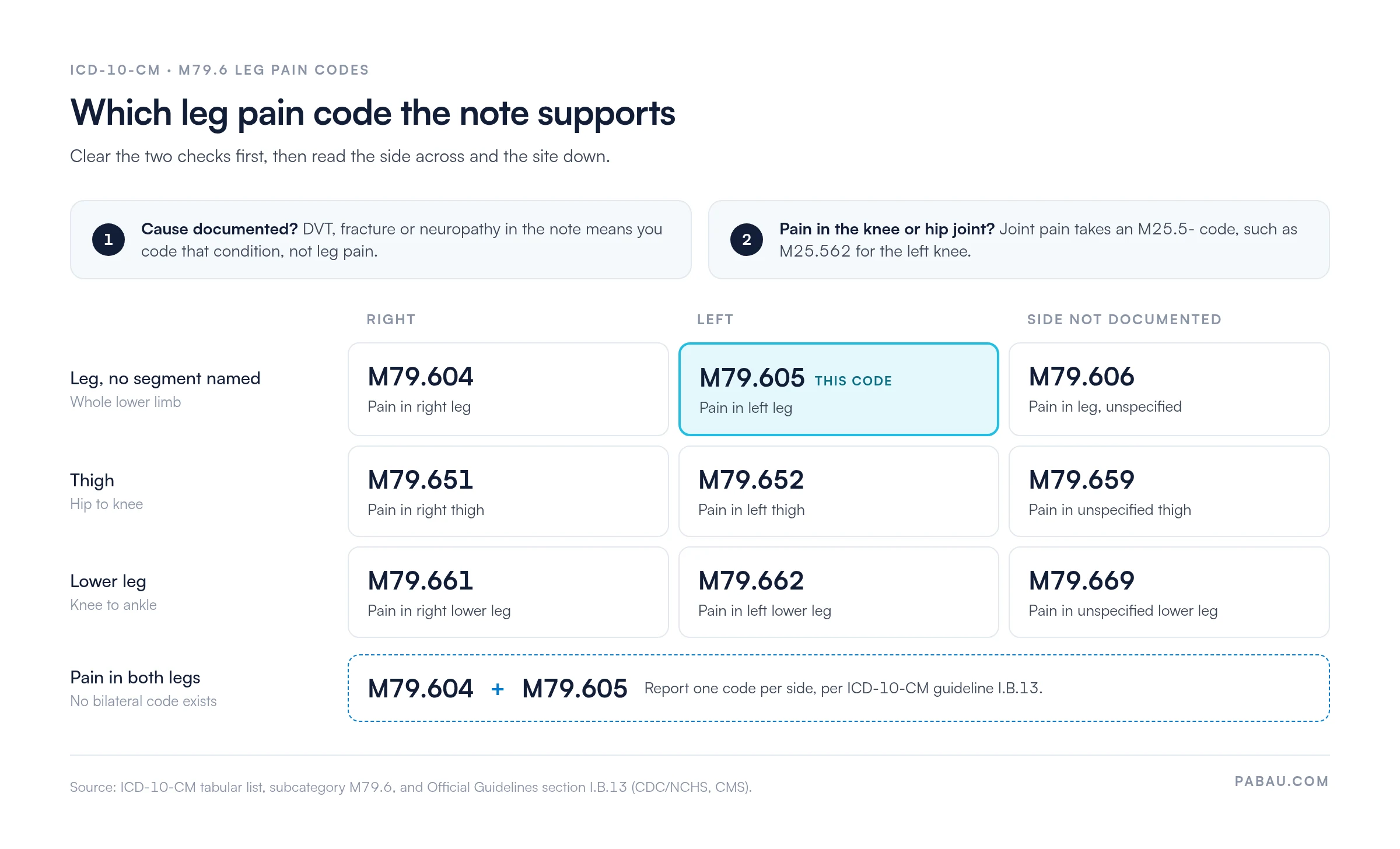
ICD-10-CM emphasizes laterality. Assigning an unspecified laterality code (such as M79.643 for Pain in unspecified finger(s)) when the provider explicitly documents the left hand can lead to claim denials or requests for medical record reviews. Always ensure the clinical chart specifies "left" and indicates whether the thumb, specific fingers, or the entire hand is affected.
2. Etiology vs. Symptom Documentation
When reviewing a chart for finger pain:
- Check for Diagnostic Statements: Does the provider state a definitive cause for the pain (e.g., "Left ring finger pain secondary to acute trigger finger")? If yes, code the definitive condition (M65.346).
- Check for Differential Diagnoses: If the provider writes "Left finger pain, rule out carpal tunnel syndrome," code the symptom (M79.645). In outpatient settings, "rule out," "possible," or "probable" diagnoses cannot be coded as confirmed; only the documented symptoms are coded.
- Identify Associated Symptoms: If the patient presents with both pain and swelling or numbness, determine whether a overarching condition explains all symptoms.
3. Applying 7th Characters for Traumatic Codes
If left finger pain is attributable to an injury or external cause (classified under Chapter 19: Injury, poisoning and certain other consequences of external causes), most codes require a 7th-character extension to denote the phase of care:
- A - Initial Encounter: Applied while the patient is receiving active treatment for the injury (e.g., surgical evaluation, emergency care, initial casting, or first evaluation by a new physician).
- D - Subsequent Encounter: Applied for encounters after the patient has received active treatment and is receiving routine care during the healing or recovery phase (e.g., cast removal, follow-up visit, physical therapy).
- S - Sequela: Applied for complications or conditions that arise as a direct result of a previous injury (e.g., chronic joint stiffness or pain arising long after a healed finger fracture). When using S, both the injury code with S and the specific late effect (e.g., joint pain) are reported.
Frequently Asked Questions
What is the default ICD-10 code if the doctor just writes "left finger pain"?
The default code for unspecified pain in one or more left fingers (excluding the thumb) is M79.645. If the documentation specifies the thumb, use M79.642.
Can I code M79.645 together with a code for a finger fracture?
No. Under standard ICD-10-CM coding conventions, acute traumatic pain caused by an underlying fracture is integral to the fracture diagnosis itself. You should report only the appropriate fracture code (e.g., from subcategory S62.6) with the correct 7th character.
What code should I use if left finger pain is caused by Raynaud's phenomenon?
If finger pain is caused by Raynaud's syndrome, report I73.00 (Raynaud's syndrome without gangrene) or I73.01 (Raynaud's syndrome with gangrene). The pain is considered a symptom of the vasospastic condition and is not coded separately with M79.645.
How do I code pain present in fingers of both the left and right hands?
ICD-10-CM does not feature a single bilateral code for finger pain. You must report two separate codes: M79.641 (Pain in right finger(s)) and M79.645 (Pain in left finger(s)). If bilateral thumbs are affected, report M79.644 (Pain in right thumb) and M79.642 (Pain in left thumb).
Is there a specific code for left index finger pain versus left little finger pain?
For general, non-specific pain (M79.6 category), ICD-10-CM does not break down non-thumb digits into individual index, middle, ring, or little finger pain codes. All four non-thumb digits on the left hand roll up to M79.645. However, specific structural pathologies (such as trigger finger M65.3 or fractures S62) do feature digit-specific codes.
Best Practices for Medical Coders and Clinicians
To maintain compliance and reduce claim rejections related to upper extremity pain:
- Prioritize Clinical Specificity: Educate providers to document the exact digit involved (thumb vs. index/middle/ring/little finger), the laterality (left vs. right), and any underlying structural or systemic cause.
- Query the Provider When Unclear: If a clinical note lists "left finger pain" alongside examination findings strongly suggesting carpal tunnel syndrome or osteoarthritis, but lacks a definitive diagnostic statement, submit a physician query for clarification before finalized billing.
- Review Systemic Etiologies: Ensure that conditions like gout (M1A / M10 series), diabetic neuropathy (E11.40), or peripheral vascular disorders are properly evaluated as primary causes when assigning codes for hand and finger distress.
Image Gallery