Is Money You Put in Permanent Life Insurance Taxable? Understanding Premium and Cash Value Taxation
In 2026, the money you put into a permanent life insurance policy—referred to as premiums—is generally not tax-deductible, meaning you pay it with after-tax dollars. However, the cash value generated by those premiums grows on a tax-de...
In 2026, the money you put into a permanent life insurance policy—referred to as premiums—is generally not tax-deductible, meaning you pay it with after-tax dollars. However, the cash value generated by those premiums grows on a tax-deferred basis, and you can typically withdraw your original contributions (your "basis") tax-free.
Contents
Permanent life insurance, including whole life, universal life, and variable life, is often marketed as a versatile financial tool because of its unique tax treatment. Unlike a traditional 401(k) or IRA, where you might receive a tax deduction for contributions, life insurance focuses its tax advantages on the "growth" and "distribution" phases rather than the "input" phase. Navigating these rules requires understanding how the Internal Revenue Service (IRS) views the "basis" of your policy and the specific conditions under which accessing your money could trigger a tax bill.
The Taxation of Premiums: The "Input" Phase
When you pay premiums into a permanent life insurance policy, you are essentially using "clean" money—income that has already been subject to federal and state income taxes. Because of this, the act of putting money into the policy does not create a new tax liability, but it also does not provide an immediate tax break for individual policyholders.
Individual vs. Business Deductibility
For the vast majority of individual policyholders, premiums are considered a personal expense. Under Internal Revenue Code Section 262, personal, living, or family expenses are generally not deductible. This stands in contrast to certain retirement accounts where contributions reduce your taxable income for the year.
In a business context, the rules are even more stringent. If a business is a beneficiary of a policy—such as in a Key Person insurance arrangement—the premiums paid by the business are not tax-deductible. This prevents a "double benefit" where the company would get a tax deduction on the way in and a tax-free death benefit on the way out.
The Concept of "Cost Basis"
Every dollar you put into your permanent life insurance policy adds to what the IRS calls your cost basis. Your basis is essentially the total amount of premiums paid, minus any dividends received in cash or used to reduce premiums, and minus any previous tax-free withdrawals. Understanding your basis is critical because the IRS allows you to withdraw money up to this amount without paying a cent in taxes, as you are simply taking back money you already paid tax on.
Tax-Deferred Growth: The Inside Build-Up
One of the primary reasons investors utilize permanent life insurance in 2026 is the "inside build-up." As your premiums are invested by the insurance company (or directed by you in a variable policy), the cash value earns interest, dividends, or capital gains.
Avoiding Yearly Taxation
In a standard brokerage account, you would typically pay taxes every year on realized capital gains and interest earned. However, under IRS Section 7702, the growth within a life insurance policy is tax-deferred. This means that as long as the money remains within the "wrapper" of the insurance policy, you do not owe taxes on the annual growth.
This compounding effect can be significant over several decades. By avoiding the "tax drag" of annual payments, the cash value has the potential to grow much faster than a comparable taxable account, assuming similar rates of return. This tax-deferred status remains intact regardless of how much the cash value exceeds the total premiums paid, provided the policy stays in force.
Accessing Your Money: Withdrawals and the FIFO Rule
When you decide to take money out of your permanent life insurance policy, the tax treatment depends heavily on how you access it. The most common method for direct access is a withdrawal.
First-In, First-Out (FIFO) Accounting
Life insurance policies generally benefit from FIFO (First-In, First-Out) tax treatment. This means the IRS considers the first dollars you withdraw to be your "basis" (the premiums you paid). Since those premiums were already taxed before you put them in, those withdrawals are tax-free.
Only after you have withdrawn an amount equal to your total cost basis do you begin withdrawing the "earnings" or "growth." At that point, any additional withdrawals are taxed as ordinary income. It is important to note that life insurance gains are never taxed at the lower long-term capital gains rates; they are always taxed at your standard income tax rate.
Policy Surrender
If you decide to cancel (surrender) the policy entirely, the insurance company will send you the net cash value. The taxation here is straightforward:
- Total Cash Received minus Total Premiums Paid = Taxable Gain.
- The gain is taxed as ordinary income in the year the policy is surrendered.
Policy Loans: The Tax-Free Alternative
A unique feature of permanent life insurance is the ability to take a loan against the cash value. In 2026, this remains one of the most tax-efficient ways to access liquidity without triggering a taxable event.
When you take a policy loan, you aren't technically withdrawing your money. Instead, you are borrowing money from the insurance company, using your cash value as collateral. Because the IRS views this as a loan rather than a distribution of income, the proceeds are tax-free, even if the loan amount exceeds your cost basis.
Risks of Policy Loans
While loans are tax-free at the time of the transaction, they carry risks:
- Interest Accrual: The insurance company charges interest on the loan. If the interest is not paid, it is added to the loan balance.
- Policy Lapse: If the loan balance plus accrued interest eventually exceeds the total cash value, the policy will lapse. If a policy lapses while a loan is outstanding, the IRS treats the "forgiven" loan as a distribution. If that distribution exceeds your basis, you will face a significant, immediate tax bill on the "phantom income."
The Modified Endowment Contract (MEC) Trap
While permanent life insurance offers great tax flexibility, the government prevents people from using it purely as a tax-free investment vehicle through the Modified Endowment Contract (MEC) rules.
If you put too much money into a policy too quickly—specifically, if the premiums exceed the limits set by the "7-pay test"—the policy becomes a MEC. Once a policy is classified as a MEC, it loses its favorable FIFO tax status.
Tax Consequences of a MEC
- LIFO Taxation: Withdrawals are treated as Last-In, First-Out. This means the earnings (taxable) come out before the basis (tax-free).
- Penalty Tax: If you take money out of a MEC before age 59½, you may be subject to a 10% federal tax penalty on the taxable portion, similar to an early withdrawal from a 401(k).
- Loans are Taxable: Unlike standard policies, loans from a MEC are treated as taxable distributions to the extent there is gain in the policy.
Comparison of Life Insurance Tax Treatments
The following table summarizes how different actions within a permanent life insurance policy are taxed under current 2026 guidelines.
| Action | Tax Status | Impact on Basis | Key Condition |
|---|---|---|---|
| Paying Premiums | Not Deductible | Increases Basis | Paid with after-tax dollars. |
| Cash Value Growth | Tax-Deferred | No Change | Remains tax-free while in the policy. |
| Withdrawals | Tax-Free up to Basis | Decreases Basis | Only "earnings" are taxed (FIFO). |
| Policy Loans | Tax-Free | No Change | Policy must remain in force to avoid tax. |
| Dividends | Generally Tax-Free | Decreases Basis | Taxed only if they exceed total premiums. |
| Death Benefit | Tax-Free (Income) | N/A | Usually free of federal income tax. |
| MEC Withdrawals | Taxable First | Decreases Basis | Subject to LIFO and 10% penalty. |
The Death Benefit: Is it Taxable for Beneficiaries?
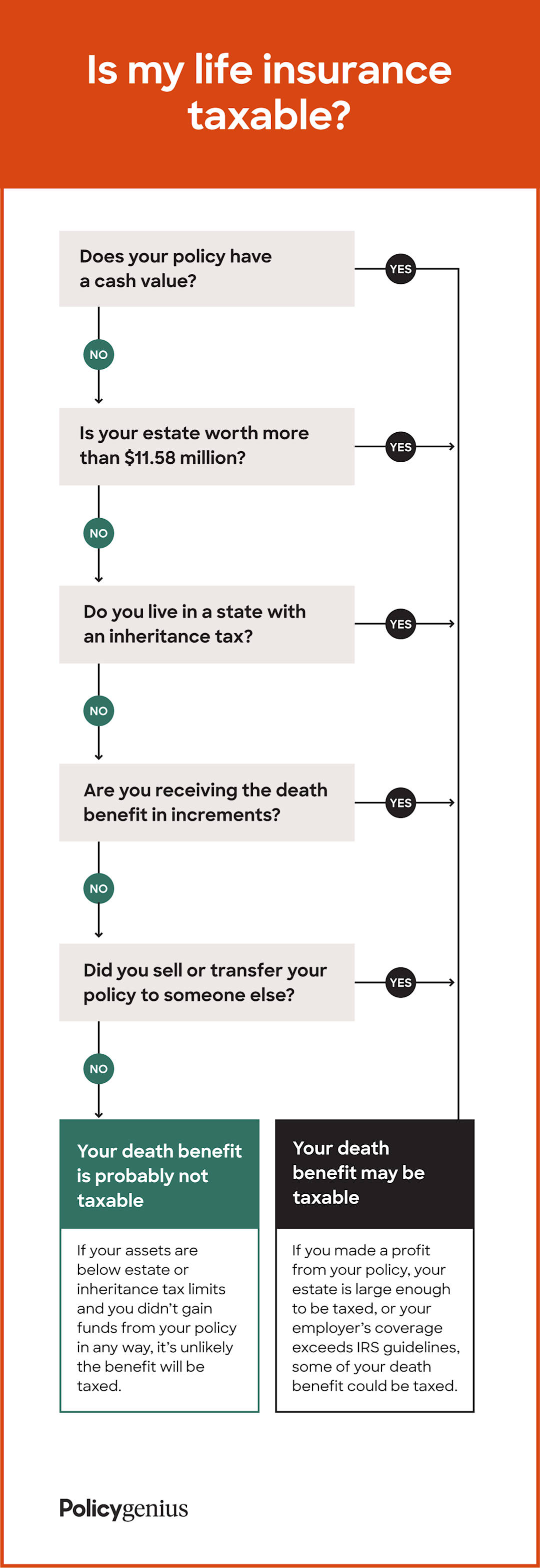
The primary purpose of life insurance is the death benefit. Under Section 101(a)(1) of the Tax Code, life insurance proceeds paid to a beneficiary due to the death of the insured are generally not subject to federal income tax. Whether the death benefit is $50,000 or $5,000,000, the beneficiary typically receives the full amount without owing the IRS.
Estate Tax Considerations
While the death benefit is free from income tax, it may be included in the deceased's taxable estate. In 2026, if the total value of the estate (including the life insurance proceeds) exceeds the federal estate tax exemption, the estate could owe taxes. To mitigate this, many high-net-worth individuals use an Irrevocable Life Insurance Trust (ILIT) to own the policy, effectively removing the death benefit from their taxable estate.
Common Mistakes and Strategic Considerations
- Lapsing a Policy with Loans: This is the most common "tax surprise." If you have a $100,000 loan on a policy with a $40,000 basis and the policy lapses, you suddenly owe income tax on $60,000 of income, even though you received no "new" cash at the time of the lapse.
- Taking Withdrawals Instead of Loans: If you have already withdrawn your full basis, any further cash needs should likely be handled via a loan to avoid the ordinary income tax triggered by a withdrawal of earnings.
- Ignoring Dividends: If you receive dividends in cash rather than reinvesting them (to buy "paid-up additions"), those dividends reduce your cost basis. If the dividends eventually exceed your total premiums, they become taxable as ordinary income.
- 1035 Exchanges: If you have a policy that is performing poorly but has a large gain, you can use a Section 1035 Exchange to move the funds to a new policy without triggering a tax on the gains. This allows you to "roll over" your basis and deferred growth into a more modern or efficient product.
Frequently Asked Questions
1. Are premiums for permanent life insurance ever tax-deductible?
Generally, no. For individuals, they are considered a personal expense. For businesses, they are not deductible if the business is a direct or indirect beneficiary. The only rare exception is if the policy is held within a qualified retirement plan or as part of a specific executive compensation arrangement, but even then, the "economic benefit" of the insurance coverage is usually taxed as income to the employee.
2. Is the interest I pay on a policy loan tax-deductible?
For individuals, interest paid on a life insurance policy loan is usually considered "personal interest" and is not tax-deductible. In 2026, the deductions for personal interest remain very limited under current tax law. Businesses may sometimes deduct interest on loans for policies covering certain employees, but this is subject to strict caps under IRC Section 264.
3. What happens if I inherit a permanent life insurance policy?
If you inherit the ownership of a policy (meaning the insured is still alive), you inherit the original owner's cost basis. There is no "step-up in basis" for the cash value of a life insurance policy like there is for stocks or real estate. If you later surrender the policy or take a withdrawal, your tax liability will be based on the premiums paid by the original owner.
4. Do I have to report the cash value growth on my tax return every year?
No. As long as the money stays inside the policy and the policy is not a Modified Endowment Contract being accessed, you do not need to report the annual growth, interest, or dividends to the IRS. The insurance company will not send you a Form 1099 unless you have a "taxable event," such as a withdrawal above basis or a policy surrender.
5. Can the IRS seize my permanent life insurance cash value for back taxes?
Yes. While many states provide strong creditor protection for life insurance cash values against private lawsuits, those protections generally do not apply to the federal government. The IRS has the authority to levy the cash value of a permanent life insurance policy to satisfy unpaid federal tax debts.
Practical Recommendation
When managing a permanent life insurance policy in 2026, your primary goal should be to maintain the policy's tax-advantaged status by avoiding an unintentional lapse or a MEC reclassification. Before taking a large withdrawal or loan, request a "Cost Basis Report" and an "In-Force Illustration" from your insurance carrier. These documents will show you exactly how much you can withdraw tax-free and how a loan might impact the long-term health of the policy. Because tax laws and individual circumstances vary, always consult with a qualified tax advisor or financial professional before making significant changes to your policy structure.
Image Gallery