Understanding AIOps in the Modern Data Center
AIOps, or Artificial Intelligence for IT Operations, leverages big data, machine learning, and analytics to automate and streamline operational workflows in contemporary enterprise environments. By aggregating and analyzing massive str...
AIOps, or Artificial Intelligence for IT Operations, leverages big data, machine learning, and analytics to automate and streamline operational workflows in contemporary enterprise environments. By aggregating and analyzing massive streams of telemetry data from hardware, networks, and applications, AIOps platforms enable IT teams to predict failures, isolate root causes instantly, and maintain resilient data center infrastructure.
Contents
The Evolution of Data Center Management
Data centers have undergone a dramatic transformation over the past two decades. Traditional facilities relied on localized, siloed monitoring tools that generated high volumes of alerts. Systems administrators spent countless hours manually filtering through alert logs, writing custom scripts, and reacting to outages after they impacted end users. As virtualization, containerization, and hybrid cloud architectures took root, the sheer velocity, variety, and volume of operational data completely overwhelmed human cognitive limits.
The modern data center is a hyper-dense ecosystem combining physical servers, software-defined storage, virtual machines, and cloud-native microservices. This complexity created an operational blind spot. Traditional reactive monitoring—where an alarm triggers only after a CPU spikes or a disk fails—is no longer sufficient to guarantee high availability. AIOps emerged to bridge this gap, shifting data center management from a reactive firefighting exercise to a proactive, predictive science.
Defining AIOps and Its Core Architecture
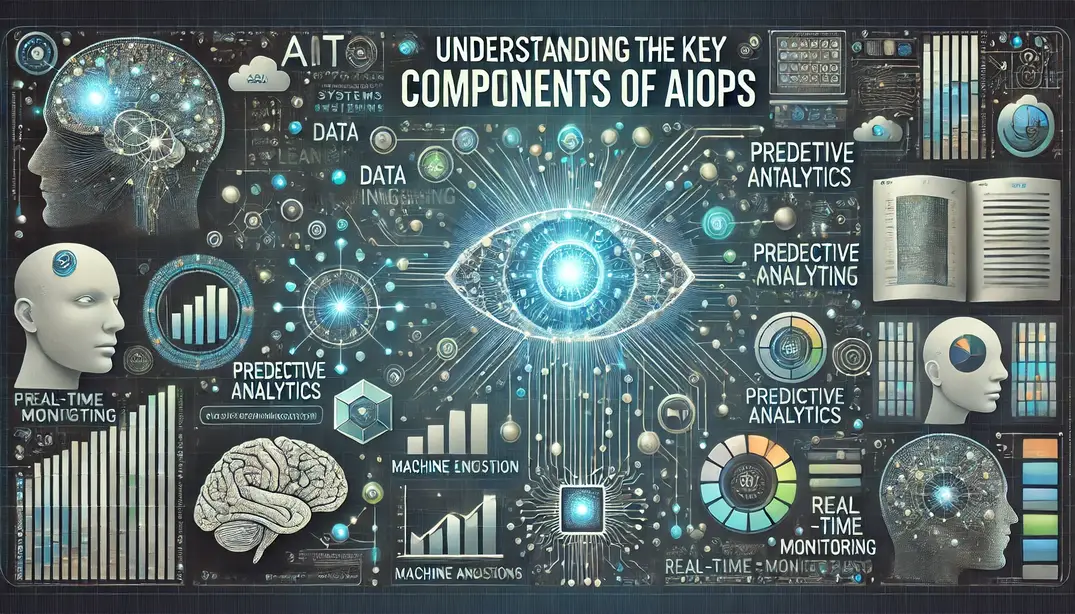
Coined by Gartner, AIOps represents the application of machine learning and data science to traditional IT operations problems. At its technical core, an AIOps platform ingests diverse, multi-format datasets from across the data center infrastructure. This ingestion engine processes telemetry in real time, normalizing disparate metrics, logs, and events into a unified data lake.
- Data Sources & Telemetry (SNMP Traps, Syslogs, APM Traces, Cloud APIs, NetFlow Data)
- AIOps Ingestion & Normalization Layer
- Machine Learning & Analytics Engine (Anomaly Detection, Pattern Matching, NLP)
- Automated Remediation (Self-Healing Scripts) and Incident Management & Predictive Analytics
The architecture of a robust AIOps platform generally relies on two complementary capabilities:
- Historical Analysis: Examining long-term data trends to forecast capacity bottlenecks, hardware degradation cycles, and seasonal usage patterns.
- Real-Time Analytics: Correlating live event streams instantly to suppress alert storms, cluster related warnings into a single incident ticket, and identify exact root causes.
By combining these capabilities, AIOps acts as a central nervous system for the data center, synthesizing disparate signals into actionable intelligence.
Core Capabilities and Functional Components
Implementing AIOps within enterprise data center infrastructure requires an understanding of its specific functional components. These capabilities allow operations teams to handle complex failure domains without manual intervention.
Noise Reduction and Alert Correlation
In a complex data center, a single hardware failure can trigger hundreds of secondary alarms across dependent network switches, hypervisors, and application monitoring tools. AIOps uses machine learning clustering algorithms to group these alerts into a single, cohesive incident. This noise reduction often eliminates over 95% of extraneous alerts, allowing systems engineers to focus immediately on the primary source of failure.
Anomaly Detection and Predictive Analytics
Static thresholds—such as alerting when CPU usage exceeds 90%—frequently result in false positives or missed warnings. AIOps establishes dynamic baselines by learning normal operational behavior across varying cycles, such as business hours versus weekends. When behavior deviates from these learned baselines, the platform flags the anomaly before it manifests as a service outage, allowing engineers to replace failing components during scheduled maintenance windows.
Automated Remediation and Self-Healing
Detection is only half the battle. Modern AIOps frameworks integrate directly with orchestration tools to execute automated runbooks. When the platform identifies a known failure pattern—such as a memory leak in a specific service container—it can automatically restart the container, reroute network traffic, or scale out virtual resources without human intervention, achieving true self-healing infrastructure.
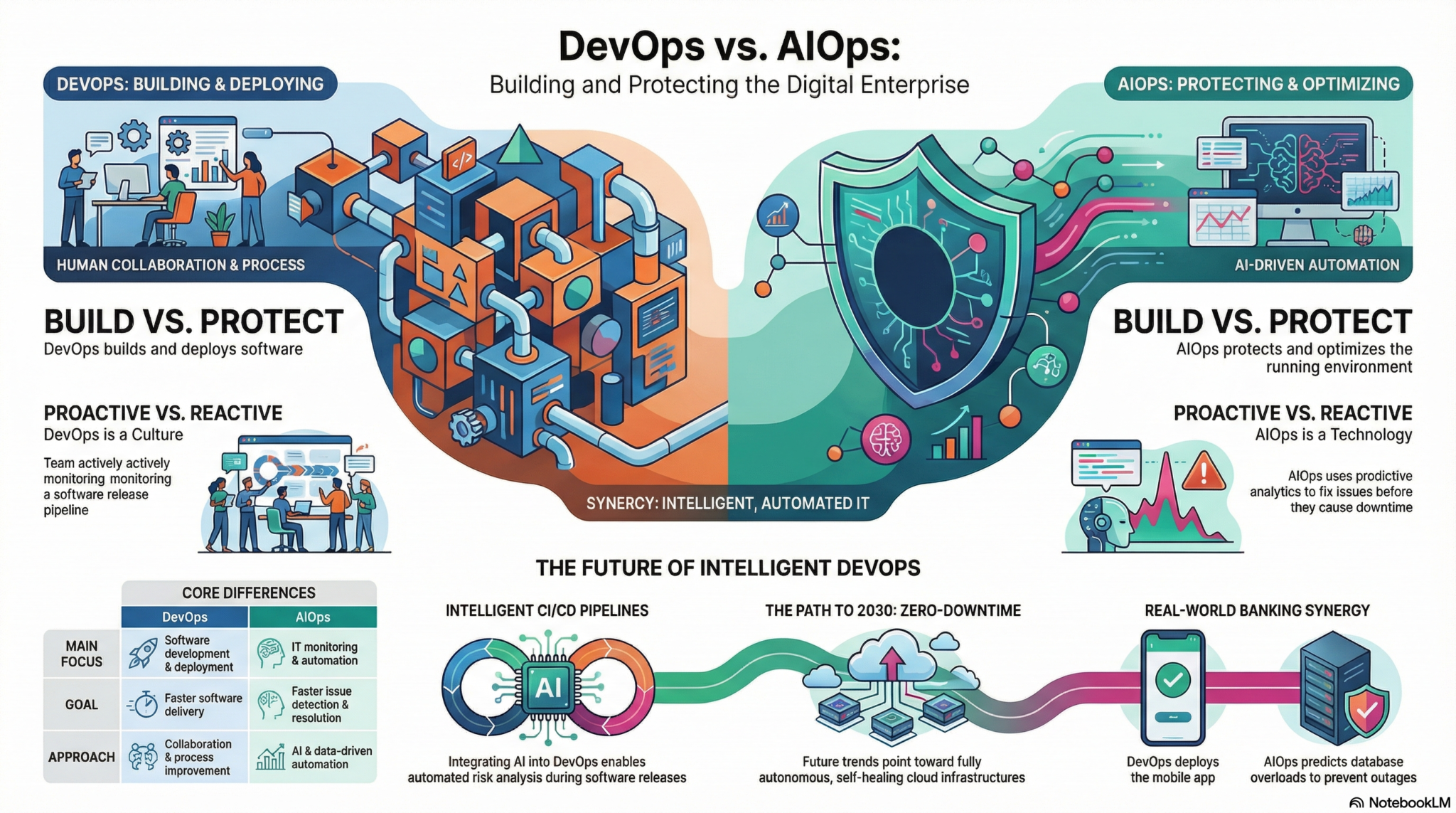
Comparing Traditional IT Operations and AIOps
Transitioning from legacy operations models to an AI-driven environment changes how engineering teams allocate time, budget, and resources.
| Operational Dimension | Traditional IT Operations | AIOps-Driven Data Center |
|---|---|---|
| Primary Approach | Reactive (Fixing issues after outages occur) | Proactive and Predictive (Preventing issues before impact) |
| Alert Management | High volume of alerts; manual noise filtering | Automated correlation; alert storm suppression |
| Root Cause Analysis | Manual log diving across siloed toolsets | Automated cross-domain correlation |
| Resolution Speed | Dependent on human availability and tribal knowledge | Accelerated via automated runbooks and self-healing |
| Data Utilization | Isolated metrics, logs, and traces | Unified data lake with continuous machine learning |
Key Benefits in the Modern Data Center
Adopting AIOps delivers measurable improvements across availability, efficiency, and engineering productivity.
- Reduced Mean Time to Resolution (MTTR): By automatically pinpointing root causes and suggesting or executing fixes, AIOps drastically shortens the duration of outages.
- Optimized Resource Utilization: Predictive analytics prevent over-provisioning by accurately forecasting compute, storage, and cooling requirements based on historical workloads.
- Operational Cost Containment: Automating repetitive troubleshooting and incident triage frees skilled engineers to focus on high-value architectural initiatives rather than routine maintenance.
- Enhanced Service Level Agreements (SLAs): Proactive anomaly detection minimizes unexpected downtime, ensuring consistent uptime for mission-critical enterprise applications.
Implementation Challenges and Operational Hurdles
Despite clear advantages, deploying AIOps in an enterprise data center requires careful planning. Organizations frequently encounter several hurdles during rollout.
Data quality is the most common obstacle. Machine learning algorithms require clean, structured, and comprehensive telemetry to produce accurate insights. If an organization has fragmented logging standards or incomplete monitoring coverage, the AIOps platform will generate inaccurate correlations.
Cultural resistance also plays a role. Operations teams accustomed to manual control loops may distrust automated remediation scripts. Overcoming this skepticism requires a phased adoption strategy, starting with passive advisory modes before granting the platform autonomous execution authority.
Finally, platform integration complexity can delay deployment. Modern data centers often run a mix of legacy bare-metal infrastructure, private clouds, and public cloud services. Ensuring that the chosen AIOps solution integrates seamlessly across these heterogeneous environments demands rigorous testing and clear API governance.
Frequently Asked Questions
What is the primary difference between traditional monitoring and AIOps?
Traditional monitoring relies on static thresholds and human intervention to detect and resolve issues after they happen. AIOps utilizes machine learning and big data analytics to ingest telemetry from multiple sources, dynamically baseline normal behavior, predict anomalies before failures occur, and automate remediation.
Does AIOps replace human systems administrators?
No. AIOps automates repetitive tasks, correlates noisy logs, and accelerates root cause analysis, but it does not replace human engineers. Instead, it elevates their role from reactive firefighters to strategic architects who design resilient systems and refine automated runbooks.
What kind of data does an AIOps platform require?
AIOps platforms ingest broad operational data, including metrics (CPU, memory, temperature), logs (syslogs, application logs), events (SNMP traps, alerts), and traces across physical hardware, virtual machines, networks, and storage arrays.
How long does it take to see ROI from an AIOps implementation?
Return on investment timelines vary based on data maturity, but most organizations experience measurable reductions in MTTR and alert noise within three to six months of initial platform deployment and baseline training.
Conclusion and Next Actions
Implementing AIOps is a strategic imperative for organizations managing the expanding scale and complexity of modern data center infrastructure. To begin, conduct an audit of your current telemetry sources to ensure log standardization and comprehensive monitoring coverage. Select a pilot project focused on a high-noise, high-impact domain—such as network alert correlation or server anomaly detection—and gradually expand automation boundaries as your team builds trust in the platform's analytical insights.
Image Gallery