How to Choose a Real Estate School in New Jersey
To choose the right real estate school in New Jersey, candidates must select an educational provider officially approved by the New Jersey Real Estate Commission (NJREC). Evaluate schools based on their course delivery format, instruct...
To choose the right real estate school in New Jersey, candidates must select an educational provider officially approved by the New Jersey Real Estate Commission (NJREC). Evaluate schools based on their course delivery format, instructor credentials, state exam pass rates, tuition transparency, and the quality of their PSI exam preparation resources.
Contents
Understanding New Jersey Real Estate Education Requirements
Before selecting an educational institution, candidates must understand the regulatory framework governing real estate licensing in New Jersey. The real estate industry in the state is regulated by the New Jersey Real Estate Commission (NJREC), a division of the New Jersey Department of Banking and Insurance. The commission establishes curriculum standards, approves education providers, and oversees licensing compliance for all real estate salespersons, broker-salespersons, and brokers.
For an aspiring real estate salesperson, New Jersey law mandates the completion of a 75-hour pre-licensing course. This curriculum covers foundational real estate principles, including:
- Real estate law and regulations in New Jersey
- Agency relationships and duties
- Real estate contracts and conveyancing
- Fair housing laws and ethics
- Property valuation and appraisal concepts
- Real estate financing and mortgages
- Land use, zoning, and environmental issues
Candidates preparing for a broker's license face expanded educational requirements. New Jersey requires 150 hours of broker pre-licensing education, which is divided into three distinct modules: a 75-hour general broker course, a 45-hour course on ethics and agency law, and a 45-hour course dedicated to office management and business operations. These broker courses can only be taken by individuals who have maintained an active salesperson license for at least three consecutive years immediately preceding their application.
Once a candidate successfully completes the mandatory 75-hour course and passes the school's internal final examination, the school issues a formal completion certificate. Candidates have exactly one year from the date of course completion to pass the state licensing exam administered by PSI Services and submit their complete license application to the NJREC. If this window lapses, the educational credits expire, and the 75-hour course must be repeated in its entirety.
Disclaimer: Real estate licensing regulations, fees, and administrative procedures are governed by state law and administrative code. Candidates should consult the official NJREC guidance for binding legal directives.
Key Criteria for Evaluating NJ Real Estate Schools
Choosing the right real estate school directly impacts your ability to absorb complex legal concepts, pass the state exam on your first attempt, and build a solid foundation for your career. When comparing accredited providers across New Jersey, systematically evaluate the following criteria.
- Candidate Goal
- Verify NJREC Approval
- Compare Delivery Formats
- Check Pass Rates & Resources
- Choose Provider
1. Official NJREC Licensing and Accreditation
Never enroll in a pre-licensing program without verifying that the school holds an active license from the New Jersey Real Estate Commission. Unapproved education providers cannot issue valid certificates of completion, and hours completed through non-certified entities will not qualify you to sit for the state licensing exam. The NJREC publishes an updated list of licensed real estate schools on the Department of Banking and Insurance website.
2. Instruction Delivery Formats
New Jersey allows approved real estate schools to offer pre-licensing instruction through several delivery methods. Choosing the format that matches your learning style, work schedule, and personal discipline is essential for successfully retaining the material.
- In-Person Classroom Instruction: Traditional classroom settings take place in a physical facility with direct, face-to-face instruction. This format provides structured accountability, direct interaction with peers, and immediate Q&A sessions with the instructor.
- Live Online Distance Learning (Livestream / Virtual Classroom): Conducted in real-time over platforms like Zoom or Webex, livestream classes offer the structure of direct instruction without the commute. The NJREC strictly enforces attendance and participation tracking for live distance learning, meaning students must keep their webcams on and attend scheduled sessions.
- Asynchronous Self-Paced Online Learning: Certain approved state providers offer fully interactive, self-paced modules. This format offers maximum flexibility for students working around job or family commitments, but it requires high self-motivation to finish the 75 hours of coursework within the school's allocated timeframe.
3. Instructor Qualifications and Teaching Background
The quality of a real estate school largely depends on the expertise of its teaching staff. Examine the qualifications of the instructors who teach the pre-licensing modules. Superior instructors generally possess:
- Active, long-standing New Jersey real estate broker licenses
- Direct experience managing brokerages or negotiating complex transactions
- Specialized designations or legal backgrounds, such as real estate attorneys or certified real estate instructors (CRI)
- Positive student evaluations that highlight clear explanations of state-specific real estate math and legal statutes
4. PSI Exam Preparation and Practice Resources
Passing the 75-hour school course is only the first hurdle; passing the 110-question PSI state licensing exam is the final test before licensure. Look for real estate schools that build comprehensive state exam preparation into their standard tuition package. High-value programs offer:
- Simulated PSI practice exams that replicate the structure, timing, and question styles of the actual test
- Targeted real estate mathematics review modules and formula cheat sheets
- State-specific legal practice drills focusing on NJREC rules, the Real Estate Full Disclosure Act, and New Jersey Fair Housing regulations
- Flashcards, audio summaries, or recorded lecture archives for review
5. Tuition Fees, Additional Costs, and Policies
Tuition for New Jersey pre-licensing courses generally ranges between $300 and $600, depending on the provider, format, and included study aids. When assessing costs, look beyond the base tuition to ensure there are no hidden expenses.
| Expense Category | Typical Price Range | Important Considerations |
|---|---|---|
| Base Tuition | $300 – $600 | Covers the 75-hour instruction block and mandatory syllabus material. |
| Textbooks & E-Books | $40 – $90 | Check whether required textbooks are included in tuition or sold separately. |
| School Final Exam Retakes | $0 – $50 | Verify whether the school charges a fee if you need to retake the final exam. |
| Course Access Extensions | $25 – $100 | Relevant for self-paced courses if you require extra time beyond the default term. |
| PSI State Exam Fee | $38 per attempt | Paid directly to PSI Services upon scheduling the state licensing exam. |
| Fingerprinting / Background Check | ~$65 | Paid directly to the state-approved vendor (IdentoGO) prior to licensing. |
Comparing New Jersey Real Estate School Formats
Selecting the optimal course format depends on your daily schedule, geographical location, self-discipline, and technical setup.
- Select Pre-Licensing Delivery:
- In-Person Classroom (Structured, Fixed Schedule)
- Live Distance Learning (Interactive, Fixed Schedule)
- Asynchronous Online (Flexible, Self-Paced Schedule)
In-Person Classroom Courses
In-person instruction is ideal for students who thrive in tactile, collaborative environments. Physical classrooms remove home distractions and allow immediate clarification of difficult concepts, such as property descriptions or prorations.
- Pros: Immediate peer networking, high accountability, direct instructor feedback.
- Cons: Fixed rigid schedules, commute time, limited geographic availability in certain counties.
Live Webinar (Distance Learning)
Live webinars combine the structured schedule of classroom learning with the convenience of studying from home. Students attend live broadcasts at specified times (e.g., weekday evenings or weekend days) and participate through audio, chat, and interactive polls.
- Pros: No commuting, structured attendance schedule keeps you on track, real-time Q&A.
- Cons: Requires reliable high-speed internet, strict webcam compliance mandated by state regulators, potential screen fatigue.
Self-Paced Online Courses
Asynchronous online courses allow students to log in and complete modules whenever their schedule permits. Modules incorporate reading materials, video lessons, pop quizzes, and progress-tracking checks.
- Pros: Maximum schedule flexibility, ability to review complex topics multiple times, no commute.
- Cons: Requires strict self-discipline, delayed response times for technical or instructional questions, higher drop-out or extension rates.
Essential Comparison Matrix: NJ School Selection
Use this matrix to compare potential real estate educational providers in New Jersey:
| Evaluation Criteria | In-Person Classroom | Live Stream Webinar | Self-Paced Online |
|---|---|---|---|
| Schedule Structure | Fixed days and times | Fixed days and times | Completely flexible (24/7) |
| Attendance Verification | Roll call by instructor | Webcam monitoring & check-ins | Module timers & quiz checkpoints |
| Interaction Level | High (Direct verbal) | Moderate to High (Chat & Mic) | Low (Email/Forum support) |
| Completion Timeline | Fast-track (2-3 weeks) or Part-time (6-8 weeks) | Fast-track (2-3 weeks) or Part-time (6-8 weeks) | Up to 6 months depending on self-pacing |
| Average Cost Range | $400 – $600 | $350 – $500 | $300 – $450 |
| Ideal Student Profile | Prefers structured visual/auditory learning | Desires structure without travel | Working professionals with variable hours |
Red Flags and Common Pitfalls to Avoid
When researching New Jersey real estate schools, watch out for these warning signs that indicate a low-quality program:
- Lack of NJREC Approval: Some national test-prep websites sell general real estate courses that do not fulfill New Jersey’s official 75-hour pre-licensing mandate. Always double-check provider accreditation against the NJREC approved school registry.
- Outdated Curriculum: Real estate statutes, disclosure rules, and licensing procedures evolve. Schools using obsolete textbooks or video lectures recorded years ago may teach outdated laws, causing students to fail state exam questions.
- Vague Exam Retake Policies: Every candidate must pass the school's internal final exam to receive their completion certificate. Reputable schools include one or two free retakes in their base tuition; predatory providers charge high fees for every attempt.
- No Support for State Exam Prep: A school that merely reads textbook pages without offering specific preparation for the 110-question PSI state exam leaves candidates unprepared for the actual testing experience.
- Exaggerated Job Placement Claims: Be cautious of proprietary school programs affiliated with single brokerages that promise immediate six-figure incomes upon completion. Focus first on passing the educational requirements; carrier selection and brokerage sponsorship can be decided separately.
The Path from School Enrolment to Professional License
To navigate the licensing process efficiently, follow this step-by-step path:
- Enroll in NJREC School
- Complete 75 Hours
- Pass School Final Exam
- Schedule PSI State Exam
- Complete Fingerprinting
- Secure Broker Sponsorship
- Submit NJREC Application
Step 1: Enroll and Complete the 75-Hour Course
Select an approved school and complete the mandatory 75 hours of instruction. Ensure your attendance record is complete, as missing even a few hours without making them up will prevent the school from issuing your completion certificate.
Step 2: Pass the School's Final Examination
Prior to graduation, you must pass the school's internal proctored exam, typically requiring a score of 70% or higher. Upon passing, the school digitally submits your completion records to the state exam vendor, PSI Services.
Step 3: Schedule and Pass the PSI State Examination
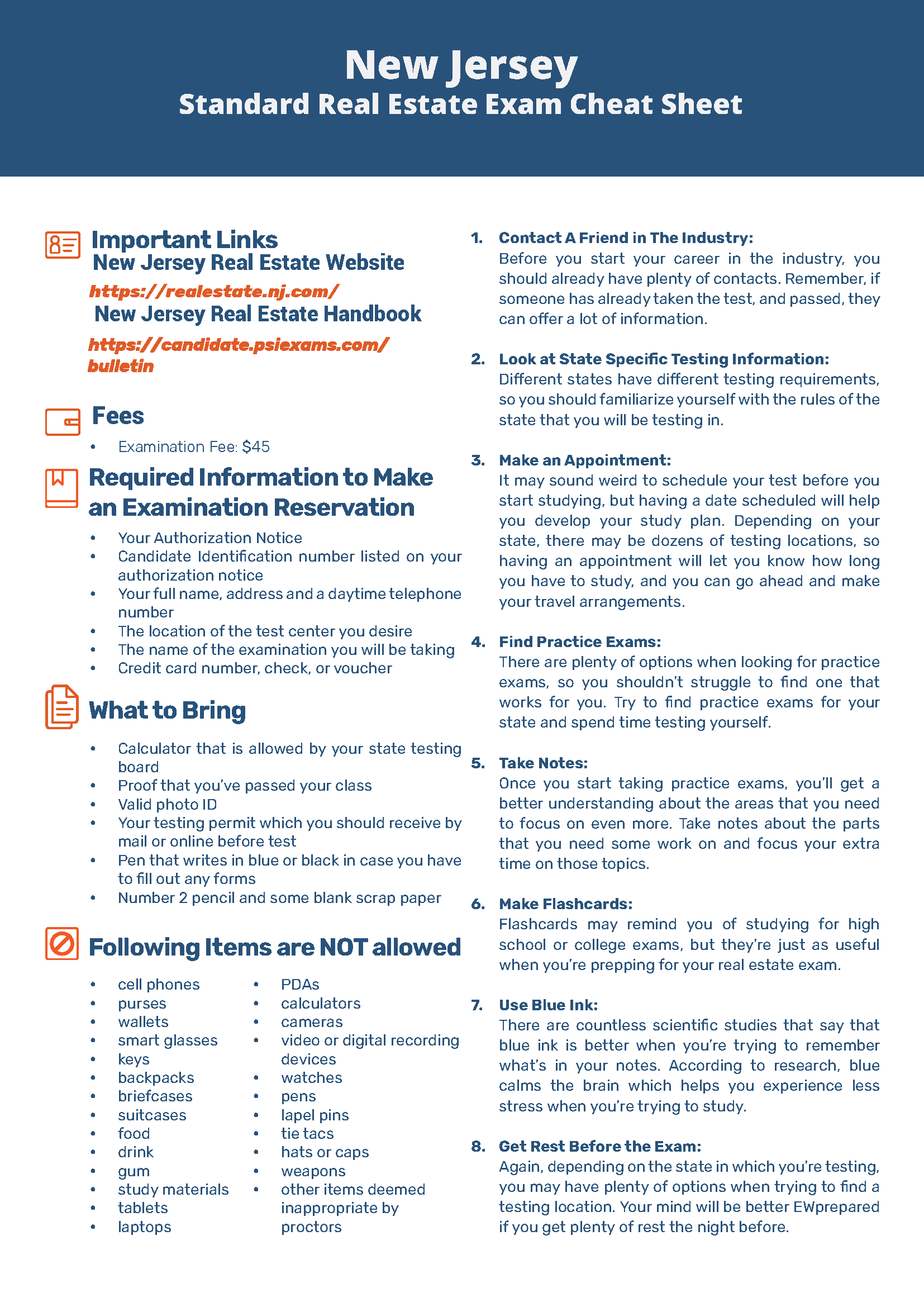
Create an account on the PSI Exams online platform and register for the New Jersey Real Estate Salesperson Examination. The test consists of 110 multiple-choice questions (covering both national real estate concepts and NJ-specific laws). You must achieve a passing score of at least 70%.
Step 4: Complete Criminal Background Fingerprinting
Schedule a fingerprinting appointment through the state's contracted vendor, IdentoGO. This step initiates the criminal history record check required by the NJREC to determine candidate eligibility.
Step 5: Select a Sponsoring Brokerage and Activate Your License
In New Jersey, a real estate salesperson cannot hold an active license independently; you must be sponsored by an active, licensed New Jersey Employing Broker. Once you choose a brokerage, your employing broker submits your formal license application and sponsorship confirmation through the online licensing system operated by the NJ Department of Banking and Insurance.
Frequently Asked Questions
How long does it take to complete real estate school in New Jersey?
The duration depends on the schedule format you select. Full-time "fast-track" courses can be completed in as little as two to three weeks (e.g., 8 hours a day, Monday through Friday). Part-time evening or weekend courses typically take six to ten weeks. Self-paced online options allow students to move faster or slower, usually within a 3- to 6-month limit set by the school.
Can I complete the 75-hour New Jersey real estate course fully online?
Yes. New Jersey permits pre-licensing education to be completed via live virtual classrooms (webinars) or asynchronous self-paced online modules, provided the course provider is directly approved by the NJREC and maintains required student tracking standards.
What happens if I fail the school's final exam?
Most NJREC-approved real estate schools allow students to retake the final exam if they do not pass on their first attempt. Check your school's specific retake policy before enrolling to learn how many retakes are allowed, whether there is a mandatory waiting period, and if retake fees apply.
How much does it cost to get a real estate license in NJ, including school fees?
Total costs generally range between $550 and $850. This breakdown includes tuition and books ($300–$600), the PSI state examination fee ($38), background check fingerprinting (~$65), and the initial NJREC licensing application fee ($160).
What is the passing score for the New Jersey real estate state exam?
Candidates must score at least 70% to pass the PSI state licensing examination. The test consists of general national real estate topics as well as state-specific legal regulations administered in a single timed session.
Final Recommendation: Next Actions
Selecting the right real estate school in New Jersey comes down to balancing regulatory compliance with your individual learning preferences.
- Verify Status: Visit the official NJ Department of Banking and Insurance website to confirm that any candidate school holds an active NJREC approval license.
- Assess Schedule & Format: Choose between in-person classes, live virtual webinars, or self-paced courses based on your daily availability and learning style.
- Confirm Exam Prep Inclusion: Ensure the program includes practice tools, real estate math drills, and simulated exams tailored specifically to the PSI testing environment.
- Review Total Costs: Confirm all tuition fees, book costs, and exam retake policies up front to prevent unexpected expenses during your licensing journey.
Image Gallery