Why the Choice Between a W-2 and 1099 Matters for Your Paycheck
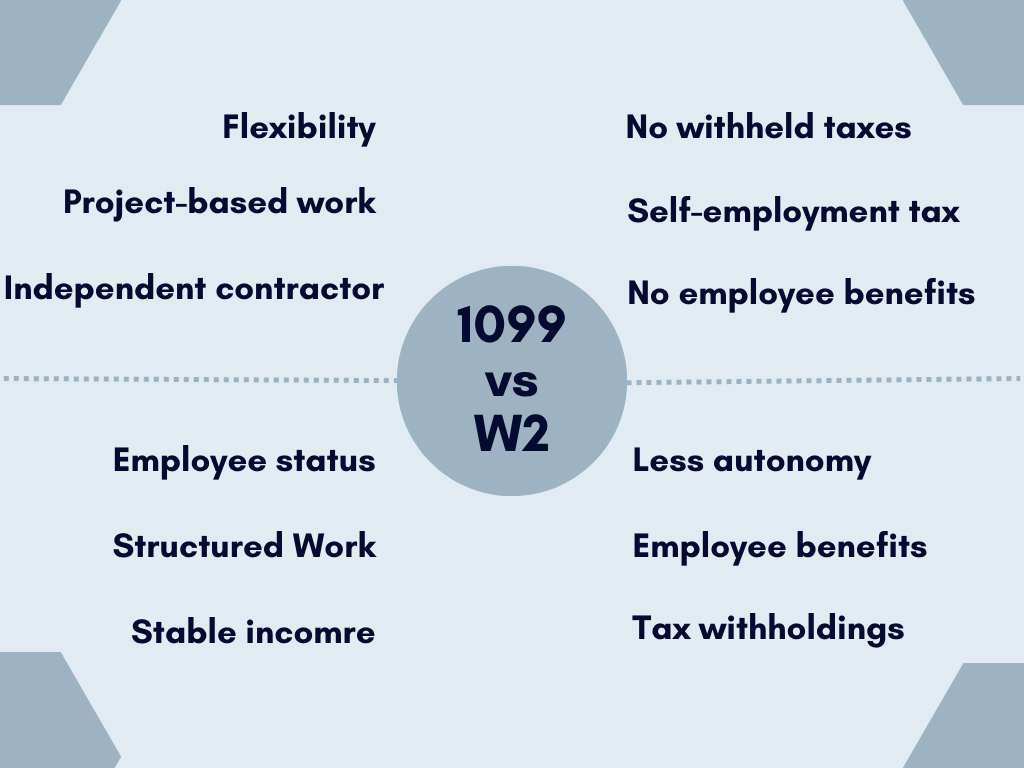
The distinction between a W-2 employee and a 1099 independent contractor dictates how your pay is calculated, taxed, and distributed. A W-2 status means your employer automatically withholds taxes and covers half of your FICA burden, w...
The distinction between a W-2 employee and a 1099 independent contractor dictates how your pay is calculated, taxed, and distributed. A W-2 status means your employer automatically withholds taxes and covers half of your FICA burden, whereas a 1099 status leaves you responsible for 100% of self-employment taxes, private benefits, and tax planning out of your gross pay.
Contents
Disclaimer: This article provides educational guidance on tax mechanics and worker classification. It does not constitute formal legal, accounting, or tax advice. Consult a Certified Public Accountant (CPA) or employment attorney regarding your specific financial situation.
Understanding Worker Classification: W-2 vs. 1099
When evaluating a job offer or contract, gross pay is only part of the equation. How the Internal Revenue Service (IRS) and the U.S. Department of Labor (DOL) classify your position determines the true cash value of your paycheck.
A W-2 employee works under a traditional common-law employment relationship. The hiring organization controls how, when, and where the work is performed. In exchange, the law requires employers to manage tax withholdings, provide workplace protections, and contribute directly to mandatory payroll taxes.
A 1099 independent contractor operates as an independent business entity. The hiring entity specifies the desired end result of the work, but the contractor retains control over their schedule, tools, methods, and operational structure. Instead of receiving a standard wage statement, contractors receive gross compensation and are issued a Form 1099-NEC at the end of the tax year.
The IRS relies on three general categories to determine whether a worker is an employee or an independent contractor:
- Behavioral Control: Does the business direct or control how the worker performs tasks (e.g., set hours, mandatory training, specific workflow instructions)?
- Financial Control: Does the business control the economic aspects of the job (e.g., fixed salary versus project fees, unmonitored business expenses, provision of equipment)?
- Type of Relationship: Are there written contracts, employee-type benefits (insurance, vacation pay), and an expectation that the relationship will continue indefinitely?
Understanding these legal criteria is critical because employers cannot simply "choose" to label a worker as a 1099 contractor to save money. The actual nature of the working relationship governs the legal tax classification under federal and state guidelines, including rules enforced by the U.S. Department of Labor Misclassification Initiative.
How Paycheck Mechanics Differ: Taxes and Withholding
The most immediate difference between a W-2 and a 1099 working relationship appears on payday. The amount listed at the top of your offer letter does not represent what actually lands in your bank account, and the calculation process varies significantly between the two statuses.
| Gross Pay Comparison | Details |
|---|---|
| W-2 Paycheck | Gross Earnings- Federal & State Income Tax Withholding- Employee Share of FICA Tax (7.65%)- Elective Benefit Premiums (Health, 401k, HSA)= Net Take-Home Pay (Employer pays matching 7.65% FICA behind scenes) |
| 1099 Paycheck | Gross Earnings (100% Paid directly to contractor)- Self-Employment Tax / SECA (15.3% reserved by worker)- Estimated Federal & State Income Taxes (reserved by worker)- Private Benefits & Business Expenses (funded by worker)= True Net Take-Home Pay (Requires manual budgeting & tax payments) |
The FICA vs. SECA Tax Divide
Under the Federal Insurance Contributions Act (FICA), social safety net programs—specifically Social Security and Medicare—are funded through payroll taxes totaling 15.3% of eligible wages.
- For W-2 Employees: The employer and employee split this responsibility evenly. Your employer automatically deducts 7.65% from your gross paycheck (6.2% for Social Security and 1.45% for Medicare) and pays the remaining 7.65% out of company funds.
- For 1099 Contractors: The employer pays 0%. Under the Self-Employment Contributions Act (SECA), the contractor is considered both employer and employee. As a result, 1099 workers pay the full 15.3% self-employment tax on their net earnings. Details on calculating these obligations are outlined in the IRS Self-Employment Tax Guide.
Income Tax Withholding vs. Quarterly Estimated Payments
For W-2 workers, employers calculate federal, state, and local income tax withholdings every pay period using the employee's Form W-4 choices. The worker receives a net paycheck with tax obligations already satisfied.
For 1099 workers, no taxes are withheld. While receiving a check for 100% of gross earnings can create the illusion of higher pay, none of that money is tax-free. Contractors must manually calculate and submit quarterly estimated tax payments to the IRS and state tax authorities using Form 1040-ES. Failing to set aside adequate tax reserves can lead to significant year-end tax bills and IRS underpayment penalties.
The Hidden Value of Benefits and Workplace Protections
Comparing a W-2 salary directly to a 1099 contract rate without factoring in employer-sponsored benefits leads to flawed financial decisions. Employer-paid benefits represent a major component of total compensation.
Health Insurance and Retirement
Employers offering W-2 positions frequently subsidize health, dental, and vision insurance premiums, often covering 70% to 80% of total plan costs. Furthermore, many W-2 employers provide matching contributions to 401(k) or 403(b) retirement plans (e.g., a dollar-for-dollar match up to 4% or 5% of annual salary).
A 1099 contractor must purchase private health insurance on the individual marketplace or through professional associations and fund 100% of their retirement contributions via Solo 401(k)s or SEP-IRAs without employer matches.
Paid Time Off and Unpaid Hours
W-2 employees generally receive paid time off (PTO), including vacation days, sick leave, and corporate holidays. If a W-2 employee takes two weeks of vacation, their paycheck remains unchanged.
If a 1099 contractor takes two weeks off, their cash flow drops to zero for that period. Contractors must incorporate non-billable hours—such as administrative work, invoicing, client prospecting, and vacation time—directly into their hourly billing rate to avoid net income deficits.
Statutory Protections
W-2 employees benefit from federal and state legal protections:
- Overtime Pay: Non-exempt W-2 employees receive 1.5 times their regular pay rate for hours worked over 40 in a workweek under the Fair Labor Standards Act (FLSA).
- Unemployment Insurance: Employers pay into federal and state unemployment trust funds. If a W-2 worker is laid off through no fault of their own, they can collect unemployment benefits.
- Workers' Compensation: Employers carry insurance to cover medical expenses and lost wages if an employee is injured on the job.
1099 contractors are excluded from overtime rules, unemployment compensation, and employer-funded workers' compensation coverage.
Tax Deductions: The 1099 Counter-Balance
While 1099 workers face higher payroll taxes and lack employer benefits, they possess tax deduction options that W-2 employees do not.
Following the Tax Cuts and Jobs Act, W-2 employees cannot deduct unreimbursed employee expenses on federal tax returns. If a W-2 worker buys a work laptop, pays for home internet, or drives a personal vehicle for work tasks without reimbursement, those expenses cannot be subtracted from their taxable income.
In contrast, 1099 contractors operate as independent businesses and report income and expenses on Schedule C (Form 1040). Contractors can deduct "ordinary and necessary" business expenses from gross revenues, reducing their total taxable income.
Common 1099 Schedule C Tax Deductions:
- Workspace & Utilities
- Home office deduction (dedicated work space)
- Business percentage of internet and mobile phone bills
- Tools & Operations
- Work software subscriptions and hardware purchases
- Professional liability insurance premiums
- Marketing, website hosting, and advertising costs
- Professional Services & Expenses
- Business mileage or actual vehicle operational costs
- Legal, accounting, and bookkeeping fees
- Self-employed health insurance deduction (Form 1040 Schedule 1)
Additionally, qualifying self-employed individuals can take advantage of the Section 199A Qualified Business Income (QBI) Deduction, which allows eligible pass-through business owners to deduct up to 20% of their qualified business income from federal income taxes, subject to IRS income thresholds and industry limitations. Review full eligibility criteria directly on the official IRS Qualified Business Income Deduction Page.
Financial Comparison: W-2 vs. 1099 Paycheck Breakdown
To understand how worker classification alters real-world take-home pay, consider a side-by-side financial scenario.
In this model, a professional is offered either a $100,000 W-2 salary with standard benefits or a $100,000 1099 contract.
Assumptions for illustration purposes:
- Single tax filer, standard deduction ($15,000 baseline estimate).
- State income tax ignored for simplified national comparison.
- 1099 contractor incurs $10,000 in legitimate Schedule C business expenses.
- 1099 contractor pays $6,000 annually for individual health insurance.
- W-2 employer contributes 50% FICA match, 4% 401(k) match, and 80% health premium coverage.
| Financial Metric | W-2 Employee Offer ($100,000) | 1099 Contractor Offer ($100,000) |
|---|---|---|
| Gross Revenue / Salary | $100,000 | $100,000 |
| Business Expenses (Schedule C) | $0 (Not Deductible) | -$10,000 |
| Net Business Profit | $100,000 | $90,000 |
| Employer FICA Contribution (7.65%) | +$7,650 (Paid by employer) | $0 |
| Worker Payroll Tax Burden | -$7,650 (7.65% FICA) | -$12,717 (15.3% SECA on 92.35% net)* |
| 1/2 Self-Employment Tax Deduction | N/A | -$6,358 (Deductible from income) |
| Out-of-Pocket Health Insurance | -$1,500 (Employer subsidized) | -$6,000 (Self-funded) |
| Employer 401(k) Match Value | +$4,000 (Value added) | $0 |
| Estimated Federal Income Tax | ~$11,500 | ~$9,800 (After QBI & deductions) |
| Estimated Net Realized Value | ~$79,350 | ~$61,483 |
*Note: Self-employment tax applies to 92.35% of net business earnings. Figures are rounded estimates for standard comparative purposes.
As demonstrated in the comparison, receiving $100,000 on a 1099 status yields significantly lower net financial value than a $100,000 W-2 salary once self-employment taxes, health insurance costs, and lost benefit matches are calculated.
The "1099 Premium" Rule of Thumb
To compensate for self-employment tax, uncompensated leave, administrative overhead, and out-of-pocket health coverage, independent contractors typically must charge an hourly rate 25% to 50% higher than an equivalent W-2 hourly wage.
- If an equivalent W-2 job pays $40/hour, a contractor should target $50/hour to $60/hour on a 1099 contract to achieve comparable net take-home pay and benefits equity.
Worker Misclassification Risks and Legal Rights
Because W-2 status requires employers to pay payroll taxes, workers' compensation insurance, and unemployment contributions, some organizations attempt to classify actual employees as 1099 contractors to lower operating overhead.
Misclassifying a worker as an independent contractor when they legally qualify as a common-law employee is illegal under federal and state tax laws.
Red Flags of Worker Misclassification
You may be misclassified as a 1099 contractor if:
- The company sets mandatory daily work hours and strict workplace locations.
- You perform the core operational work of the business alongside standard W-2 employees doing identical duties.
- The business supplies all of your work equipment, tools, software licenses, and training materials.
- You are prevented from offering your services to other clients or running your own independent business.
Remedying Misclassification
If you suspect you have been improperly classified as a 1099 contractor, you have formal recourse:
- File IRS Form SS-8: Submit a formal request via IRS Form SS-8 (Determination of Worker Status) to have the IRS officially evaluate your employment relationship.
- Form 8919: If the IRS determines you were misclassified, you can file IRS Form 8919 (Uncollected Taxes on Wages) alongside your tax return to pay only your 7.65% employee share of FICA tax, shifting the remaining liability back to the employer.
Frequently Asked Questions
Is a 1099 paycheck always larger upfront than a W-2 paycheck?
Yes, a 1099 paycheck often appears larger on paper because hiring companies do not deduct federal income taxes, state taxes, or FICA payroll taxes. However, this gross amount is deceiving. The recipient is legally obligated to set aside 25% to 35% of that check into a separate tax account to cover quarterly estimated tax obligations and self-employment tax.
How much extra should I ask for on a 1099 offer compared to W-2?
As a general rule, aim for a rate that is 25% to 50% higher than an equivalent W-2 rate. This premium accounts for the 7.65% missing employer FICA tax contribution, out-of-pocket health insurance premiums, private retirement funding, uncompensated vacation and sick time, and operational business costs.
Can I deduct home office expenses if I work remotely on a W-2 paycheck?
No. Under current federal tax guidelines, W-2 employees cannot deduct home office expenses, personal computers, internet bills, or cell phone plans on federal tax returns, even if remote work is mandatory. Home office deductions are strictly reserved for self-employed individuals and 1099 contractors reporting income on Schedule C.
What happens if I miss a 1099 quarterly estimated tax payment?
If you fail to make required quarterly estimated tax payments via Form 1040-ES, the IRS can assess underpayment penalties and interest charges when you file your annual tax return. Penalties accrue based on how much was owed and how late the payment was made. You can avoid penalties if your total tax withholdings and timely estimated payments meet IRS "safe harbor" thresholds (e.g., paying at least 90% of the current year's tax liability or 100% of the prior year's tax liability).
Can an employer let me pick whether I want to be a W-2 or 1099 worker?
Legally, no. Worker classification is dictated by the actual facts of the working relationship under federal IRS common-law guidelines and Department of Labor rules, not personal preference or contract phrasing. If an employer controls your schedule, work methods, and equipment, the position is legally a W-2 role regardless of whether both parties agree to call it a 1099 contract.
Next Steps: Evaluating Your Options
Before accepting a job offer or contract agreement, follow this checklist to verify your real take-home pay:
- Calculate the True Tax Drag: If offered a 1099 contract, multiply the gross contract figure by 15.3% for self-employment tax before estimating standard income tax brackets.
- Audit Expense Potential: Itemize potential business deductions. If you will incur minimal business expenses (e.g., performing digital work on a personal laptop), a 1099 structure provides fewer tax reduction benefits to offset the higher self-employment tax burden.
- Calculate Benefits Replacement Cost: Obtain quotes for individual health coverage on state insurance exchanges and add the cost of lost employer 401(k) matches to your baseline income needs.
- Confirm Legal Classification: Ensure the work structure aligns with IRS behavioral and financial control guidelines. If the employer mandates strict hours and tools but insists on 1099 reporting, seek guidance from a qualified CPA or employment attorney before signing.
Image Gallery