Understanding the Tax Implications of Cashing In a Life Insurance Policy
When you cash in a permanent life insurance policy during your lifetime, any amount received above your total cost basis—the cumulative premiums paid minus non-taxable dividends or withdrawals—is taxed as ordinary income. Proceeds equa...
When you cash in a permanent life insurance policy during your lifetime, any amount received above your total cost basis—the cumulative premiums paid minus non-taxable dividends or withdrawals—is taxed as ordinary income. Proceeds equal to or below your cost basis are returned tax-free. However, specific tax rules apply depending on whether you surrender the policy, take loans, or hold a Modified Endowment Contract.
Contents
Core Tax Principles: Cost Basis vs. Taxable Gain
Understanding how the Internal Revenue Service (IRS) taxes life insurance policy payouts during your lifetime begins with identifying the difference between death benefits and living benefits. While death benefits paid to beneficiaries upon the insured's passing are generally income-tax-free under Internal Revenue Code (IRC) Section 101(a), cashing in a policy while you are alive triggers rules governed primarily by IRC Section 72.
When you access cash value built inside a whole life, universal life, or variable universal life policy, the IRS divides your payout into two distinct categories:
- Return of Capital (Cost Basis): This is the total amount of money you paid into the contract via policy premiums, reduced by any prior non-taxable distributions, dividends received in cash, or tax-free withdrawals. Because this portion represents money paid with after-tax dollars, it is returned to you tax-free.
- Investment Gain (Taxable Growth): This represents interest, dividends, or investment growth accumulated within the policy over time. Any amount paid out that exceeds your calculated cost basis is treated as taxable gain.
Crucially, taxable gains from a surrendered or accessed life insurance policy are classified as ordinary income, not capital gains. This means gains are taxed at your standard federal and state income tax bracket rates, which can reach up to 37% at the federal level depending on your overall income.
Methods of Accessing Cash Value and Their Tax Rules
The tax consequences of receiving money from a policy while alive depend directly on the transaction method used to extract the funds.
- Life Insurance Cash Access
- Full Policy Surrender
- Taxed on Gain > Basis
- Cost Basis returned Free
- Policy Loan
- Non-Taxable (if active)
- Phantom Income if Lapsed
- Partial Withdrawal
- FIFO Accounting (Non-MEC)
- Taxed only after Basis extracted
- Life Settlement
- Basis: Tax-Free
- Gain to Cash Value: Ordinary
- Excess: Capital Gain
- Full Policy Surrender
1. Full Policy Surrender
Surrendering your policy means terminating the coverage completely in exchange for its current net cash surrender value. The insurance company calculates this by taking the total cash value accumulated in the contract and subtracting any contractually stipulated surrender charges or outstanding loan balances.
- Tax Formula:
Taxable Income = (Net Cash Received + Outstanding Loan Balances) - Total Cost Basis - Reporting: The insurance carrier reports the distribution to you and the IRS on IRS Form 1099-R.
If your policy’s surrender charges equal or exceed the accumulated cash value, you may receive nothing, yet still owe taxes if an outstanding loan balance was forgiven upon termination.
2. Partial Withdrawals
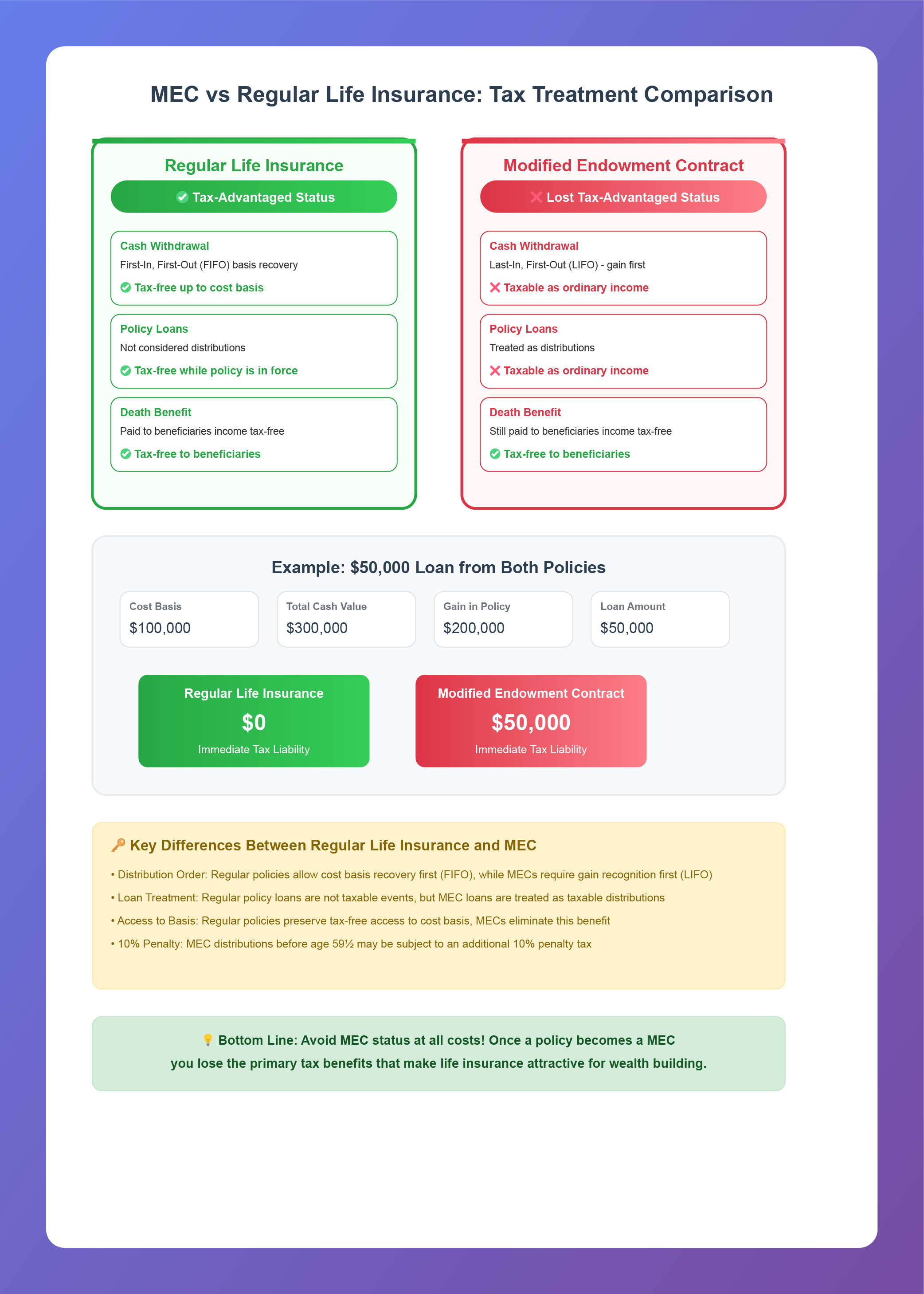
If you take a partial withdrawal (or partial surrender) from a standard permanent policy, the IRS applies First-In, First-Out (FIFO) tax treatment under IRC Section 72(e).
Under FIFO rules, withdrawals are treated as coming from your tax-free cost basis first. You pay zero income tax on partial withdrawals until your total withdrawals equal your cumulative premiums paid. Only after you have recovered 100% of your cost basis do subsequent withdrawals become fully taxable as ordinary income.
Exception: If a partial withdrawal causes a reduction in the policy's death benefit during the first 15 years of the policy, specific recalculation rules under IRC Section 7702(f)(7) may force a portion of the early withdrawal to be taxed on a Last-In, First-Out (LIFO) basis.
3. Policy Loans
Policy loans represent one of the most tax-efficient ways to access liquidity from a life insurance contract during your lifetime. When you borrow against your cash value, the money received is structured as a loan collateralized by the policy, not a distribution.
- Active Policy Status: As long as the policy remains active and in force, policy loans are completely tax-free, even if the borrowed amount exceeds your premium cost basis.
- The Lapse Trap (Phantom Income): If an outstanding policy loan grows to equal the remaining cash value, or if you intentionally surrender a policy with an outstanding loan balance, the insurance company will terminate the contract. At that exact moment, the forgiven loan amount is treated by the IRS as cash proceeds received. If the forgiven loan plus any cash received exceeds your original cost basis, you will owe ordinary income taxes on the difference—creating a taxable event without receiving any fresh cash to pay the tax bill.
4. Selling the Policy (Life Settlement)
If you sell your life insurance policy to a third-party investor (a life settlement transaction), the taxation rules follow a multi-tier structure established by the Tax Cuts and Jobs Act and clarified under IRS Revenue Ruling 2009-13:
- Basis Recovery: Proceeds up to your original cost basis are received tax-free.
- Ordinary Income: Proceeds exceeding your basis up to the policy's cash surrender value are taxed as ordinary income.
- Capital Gain: Any proceeds received above the policy's cash surrender value are taxed as long-term or short-term capital gains, depending on how long you owned the policy.
Modified Endowment Contracts (MECs) and the 7-Pay Test
To prevent high-net-worth individuals from using life insurance contracts strictly as tax-sheltered investment vehicles, Congress enacted rules governing Modified Endowment Contracts (MECs) under IRC Section 7702A.
A life insurance policy becomes classified as a MEC if the total cumulative premiums paid into the contract during its first seven years exceed the amount required to fund a fully paid-up policy under the 7-Pay Test.
How MEC Taxation Works
If a policy triggers MEC status, it retains its tax-free death benefit for beneficiaries, but loses its favorable lifetime distribution rules:
- LIFO Accounting: All distributions, partial withdrawals, and policy loans are taxed under Last-In, First-Out (LIFO) accounting rules. This means accumulated gain is pulled out first and taxed as 100% ordinary income before you can access your tax-free basis.
- 10% Penalty Tax: If you take a withdrawal, loan, or surrender from a MEC before reaching age 59½, the IRS imposes a 10% early withdrawal penalty on the taxable portion of the distribution, similar to early traditional IRA withdrawals.
Tax-Free Alternatives for Accessing Cash Value
If you need liquidity or wish to reallocate assets without incurring a immediate tax bill, several tax-favored mechanisms exist under federal tax law.
Accelerated Death Benefits (ADBs)
Under IRC Section 101(g), individuals diagnosed with a terminal illness (certified by a physician as having an expectation of death within 24 months) or a qualifying chronic illness can receive a portion of their policy’s death benefit tax-free while still alive.
For chronically ill individuals who cannot perform at least two Activities of Daily Living (ADLs), tax-free accelerated payments may be subject to daily per diem limits set annually by the IRS under Section 7702B.
IRC Section 1035 Exchanges
If you want to exit a policy with substantial taxable gain but do not immediately need cash income, you can execute a Section 1035 Exchange. This provision allows you to transfer the full cash value of an existing life insurance contract into a new life insurance policy, an annuity, or a long-term care insurance policy on a non-taxable basis.
To maintain tax-deferred status, the funds must transfer directly between insurance carriers; you cannot take personal possession of the cash check during the exchange process.
Comprehensive Tax Comparison Matrix
The following table summarizes how different cash-out methods compare under U.S. federal tax law for standard, non-MEC permanent policies:
| Access Method | Tax Status of Proceeds | Accounting Order | 10% IRS Penalty Risk? | Primary Tax Risk / Caveat |
|---|---|---|---|---|
| Full Surrender | Taxable above Basis | N/A (Total Value) | No | Surrender charges reduce total net cash; gain taxed as ordinary income. |
| Partial Withdrawal | Tax-free up to Basis | FIFO (Basis First) | No | Withdrawals reduce overall death benefit and future growth potential. |
| Policy Loan | Tax-Free | N/A (Borrowing) | No | Contract lapse with outstanding loan triggers massive ordinary tax. |
| MEC Withdrawal/Loan | Fully Taxable Earnings | LIFO (Earnings First) | Yes (If under 59½) | Loss of FIFO tax advantages permanently for that contract. |
| Life Settlement (Sale) | Tiered: Basis / Ordinary / Capital | Multi-Tiered | No | Broker fees and complex tax calculation across three distinct bands. |
| Accelerated Benefits | Tax-Free (IRC 101g) | N/A | No | Requires qualified terminal or chronic illness certification. |
| 1035 Exchange | Tax-Deferred Transfer | N/A | No | Cash must move directly between insurers without touching policyholder. |
Common Tax Traps to Avoid
Taxpayers who cash in life insurance policies frequently encounter unexpected tax liabilities due to common procedural misunderstandings:
1. Surrendering Policies with Unpaid Loan Balances
When a policy with an outstanding loan is surrendered, the insurer subtracts the debt from the gross cash value to calculate your net cash payout. However, the IRS treats the debt payoff as part of your total gross distribution. If Net Cash Received + Outstanding Loan exceeds your basis, you will face an income tax liability that may be far larger than the actual cash check received.
2. Assuming Capital Gains Rates Apply
Unlike stocks, bonds, or real estate, gains extracted from a surrendered life insurance contract do not qualify for preferential long-term capital gains tax rates (0%, 15%, or 20%). The IRS classifies life insurance earnings strictly as ordinary income.
3. Miscalculating Cost Basis
Policyholders often fail to track dividends correctly. If you received policy dividends in cash or used them to pay premiums in prior years, your total cost basis is reduced by those dividend amounts. Overestimating your basis leads to underreporting taxable gain on tax filings.
Frequently Asked Questions
Is cashing out a life insurance policy considered taxable income?
Cashing out a life insurance policy is taxable only on the amount that exceeds your total cost basis (the aggregate premiums you paid into the policy minus non-taxable distributions). The amount equal to your cost basis is returned tax-free. Gains above your basis are taxed as ordinary income.
How do I report a surrendered life insurance policy on my taxes?
The insurance carrier will send you and the IRS an IRS Form 1099-R during the tax season following the calendar year of surrender. Gross distribution amounts are listed in Box 1, and the taxable portion is reported in Box 2a. You must include this taxable gain on your federal income tax return (IRS Form 1040).
Can I sell my life insurance policy instead of surrendering it?
Yes. Selling a policy through a life settlement often yields a higher payout than surrendering it back to the insurance company. Tax implications differ: proceeds up to your basis are tax-free, gains up to the cash surrender value are taxed as ordinary income, and any excess purchase price is taxed as capital gains.
Does a policy loan count as taxable income?
No, policy loans from a standard non-MEC life insurance contract are not considered taxable income when taken. However, if the policy lapses, terminates, or is surrendered while a loan balance is outstanding, the debt cancellation is treated as a taxable distribution to the extent it exceeds your basis.
What is the tax penalty for cashing in a Modified Endowment Contract (MEC)?
If you withdraw money or take a loan from a policy designated as a MEC, earnings are distributed first under LIFO rules and taxed as ordinary income. Additionally, if you are under age 59½ at the time of distribution, the IRS imposes a 10% penalty tax on the taxable portion of the payout.
Strategic Recommendations and Next Steps
Before taking steps to cash in, surrender, or modify an existing permanent life insurance policy, take the following actions:
- Request an In-Force Illustration and Basis Letter: Ask your insurance company to provide an official written statement of your current cumulative premiums paid (cost basis), total cash value, surrender charges, and outstanding loan balances.
- Evaluate Alternative Cash Options: If you require immediate funds, consider taking tax-free partial withdrawals up to your basis or using tax-free policy loans rather than performing a full contract surrender.
- Analyze MEC Status: Check whether your contract is classified as a Modified Endowment Contract before requesting distributions to avoid unexpected 10% IRS penalties and LIFO taxation.
- Consult a Qualified Professional: Tax laws surrounding life insurance contracts under IRC Sections 72, 101, and 7702 are highly technical. Consult a Certified Public Accountant (CPA) or fee-only Certified Financial Planner (CFP) to calculate the precise tax impact based on your overall personal income bracket before executing a surrender.
Disclaimer: This guide is provided for educational and informational purposes only and does not constitute formal legal, accounting, or tax advice. Tax regulations are subject to change and vary based on individual financial circumstances and state law.
Image Gallery