Is Workers' Compensation Required in Florida for a Company With 2 Employees?
Whether a Florida business with two employees must carry workers' compensation insurance depends on its industry classification. Non-construction businesses with fewer than four workers are generally exempt from mandatory coverage unde...
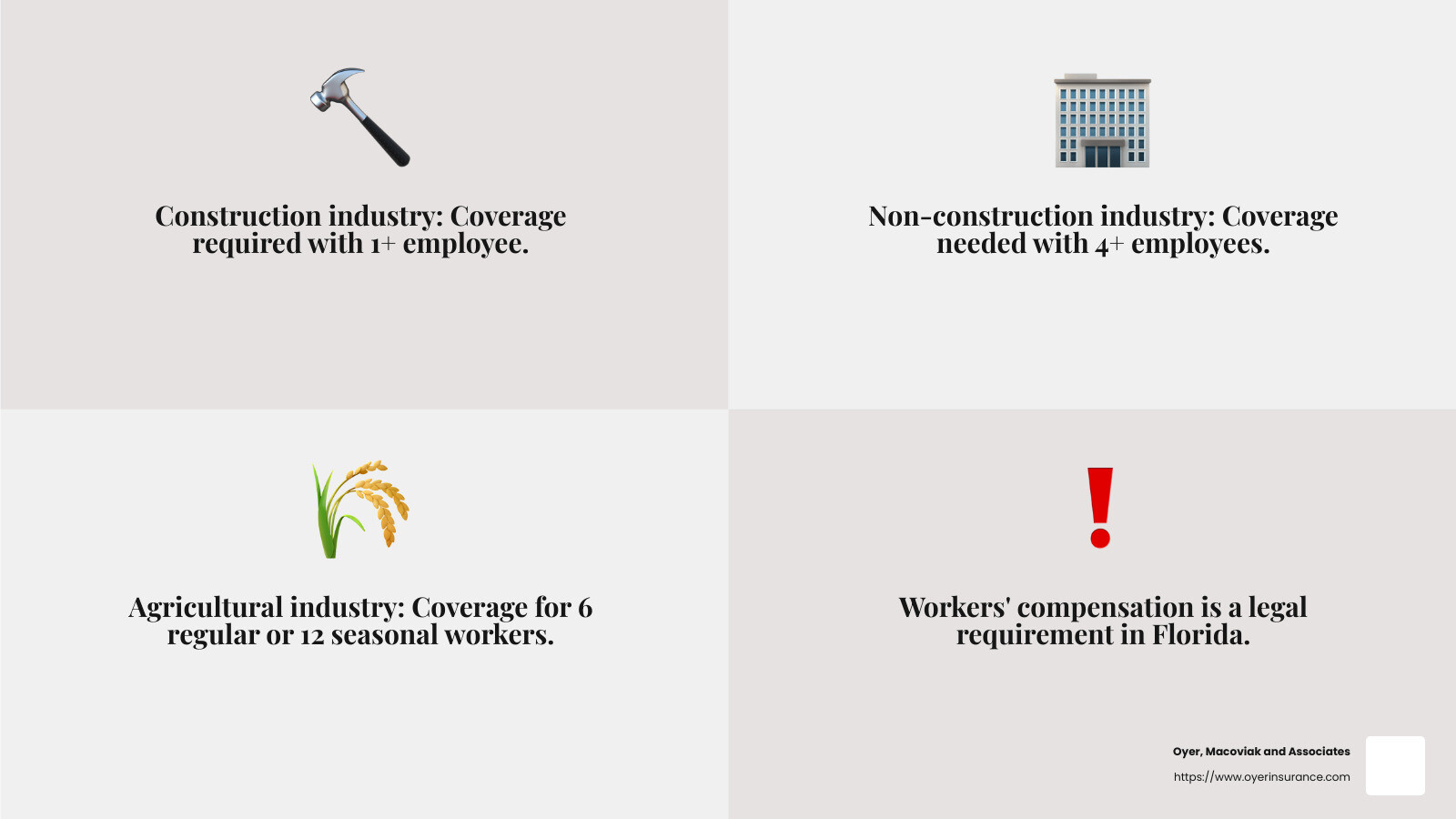
Whether a Florida business with two employees must carry workers' compensation insurance depends on its industry classification. Non-construction businesses with fewer than four workers are generally exempt from mandatory coverage under state law. Conversely, construction companies must secure workers' compensation insurance if they employ one or more workers, while agricultural operations only require coverage once they reach six regular employees.
Contents
Understanding Florida's Workers' Compensation Thresholds by Industry
Florida’s workers’ compensation regulations are governed by Chapter 440 of the Florida Statutes. Unlike many states that apply a single universal employee threshold to all commercial enterprises, Florida establishes distinct mandatory coverage thresholds based on the hazard profile of the specific industry.
The state regulatory authority—the Florida Department of Financial Services, Division of Workers' Compensation—enforces these rules strictly across three main industry classifications: non-construction, construction, and agriculture.
- Florida Workers' Comp Employee Thresholds (F.S. 440)
- Non-Construction (4+ Employees)
- 2 Employees = Exempt
- Construction (1+ Employee)
- 2 Employees = Mandatory
- Agriculture (6+ Regular or 12+ Seasonal)
- 2 Employees = Exempt
- Non-Construction (4+ Employees)
1. Non-Construction Businesses (Threshold: 4 or More Employees)
For general commercial enterprises outside of building and construction trades—such as retail stores, professional service firms, IT consultancies, marketing agencies, and restaurants—Florida law requires coverage only when an employer has four (4) or more employees.
If your non-construction business employs exactly two employees, you are not legally required by Florida statute to carry workers' compensation insurance. However, calculating the number of employees requires strict adherence to statutory definitions, as business owners and corporate officers are counted by default unless a valid exemption is filed with the state.
2. Construction Industry (Threshold: 1 or More Employees)
The construction trade operates under significantly stricter statutory requirements due to the elevated risk of physical injury. In Florida, any employer operating in the construction industry with one (1) or more employees must secure workers' compensation insurance.
If your business performs construction, renovation, plumbing, electrical, roofing, masonry, or site preparation work, having two employees makes workers' compensation coverage mandatory. There is no small-business waiver or grace period for minor construction crews.
3. Agricultural Industry (Threshold: 6 Regular or 12 Seasonal Employees)
Agricultural operations—including farms, groves, ranches, and nurseries—are governed by separate rules:
- Coverage is mandatory if the business has six (6) or more regular employees.
- Coverage is mandatory if the business employs twelve (12) or more seasonal workers who perform labor for more than 30 days in a calendar year (or more than 45 days in a calendar year in total).
For an agricultural operation employing only two workers, state law does not mandate coverage.
Who Counts as an "Employee" Under Florida Law?
Determining whether your business has reached an employee threshold requires understanding who qualifies as an employee under Florida Statute § 440.02. Miscalculating worker count is one of the most common compliance mistakes made by small business owners.
- Does a Worker Count Toward the Threshold?
- Full & Part-Time Staff (ALWAYS COUNTS)
- Must be included in total headcount calculation.
- Corporate Officers & LLC Members (COUNTS BY DEFAULT)
- Included unless valid DWC-250 exemption is on file.
- Independent Contractors (DOES NOT COUNT)
- Must meet strict legal tests to avoid reclassification.
- Full & Part-Time Staff (ALWAYS COUNTS)
Full-Time and Part-Time Staff
Florida law makes no distinction between full-time, part-time, temporary, or seasonal employees when counting staff for non-construction thresholds. A part-time worker who works five hours per week counts equally alongside a 40-hour-per-week staff member.
Corporate Officers and LLC Members
By default, corporate officers of a corporation and managing members of a Limited Liability Company (LLC) are classified as employees under Florida law.
- In Non-Construction: If a corporation has two co-owners (officers) and hires two part-time workers, the company has four employees under the law. This triggers the mandatory coverage requirement unless one or both officers file an official exemption.
- In Construction: Corporate officers and LLC members count as employees immediately. Even a sole owner with one helper meets the two-person mark and must comply with state insurance mandates.
Sole Proprietors and Partners
Unlike corporate officers, sole proprietors and partners in a non-construction general partnership are not automatically considered employees. They are excluded from coverage unless they elect to be included by filing specific forms with the state.
Independent Contractors vs. Employees
Business owners cannot simply label workers as 1099 independent contractors to avoid workers' compensation requirements. Florida regulators use strict statutory standards to determine worker classification. In the construction industry, state law applies a specific 6-factor test under F.S. § 440.02(15)(d). If the Division of Workers' Compensation determines during an audit or inspection that your two independent contractors are functionally employees, your business will face immediate statutory non-compliance.
Summary of Florida Workers' Compensation Rules by Sector
The following table summarizes the legal requirements, thresholds, and exemption rules for a business with two employees across key Florida industry categories:
| Industry Category | Statutory Threshold | Is Coverage Required for 2 Employees? | Corporate Officer Exemption Allowed? | Mandatory Minimum Coverage Penalty |
|---|---|---|---|---|
| Non-Construction (e.g., Office, Retail, Tech) | 4 or more employees | No (Optional) | Yes (No fee; unlimited number of officers) | Stop-Work Order + 2x avoided premium |
| Construction Trade (e.g., Roofing, Plumbing, HVAC) | 1 or more employees | Yes (Mandatory) | Yes (Max 3 officers; must own ≥10% stock; $50 fee) | Stop-Work Order + 2x avoided premium + criminal charges |
| Agricultural (Farms, Orchards, Nurseries) | 6 regular / 12 seasonal | No (Optional) | Yes | Stop-Work Order + 2x avoided premium |
| Out-of-State Employers (Operating in FL) | 1 or more FL workers | Yes (If construction or FL policy required) | Subject to Florida filing rules | Stop-Work Order + statutory fines |
Corporate Officer and LLC Member Exemptions in Florida
If your business structure includes corporate officers or LLC members, filing an official exemption with the state can alter your worker count and compliance status.
- Filing Form DWC-250 Exemption Process
- Non-Construction Exemption
- Form DWC-250 (Certificate)
- No state filing fee
- Unlimited eligible officers
- Excludes officer from headcount
- Construction Exemption
- Form DWC-250 (Certificate)
- $50 state filing fee
- Maximum 3 officers per entity
- Officer must own ≥10% stock/membership
- Non-Construction Exemption
Non-Construction Exemptions
Corporate officers and LLC members of non-construction businesses may elect to exempt themselves from workers' compensation laws by submitting Form DWC-250 (Notice of Election to be Exempt).
- Cost: Free of charge.
- Quantity Limits: No limit on the number of corporate officers who can apply.
- Impact: Once an exemption certificate is approved, that officer is excluded from the company's total employee headcount. For example, if a firm has two corporate officers and two staff employees, and both officers hold valid exemptions, the business headcount drops to two, keeping it safely below the four-employee non-construction threshold.
Construction Exemptions
Construction industry rules for exemptions are far more stringent:
- Filing Fee: $50 per applicant, valid for two years.
- Quantity Limit: Maximum of three (3) corporate officers or LLC members per entity.
- Ownership Requirement: The applicant must prove at least 10% direct ownership in the corporation or LLC.
- Impact on Coverage: Exempting a construction officer reduces individual payroll risk, but if the business still employs even a single non-exempt worker, the company must maintain a active workers' compensation policy.
Why a 2-Employee Non-Construction Firm Might Still Need Coverage
Even if state law does not legally force a non-construction firm with two employees to buy workers' compensation insurance, maintaining a policy is often necessary for operational and financial reasons.
- Strategic Reasons to Carry Voluntary Workers' Compensation
- Commercial Leases
- Landlords often require coverage as a lease condition.
- Client Contracts
- General contractors & enterprise clients demand active policies.
- Lawsuit Shield
- Common law liability protections are lost without coverage.
- Commercial Leases
1. Commercial Lease and Client Contract Demands
Many commercial landlords, general contractors, enterprise clients, and government agencies require all vendors and tenants to present a Certificate of Insurance (COI) showing active workers' compensation coverage—regardless of statutory exemptions. Without a policy, your two-employee firm may be disqualified from bidding on lucrative projects or signing office leases.
2. Loss of Common-Law Liability Protections
Under Florida’s workers' compensation system, covered employers benefit from the "exclusive remedy doctrine." This legal protection shields employers from employee negligence lawsuits stemming from workplace injuries.
If an exempt two-employee business chooses not to carry workers' compensation and a worker suffers a catastrophic injury on the job, the injured employee can sue the employer in civil court. Without insurance, the business owners face direct personal and corporate liability for medical bills, lost wages, and pain-and-suffering damages.
3. Ghost Policies and Minimum Premium Policies
For small businesses that need to show proof of insurance to clients but have minimal payroll exposure, commercial insurers offer "Minimum Premium Policies" or "Ghost Policies." These policies provide statutory coverage compliance and issue official Certificates of Insurance at an affordable base rate.
Penalties for Non-Compliance in Florida
Operating without legally mandated workers' compensation insurance in Florida carries severe civil and criminal penalties enforced by the Division of Workers' Compensation Bureau of Enforcement.
- Enforcement & Penalty Cascade (F.S. 440.107)
- Stop-Work Order (SWO)
- Immediate shutdown of all workplace operations.
- Financial Penalty
- 2x the total premium that should have been paid (2 yrs).
- Criminal Prosecution
- Unlicensed/Uninsured operation can be charged as a felony.
- Stop-Work Order (SWO)
If a construction company with two employees—or a non-construction company with four employees—fails to maintain coverage:
- Stop-Work Orders (SWO): Investigators can issue an immediate Stop-Work Order under F.S. § 440.107. The business must immediately cease all operational activities at all job sites in Florida until full compliance is achieved and penalties are resolved.
- Monetary Fines: The state assesses a civil penalty equal to two times (2x) the amount the employer would have paid in workers' compensation premiums during the preceding two years, or $1,000—whichever is greater.
- Penalty for SWO Violation: Operating a business in violation of a Stop-Work Order is a third-degree felony under Florida law, punishable by monetary fines and potential imprisonment.
- Payroll Fraud Penalties: Intentionally misclassifying workers as independent contractors or underreporting payroll to reduce premiums constitutes insurance fraud under F.S. § 440.105.
Estimated Costs and How to Obtain Coverage
Workers' compensation premiums in Florida are determined using standard rates set by the National Council on Compensation Insurance (NCCI) and approved by the Florida Office of Insurance Regulation.
How Premium Rates Are Calculated
The basic formula for calculating workers' compensation insurance premium is:
$$\text{Annual Premium} = \left( \frac{\text{Gross Annual Payroll}}{100} \right) \times \text{NCCI Code Classification Rate} \times \text{Experience Modifier}$$
- Classification Code: High-risk industries like roofing or tree trimming carry higher rates per $100 of payroll (e.g., $12.00–$25.00+), while low-risk clerical office positions carry lower rates (e.g., $0.15–$0.50).
- Experience Modification Factor (Ex-Mod): Small firms usually start with a standard baseline factor of 1.0.
Policy Sourcing Options
- Voluntary Commercial Market: Small business owners can purchase coverage through commercial insurance agents representing admitted insurance carriers in Florida.
- Florida Workers Compensation Joint Underwriting Association (FWCJUA): If a high-risk or small business cannot secure coverage in the standard commercial market due to claim history or specialized operations, the FWCJUA serves as Florida's state-created insurer of last resort.
Frequently Asked Questions
1. Does a 2-person LLC in Florida need workers' compensation insurance?
If the LLC operates in a non-construction industry, coverage is not legally required because the total headcount is below the four-employee threshold. However, if the LLC operates in the construction industry, coverage is mandatory even with two members, unless valid exemptions (Form DWC-250) are filed for eligible members.
2. Can I use 1099 independent contractors to stay under the 4-employee limit in Florida?
Simply issuing a Form 1099 does not exempt a worker from being counted as an employee. Florida state auditors use multi-factor legal tests to determine whether a worker is an independent contractor or an employee. If regulators deem your 1099 workers to be functional employees, you could face immediate penalties for failing to carry insurance.
3. How long does a Florida workers' compensation exemption certificate last?
A Certificate of Election to be Exempt (Form DWC-250) issued by the Florida Division of Workers' Compensation is valid for two (2) years from its effective date. Business owners must renew their exemption online before the expiration date to avoid lapses in coverage status.
4. What happens if a worker gets injured when a 2-employee business does not have insurance?
In a non-construction business where coverage is not statutorily required, an injured employee can sue the business owner directly in civil court under tort law. The business loses standard liability protections and may be held fully liable for all medical bills, rehabilitation costs, lost wages, and legal fees.
5. How quickly can a business obtain a Workers' Compensation Stop-Work Order lifted in Florida?
To lift a Stop-Work Order, an employer must immediately purchase a compliant workers' compensation policy, present payroll records to the state investigator, and pay the calculated monetary penalty (or enter into an approved state Payment Agreement plan).
Practical Action Steps for Small Business Owners
To ensure compliance with Florida workers' compensation statutes, small business owners with small teams should complete the following steps:
- Verify Your Official NCCI Industry Classification: Confirm whether your business falls under non-construction, construction, or agricultural definitions under F.S. Chapter 440.
- Perform an Accurate Headcount Audit: Count all full-time employees, part-time staff, and active corporate officers or LLC members.
- File Exemption Forms Promptly: If you run a non-construction company with corporate officers or LLC members, submit Form DWC-250 online to formally lower your statutory headcount if desired.
- Evaluate Client and Contractual Risk: Review commercial leases, vendor contracts, and liability risks to determine if buying a voluntary minimum premium policy makes financial sense even if legally exempt.
- Maintain Accurate Payroll Records: Keep detailed timecards, payroll ledgers, and 1099 documentation readily accessible to defend your worker classifications during state compliance audits.
Disclaimer: Workers' compensation regulations and legal definitions are subject to legislative updates and administrative enforcement rulings. Business owners should consult a licensed Florida commercial insurance agent or qualified legal counsel to address specific operational compliance requirements.
Image Gallery