The Secrets of the Mona Lisa Revealed: Science, Symbolism, and History
Leonardo da Vinci’s Mona Lisa stands as the most famous, studied, and scrutinized painting in human history, hiding beneath its iconic varnish a complex matrix of optical illusions, mathematical precision, chemical transformations, and...
Leonardo da Vinci’s Mona Lisa stands as the most famous, studied, and scrutinized painting in human history, hiding beneath its iconic varnish a complex matrix of optical illusions, mathematical precision, chemical transformations, and biographical symbolism that modern scientific analysis continues to decode.
Contents
Introduction: Beyond the Enigmatic Smile
For centuries, the global fascination with the Mona Lisa has centered almost entirely on her ambiguous facial expression—a psychological puzzle that seems to shift between amusement and melancholy depending on the viewer's gaze. However, advanced non-invasive scientific examinations, multi-spectral imaging, X-ray fluorescence spectrometry, and laser scanning have moved the conversation far beyond subjective art criticism. Today, the true secrets of the Mona Lisa lie in Leonardo da Vinci’s mastery of Renaissance optics, his pioneering chemical techniques, and the hidden layers of composition that reveal a meticulously planned masterpiece rather than a spontaneous portrait.
Resolving the enduring debate over the painting’s identity, provenance, and physical evolution requires a thorough examination of the empirical data gathered by conservation scientists, particularly those at the Musée du Louvre and independent heritage laboratories. By stripping away centuries of myth, varnish discoloration, and romantic speculation, modern research exposes a sophisticated technological artifact that bridges high art and cutting-edge Renaissance science.
The Optical Illusion of the Smile
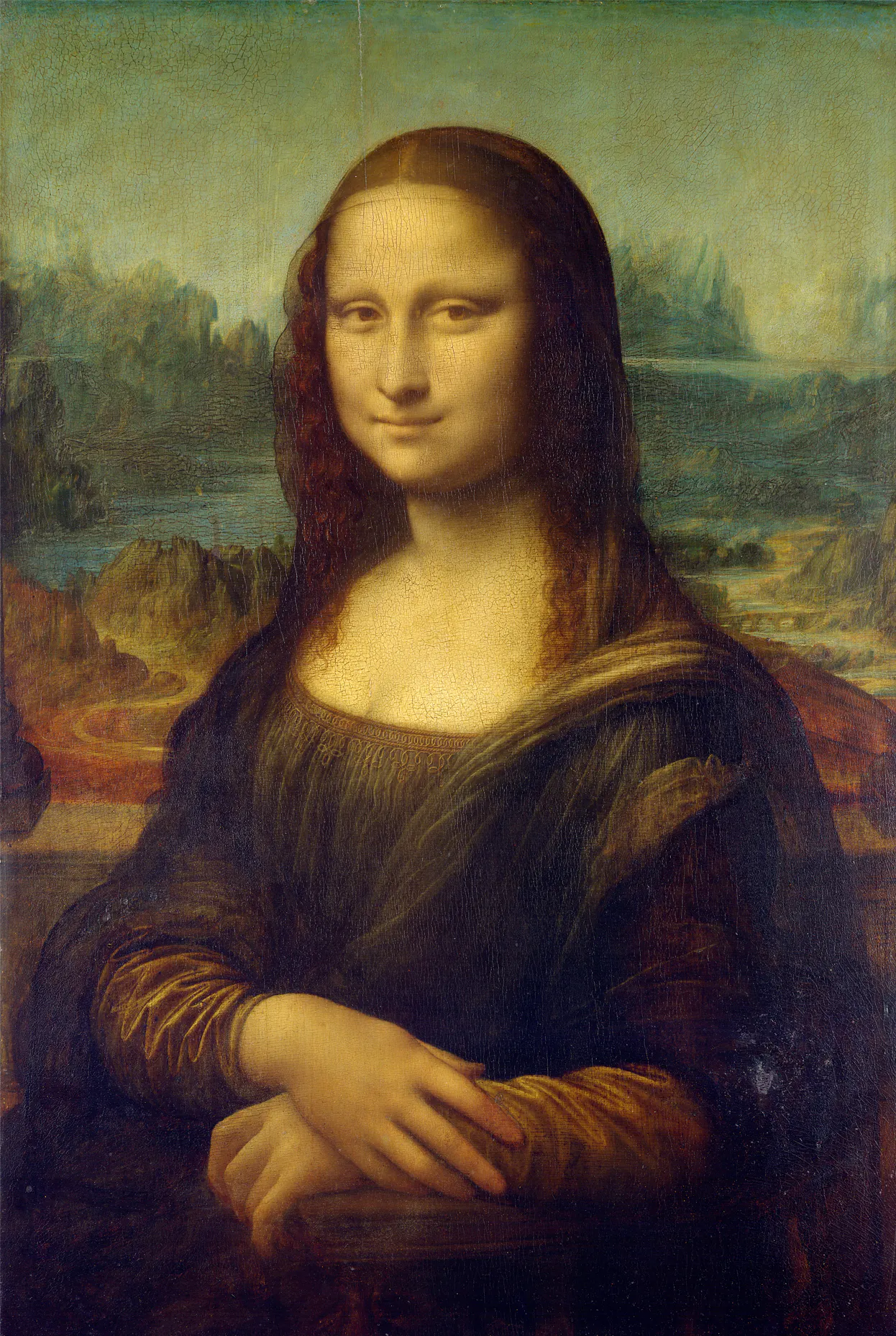
The shifting nature of the Mona Lisa’s expression is not a trick of human imagination, but a deliberate optical phenomenon engineered by Leonardo da Vinci through an advanced painting technique known as sfumato. Derived from the Italian word fumo (meaning smoke), sfumato involves the delicate, imperceptible blending of tones and colors so that there are no harsh outlines, mimicking the way the human eye naturally perceives objects in dim or atmospheric light.
Leonardo achieved this effect by applying dozens of microscopic, translucent layers of oil paint containing varying mixtures of mineral pigments and binders. The thickness of these glazes across the lips and cheekbones is measured in micrometers—thinner than a human hair. When a viewer looks directly at the Mona Lisa's eyes, the high-contrast details are captured by the fovea, the central region of the retina responsible for sharp, color vision. In this direct gaze, the corners of the mouth appear slightly downward or neutral.
However, when the viewer's eye shifts to look at the landscape or hands, the peripheral vision takes over. The peripheral retina is highly sensitive to shadows and low-frequency spatial information, which highlights the subtle, dark sfumato shading at the corners of the mouth. This creates the illusion that the corners are curving upward into a smile. By manipulating human neurobiology and the mechanics of vision, Leonardo engineered a dynamic portrait that literally changes based on how it is observed.
Hidden Layers: What Underdrawings Reveal
Modern multi-spectral scanning and infrared reflectography have pierced through the darkened layers of aged varnish and degraded oil paints to reveal the ghost of an entirely different creative process hidden beneath the final surface. These technological windows into the canvas (or rather, the white poplar panel) show that the Mona Lisa underwent significant compositional changes during its creation, which contradicts Giorgio Vasari's romanticized accounts of Leonardo painting effortlessly.
The Initial Sketch and Compositional Shifts
- Initial Hand Positioning: Infrared analysis reveals that Leonardo originally painted the subject’s fingers in a slightly different posture, resting closer to the edge of the chair armrest before adjusting them to drape gracefully across her lap.
- Hairline and Veil Modifications: The transparent veil draped over her hair was adjusted during the painting process, shifting the silhouette of the head against the background landscape.
- Underdrawing Gridlines: Faint traces of preparatory carbon-black underdrawings and incised lines indicate that Leonardo mapped out the geometrical proportions of the face using strict Renaissance canons of proportion, ensuring mathematical harmony between the eyes, nose, and mouth.
These hidden revisions demonstrate that the Mona Lisa was not a quick commission completed in a few sittings, but a prolonged, evolving meditation on human physiognomy and composition that Leonardo returned to over many years.
The Chemistry of the Masterpiece: Pigments and Varnish
The physical longevity and unique luminous quality of the Mona Lisa are direct results of Leonardo’s innovative chemical formulations. Unlike many of his contemporaries who relied primarily on egg tempera, Leonardo was an early adopter of oil painting techniques, experimenting heavily with the refractive index of binders and the purity of pigments.
X-ray fluorescence studies have detailed the specific mineral palette utilized in the work:
| Pigment Component | Chemical Identity / Source | Primary Application in the Mona Lisa |
|---|---|---|
| Lead White | Basic lead carbonate ($2PbCO_3 \cdot Pb(OH)_2$) | Highlights on skin, veil, and sleeve fabrics; base priming layers |
| Vermilion | Mercuric sulfide ($HgS$) | Subtle undertones in the lips and cheeks |
| Ultramarine | Ground lapis lazuli | Deep blues in the distant background mountain range |
| Umber / Sienna | Natural iron and manganese oxides | Earthy tones for hair, shadows, and the wooden armrest |
| Manganese Dioxide | Mineral drier compound | Accelerated the curing and drying of thick oil glazes |
Leonardo’s addition of manganese to the lead-containing layers of the portrait is particularly notable. At the microscopic level, researchers discovered that manganese acted as a chemical catalyst, enabling the thick oil matrix to dry evenly without wrinkling or cracking—a common technical failure in Renaissance oil paintings. Over the centuries, however, this varnish has oxidized, yellowing and darkening the overall tone of the painting from its original vibrant blue-and-green palette into the golden-brown hue familiar to modern museum visitors.
Landscape Dualism and Geological Accuracy
The striking, otherworldly landscape visible behind Mona Lisa has long been a subject of intense debate among geologists, art historians, and topographers. Rather than an idealized fantasy backdrop typical of medieval art, modern geospatial analysis suggests that Leonardo rendered a specific, recognizable geographic region in northern Italy.
Researchers specializing in geomorphology have linked the bridge, winding river, and jagged rock formations to the Val di Chiana in Tuscany, specifically near the town of Laterina and the Bobbio bridge in the province of Piacenza. During Leonardo’s lifetime, this region was undergoing significant hydraulic engineering projects, an area of deep professional interest for the polymath, who worked extensively as a military engineer and cartographer.
Furthermore, the landscape exhibits a distinct optical phenomenon known as aerial perspective. As distance increases, particles in the atmosphere scatter light, causing distant objects to appear paler, less saturated, and tinged with blue. Leonardo exaggerated and perfected this scientific principle in the Mona Lisa, using ultra-thin blue glazes to push the mountain ranges miles into the visual distance, creating an overwhelming sense of three-dimensional depth on a flat wooden panel.
The Identity Debate: Lisa Gherardini Versus Alternative Theories
While the historical consensus—anchored by the discovery of a marginal note written by Renaissance clerk Agostino Vespucci in 1503—identifies the sitter as Lisa Gherardini, the wife of Florentine silk merchant Francesco del Giocondo, alternative hypotheses persist in popular culture and academic circles.
- Lisa Gherardini (The Consensus View): Vespucci's marginalia explicitly compares Leonardo to the ancient Greek painter Apelles and notes that Leonardo was currently working on a portrait of Lisa Gherardini. This contemporary written record remains the strongest evidence supporting the traditional title La Gioconda.
- Pacifico Brandani’s Commission: Some historical documents suggest Giuliano de' Medici commissioned a portrait of a noblewoman, leading fringe theorists to propose alternative subjects such as Pacifico Brandani’s mistress or noblewomen from the court of Milan.
- Self-Portrait Hypothesis: Computer-generated facial recognition studies comparing the bone structure of the Mona Lisa to known self-portraits of Leonardo da Vinci have noted striking geometric similarities in the spacing of the eyes, nose, and jawline, fueling the theory that the painting is a coded, idealized self-portrait in female form.
Despite these competing theories, the weight of archival documentation heavily favors Lisa Gherardini, though Leonardo’s tendency to idealize and synthesize facial features means the portrait transcends mere photographic likeness.
Frequently Asked Questions
Why is the Mona Lisa so famous?
The fame of the Mona Lisa is the result of a historical accumulation of factors: its technical mastery of sfumato, its status as a pinnacle of High Renaissance art, and most notably, its sensational theft from the Musée du Louvre in 1911 by Vincenzo Perugia. The subsequent two-year media frenzy turned the painting into a global cultural icon, cementing its status in the modern public consciousness.
Can the original colors of the Mona Lisa still be seen?
The original colors are largely obscured by centuries of aged, oxidized varnish, which has imparted a yellow-brown tint to the entire surface. However, digital restoration projects utilizing multi-spectral imaging have generated high-fidelity digital simulations showing the painting's original palette, which featured brighter blues in the sky, a greener landscape, and pinker skin tones.
What kind of wood was used for the Mona Lisa panel?
The Mona Lisa is painted on a solid panel of white poplar (Populus alba), measuring approximately 77 by 53 centimeters. Wood experts have traced the panel to poplar trees grown in the Italian region, chosen for its fine, stable grain that minimized warping over centuries of environmental shifts.
Is the Mona Lisa protected by bulletproof glass?
Yes. Since being targeted by various acts of vandalism in the 20th and 21st centuries, the Mona Lisa has been housed in a custom-built, climate-controlled enclosure made of ultra-clear, bulletproof laminated glass designed to maintain strict temperature and humidity levels while neutralizing physical threats.
Practical Next Actions and Conservation Viewing
For those planning to examine the Mona Lisa in person at the Musée du Louvre in Paris, preparation is essential due to strict crowd control and conservation protocols.
- Book Timed-Entry Tickets: Advance reservation through the official Louvre ticketing portal is mandatory; same-day entry for the Mona Lisa room is rarely available.
- Understand Viewing Limitations: Visitors view the painting from behind a velvet barrier several meters away from the bulletproof case, making binoculars or high-magnification camera lenses impractical.
- Explore Digital Archives: To study the brushwork, crackle patterns (craquelure), and underdrawings in detail, utilize the Louvre’s official high-resolution digital collections online, which provide far greater clarity than physical museum viewing allows.
Image Gallery