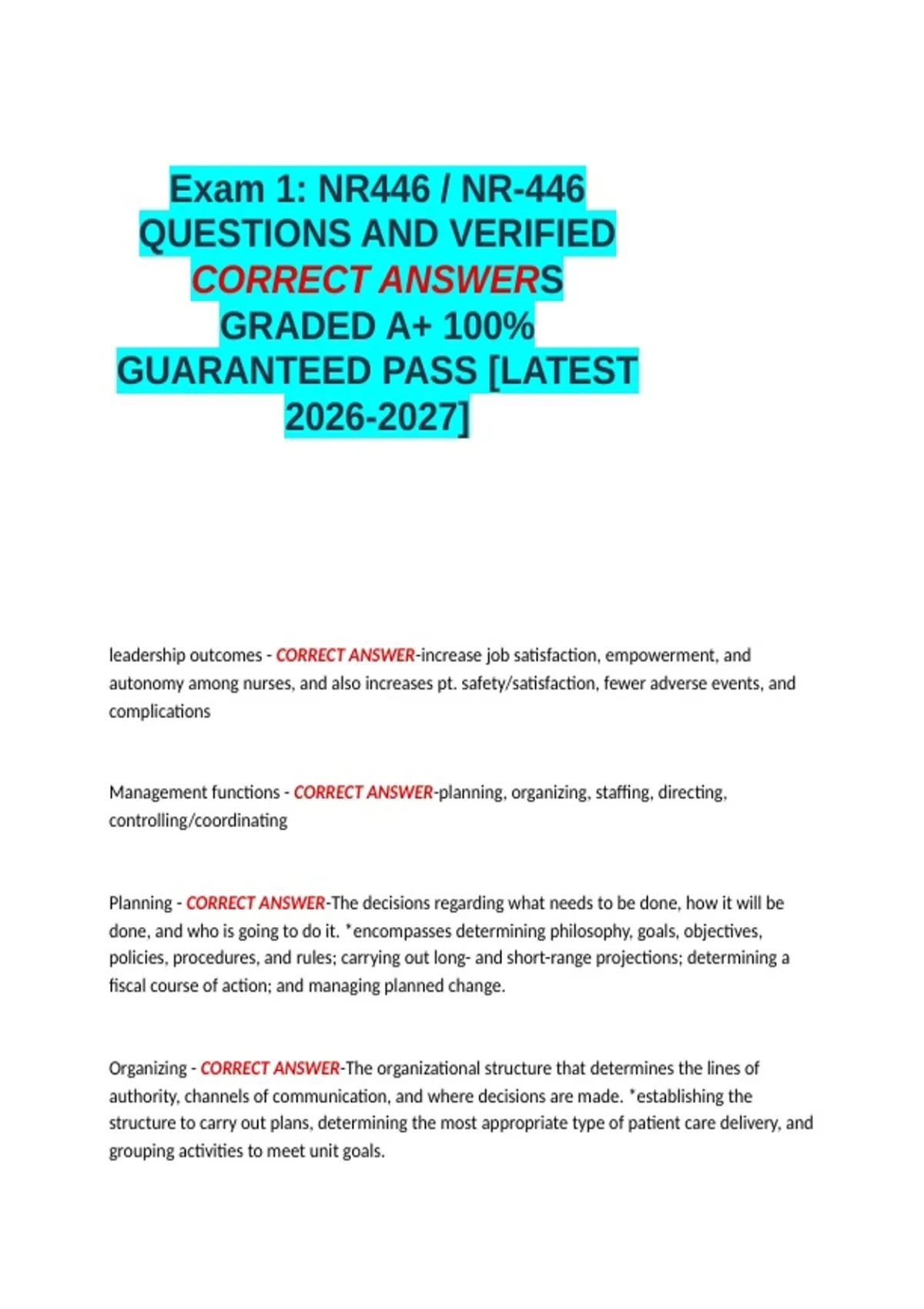
Mastering NR446 Collaborative Healthcare Nursing: Your Comprehensive 2026 Exam 1 Study Guide
(Note: NR446 represents Collaborative Healthcare Nursing, an essential upper-division course in modern Bachelor of Science in Nursing [BSN] programs focusing on interprofessional communication, systems leadership, quality improvement,...
(Note: NR446 represents Collaborative Healthcare Nursing, an essential upper-division course in modern Bachelor of Science in Nursing [BSN] programs focusing on interprofessional communication, systems leadership, quality improvement, and evidence-based practice.)
Contents
Navigating upper-division nursing coursework requires moving past simple memorization and adopting the analytical mindset of a healthcare systems leader. The first major assessment in Chamberlain University's or equivalent BSN nursing leadership tracks—commonly coded as NR446 Exam 1—evaluates your grasp of foundational leadership theories, interprofessional collaboration dynamics, quality improvement frameworks, and the core operational structures governing contemporary patient care delivery. As healthcare delivery models evolve to meet the complex demands of 2026, nursing students must master these concepts not just to pass a test, but to function effectively as safe, communicative, and empowered change agents on clinical units.
Core Conceptual Frameworks of Nursing Leadership and Management
To excel on your upcoming evaluation, you must clearly distinguish between traditional management duties and visionary nursing leadership. While managers historically focused on maintaining order, controlling resources, and enforcing compliance, modern healthcare systems demand adaptive leaders who cultivate intrinsic motivation, foster psychological safety among interprofessional teams, and champion patient safety initiatives at the bedside.
Understanding classical and contemporary leadership theories is non-negotiable for this assessment. Expect scenario-based questions that ask you to identify the appropriate leadership style for a given clinical emergency or unit transformation project:
- Transactional Leadership: Focuses on daily operations, reward systems, and corrective actions. Effective for maintaining strict compliance with medication administration safety protocols or managing structured shift handoffs.
- Transformational Leadership: Relies on a shared vision, inspiration, and empowering staff to transcend their own self-interest for the collective good of patient outcomes. Essential for implementing major hospital-wide electronic health record upgrades or magnet designation journeys.
- Democratic (Participative) Leadership: Encourages staff input and group consensus in decision-making. Highly effective when redesigning unit scheduling policies or evaluating new clinical equipment.
- Laissez-Faire Leadership: Characterized by passive, hands-off behavior where the leader relinquishes control to the group. Generally ineffective in acute care environments, though occasionally useful with highly autonomous, self-directed clinical nurse specialists.
Effective delegation represents another heavily tested domain. You must remember the Five Rights of Delegation: Right Task, Right Circumstances, Right Person, Right Direction/Communication, and Right Supervision/Evaluation. Never forget that while a Registered Nurse (RN) can delegate components of care to Licensed Practical Nurses (LPNs) or Unlicensed Assistive Personnel (UAP), the RN retains absolute accountability for the overall nursing process, initial patient assessment, triage, and complex clinical judgment.
Interprofessional Communication and Conflict Resolution Strategies
Modern patient safety initiatives spearheaded by regulatory bodies emphasize that poor communication is a primary root cause of sentinel events. Exam 1 will heavily test your knowledge of structured communication tools designed to bridge communication gaps between nurses, physicians, pharmacists, and allied health professionals.
Mastering tools like SBAR (Situation, Background, Assessment, Recommendation) allows you to deliver concise, objective patient data during emergency provider notifications or shift change reports. Furthermore, managing interprofessional conflict requires structured conflict-resolution frameworks. The following comparison highlights how different resolution styles impact clinical team dynamics.
| Conflict Resolution Style | Operational Definition | Clinical Application in Nursing | Impact on Patient Safety |
|---|---|---|---|
| Collaboration | High assertiveness, high cooperativeness; working toward a win-win solution where all parties' concerns are integrated. | Developing a comprehensive, multi-disciplinary fall-prevention care plan involving physical therapy, nursing, and pharmacy. | Maximizes patient safety and long-term care compliance by utilizing diverse professional expertise. |
| Compromise | Moderate assertiveness and cooperativeness; each party gives up something to reach a mutually acceptable agreement. | Adjusting unit break schedules or shift coverage policies to accommodate both veteran and newly hired nursing staff preferences. | Maintains unit morale and staffing stability, indirectly supporting consistent patient oversight. |
| Accommodation | Low assertiveness, high cooperativeness; one party neglects their own concerns to satisfy the other party. | Yielding to a physician's minor preference on routine non-pharmacological comfort measures to preserve immediate working harmony. | Neutral to slightly risky if clinical safety standards are compromised to keep the peace. |
| Avoidance | Low assertiveness, low cooperativeness; deliberately ignoring or withdrawing from the conflict situation. | Ignoring personality clashes between two coworkers during a busy shift without addressing underlying tension. | High risk for unresolved hostility, miscommunication, and potential medical errors during high-stress situations. |
Quality Improvement Methodologies and Patient Safety Standards
Quality improvement (QI) is not merely an administrative buzzword; it is a systematic, data-driven approach to improving patient care outcomes and eliminating waste. Exam 1 will require you to differentiate between quality assurance (QA)—which traditionally looked backward to find blame and ensure minimum compliance—and quality improvement (QI), which looks forward continuously to optimize processes and systems.
Familiarize yourself with foundational improvement models that guide contemporary healthcare operations:
- PDSA Cycle (Plan-Do-Study-Act): A four-stage iterative problem-solving model used for improving processes or carrying out change. You Plan the change, Do carry out a small-scale test, Study the resulting data to evaluate success, and Act by either adopting, adapting, or abandoning the modification.
- Root Cause Analysis (RCA): A structured retrospective investigative tool deployed after a sentinel event or medical error occurs. Instead of punishing the individual nurse, an RCA digs deep into systemic failures, communication breakdowns, and workflow design flaws.
- Six Sigma and Lean Methodologies: Originating in manufacturing, these frameworks focus on eliminating waste, reducing variation in clinical procedures, and streamlining patient throughput from admission to discharge.
Practical Exam Preparation and High-Yield Study Strategies
Preparing for NR446 Exam 1 requires moving beyond passive reading of textbook chapters. Because the exam features rigorous application-level questions—often formatted as "select all that apply" (SATA) or complex clinical scenarios—you must practice active analytical techniques.
Expert Study Tips for Success
Focus on Application, Not Memorization: Do not just memorize the definition of transformational leadership. Ask yourself: "How would a transformational leader handle a nurse resisting a new evidence-based pressure injury prevention protocol?"
Master the Elimination Technique on SATA Questions: Treat every option in a multiple-choice question as a true or false statement independent of the others. Never assume a specific number of options are correct.
Review Rationale for Incorrect Answers: When taking practice quizzes, spend twice as much time analyzing why the incorrect choices are wrong as you do celebrating the correct ones. This trains your brain to spot distractor terms and NCLEX-style traps.
Frequently Asked Questions
What specific topics are typically covered on NR446 Exam 1?
Exam 1 generally covers nursing leadership theories, management styles, the five rights of delegation, interprofessional communication frameworks like SBAR, conflict resolution strategies, and foundational quality improvement models like the PDSA cycle. Mastering these domains ensures you can handle both theoretical questions and complex clinical scenario items.
How should I approach "Select All That Apply" (SATA) questions on this exam?
Evaluate each option individually as an independent true or false statement without trying to guess a preset total of correct answers. Look for absolute words like "always" or "never," which usually indicate incorrect choices, and focus on patient safety as your primary guiding metric.
What is the difference between delegation and assignment in nursing?
Delegation involves transferring the authority to perform a specific nursing task to a competent individual while the RN retains ultimate accountability for the outcome. Assignment, by contrast, refers to the routine distribution of work that each staff member is already authorized and licensed to perform within their legal scope of practice.
How does transformational leadership differ from transactional leadership?
Transformational leadership focuses on inspiring staff through a shared vision, empowerment, and long-term cultural change within a healthcare unit. Transactional leadership relies on a system of rewards, punishments, and strict adherence to established rules to maintain day-to-day operational compliance.
Why is interprofessional collaboration emphasized so heavily in nursing leadership?
Interprofessional collaboration reduces medical errors, bridges communication gaps between distinct clinical departments, and optimizes patient health outcomes. Modern healthcare systems recognize that complex patient needs cannot be safely managed in professional silos.
What is the primary purpose of conducting a Root Cause Analysis (RCA)?
An RCA is a retrospective investigative tool used to identify the underlying systemic, environmental, and procedural factors that contributed to a sentinel event or medical error. Its primary goal is to redesign faulty processes rather than assign individual blame.
Maximizing Your Success
Succeeding on NR446 Exam 1 sets a powerful academic and professional tone for your advancement into senior nursing practice. By approaching the material through the lens of a proactive, safety-focused healthcare leader—rather than just a student chasing a grade—you build the critical thinking foundation necessary to protect your patients and elevate your entire clinical unit. Review your notes, apply these frameworks to real-world clinical observations from your shifts, and approach your exam day with absolute confidence.
Image Gallery