What War Was WW2: A Comprehensive History of the Global Conflict
World War II was a global conflict that took place between 1939 and 1945. It involved most of the world's nations, including all great powers, organized into two opposing military alliances: the Allies and the Axis. It remains the dead...
World War II was a global conflict that took place between 1939 and 1945. It involved most of the world's nations, including all great powers, organized into two opposing military alliances: the Allies and the Axis. It remains the deadliest conflict in history, resulting in 70 to 85 million fatalities worldwide.
Contents
The Origins and Causes of World War II
To understand what war WW2 was, one must look at the unresolved tensions following the First World War. While the 1918 armistice ended the fighting of the "Great War," the subsequent Treaty of Versailles (1919) imposed heavy reparations, territorial losses, and military restrictions on Germany. These conditions, combined with the hyperinflation of the 1920s and the global Great Depression starting in 1929, created a fertile environment for extremist ideologies.
The rise of the Nazi Party, led by Adolf Hitler, capitalized on German resentment. Hitler’s ideology of Lebensraum (living space) demanded the expansion of German territory into Eastern Europe. Simultaneously, in Italy, Benito Mussolini established a Fascist regime, and in the East, the Empire of Japan pursued an aggressive imperialist policy to secure natural resources and dominance in Asia.
The Failure of International Diplomacy
The League of Nations, established after WWI to prevent such conflicts, proved ineffective. It lacked a military force and the participation of the United States, leaving it unable to stop the Japanese invasion of Manchuria in 1931 or the Italian invasion of Ethiopia in 1935. The policy of appeasement, primarily championed by Britain and France, allowed Hitler to remilitarize the Rhineland and annex Austria and the Sudetenland. This policy finally collapsed when Germany invaded Poland on September 1, 1939, prompting Britain and France to declare war.
The Combatants: The Allies vs. The Axis Powers
The war was fought between two primary military alliances. As of our current perspective in 2026, historians continue to analyze the complex logistics and industrial outputs that defined these groups.
The Axis Powers
The Axis was led by Germany, Italy, and Japan. These nations shared interests in territorial expansion and the destruction of the existing international order. While they signed the Tripartite Pact in 1940, their coordination was often limited by geographic distance and differing strategic priorities. Germany focused on European hegemony, while Japan sought a "Greater East Asia Co-Prosperity Sphere."
The Allied Powers
The Allies were a much broader coalition, eventually including dozens of nations. The "Big Three" leaders—Winston Churchill (UK), Franklin D. Roosevelt (USA), and Joseph Stalin (USSR)—directed the primary strategy.
- The United Kingdom: Remained the sole European power resisting Germany from 1940 until the invasion of the Soviet Union.
- The Soviet Union: Joined the Allies after being invaded by Germany in June 1941 (Operation Barbarossa).
- The United States: Formally entered the war following the Japanese attack on Pearl Harbor on December 7, 1941.
- China: Had been at war with Japan since 1937, forming a critical front in the Pacific theater.
Major Theaters and Strategic Turning Points
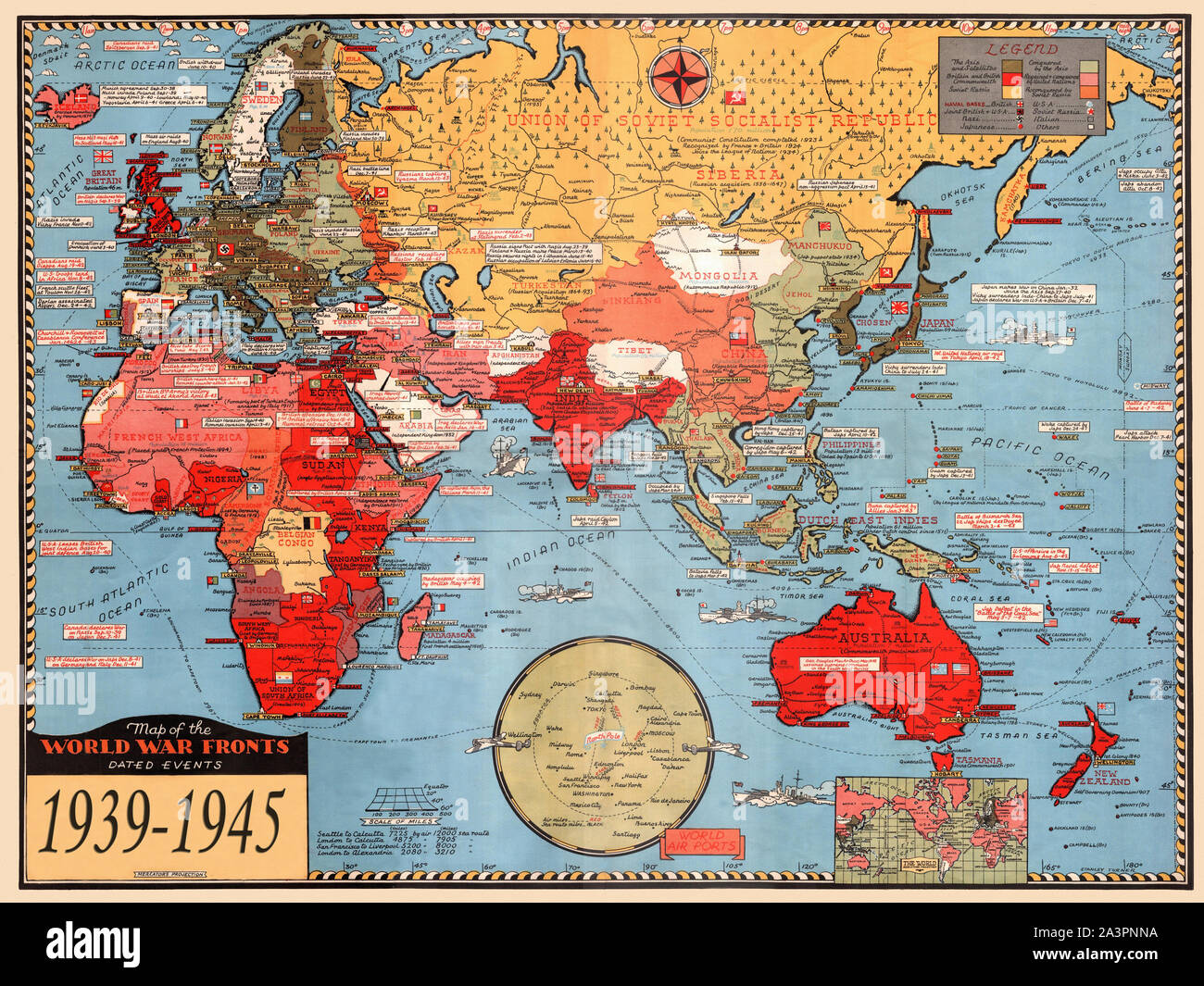
World War II was a truly global war, with significant combat occurring across Europe, the Pacific, North Africa, and the Atlantic Ocean.
The European and Mediterranean Theater
In the early years, German Blitzkrieg (lightning war) tactics overwhelmed Western Europe. However, the war’s momentum shifted at the Battle of Stalingrad (1942–1943), where the Soviet Red Army decimated the German Sixth Army. This was the bloodiest battle in human history and marked the beginning of the German retreat.
In the West, the D-Day invasion (June 6, 1944) saw Allied forces land in Normandy, France. This opened a massive second front that squeezed the German military between the advancing Western Allies and the Soviet Union. The war in Europe ended with the unconditional surrender of Germany on May 8, 1945, known as V-E Day.
The Pacific Theater
The war in the Pacific was characterized by naval battles and "island hopping" campaigns. The Battle of Midway (June 1942) was a decisive naval victory for the United States, halting Japanese expansion. Over the next three years, U.S. and Allied forces captured strategic islands to establish airbases within range of the Japanese mainland.
The conflict reached its end following the deployment of the first atomic bombs on Hiroshima and Nagasaki in August 1945. Faced with nuclear destruction and a Soviet declaration of war, Japan surrendered on September 2, 1945, marking the official end of World War II.
| Battle | Year | Theater | Significance |
|---|---|---|---|
| Invasion of Poland | 1939 | Europe | Triggered the start of the war in Europe. |
| Battle of Britain | 1940 | Europe (Air) | Prevented a German invasion of the United Kingdom. |
| Pearl Harbor | 1941 | Pacific | Brought the United States into the war. |
| Battle of Midway | 1942 | Pacific | Ended Japanese naval supremacy in the Pacific. |
| Stalingrad | 1942-43 | Eastern Front | The turning point for the Soviet Union against Germany. |
| D-Day (Normandy) | 1944 | Western Front | Largest seaborne invasion; led to the liberation of France. |
The Holocaust and the Human Cost of Total War
World War II was not just a military conflict; it was a period of unprecedented systemic atrocity. The Holocaust (or Shoah) was the state-sponsored, systematic murder of approximately six million Jews by the Nazi regime and its collaborators. Millions of others, including Romani people, individuals with disabilities, Soviet prisoners of war, and political dissidents, were also targeted for extermination.
The concept of Total War meant that entire populations were mobilized for the war effort. Civilians became targets through strategic bombing campaigns, such as the Blitz in London or the firebombing of Dresden and Tokyo. The war's end revealed the full scale of the destruction, with cities across Europe and Asia reduced to rubble and millions of displaced persons searching for homes in a reshaped world.
Technological Warfare and the Atomic Age
The rapid pace of technological innovation during the war changed the nature of human existence. Advancements in radar, jet propulsion, and penicillin saved lives and defined future industries. However, the most significant development was the Manhattan Project, which produced the first nuclear weapons.
The use of atomic bombs in 1945 introduced a new era of geopolitical tension. From our vantage point in 2026, the legacy of these weapons remains central to international security and the doctrine of nuclear deterrence. The war also accelerated the development of computing, with pioneers like Alan Turing breaking the German Enigma code, laying the groundwork for the modern digital age.
Post-War Repercussions and the New World Order
The conclusion of World War II fundamentally altered the global map. The European colonial empires—primarily those of Britain and France—began to collapse, leading to a massive wave of decolonization in Africa and Asia.
The Formation of the United Nations
Determined to prevent a "World War III," world leaders established the United Nations (UN) in 1945. Unlike the League of Nations, the UN included all major powers and was designed to facilitate international cooperation and provide a forum for resolving disputes through diplomacy rather than armed conflict.
The Cold War Begins
The temporary alliance between the Western democracies and the Soviet Union fractured almost immediately after the common enemy was defeated. This led to the Cold War, a decades-long struggle for global influence between the United States and the USSR. Germany was divided into East and West, and the "Iron Curtain" descended across Europe, defining international relations until the early 1990s.
Frequently Asked Questions
What exactly started World War II?
The most widely accepted start date is September 1, 1939, when Nazi Germany invaded Poland. This followed years of territorial aggression and the failure of diplomatic efforts. In Asia, many historians argue the war began earlier, with the Japanese invasion of China in 1937.
Which countries were the main "Allies" and "Axis"?
The main Allied powers were the United Kingdom, the Soviet Union, the United States, and China. The primary Axis powers were Germany, Italy, and Japan. While dozens of other nations joined the Allies, these seven countries directed the vast majority of military operations.
How many people died in World War II?
Estimates suggest that between 70 and 85 million people died, which was about 3% of the world population at the time. This includes both military personnel and civilians, with the Soviet Union suffering the highest number of casualties, estimated at over 20 million.
Why was World War II called a "Total War"?
It is called a "Total War" because the participating nations committed all their resources—economic, industrial, and human—to the war effort. There was little distinction between combatants and non-combatants, as civilian infrastructure was often targeted to weaken the enemy's ability to produce weapons and supplies.
How did World War II end?
The war ended in two stages. First, Germany surrendered unconditionally in May 1945 after Allied forces captured Berlin. Second, Japan surrendered in September 1945 following the atomic bombings of Hiroshima and Nagasaki and the Soviet entry into the war against Japan.
Recommended Next Actions
For those seeking to understand the granular details of the conflict, the National WWII Museum offers extensive digital archives and primary source documents that are invaluable for research. In 2026, many of these resources have been further digitized, providing high-resolution access to maps, diaries, and military records. If you are conducting academic research, consulting the U.S. National Archives is the standard for verifying official military orders and government correspondence from the era.
Image Gallery