Decoding the Bromine Noble Gas Configuration and Electron Structure
Bromine possesses a noble gas configuration of [Ar] 3d¹⁰ 4s² 4p⁵, which establishes its position as a halogen in Group 17 of the periodic table, characterized by seven valence electrons that drive its high reactivity and strong tendenc...
Bromine possesses a noble gas configuration of [Ar] 3d¹⁰ 4s² 4p⁵, which establishes its position as a halogen in Group 17 of the periodic table, characterized by seven valence electrons that drive its high reactivity and strong tendency to gain a single electron to achieve an octet.
Contents
Understanding the atomic structure of chemical elements forms the foundation of modern chemistry, allowing scientists to predict bonding behavior, reactivity, and physical properties. Among the halogens, bromine stands out as a volatile, reddish-brown liquid at standard temperature and pressure. To fully comprehend how bromine interacts with other elements, one must look past its macroscopic properties and examine its inner electronic architecture. By analyzing the bromine noble gas shorthand configuration, students and researchers can decipher the distribution of its 35 electrons and understand the energetic stability that governs its chemical identity.
Fundamentals of Electron Configuration and Noble Gas Shorthand
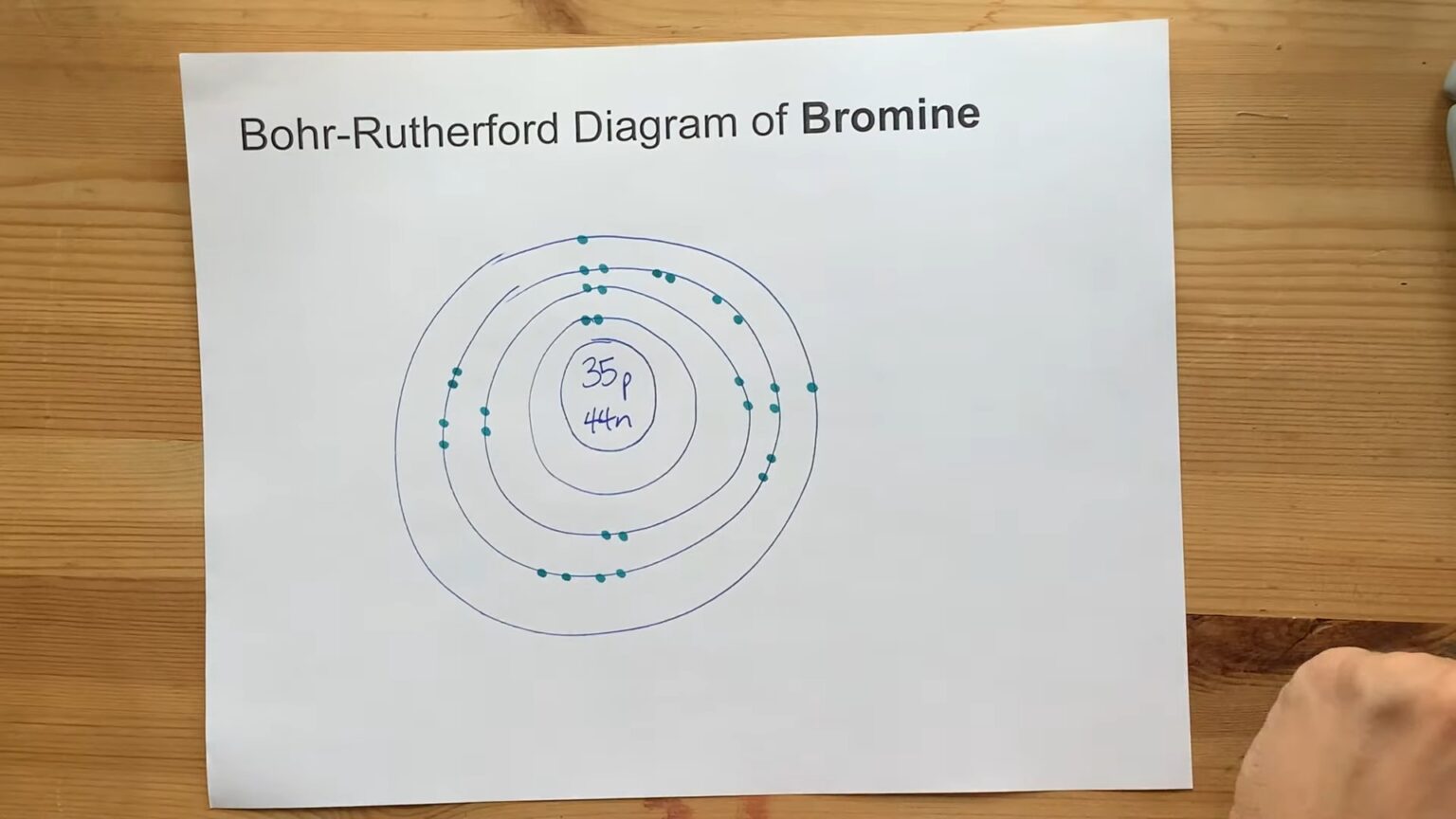
An electron configuration is the distribution of electrons of an atom or molecule in atomic or molecular orbitals. In a neutral bromine atom, there are 35 electrons orbiting the nucleus. Writing out every single orbital from the lowest energy level to the highest can become cumbersome, requiring a lengthy string of quantum states such as $1s^2 2s^2 2p^6 3s^2 3p^6 4s^2 3d^{10} 4p^5$.
To simplify this notation and highlight the chemically active electrons, chemists use the noble gas shorthand, also known as condensed electron configuration. This method involves taking the symbol of the nearest preceding noble gas—which has a completely filled, highly stable set of inner-core shells—and appending the remaining valence and outermost core electrons. For bromine, the preceding noble gas is argon (Ar), which has an atomic number of 18 and a configuration of $1s^2 2s^2 2p^6 3s^2 3p^6$.
By substituting the argon core with the bracketed symbol [Ar], the remaining 17 electrons are written explicitly: [Ar] 3d¹⁰ 4s² 4p⁵. This notation immediately separates the inert core electrons from the chemically significant outer electrons, providing a streamlined roadmap for chemical analysis.
Step-by-Step Derivation of Bromine’s Electron Structure
Determining the electron configuration of bromine requires following established quantum mechanical rules, specifically the Aufbau principle, the Pauli exclusion principle, and Hund's rule. Bromine has an atomic number ($Z$) of 19 through 35, meaning a neutral atom has 35 protons and 35 electrons.
According to the Aufbau principle, electrons fill atomic orbitals of the lowest available energy level before occupying higher energy levels. The filling order follows the Madelung rule ($n + l$ rule): $1s$, $2s$, $2p$, $3s$, $3p$, $4s$, $3d$, $4p$, and so on.
- Inner Core Fill: The first 18 electrons fill the orbitals up to argon: $1s^2 2s^2 2p^6 3s^2 3p^6$. This equates to
[Ar]. - Fourth Shell $s$-Orbital: The next 2 electrons enter the $4s$ orbital, giving $4s^2$.
- Third Shell $d$-Orbital: Following energy level filling rules, the $3d$ subshell is filled next before the $4p$ subshell, accommodating 10 electrons to yield $3d^{10}$.
- Fourth Shell $p$-Orbital: The remaining 5 electrons enter the $4p$ subshell, resulting in $4p^5$.
Combining these steps yields the complete condensed configuration of [Ar] 3d¹⁰ 4s² 4p⁵. The table below breaks down the electron distribution across principal energy levels (shells) and subshells.
| Principal Shell ($n$) | Subshell | Capacity | Occupied Electrons | Cumulative Total |
|---|---|---|---|---|
| 1 ($K$) | $1s$ | 2 | 2 | 2 |
| 2 ($L$) | $2s, 2p$ | 8 | 8 | 10 |
| 3 ($M$) | $3s, 3p, 3d$ | 18 | 18 | 28 |
| 4 ($N$) | $4s, 4p$ | 8 (valence) | 7 | 35 |
Valence Electrons and Chemical Reactivity
The most consequential feature revealed by the bromine noble gas configuration is its valence electron count. In the expression [Ar] 3d¹⁰ 4s² 4p⁵, the inner $3d^{10}$ electrons are typically treated as part of the core because they are lower in energy and less involved in standard chemical bonding compared to the outermost shell. Consequently, bromine possesses seven valence electrons in its fourth principal energy level ($4s^2 4p^5$).
Because main-group elements strive to achieve a stable octet (eight electrons in their outermost shell, mirroring the noble gases), bromine is one electron short of a full outer shell. This electron deficiency dictates its chemical behavior:
- High Electronegativity: Bromine strongly attracts electrons from other atoms to complete its octet.
- Oxidizing Power: It acts as an effective oxidizing agent, readily accepting electrons in redox reactions.
- Ionic and Covalent Bonding: Bromine frequently forms bromide ions ($Br^-$) by gaining a single electron, or it shares an electron pair to form single covalent bonds, as seen in hydrogen bromide ($HBr$) or diatomic bromine ($Br_2$).
Comparative Analysis of Halogen Electron Configurations
Bromine sits directly between chlorine and iodine in Group 17 of the periodic table. Examining the noble gas configurations of the halogen series highlights periodic trends in atomic structure, shielding effects, and down-group reactivity changes.
| Element | Atomic Number ($Z$) | Noble Gas Configuration | Valence Electrons |
|---|---|---|---|
| Fluorine (F) | 9 | [He] 2s² 2p⁵ |
7 ($2s^2 2p^5$) |
| Chlorine (Cl) | 17 | [Ne] 3s² 3p⁵ |
7 ($3s^2 3p^5$) |
| Bromine (Br) | 35 | [Ar] 3d¹⁰ 4s² 4p⁵ |
7 ($4s^2 4p^5$) |
| Iodine (I) | 53 | [Kr] 4d¹⁰ 5s² 5p⁵ |
7 ($5s^2 5p^5$) |
As demonstrated in the comparison table, all halogens share the characteristic $s^2 p^5$ outer valence structure. However, bromine and iodine incorporate filled $d$-orbitals in their inner core levels (3d¹⁰ and 4d¹⁰, respectively). This transition metal contraction affects effective nuclear charge and atomic radii, making heavier halogens slightly less reactive than fluorine and chlorine while altering their physical states at room temperature.
Frequently Asked Questions About Bromine Configuration
What does [Ar] represent in the bromine electron configuration?
The bracketed [Ar] denotes the electron configuration of argon, which accounts for the first 18 electrons of bromine ($1s^2 2s^2 2p^6 3s^2 3p^6$). Using this shorthand avoids writing out filled inner-core shells repeatedly, allowing scientists to focus strictly on the outermost valence electrons that govern chemical bonding.
How many valence electrons does bromine have?
Bromine has seven valence electrons, located in its fourth principal energy level ($4s^2 4p^5$). While it also contains ten $3d$ electrons, these reside in a lower energy shell and function as core-like electrons rather than participating directly in standard covalent or ionic bond formation.
Why does the $3d$ orbital fill before the $4p$ orbital?
The $3d$ orbital fills before the $4p$ orbital based on the Aufbau principle and the energy state of the orbitals. Although the principal quantum number ($n$) is 3 for $d$ and 4 for $p$, the actual energy sum ($n + l$) places the $3d$ subshell at a lower energy state than the $4p$ subshell during multi-electron atom filling.
Is bromine stable with its electron configuration?
A neutral bromine atom is chemically reactive and unstable on its own because it lacks a full octet. To achieve stability, bromine atoms readily gain one electron to form the bromide anion ($Br^^{-}$, achieving a noble gas configuration equivalent to krypton) or share electrons to form diatomic molecules ($Br_2$) or covalent compounds.
How does bromine's configuration affect its physical state?
Bromine's configuration of 35 electrons distributed across four shells gives it a relatively large electron cloud compared to fluorine and chlorine. Intermolecular London dispersion forces increase with molecular size, making bromine a dense, reddish-brown liquid at room temperature, unlike lighter halogens that exist as gases.
Practical Next Actions for Chemistry Students
Mastering the bromine noble gas configuration provides a stepping stone for analyzing more complex transition metals and heavier main-group elements. To reinforce this knowledge, practice writing out the condensed and expanded electron configurations for neighboring elements like selenium and krypton. Pay close attention to how d-block and p-block subshells fill sequentially, and apply these principles when predicting ion charges in ionic compound formation.
Image Gallery