The Best Countries That Are Easy to Move to in 2026: A Global Guide
Moving to a new country in 2026 is most accessible through specialized visa pathways such as digital nomad permits, passive income visas, and streamlined skilled labor programs. Countries like Portugal, Spain, Mexico, and Thailand curr...
Moving to a new country in 2026 is most accessible through specialized visa pathways such as digital nomad permits, passive income visas, and streamlined skilled labor programs. Countries like Portugal, Spain, Mexico, and Thailand currently offer the most straightforward requirements regarding income thresholds, bureaucratic processing times, and long-term residency options for foreigners.
Contents
Determining which country is "easy" to move to depends heavily on your financial status, professional background, and nationality. While "easy" is subjective, it generally refers to nations with transparent immigration laws, manageable income requirements, and high approval rates for residency applications. In 2026, the global landscape has shifted toward attracting remote talent and self-sufficient retirees to bolster local economies.
The European Landscape: Accessibility and Quality of Life
Europe remains a top destination due to its infrastructure and safety. However, the "easiness" of moving here has bifurcated. While traditional work permits remain rigorous, specific residency visas for remote workers and those with independent means have become the standard for relocation.
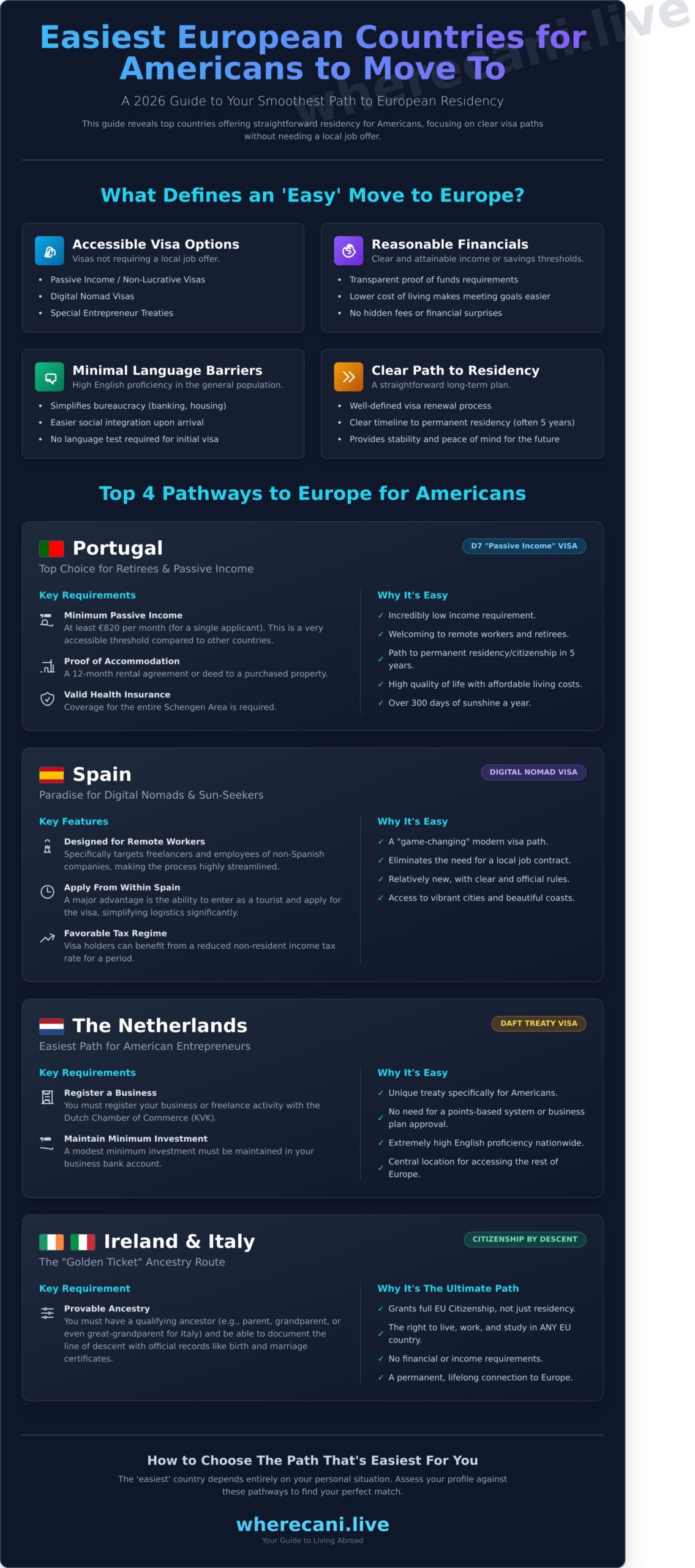
Portugal: The D7 and Digital Nomad Visas
Portugal continues to be a premier choice for expats in 2026. The country offers two primary routes that are notably accessible. The D7 Visa, originally designed for retirees, remains the gold standard for those with passive income (pensions, dividends, or rental income). Meanwhile, the Digital Nomad Visa (D8) caters specifically to remote workers.
The D7 requires applicants to demonstrate a recurring income that meets the Portuguese minimum wage requirements, which have seen incremental adjustments through 2026. One of the primary advantages of the Portuguese system is the path to permanent residency or citizenship after five years, provided you meet basic language requirements (A2 level). The administrative transition from SEF to AIMA (Agency for Integration, Migration and Asylum) has streamlined digital filings, though physical appointments still require early booking.
Spain: The Digital Nomad Visa (DNV)
Since its full implementation, the Spanish Digital Nomad Visa has become one of the most sought-after permits in Europe. It allows non-EU citizens to live in Spain while working for companies located outside of the country.
To qualify in 2026, applicants must prove they earn at least 200% of the Spanish national minimum wage (SMI). A significant benefit of this visa is the Beckham Law tax regime, which allows successful applicants to be taxed at a flat rate of 24% on Spanish-sourced income up to a certain threshold, rather than the progressive tax rates that can exceed 45%. Spain’s infrastructure, particularly in cities like Valencia and Malaga, is highly adapted to international residents, making the logistical move relatively seamless.
Georgia: The 360-Day Freedom
For those seeking the absolute path of least resistance, Georgia (the country) remains an anomaly. For citizens of over 95 countries, Georgia offers a one-year visa-free stay. You can arrive on a tourist stamp and stay for 365 days, during which you are permitted to work or start a business.
By 2026, Georgia has further modernized its tax code for "Small Business Status," where individuals earning up to approximately $185,000 USD (500,000 GEL) per year pay only 1% in turnover tax. This makes it the easiest country for entrepreneurs and freelancers to establish a legal tax residence with minimal paperwork.
North and Central America: Proximity and Simplification
For North Americans or those looking for a lower cost of living relative to the US and Canada, Mexico and Panama offer some of the world’s most efficient immigration systems.
Mexico: Temporary Residency via Economic Solvency
Mexico does not offer a specific "digital nomad visa," but its Temporary Resident Visa serves the same purpose with even greater flexibility. The process is often completed in two stages: an interview at a Mexican consulate abroad and a final processing at an Instituto Nacional de Migración (INM) office in Mexico.
In 2026, the "Economic Solvency" route remains the most popular. Applicants must show a monthly bank balance or a steady monthly income over the previous six months. Once granted, the temporary residency is valid for one year and renewable for three more, after which it can be converted to permanent residency. Unlike many other countries, Mexico’s permanent residency does not require the holder to live in the country for a minimum number of days to maintain status.
Panama: The Friendly Nations Visa
Panama’s Friendly Nations Visa has undergone revisions but remains an accessible route for citizens of approximately 50 "friendly" countries. In 2026, the most common way to qualify is by obtaining a job with a Panamanian company or by purchasing real estate valued at a minimum of $200,000 USD.
While more expensive than Mexico, Panama offers a territorial tax system, meaning you are generally not taxed on income earned outside of Panama. For retirees, the Pensionado Visa is arguably the best in the world, offering lifetime residency and significant discounts on everything from utility bills to movie tickets, provided you have a guaranteed lifetime pension of at least $1,000 USD per month.
Asia: New Frontiers for Long-Term Stays
Traditional "visa runs" in Asia are becoming a thing of the past as countries introduce formal long-term stays to capture the expat market.
Thailand: The Destination Thailand Visa (DTV)
The Destination Thailand Visa (DTV), introduced to replace older, more complex schemes, is the current highlight for 2026. It allows for a stay of up to five years with multiple entries. The requirements are significantly lower than the elite "LTR" (Long-Term Resident) visa; applicants primarily need to show proof of funds (approximately $14,000 USD or 500,000 THB) and work for a foreign entity or provide a portfolio for "cultural" activities like Muay Thai or Thai cooking classes.
Thailand's cost of living and world-class healthcare in cities like Bangkok and Chiang Mai make it an easy transition for those coming from Western nations. The Thai Board of Investment (BOI) also continues to support the LTR visa for high-wealth individuals and specialized professionals, offering 10-year stays.
Comparison of Easiest Countries to Move to in 2026
The following table compares the most popular residency-by-income pathways based on current 2026 requirements.
| Country | Primary Visa Type | Min. Monthly Income (Approx.) | Initial Stay Length | Path to Citizenship |
|---|---|---|---|---|
| Portugal | D7 / D8 | ~€820 - €3,280 | 2 Years | Yes (5 Years) |
| Spain | Digital Nomad | ~€2,650 | 3 Years | Yes (10 Years) |
| Mexico | Temporary Resident | ~$3,500 - $4,500 | 1 Year (Renewable) | Yes (5 Years) |
| Thailand | DTV | Proof of ~$14k Savings | 5 Years | Very Difficult |
| Panama | Friendly Nations | Real Estate or Job | 2 Years (Temp) | Yes (5 Years) |
| Georgia | Visa-Free | N/A | 1 Year | Yes (10 Years) |
Key Requirements and Prerequisites for a Smooth Move
While the countries listed above are "easy" relative to others, there are universal prerequisites you must satisfy to ensure your application is not rejected.
- Apostilled Documents: Most countries in 2026 require your birth certificate, marriage certificate, and criminal background checks to be apostilled. This is a form of international legalization under the Hague Convention.
- Private Health Insurance: Almost every residency permit requires proof of health insurance that provides coverage in the host country with no co-pays and a high coverage limit (often €30,000 or more).
- Proof of Remote Work: If applying for a nomad visa, you need a contract or a letter from your employer stating that you are permitted to work remotely from abroad.
- Local Bank Accounts: In countries like Portugal and Spain, having a local bank account and a local tax ID (like a NIF or NIE) is often a prerequisite for signing a lease or finalizing a visa.
Common Pitfalls to Avoid
Moving abroad involves more than just getting the sticker in your passport. Many expats fail because they overlook the "soft" hurdles of relocation.
- Tax Residency: Most people confuse a "residency permit" with "tax residency." If you spend more than 183 days in most countries, you automatically become a tax resident. Always consult with a cross-border tax specialist to avoid double taxation.
- Housing Markets: In 2026, popular expat hubs like Lisbon and Mexico City face housing shortages. Securing a long-term rental contract is often harder than getting the visa itself.
- Translation Requirements: Ensure your documents are translated by "certified" or "sworn" translators recognized by the specific consulate you are applying to. Generic translations are rarely accepted.
Frequently Asked Questions
Which country is the easiest to move to without a job?
Mexico and Portugal (D7) are the easiest if you have savings or passive income. If you have neither, Georgia is the only viable option where you can arrive without a pre-arranged visa and seek local work or start a freelance business immediately.
Can I move to these countries with my family?
Yes, most of the visas mentioned—specifically the Spanish Digital Nomad Visa and the Mexican Temporary Residency—allow for "family reunification." You will need to show additional income or savings for each dependent (usually 50% more for a spouse and 25% more for each child).
Do I need to speak the local language to move?
For the initial visa, usually no. However, for long-term residency or citizenship in countries like Portugal, Spain, or Mexico, you will eventually need to pass a basic language proficiency exam.
What is the fastest visa to get in 2026?
The Thailand DTV and the Mexico Temporary Resident Visa are among the fastest, often processed within 2 to 4 weeks at a consulate. European visas typically take 2 to 4 months due to higher demand and more rigorous background checks.
Is the "Golden Visa" still an option in 2026?
Many Golden Visas (residency by real estate investment) have been restricted. Portugal has removed the real estate path, and Spain has increased scrutiny. Currently, the most "accessible" investment visas are found in Greece and Italy, though they require much higher capital than the income-based visas discussed here.
Next Steps for Your Relocation
If you are ready to move, your first action should be to verify the specific income requirements at the nearest consulate of your target country. Requirements are updated annually based on local minimum wage changes. Start by gathering your "long-lead" documents, such as FBI or national police background checks, as these often take the longest to procure and apostille.
Image Gallery