Understanding Formula 1 Constructors' Points: Scoring, Strategy, and Financial Impact
In Formula 1, constructors' points are the cumulative total of points earned by a team’s two cars during a championship season. Points are awarded for top-10 finishes in Grands Prix, top-8 finishes in Sprint races, and the fastest lap....
In Formula 1, constructors' points are the cumulative total of points earned by a team’s two cars during a championship season. Points are awarded for top-10 finishes in Grands Prix, top-8 finishes in Sprint races, and the fastest lap. This total determines the World Constructors' Championship standings, which dictates team prize money and status.
Contents
The Architecture of the F1 Constructors' Scoring System
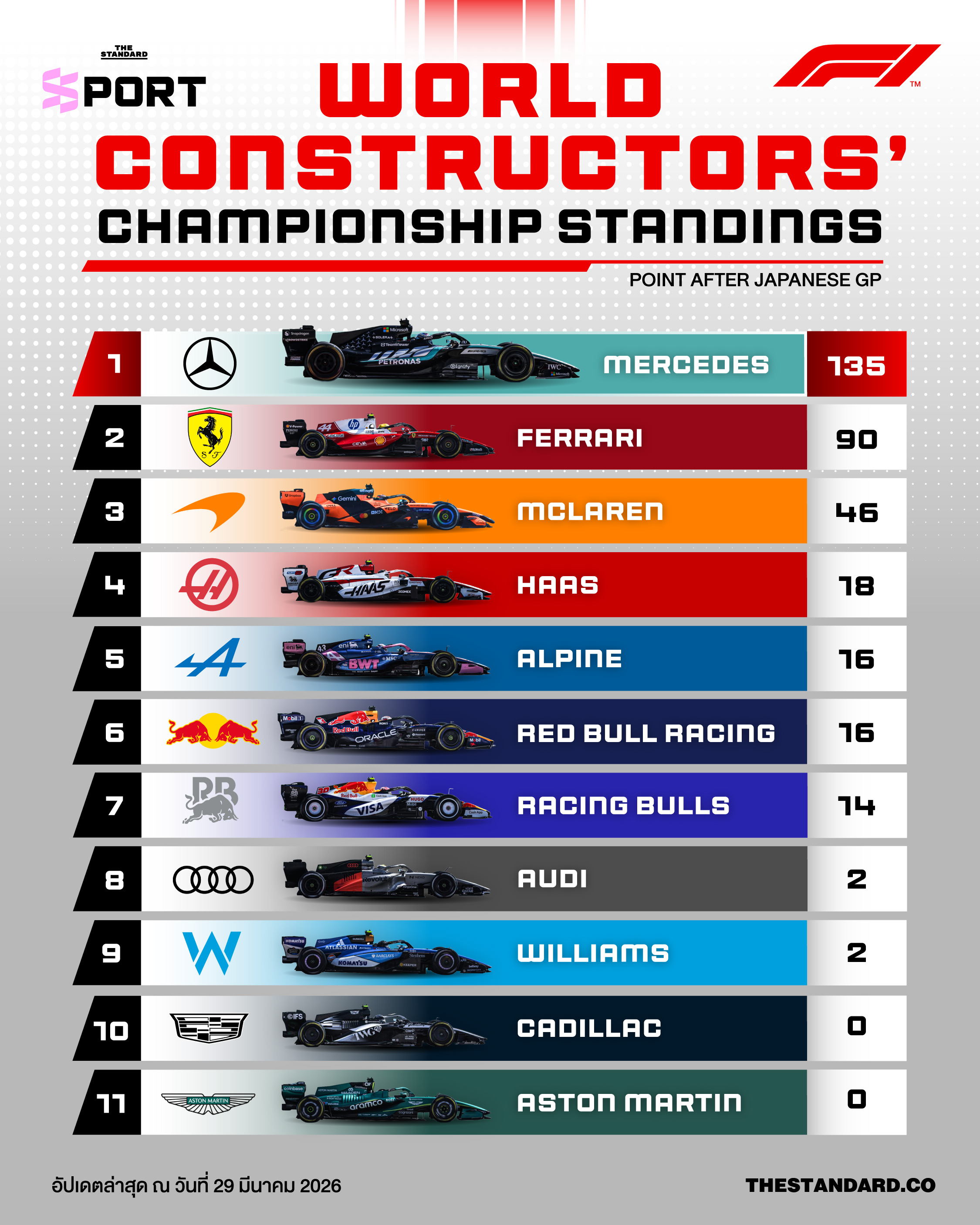
The World Constructors' Championship (WCC) operates on a simple premise: a team is the sum of its parts. Unlike the World Drivers' Championship (WDC), which tracks individual glory, the WCC tracks the efficiency, reliability, and collective performance of the engineering outfit. In 2026, the scoring remains a high-stakes calculation where every position in the top ten represents both a sporting achievement and a massive financial milestone.
Points are awarded to teams based on the finishing positions of both of their entries in a sanctioned Grand Prix. If a team enters two cars—which is the standard requirement for all ten teams on the grid—the points earned by both drivers are added together to form the team's total for that weekend. This cumulative nature means that a team with two consistently high-finishing drivers often outperforms a team with one superstar and one struggling teammate.
The Grand Prix Points Scale
The primary source of constructors' points is the Sunday Grand Prix. The points distribution follows a "weighted" scale, rewarding winners significantly more than those in the lower half of the top ten to encourage aggressive racing for the podium.
| Position | Points Awarded |
|---|---|
| 1st Place | 25 |
| 2nd Place | 18 |
| 3rd Place | 15 |
| 4th Place | 12 |
| 5th Place | 10 |
| 6th Place | 8 |
| 7th Place | 6 |
| 8th Place | 4 |
| 9th Place | 2 |
| 10th Place | 1 |
The Fastest Lap Bonus
Since 2019, an additional point has been available for the driver who sets the fastest lap of the race. For a constructor to claim this point, two conditions must be met:
- The driver must set the fastest timed lap of the Grand Prix.
- That driver must finish the race inside the top 10 (the points-paying positions).
If the driver who sets the fastest lap finishes 11th or lower, or fails to finish, no point is awarded to either the driver or the constructor for the fastest lap. This creates a strategic "cat and mouse" game toward the end of races. A team might pit a driver for fresh tires in the closing laps specifically to "steal" the fastest lap point away from a rival constructor, even if it doesn't change their primary finishing position.
Sprint Race Contributions to the WCC
The 2026 calendar continues to utilize the Sprint format at select high-engagement venues. Sprint races are shorter versions of the Grand Prix (approximately 100km) and offer a secondary stream of points for constructors.
Unlike the Grand Prix, where the top ten score, the Sprint only awards points to the top eight finishers. The scale is linear: 8 points for 1st place, descending to 1 point for 8th place. Because these sessions occur on Saturdays, they provide a vital opportunity for teams to recover from a poor qualifying session or to extend a lead before the main event on Sunday.
For a constructor, a perfect weekend (maximum points) would involve a 1-2 finish in the Sprint, a 1-2 finish in the Grand Prix, and the fastest lap point. This equates to 59 points in a single weekend (15 from the Sprint and 44 from the Grand Prix), which can drastically shift the standings in the mid-field or the title race.
Why the Constructors' Championship is the Financial Lifecycle of F1
While fans and media often focus on the World Drivers' Championship, the teams themselves are often more preoccupied with the Constructors' standings. The reason is simple: the prize money.
The Concorde Agreement and Revenue Distribution
The distribution of Formula 1’s massive commercial rights income—generated from TV deals, sponsorships, and race hosting fees—is governed by a document known as the Concorde Agreement. Under this agreement, a significant portion of F1's profits is distributed among the ten teams based almost entirely on their finishing position in the WCC from the previous year.
The difference between finishing 5th and 6th in the standings can be worth tens of millions of dollars. For independent teams like Williams, Sauber, or Haas, these points are not just "scores"; they are the budget for next year’s research and development. This financial pressure is why team orders are often used—if two teammates are racing each other and risk crashing, the team will intervene to ensure both cars finish and secure the points for the "company."
The "Success Tax": FIA Entry Fees
Interestingly, scoring more points also comes with a literal cost. To enter the 2026 championship, every team must pay an entry fee to the FIA. This fee consists of a base amount plus a specific dollar amount for every point scored in the 2025 season. The reigning Constructors' Champion pays a higher rate per point than the rest of the field. This "success tax" ensures the FIA can fund its regulatory and safety operations, but it also means that the top teams like Red Bull, Ferrari, or Mercedes often pay entry fees exceeding $6 million to $7 million.
Strategy and Point Optimization
Because both cars contribute to the total, constructors must manage their drivers as a unit. This leads to several unique tactical scenarios:
- Sacrificial Strategy: A team may use one driver to hold up a rival, allowing their other driver to build a gap. While the "sacrificed" driver might lose a position (and points), the net gain for the team could be higher if it secures a podium or prevents a rival from scoring.
- Reliability vs. Pace: In the closing stages of a season, a team leading the WCC by a small margin might choose to turn down their engines to ensure reliability. Finishing 4th and 5th (22 points) is better for the constructor than one car winning (25 points) and the other suffering an engine failure (0 points).
- Driver Swaps: If a driver is injured or replaced mid-season, the points they scored remain with the constructor. For example, if a reserve driver steps in for a race and finishes 8th, those 4 points are added to the team’s season total exactly as if the regular driver had scored them.
Tie-Breakers and Deadlocks
In the event that two teams end the season with the exact same number of points, the FIA uses a countback system to determine the winner. The deadlock is broken by looking at the quality of finishes:
- The team with the most 1st place finishes is ranked higher.
- If they have the same number of wins, the team with the most 2nd place finishes is ranked higher.
- The process continues down through 3rd, 4th, and so on, until a winner is found.
In the extremely rare case that the teams have identical finishing records across the entire season, the FIA reserves the right to nominate a winner based on such criteria as it deems fit, though this has never been required in the modern era.
Historical Evolution of Scoring
The points system has not always been this generous. In the early days of F1 (1950s), only the top five finishers scored points, and only the best-placed car from each team counted toward the constructors' total. It wasn't until 1958 that the International Cup for F1 Constructors was officially established.
Throughout the 1990s and early 2000s, the 10-6-4-3-2-1 system was the standard. The move to the 25-point system in 2010 was designed to provide a larger "gap" between first and second place, rewarding the win more than consistency. In 2026, the inclusion of Sprints and fastest lap points has made the scoring the most complex—and potentially lucrative—it has ever been.
Summary Table: Scoring Opportunities in 2026
| Event Type | Scoring Positions | Maximum Team Points (per event) |
|---|---|---|
| Grand Prix | 1st - 10th | 44 (1st & 2nd) + 1 (Fastest Lap) = 45 |
| Sprint Race | 1st - 8th | 15 (1st & 2nd) |
| Full Weekend | All of the above | 60 (If Sprint, GP 1-2, and Fastest Lap) |
Frequently Asked Questions
What happens to points if a race is shortened? If a race is suspended and cannot be resumed, partial points are awarded. Following the 2021 Belgian GP controversy, the rules were refined: no points are awarded unless at least two laps are completed under green flag conditions (without a Safety Car). If less than 25% of the race is completed, only a small percentage of points are given; the scale increases at 50% and 75% completion.
Do constructors get points for Qualifying? No. While Qualifying determines the starting grid for the Grand Prix (or the Sprint), no points are awarded for pole position or qualifying performance. The only exception is the indirect contribution Qualifying makes by placing a car in a better position to score during the race.
Can a team lose constructors' points as a penalty? Yes. The FIA can strip a team of constructors' points for technical infringements or sporting misconduct without necessarily stripping the drivers of their individual points. A famous example is the 2007 "Spygate" scandal, where McLaren was excluded from the Constructors' Championship but their drivers were allowed to keep their points.
Are points awarded for the fastest lap in a Sprint race? No. Currently, the bonus point for the fastest lap is only available during the full-length Sunday Grand Prix. There is no fastest lap bonus point awarded during the Saturday Sprint.
What is the minimum number of cars a team must run to score? A team must enter two cars for the championship. While a team could theoretically score points with only one car (if the other retires or fails to start), they are required by the sporting regulations to attempt to field two cars at every event.
Practical Recommendation for Fans and Analysts
When evaluating team performance in 2026, do not just look at the podiums. To understand a team’s true health, look at their scoring efficiency—the percentage of races where both cars finished in the points. A team like Ferrari or McLaren that consistently puts two cars in the top six will often beat a team like Red Bull if the latter relies too heavily on a single driver. For those following the mid-field battle (the "Class B" championship), the WCC is the only metric that matters, as it defines their engineering budget for the next three years.
Image Gallery