What is SAP S/4HANA? The Definitive Guide to SAP’s Modern ERP Suite
SAP S/4HANA is an enterprise resource planning (ERP) suite designed to run exclusively on the SAP HANA in-memory database. As the successor to SAP ECC, it utilizes a simplified data model, the SAP Fiori user experience, and advanced te...
SAP S/4HANA is an enterprise resource planning (ERP) suite designed to run exclusively on the SAP HANA in-memory database. As the successor to SAP ECC, it utilizes a simplified data model, the SAP Fiori user experience, and advanced technologies like artificial intelligence to enable real-time data processing and streamlined business operations.
Contents
For decades, organizations relied on SAP R/3 and later SAP ECC (ERP Central Component) to manage their core business processes. However, as data volumes exploded and the need for instantaneous insights grew, the limitations of traditional disk-based databases became apparent. SAP S/4HANA—short for SAP Business Suite 4 SAP HANA—represents a complete architectural shift. Launched in 2015, it has become the standard for modern enterprise operations, especially as the 2027 deadline for mainstream maintenance of legacy SAP ECC systems approaches.
The Architecture of SAP S/4HANA
The defining characteristic of SAP S/4HANA is its reliance on SAP HANA, an in-memory, column-oriented relational database management system. Unlike traditional databases that store data on hard disks and move it to RAM only when needed, SAP HANA keeps all active data in the system’s memory. This eliminates the "bottleneck" of disk I/O, allowing for processing speeds that are significantly faster than legacy systems.
Columnar Storage and Data Compression
In a traditional row-based database, the system must read every column in a row to find a specific value. SAP S/4HANA uses columnar storage, which allows the system to read only the relevant columns. This is particularly effective for analytical queries where a user might want to calculate the total sales across millions of records. Furthermore, because data in columns is often repetitive, SAP S/4HANA can achieve high compression rates, reducing the overall data footprint of an organization.
The Universal Journal (ACDOCA)
One of the most radical technical changes in S/4HANA is the introduction of the Universal Journal, represented by the table ACDOCA. In legacy ECC systems, financial data was fragmented across multiple tables (for General Ledger, Accounts Payable, Accounts Receivable, Asset Accounting, and Management Accounting). This fragmentation required complex "reconciliation" at the end of every month.
In S/4HANA, all financial transactions are written to a single table (ACDOCA). This provides a "Single Source of Truth," eliminating the need for reconciliation and allowing for a "continuous close" process. Finance teams can generate a balance sheet or P&L statement in real-time at any point during the month.
Key Differences Between SAP ECC and SAP S/4HANA
Understanding the shift from ECC to S/4HANA requires looking at both the technical backend and the functional frontend. While ECC was designed to run on various databases (Oracle, IBM DB2, Microsoft SQL Server), S/4HANA is optimized strictly for SAP HANA.
| Feature | SAP ECC (Legacy) | SAP S/4HANA (Modern) |
|---|---|---|
| Database Support | AnyDB (Oracle, SQL, etc.) | SAP HANA Only (In-memory) |
| Data Model | Complex with many aggregate tables | Simplified; no aggregate/index tables |
| User Interface | SAP GUI (Transaction-based) | SAP Fiori (Role-based/Web-based) |
| Financial Ledger | Multiple tables (FI, CO, AA separate) | Universal Journal (ACDOCA) |
| Analytics | Separate OLAP system (SAP BW) | Embedded Analytics in real-time |
| Inventory Management | Table MSEG (locking issues common) | MATDOC (simplified for high throughput) |
The End of "Aggregates"
In legacy systems, to ensure acceptable performance, SAP created "aggregate tables" that stored pre-calculated totals. If you wanted to know your total inventory, the system didn't calculate it on the fly; it looked at a summary table. S/4HANA’s speed is so high that it calculates these totals from the line items directly, removing the need for aggregate tables. This reduces data redundancy and ensures that the numbers are always 100% current.
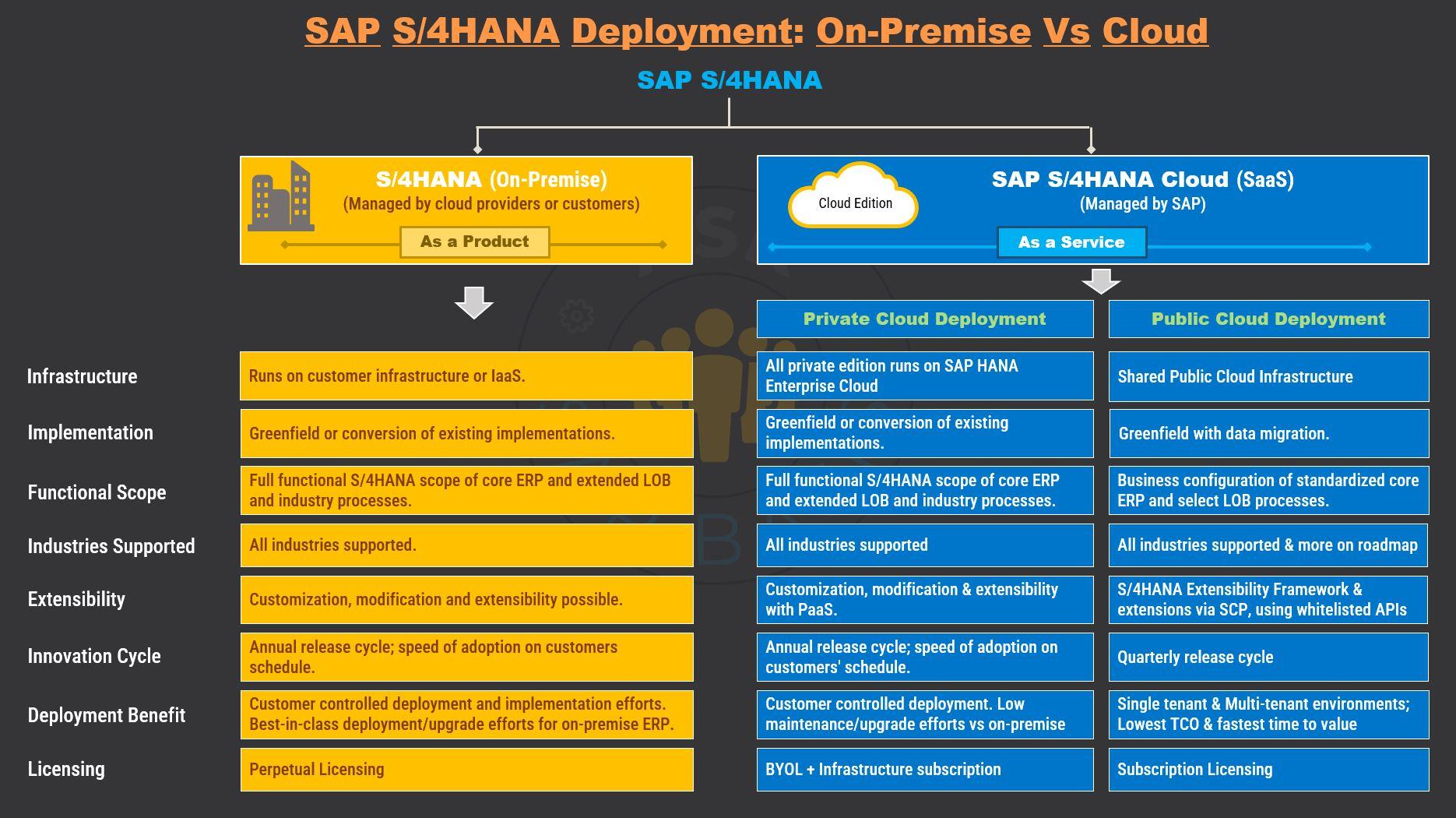
Deployment Options: On-Premise vs. Cloud
As of 2026, SAP’s strategy is heavily weighted toward the cloud, though they continue to offer flexibility for organizations with specific regulatory or infrastructure requirements.
RISE with SAP (S/4HANA Cloud, Private Edition)
RISE with SAP is a "Business Transformation as a Service" (BTaaS) offering. It bundles S/4HANA Cloud (Private Edition) with infrastructure managed by SAP (often hosted on hyperscalers like AWS, Azure, or Google Cloud), along with business process intelligence tools like SAP Signavio. This is the primary path for existing ECC customers who want to move to the cloud while keeping their custom developments (Z-code).
GROW with SAP (S/4HANA Cloud, Public Edition)
GROW with SAP is designed for mid-market companies or subsidiaries of large enterprises. It uses a Public Cloud multi-tenant architecture. In this model, every customer uses the same software version and follows "Clean Core" principles. Customization is limited to "Side-by-Side" extensibility via the SAP Business Technology Platform (BTP), ensuring that the system is easy to upgrade and maintain.
S/4HANA On-Premise
For organizations in highly regulated industries (such as defense or specific government sectors) that require absolute control over their data centers, the On-Premise version remains available. This version allows for maximum customization but places the burden of maintenance, security, and hardware upgrades on the customer.
The SAP Fiori User Experience
For decades, SAP users were confined to the "SAP GUI," a complex interface characterized by deep menus and transaction codes (T-codes). SAP S/4HANA introduces SAP Fiori, a modern, web-based user experience built on HTML5 (OpenUI5).
Fiori is designed to be role-based. Instead of a user having to navigate a massive menu to find one specific task, their Fiori Launchpad presents them with "Tiles" relevant only to their specific job function. Whether a user is an Accounts Payable Clerk or a Warehouse Manager, the interface is consistent across desktops, tablets, and smartphones. Fiori also supports "Insights to Action," where a tile might show a real-time KPI (e.g., "5 Overdue Invoices") and allow the user to click directly into the resolution screen.
Business Benefits and AI Integration
By 2026, the conversation around S/4HANA has shifted from basic migration to the utilization of SAP Business AI. Because S/4HANA sits on a high-speed database, it can process the massive datasets required for machine learning and generative AI.
- Predictive Analytics: S/4HANA can analyze historical data to predict future trends, such as stock-outs in the supply chain or late payments from customers.
- Automated Shared Services: Through Robotic Process Automation (RPA) and AI, the system can automatically match incoming bank statements to open invoices, achieving "touchless" accounting in many scenarios.
- Real-Time Supply Chain Visibility: Organizations can run Material Requirements Planning (MRP Live) in minutes rather than hours. This allows companies to react to supply chain disruptions immediately rather than waiting for an overnight batch job.
- Sustainability Management: Modern S/4HANA versions include embedded "Green Ledger" capabilities, allowing companies to track their carbon footprint with the same level of granular detail as their financial transactions.
Migration Strategies: How to Get There
There is no "one size fits all" approach to moving from legacy ECC to S/4HANA. The choice depends on the health of the existing system and the desired business outcomes.
1. Greenfield (New Implementation)
This is a "start from scratch" approach. The organization abandons its old ECC system and builds a new S/4HANA environment. This is ideal for companies with highly customized, "messy" legacy systems who want to return to standard business processes and a "Clean Core."
- Pros: Clean start, high adoption of standard features.
- Cons: High effort for data migration from the old system.
2. Brownfield (System Conversion)
This is a technical upgrade of an existing ECC system to S/4HANA. It preserves the existing business processes and history.
- Pros: Shorter timeline, preserves historical data and custom code.
- Cons: Carries over legacy "technical debt" and inefficient processes.
3. Selective Data Transition (Bluefield)
A hybrid approach where a new system is created (like Greenfield), but specific historical data and customized processes are selectively migrated (like Brownfield). This often requires specialized tools from partners like SNP or CBS.
Preparing for the 2027 Maintenance Deadline
SAP has announced that mainstream maintenance for the SAP Business Suite 7 core applications (including ECC 6.0) will end on December 31, 2027. While extended maintenance is available until 2030 for an additional fee, most organizations are now in the active phases of transition.
As of 2026, the window for a comfortable migration is closing. A typical S/4HANA implementation for a large enterprise can take 12 to 24 months. Organizations still on ECC must prioritize their "Readiness Checks" and "Simplification Item Reviews" immediately to identify potential blockers, such as incompatible custom code or obsolete business functions.
Frequently Asked Questions
Is SAP S/4HANA just a database upgrade?
No. While it requires the SAP HANA database, S/4HANA is a complete rewrite of the ERP application layer. It involves a simplified data model, a new user interface (Fiori), and entirely new functional capabilities that do not exist in the legacy ECC environment.
Do I have to use SAP Fiori with S/4HANA?
Technically, many traditional SAP GUI transactions still work in S/4HANA. However, to access the new innovations, real-time analytics, and AI-driven features, the Fiori interface is mandatory. Relying solely on the legacy GUI prevents an organization from realizing the full ROI of the platform.
What is the "Clean Core" strategy?
"Clean Core" is an architectural approach where the main ERP system is kept as close to standard as possible. Instead of modifying the core SAP code (as was common in ECC), developers use the SAP Business Technology Platform (BTP) to build "Side-by-Side" extensions. This allows for easier, faster upgrades to the core S/4HANA system.
Can S/4HANA run on Oracle or Microsoft SQL?
No. SAP S/4HANA is specifically designed to leverage the unique architecture of the SAP HANA database. It cannot run on any other database platform. This is a fundamental change from SAP ECC, which was database-agnostic.
How much does SAP S/4HANA cost?
Pricing is complex and varies significantly based on the deployment model (subscription for Cloud vs. perpetual licenses for On-Premise), the number of users (FUE - Full Use Equivalents), and the specific business modules required. For most new customers, RISE with SAP or GROW with SAP provides a predictable subscription-based OPEX model.
Practical Recommendation
If your organization is still running SAP ECC, the primary objective for 2026 should be the completion of a Technical Readiness Check. Use SAP’s automated tools to analyze your current environment for compatibility with S/4HANA. Focus on the "Simplification List," which outlines exactly which transactions and tables will change or disappear. If you have significant custom code, begin a code remediation project now to ensure compatibility with the HANA database. For most enterprises, the RISE with SAP path offers the most balanced route to modernization while minimizing the risks of infrastructure management.
Image Gallery