Comprehensive Guide to F-22 Raptor Missile Systems and Armament
The Lockheed Martin F-22 Raptor employs a sophisticated suite of air-to-air missiles, primarily consisting of the AIM-120 AMRAAM for beyond-visual-range engagements and the AIM-9 Sidewinder for short-range dogfighting. These weapons ar...
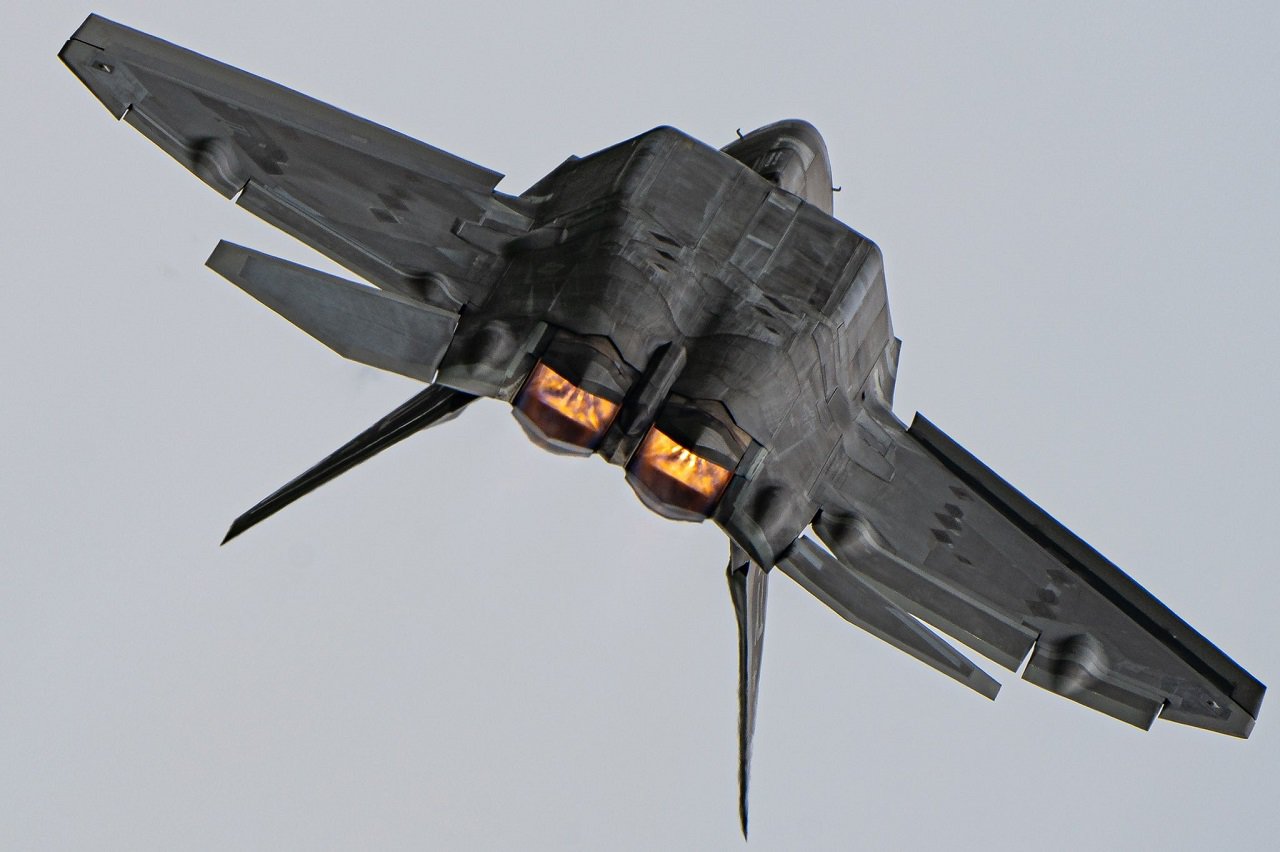
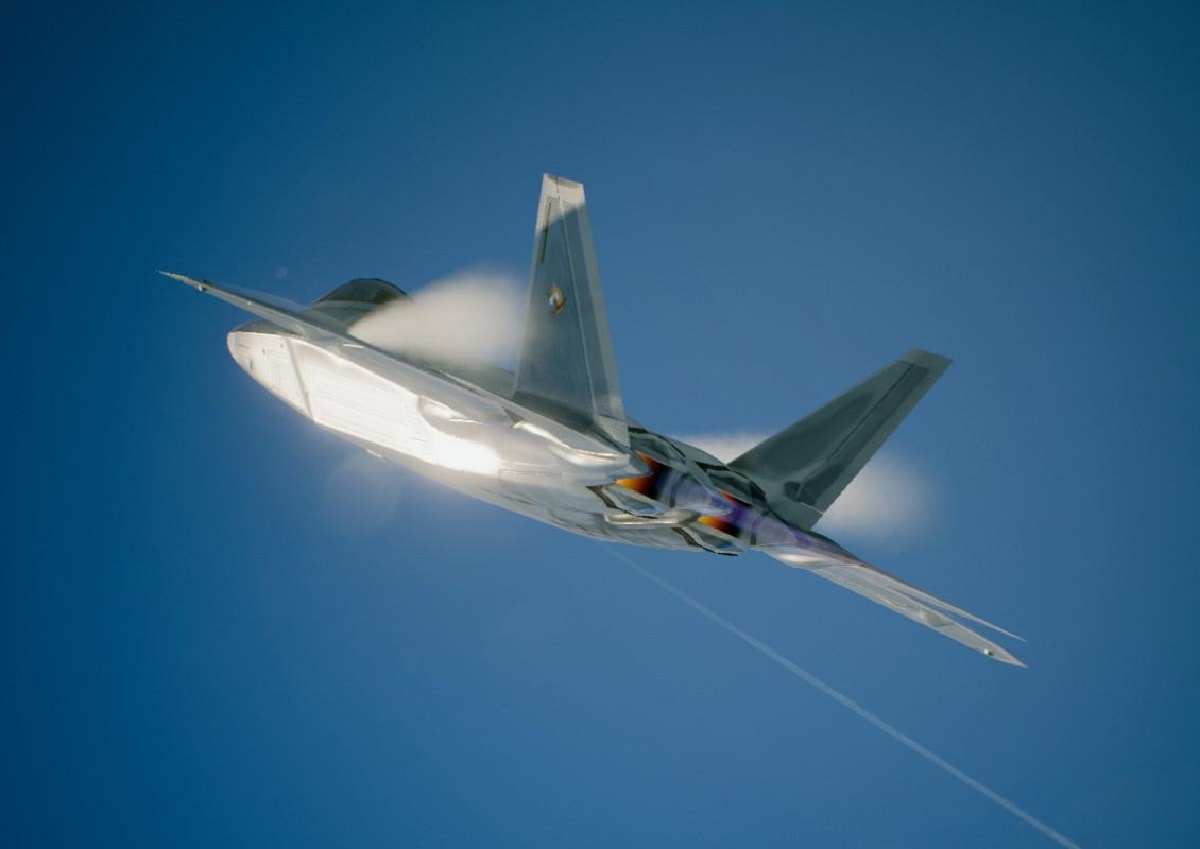
The Lockheed Martin F-22 Raptor employs a sophisticated suite of air-to-air missiles, primarily consisting of the AIM-120 AMRAAM for beyond-visual-range engagements and the AIM-9 Sidewinder for short-range dogfighting. These weapons are housed in three internal bays to maintain the aircraft’s low-observable (stealth) profile, ensuring high lethality against modern aerial threats.
Contents
As of 2026, the F-22 Raptor remains the gold standard for air superiority, a position maintained through continuous software and hardware upgrades to its kinetic systems. While the airframe itself is a marvel of supercruise and supermaneuverability, it is the Raptor’s "teeth"—its missile compliment—that allows it to dominate the "first look, first shot, first kill" arena. To understand the F-22's combat efficacy, one must analyze the specific missile variants it carries, the specialized mechanical launchers that deploy them, and the sensor fusion that guides them to their targets.
Stealth Integration and Internal Weapon Bays
The primary design constraint of the F-22 Raptor is the preservation of its Radar Cross Section (RCS). Carrying missiles on external wing pylons would significantly increase the aircraft's visibility to enemy radar. Consequently, the F-22 utilizes a unique internal carriage system.
The Raptor features three internal weapon bays:
- The Main Belly Bay: Located on the underside of the fuselage, this large bay is divided into two sections, typically carrying up to six medium-range missiles.
- Side Bays: Two smaller bays located on either side of the intake trunks, each designed to hold a single short-range, heat-seeking missile.
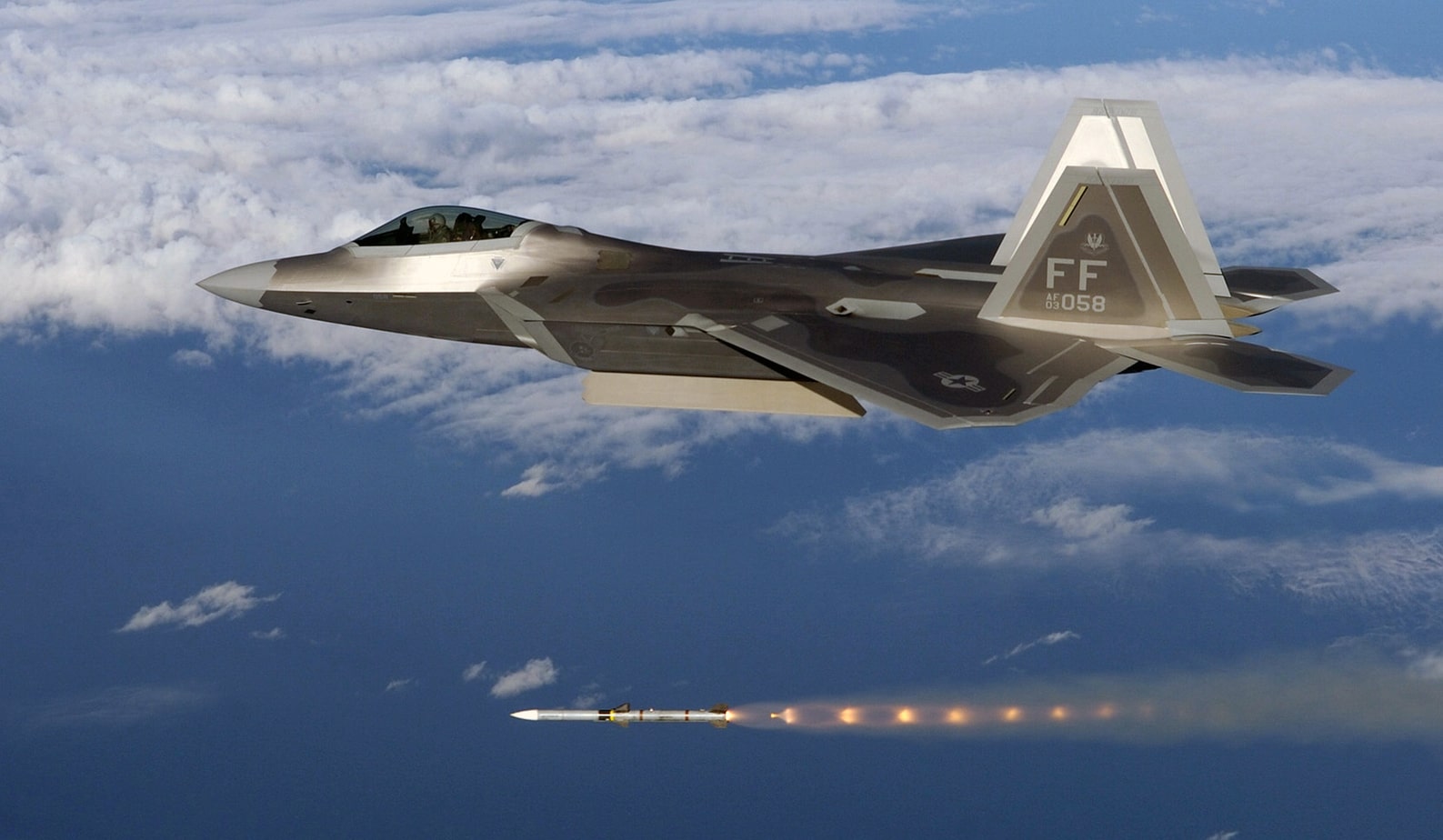
The engineering challenge of internal bays involves more than just space. At supersonic speeds, opening a bay door creates massive turbulence and can affect the flight dynamics of the missile. To solve this, the F-22 uses high-speed hydraulic actuators that can cycle the doors in less than a second. For the main bay, the LAU-142/A AVEL (AMRAAM Vertical Eject Launcher) is used. This pneumatic system forcibly ejects the missile away from the aircraft into the slipstream, ensuring a clean separation before the missile's rocket motor ignites. This minimizes the risk of the missile’s exhaust damaging the aircraft's stealth coatings.
The Primary Long-Range Punch: AIM-120 AMRAAM
The AIM-120 Advanced Medium-Range Air-to-Air Missile (AMRAAM), often referred to as the "Slammer," is the F-22’s primary weapon for Beyond-Visual-Range (BVR) combat. By 2026, the F-22 fleet has transitioned almost entirely to the AIM-120D and its subsequent variants.
AIM-120D Capabilities
The AIM-120D represents a significant leap over previous iterations like the AIM-120C. Key enhancements include:
- Increased Range: Through optimized flight paths and motor management, the "D" variant offers approximately a 50% increase in range over the older "C" models, allowing the F-22 to engage targets from distances exceeding 100 miles (160 km).
- Two-Way Datalink: Unlike older missiles that only received updates from the jet, the AIM-120D can transmit data back to the F-22. This allows the pilot to monitor the missile's health and tracking status in real-time.
- GPS-Aided Inertial Navigation: This improves the missile's mid-course guidance accuracy, ensuring that when the missile's own active radar seeker turns on, the target is exactly where the missile expects it to be.
Tactical Engagement
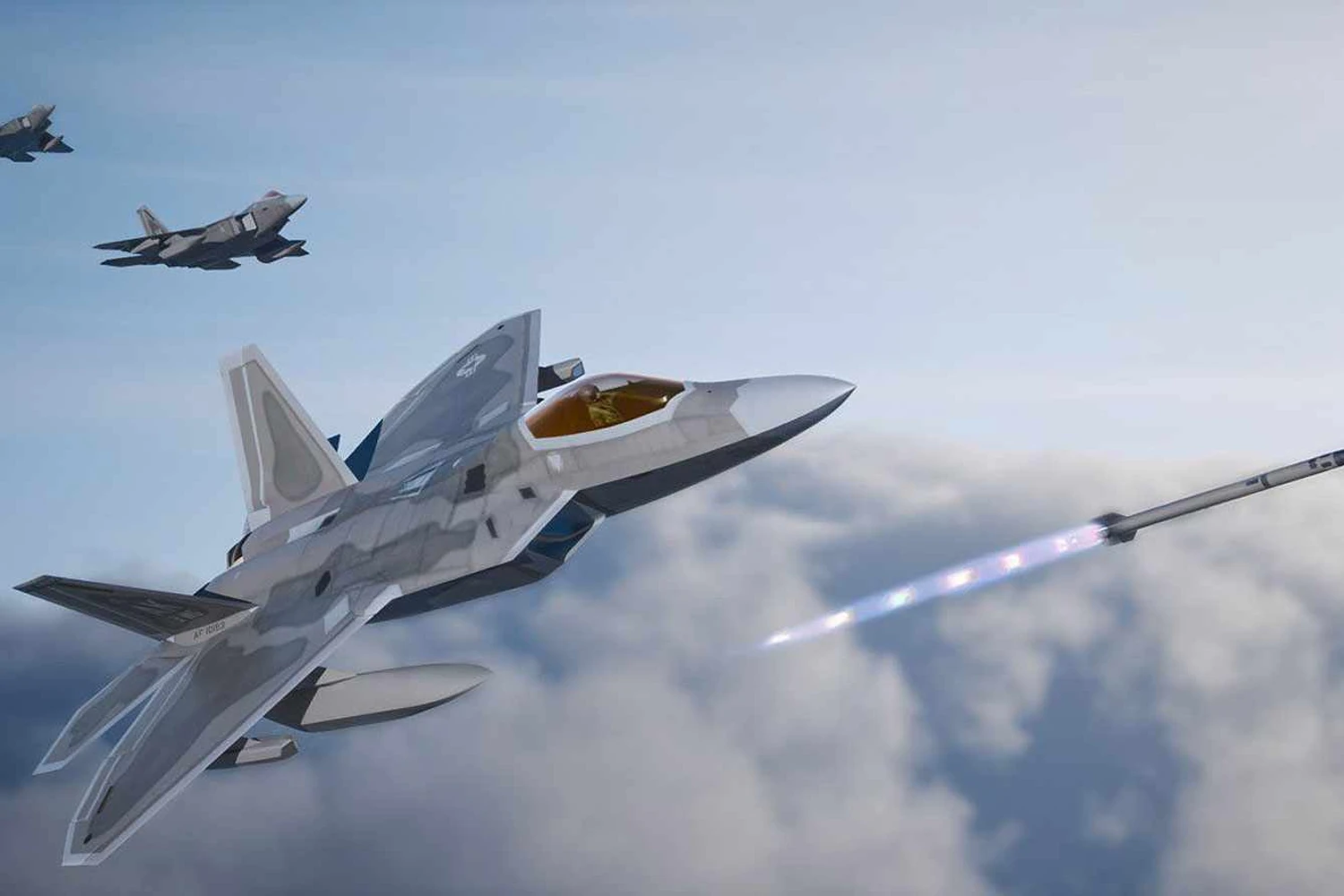
The F-22 utilizes its AN/APG-77(V)1 AESA radar to track multiple targets simultaneously. Due to the Raptor’s stealth, it can often approach within the "No-Escape Zone" of the AMRAAM before the enemy is even aware of the Raptor's presence. The missile is launched, guided mid-course by the F-22’s radar, and then switches to its own internal active radar for the terminal phase, making it a "fire-and-forget" weapon.
Close-In Lethality: The AIM-9 Sidewinder
For within-visual-range (WVR) encounters, the F-22 carries the AIM-9 Sidewinder. While the Raptor was designed to kill enemies from a distance, its agility and thrust-vectoring engines make it a formidable dogfighter if forced into a close-range "knife fight."
The AIM-9X Block II
The current standard for the F-22 is the AIM-9X Block II. This missile is a massive departure from the original Sidewinders of the Cold War.
- High Off-Boresight (HOBS): When paired with the F-22's latest helmet-mounted queuing systems (though the F-22 initially lacked a Helmet Mounted Display, 2026-era upgrades have largely addressed this), the AIM-9X can be fired at targets that are not directly in front of the aircraft. The missile can literally turn 180 degrees after launch.
- Imaging Infrared (IIR) Seeker: The missile does not just look for a "hot spot" (the engine); it creates a thermal image of the target. This makes it incredibly difficult to fool with flares or other infrared countermeasures.
- The Trapeze Launcher: Because the Sidewinder is carried in side bays, it uses the LAU-141/A launcher. Upon activation, the bay door opens, and a trapeze arm extends the missile's seeker into the airflow so it can "lock on" before being released.
The Future of F-22 Armament: AIM-260 JATM
As of 2026, the F-22 is beginning to integrate the AIM-260 Joint Advanced Tactical Missile (JATM). This missile was developed specifically to counter long-range threats like the Chinese PL-15.
The AIM-260 is designed to fit in the same internal dimensions as the AMRAAM, ensuring that the F-22 does not lose any capacity. Its primary advantage is a significantly extended range and a dual-mode seeker (likely combining radar and infrared). This ensures that the F-22 remains the dominant "first shot" platform in contested environments where enemy jamming and long-range sensors are prevalent.
Comparative Specifications of F-22 Missiles
The following table outlines the primary specifications for the missiles integrated into the F-22 Raptor's combat loadout.
| Missile Type | Variant | Guidance System | Primary Role | Max Range (Approx.) | Carriage |
|---|---|---|---|---|---|
| AIM-120 AMRAAM | AIM-120D-3 | Active Radar / Datalink | BVR Air-to-Air | 160+ km | Internal Main Bay (Up to 6) |
| AIM-9 Sidewinder | AIM-9X Block II | Imaging Infrared (IIR) | WVR Air-to-Air | 20+ km | Internal Side Bays (2) |
| AIM-260 JATM | Initial Prod. | Multi-mode (Radar/IR) | Long-range Air-to-Air | 200+ km | Internal Main Bay (Up to 6) |
| GBU-39 SDB* | Block II | GPS / Laser / Radar | Air-to-Ground | 110 km | Internal Main Bay (Up to 8) |
*Note: While the GBU-39 is a bomb rather than a missile, it is included to show the versatility of the internal bays.
Fire Control and Sensor Fusion
The effectiveness of the F-22’s missiles is inextricably linked to the aircraft’s Sensor Fusion capabilities. The F-22 does not just "see" a target on radar; it integrates data from the AESA radar, the ALR-94 electronic warfare suite, and external data links (like Link 16 or IFDL).
This fusion allows the pilot to fire missiles in "passive" modes. For example, the F-22 can track an enemy’s radar emissions and launch an AMRAAM toward those coordinates without ever turning on its own radar—meaning the enemy receives no "lock-on" warning until the missile’s own small radar activates in the final seconds of flight. This "silent killer" approach is what makes the Raptor’s missile systems so feared in modern aerial warfare.
Operational Considerations and Limitations
Despite its dominance, the F-22's missile system has inherent limitations:
- Magazine Depth: The F-22 is limited to eight internal air-to-air missiles (6 AMRAAM, 2 Sidewinder). In a high-intensity conflict against a numerically superior foe, this "magazine depth" is a concern. This is why the F-22 often operates in "wolf packs" with F-15EX or F-35 aircraft, where the F-22 acts as the forward-deployed sensor and "sniper."
- Maintenance of Stealth Coatings: Every time a weapon bay is cycled or a missile is loaded, the specialized radar-absorbent material (RAM) around the bay edges must be inspected. Any degradation can increase the aircraft's RCS.
- Supersonic Separation: Launching a missile at Mach 1.5+ creates extreme aerodynamic stresses. While the F-22 is rated for this, it requires the missiles to be ruggedized beyond standard versions used on non-stealth aircraft.
Frequently Asked Questions
How many missiles can the F-22 Raptor carry?
The F-22 typically carries eight missiles internally: six AIM-120 AMRAAMs in the main belly bay and two AIM-9 Sidewinders in the side bays. While it can carry more missiles on external underwing pylons, doing so compromises its stealth capabilities and is usually only done for ferry flights or in "permissive" environments where enemy radar is not a threat.
Can the F-22 fire missiles while flying faster than the speed of sound?
Yes. The F-22 is designed to launch both AMRAAM and Sidewinder missiles at supersonic speeds. The internal bays use specialized pneumatic ejectors (the LAU-142/A) to push the missiles into the slipstream with enough force to ensure they clear the aircraft's shockwave and turbulence before the motor ignites.
What is the range of the F-22’s missiles?
The range varies by missile type. The AIM-9X Sidewinder is a short-range weapon effective up to approximately 20–30 km. The AIM-120D AMRAAM is a beyond-visual-range missile with an estimated range exceeding 160 km. The newer AIM-260 JATM is expected to push this range even further, potentially past 200 km, to counter long-range adversary threats.
Does the F-22 use any air-to-ground missiles?
The F-22 is primarily an air superiority fighter, but it can carry air-to-ground precision-guided munitions. This includes the GBU-32 JDAM (Joint Direct Attack Munition) and the GBU-39 Small Diameter Bomb (SDB). While these are technically bombs rather than missiles, they provide the Raptor with a potent strike capability against fixed and mobile ground targets.
Can the F-22 track targets for missiles launched by other aircraft?
Yes. Through its Intra-Flight Data Link (IFDL) and Link 16 integration, the F-22 can act as a "forward controller." It can use its stealth and advanced sensors to track an enemy and then transmit that targeting data to other "shooter" aircraft (like an F-15 or F-16) that are further back, allowing those planes to fire their missiles without ever seeing the target on their own radars.
Conclusion and Next Actions
The F-22 Raptor's missile systems are a masterclass in the integration of stealth and kinetic power. By housing its AIM-120 and AIM-9 missiles internally and utilizing advanced sensor fusion to guide them, the Raptor maintains a tactical advantage that few aircraft can match even in 2026. For those interested in the future of air combat, the next logical step is to monitor the full integration of the AIM-260 JATM, which will redefine the Raptor’s engagement envelope for the coming decade. Aviation professionals and enthusiasts should look toward upcoming Air Force budget disclosures for updates on the "Next Generation Air Dominance" (NGAD) program, which will eventually succeed the Raptor's missile-carrying mantle.
Image Gallery