Understanding Cipher Feedback Mode in Cryptography
Cipher Feedback Mode (CFB) is a mode of operation for block ciphers that allows a block cipher to function as a self-synchronizing stream cipher. By encrypting the previous ciphertext block and XORing the result with the plaintext, CFB...
Cipher Feedback Mode (CFB) is a mode of operation for block ciphers that allows a block cipher to function as a self-synchronizing stream cipher. By encrypting the previous ciphertext block and XORing the result with the plaintext, CFB enables the encryption of data in increments smaller than the block size, providing flexibility for streaming applications where input length is variable.
Contents
The Mechanism of Cipher Feedback Mode
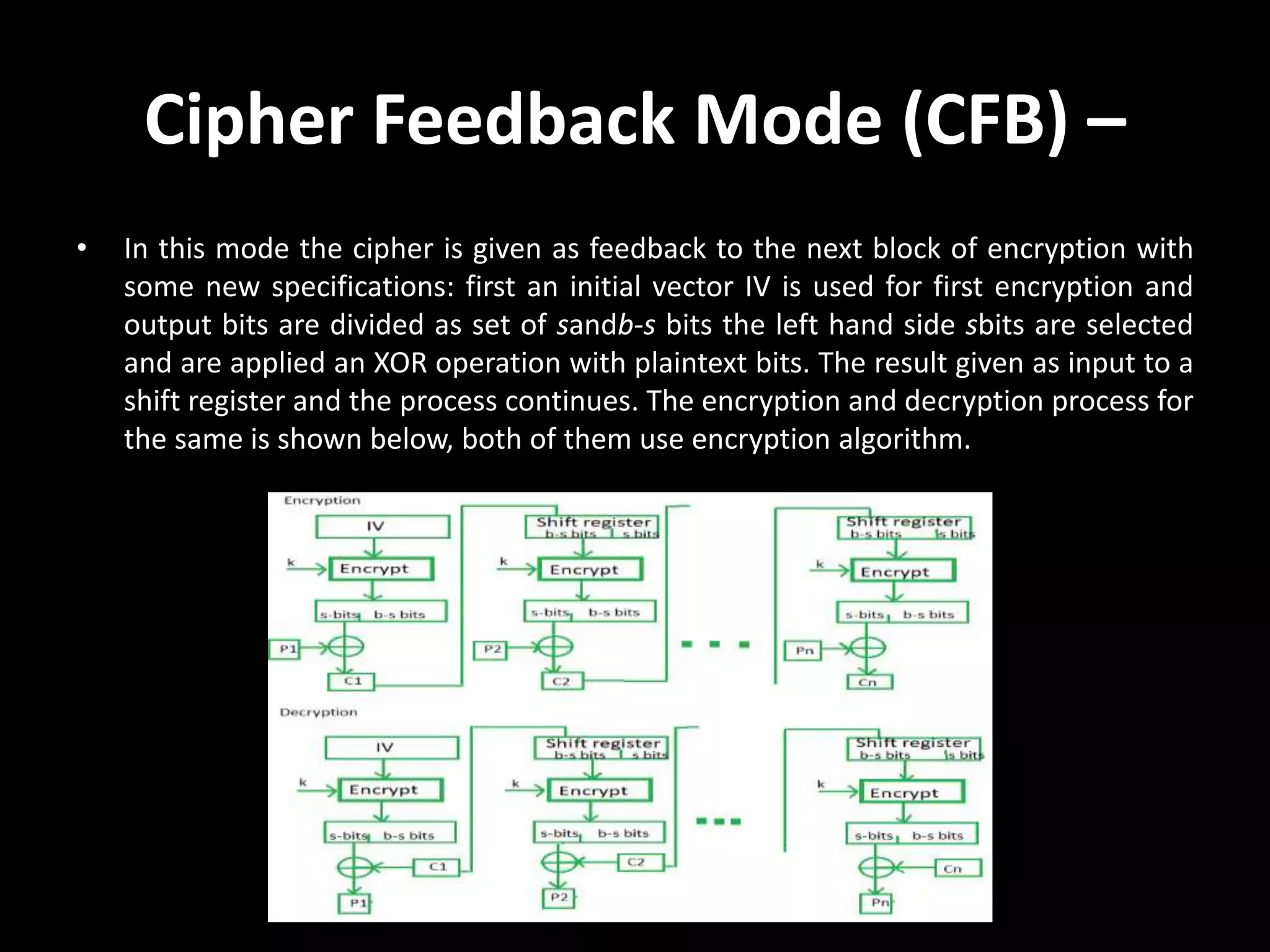
At its core, Cipher Feedback Mode transforms a block cipher—such as the Advanced Encryption Standard (AES)—into a stream cipher. Unlike Electronic Codebook (ECB) mode, which processes data in static, independent blocks, CFB processes data by creating a feedback loop. This architecture allows the system to encrypt segments of data that are shorter than the native block size of the underlying algorithm.
The process begins with an Initialization Vector (IV). The IV is a non-secret, random value that ensures that the same plaintext encrypted with the same key produces different ciphertext, preventing pattern analysis. In CFB mode, the IV is encrypted by the block cipher. The output of this encryption is then XORed with the first segment of the plaintext to produce the first segment of ciphertext.
Crucially, this ciphertext segment is then fed back into the input register of the block cipher, effectively shifting the previous IV or ciphertext out and replacing it with the new ciphertext segment. This shifting window process continues for every subsequent segment. Because each ciphertext segment depends on the encryption of the previous segment, the mode maintains a continuous state, which effectively masks the underlying block-based structure of the algorithm.
Key Characteristics and Operational Advantages
The primary appeal of CFB lies in its stream-like behavior. In many network communication protocols, data arrives in arbitrary chunks that may not align with the 128-bit block boundaries of standard ciphers like AES. CFB allows a system to encrypt these segments as they arrive without waiting for a full 128-bit block to be populated.
One of the most notable features of CFB is its self-synchronizing property. If a transmission error occurs—such as a lost or corrupted ciphertext bit—the system can recover. After a specific number of segments (equal to the block size of the underlying algorithm), the input register will once again contain the correct sequence of bits, and decryption will automatically resume normally. This makes CFB resilient in environments where channel noise is a factor.
Furthermore, CFB decryption is remarkably efficient because it only requires the forward encryption function of the block cipher, even when decrypting. The decryption process works by taking the previous ciphertext segment, encrypting it using the block cipher, and XORing that result with the incoming ciphertext to recover the original plaintext. This eliminates the need to implement the reverse (decryption) function of the block cipher in resource-constrained hardware or firmware.
Comparison of Encryption Modes
To understand where CFB fits within the cryptographic landscape, it is helpful to compare it against other common operational modes.
| Mode | Input Dependency | Error Propagation | Parallelization |
|---|---|---|---|
| CFB | Chained (Sequential) | Limited | No |
| ECB | Independent | None (per block) | Yes |
| CBC | Chained (Sequential) | High | No |
| CTR | Independent | None | Yes |
As shown in the table, CFB provides a balance between the simplicity of ECB and the security of chained modes like Cipher Block Chaining (CBC). However, because CFB relies on the previous ciphertext to generate the current input, it is inherently sequential. This prevents it from taking advantage of multi-core processing or parallel hardware acceleration, which are strengths of modes like Counter (CTR) mode.
Implementation Considerations and Security Limitations
While CFB offers functional utility, security engineers must be aware of its limitations. Like any cryptographic implementation, misuse can lead to vulnerabilities.
First, the Initialization Vector must be unique for every execution of the encryption process. If an IV is reused with the same key—a scenario often called an "IV collision"—an attacker can perform XOR operations to reveal information about the plaintext, effectively breaking the confidentiality of the stream. In 2026, standards such as those provided by the National Institute of Standards and Technology (NIST) strictly dictate that IVs must be unpredictable and never reused under the same key.
Second, CFB does not provide integrity or authenticity by itself. Even if the data is encrypted, an attacker who can modify the ciphertext might cause predictable changes in the decrypted plaintext. In modern system design, this is typically addressed by combining CFB with a Message Authentication Code (MAC) or using an Authenticated Encryption with Associated Data (AEAD) approach, such as AES-GCM (Galois/Counter Mode).
Finally, implementation must ensure that the segment size is appropriate for the application. While CFB can handle 1-bit increments, doing so is computationally expensive because it requires a full block encryption for every single bit processed. Most practical implementations use a segment size equal to the block size or a significant fraction thereof to balance efficiency with granularity.
Frequently Asked Questions
Is Cipher Feedback Mode still considered secure in 2026? CFB remains a standard and secure mode of operation when implemented according to NIST SP 800-38A guidelines. However, it is rarely the default choice for high-speed, modern applications because it does not support parallelization and lacks inherent integrity verification compared to AEAD modes like GCM.
How does CFB handle partial block sizes? CFB handles partial blocks by keeping a shift register that holds the previous ciphertext. When a partial block of plaintext arrives, the most significant bits of the block cipher output are XORed with that plaintext segment. The register is then shifted, and the new ciphertext segment is appended, ensuring the cipher remains synchronized regardless of the data input size.
Can I use the same IV for CFB encryption multiple times? No. Reusing an IV with the same key allows attackers to perform cryptanalysis on the XORed output. The IV must be generated using a cryptographically secure random number generator for every session to ensure that each encryption process produces a unique output sequence.
Why would I choose CFB over CBC mode? CFB is often chosen when you need to encrypt data of an unknown or variable length without padding the plaintext to reach a full block size. Furthermore, because CFB only requires the encryption algorithm for both encryption and decryption, it is ideal for hardware devices that have limited storage capacity for algorithm code.
What is the impact of a corrupted bit in CFB mode? CFB has self-synchronizing properties. If one bit of ciphertext is corrupted, the current block decryption will be incorrect, but the subsequent blocks will correct themselves after a number of bits equal to the block size have passed. It is significantly more resilient to transient transmission errors than CBC, where a corrupted block can render subsequent blocks unusable.
Recommendations for Secure Implementation
If you are currently designing a system that requires streaming encryption, assess your specific requirements for parallelization and integrity. If your architecture is heavily dependent on throughput and high-speed processing, consider transitioning to CTR or GCM modes. If your application resides on resource-constrained hardware and you require the ability to encrypt small, non-standard chunks of data, CFB remains a robust and verified choice.
Always ensure that your library implementation is updated to meet 2026 security compliance standards. Never implement cryptographic primitives from scratch; rely on peer-reviewed, audited libraries such as OpenSSL, BoringSSL, or the cryptographic modules provided by your operating system vendor.
Image Gallery