Life Insurance and Annuities in Divorce: A Comprehensive Guide to Asset Division and Financial Security
In a divorce, life insurance and annuities are treated as marital assets if they were funded with marital income during the marriage. Cash-value life insurance and deferred annuities must be professionally valued and divided, while ter...
In a divorce, life insurance and annuities are treated as marital assets if they were funded with marital income during the marriage. Cash-value life insurance and deferred annuities must be professionally valued and divided, while term life insurance is frequently maintained as a court-ordered security for alimony or child support. Proper legal documentation, such as a specific settlement agreement or a Qualified Domestic Relations Order (QDRO), is essential to avoid tax penalties and ensure beneficiary designations align with the final decree.
Contents
The Classification of Insurance and Annuity Assets
The first step in any divorce proceeding involves the "discovery" phase, where all financial assets are identified and classified. In 2026, the legal framework for asset division continues to rely on the distinction between community property states and equitable distribution states. Understanding how life insurance and annuities fit into these categories is vital for a fair settlement.
Marital vs. Separate Property
If a life insurance policy or annuity was purchased before the marriage and no marital funds (income earned during the marriage) were used to pay premiums, it is generally considered separate property. However, if marital funds were used to pay even a portion of the premiums, the asset may be deemed "commingled." In such cases, the non-owning spouse may be entitled to a percentage of the cash value or a portion of the future death benefit.
The Role of the Automatic Temporary Restraining Order (ATRO)
In many jurisdictions, the moment a divorce petition is filed, an Automatic Temporary Restraining Order (ATRO) goes into effect. This legal stay prevents either spouse from making significant financial changes, including changing beneficiary designations on life insurance policies or withdrawing funds from annuities. Violating an ATRO can lead to severe legal sanctions and may be viewed unfavorably by the court during the final asset division.
Dividing Life Insurance Policies
Life insurance is not a singular product; its treatment in divorce depends heavily on whether the policy is a "term" policy or a "permanent" (cash value) policy.
Term Life Insurance
Term life insurance has no cash buildup. It provides a death benefit for a specific period. Because it lacks an investment component, it is rarely "divided" as an asset. Instead, it becomes a tool for securing support obligations. A court may order the payor of alimony or child support to maintain a term policy with the recipient spouse (or a trust for the children) named as the beneficiary. This ensures that if the payor dies, the financial support does not vanish.
Permanent Life Insurance (Whole, Universal, Variable)
These policies accumulate a cash surrender value, which is considered a marital asset. There are three common ways to handle these in a divorce:
- Surrender the Policy: The policy is cancelled, and the cash surrender value is split between the spouses. This provides immediate liquidity but ends the insurance coverage.
- Buy-Out: One spouse keeps the policy and "buys out" the other spouse's share of the cash value by trading other assets (like equity in a home or a retirement account).
- Policy Split: Some insurers allow a single permanent policy to be split into two separate, smaller policies. This is rare and depends on the specific terms of the insurance contract.
Navigating Annuities During Divorce
Annuities are complex financial contracts that combine features of insurance and investment. Because they are designed to provide long-term income, their division requires careful actuarial and tax analysis.
Types of Annuities and Their Valuation
- Deferred Annuities: These are in the "accumulation phase." Their value is generally the current account balance. However, one must account for surrender charges—fees charged by the insurance company for withdrawing money early.
- Immediate Annuities: These are already paying out income. Valuing these is more difficult because it requires calculating the present value of all future payments based on the recipient's life expectancy and current interest rates. This often requires the expertise of a forensic accountant.
Transferring Annuity Ownership
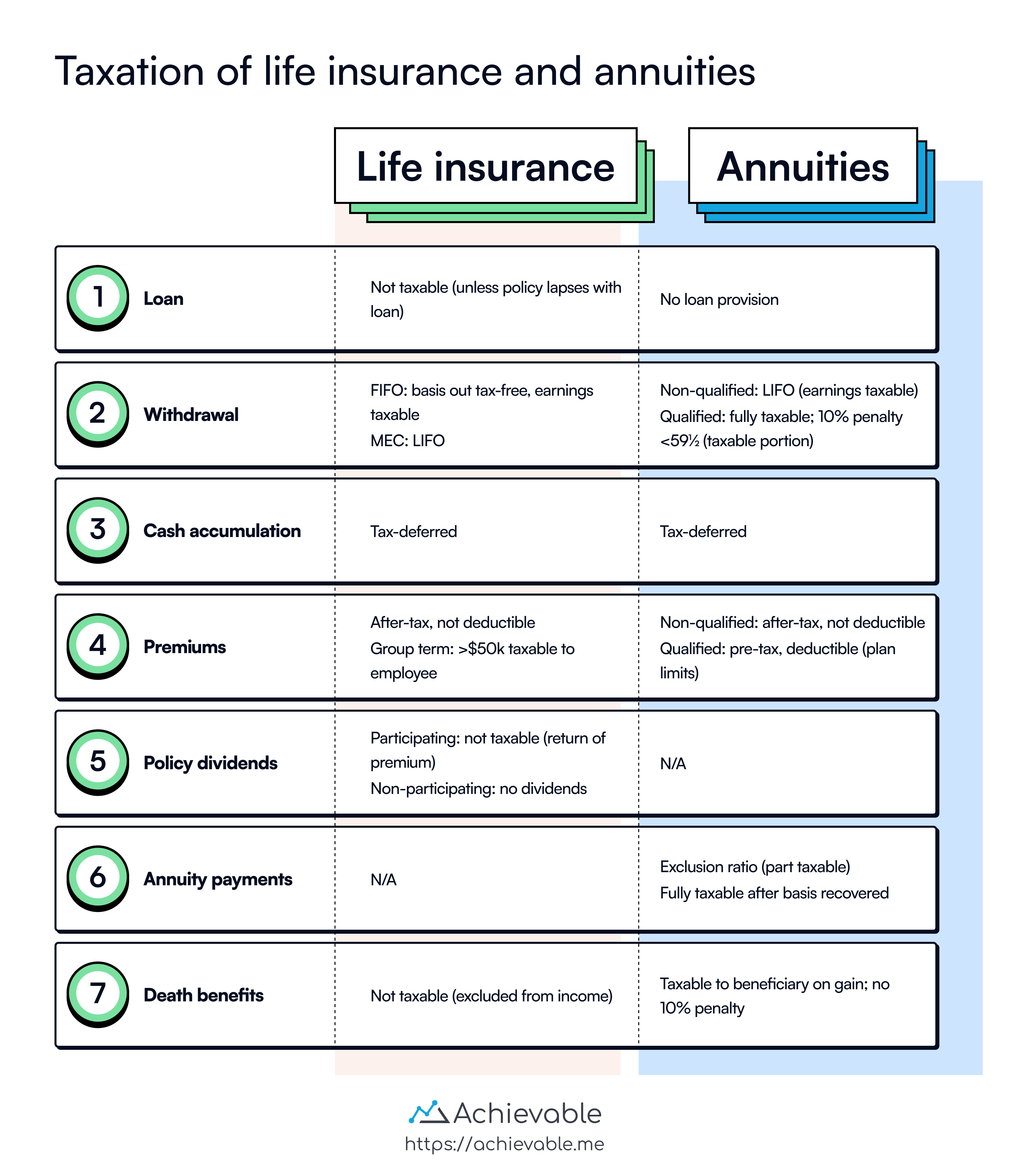
Transferring an annuity between spouses is a sensitive process. Under Internal Revenue Code (IRC) Section 1041, transfers of property between spouses "incident to divorce" are generally non-taxable. However, if the annuity is a "qualified" annuity (meaning it is part of a retirement plan like a 403(b) or an IRA), it must be transferred via a Qualified Domestic Relations Order (QDRO) or a specific "transfer incident to divorce" instruction to avoid being hit with immediate income tax and a 10% early withdrawal penalty.
Tax Implications and Pitfalls
Failure to account for taxes can turn a seemingly equal 50/50 split into a 40/60 split in favor of the spouse who receives "tax-free" assets.
The 1035 Exchange
In some cases, a spouse may receive a portion of an annuity and wish to move it to a different insurance company. A Section 1035 exchange allows for the tax-free transfer of funds from one annuity contract to another. It is critical that the funds move directly from one company to the other; if the spouse receives a check, the IRS may view it as a taxable distribution.
Cost Basis Considerations
When dividing an annuity, the "cost basis" (the amount of after-tax money originally invested) is usually divided proportionally. The spouse receiving the asset will eventually owe income tax on the "earnings" portion of the annuity when payments begin. Attorneys must calculate the deferred tax liability when determining the true value of the annuity during negotiations.
Comparison of Life Insurance and Annuities in Divorce
The following table outlines the primary differences in how these two financial vehicles are handled during the dissolution of a marriage.
| Feature | Life Insurance (Permanent) | Annuities (Non-Qualified) |
|---|---|---|
| Primary Value | Cash Surrender Value + Death Benefit | Account Balance or Present Value of Income |
| Division Method | Buy-out, Surrender, or Security for Support | QDRO-like transfer or 1035 Exchange |
| Tax Status of Transfer | Generally tax-free under IRC §1041 | Generally tax-free under IRC §1041 |
| Beneficiary Issues | Often mandated by court to secure alimony | Usually changed to reflect new ownership |
| Surrender Charges | Can significantly reduce net value | Often high in early years of the contract |
| Post-Divorce Use | Risk management and estate planning | Retirement income and tax-deferred growth |
Practical Steps for Managing Beneficiaries
One of the most common post-divorce legal battles involves the "forgotten beneficiary." If a spouse is listed as a beneficiary on a life insurance policy and the owner dies without changing the designation, the ex-spouse may still receive the payout, even if the divorce decree stated otherwise.
Revocation-on-Divorce Statutes
Many states have enacted revocation-on-divorce laws. These statutes automatically revoke a spouse’s status as a beneficiary upon the finalization of a divorce. However, these laws do not apply to all policies—specifically those governed by federal law, such as ERISA-mandated employer-provided life insurance. In those cases, the written beneficiary designation on file with the plan administrator almost always overrides state law and even the divorce decree.
Irrevocable Beneficiary Designations
If the court orders one spouse to maintain life insurance to secure child support, the other spouse should request to be named as an irrevocable beneficiary. This prevents the policy owner from changing the beneficiary or taking out a policy loan against the cash value without the other spouse's written consent.
Frequently Asked Questions
Can I be forced to keep my ex-spouse on my life insurance policy?
Yes. If you have an obligation to pay alimony or child support, a judge may order you to maintain a life insurance policy with your ex-spouse or a trustee for your children as the beneficiary. This serves as a "security interest" to replace the lost income should you pass away before your support obligations are met.
What happens if my spouse stops paying the premiums on a court-ordered policy?
This is a violation of the court order. To prevent the policy from lapsing, the decree should include a provision allowing the recipient spouse to pay the premiums and then seek reimbursement from the owner, or have the support amount increased to cover the cost of a new policy.
Is an annuity divided the same way as a 401(k)?
Not exactly. While a 401(k) always requires a QDRO, a non-qualified annuity (purchased with after-tax dollars outside of a retirement plan) is divided through a change of ownership form or a 1035 exchange. However, a "qualified" annuity within a retirement plan does require a QDRO.
How do we value an annuity that is already in "pay-out" status?
Valuing an immediate annuity requires an actuary. They look at the monthly payment, the projected lifespan of the annuitant, and the "discount rate" to determine what a lump sum today would be worth compared to those future payments. This "present value" is the number used for asset division.
Can we split a life insurance policy into two?
While technically possible with some "survivorship" or "second-to-die" policies, most standard individual policies cannot be split. The typical solution is for one spouse to take over the policy and the other to purchase a new, individual policy, with the cash value of the original policy being equalized through other assets.
Final Recommendations
When dealing with life insurance and annuities in a divorce, the margin for error is slim. In 2026, with the increasing complexity of hybrid financial products, simple "50/50" math is rarely sufficient.
Individuals should:
- Obtain the "In-Force Illustration": Request this from the insurance company to see the actual projected values, not just the current balance.
- Verify ERISA Status: Determine if the policy is employer-provided (ERISA) or privately owned, as this changes which laws govern beneficiary changes.
- Consult a Tax Professional: Ensure that any transfer of annuity ownership follows IRC Section 1041 or Section 1035 protocols to avoid an unnecessary tax bill.
- Update All Designations: Immediately upon the finalization of the divorce, update all beneficiary forms for any policies you retain, unless the court has ordered otherwise.
Image Gallery