Why the Angel in Acanthamoeba Keratitis Matters: Clinical Significance and Diagnostic Urgency
In Acanthamoeba keratitis, the "angel"—specifically the pathognomonic ring-shaped stromal infiltrate—matters because it serves as a critical clinical marker for advanced infection. Its presence often confirms the diagnosis but also sig...
In Acanthamoeba keratitis, the "angel"—specifically the pathognomonic ring-shaped stromal infiltrate—matters because it serves as a critical clinical marker for advanced infection. Its presence often confirms the diagnosis but also signals a deeper, more aggressive immune response that necessitates immediate, intensive biocidal therapy to prevent permanent vision loss.
Contents
Understanding Acanthamoeba Keratitis (AK)
Acanthamoeba keratitis (AK) is a rare but devastating corneal infection caused by ubiquitous, free-living amoebae found in soil, dust, and water. While the incidence is relatively low compared to bacterial keratitis, the morbidity associated with AK is disproportionately high. As of 2026, the primary risk factor remains contact lens wear, particularly involving poor hygiene practices such as using tap water for lens care or "topping off" disinfectant solutions.
The infection is notoriously difficult to treat because the organism exists in two stages: the active, reproducing trophozoite and the highly resilient, dormant cyst. The "angel" or ring infiltrate is a clinical manifestation of the body’s attempt to sequester these organisms within the corneal layers. Understanding why this specific shape forms and what it represents is the difference between saving a patient's sight and facing a corneal transplant.
The "Angel" Phenomenon: Defining the Ring Infiltrate
The "angel" in AK refers to the Wessely ring, a circular or semi-circular white infiltrate in the corneal stroma. In some clinical circles, the way these infiltrates spread or mirror each other in imaging has been described as "angel-wing" patterns. However, its importance lies not in its shape, but in its composition.
Pathophysiology of the Wessely Ring
The ring is not composed of the amoebae themselves. Instead, it is an immunological "battleground." It consists of inflammatory cells—primarily polymorphonuclear leukocytes (neutrophils)—precipitating in the stroma where the host's antibodies meet the antigens released by the Acanthamoeba.
When the Acanthamoeba trophozoites release cytolytic enzymes to break down corneal tissue, the immune system responds by surrounding the site of infection. This ring acts as a visible marker of a high-intensity immune conflict. If the "angel" has appeared, it indicates that the infection is no longer superficial; the parasites have likely invaded the deeper stromal layers of the cornea.
Why the Appearance of the "Angel" Matters for Prognosis
The timing of the ring's appearance is a double-edged sword for clinicians and patients alike. On one hand, it provides a "smoking gun" for a diagnosis that is notoriously elusive. On the other, it usually appears several weeks into the infection, meaning the window for early, highly effective intervention may have already closed.
- Diagnostic Confirmation: In the early stages (days 1–14), AK often mimics Herpes Simplex Virus (HSV) keratitis, presenting with dendritic-like epithelial lesions. Many patients are misdiagnosed and treated with topical steroids or anti-virals, which can actually worsen AK. The appearance of the ring infiltrate (the "angel") helps rule out many mimics, pointing directly toward Acanthamoeba or occasionally fungal pathogens.
- Assessment of Severity: The density and diameter of the ring provide a visual gauge of the severity of the inflammatory response. A complete 360-degree ring often correlates with higher pain levels and a poorer visual prognosis.
- Treatment Calibration: Once the ring is present, clinicians must be more aggressive. The presence of stromal involvement means that simple epithelial debridement will not suffice; the patient requires deep-penetrating biguanides and diamidines.
The Pain-Clinical Sign Paradox
One of the most significant reasons the "angel" matters is how it relates to the patient's symptoms. A hallmark of Acanthamoeba keratitis is pain out of proportion to clinical findings. In the early stages, a patient may be in excruciating pain while the eye looks relatively clear to the naked eye.
By the time the ring infiltrate forms, the pain may actually plateau or change in quality. This is because the amoebae have a predilection for migrating along corneal nerves—a process known as radial keratoneuritis. The "angel" signifies that the infection has moved from the nerves into the general stroma. Understanding this progression is vital for managing patient expectations and ensuring they do not mistake a change in pain type for a sign of recovery.
Differential Diagnosis: Distinguishing AK from Mimics
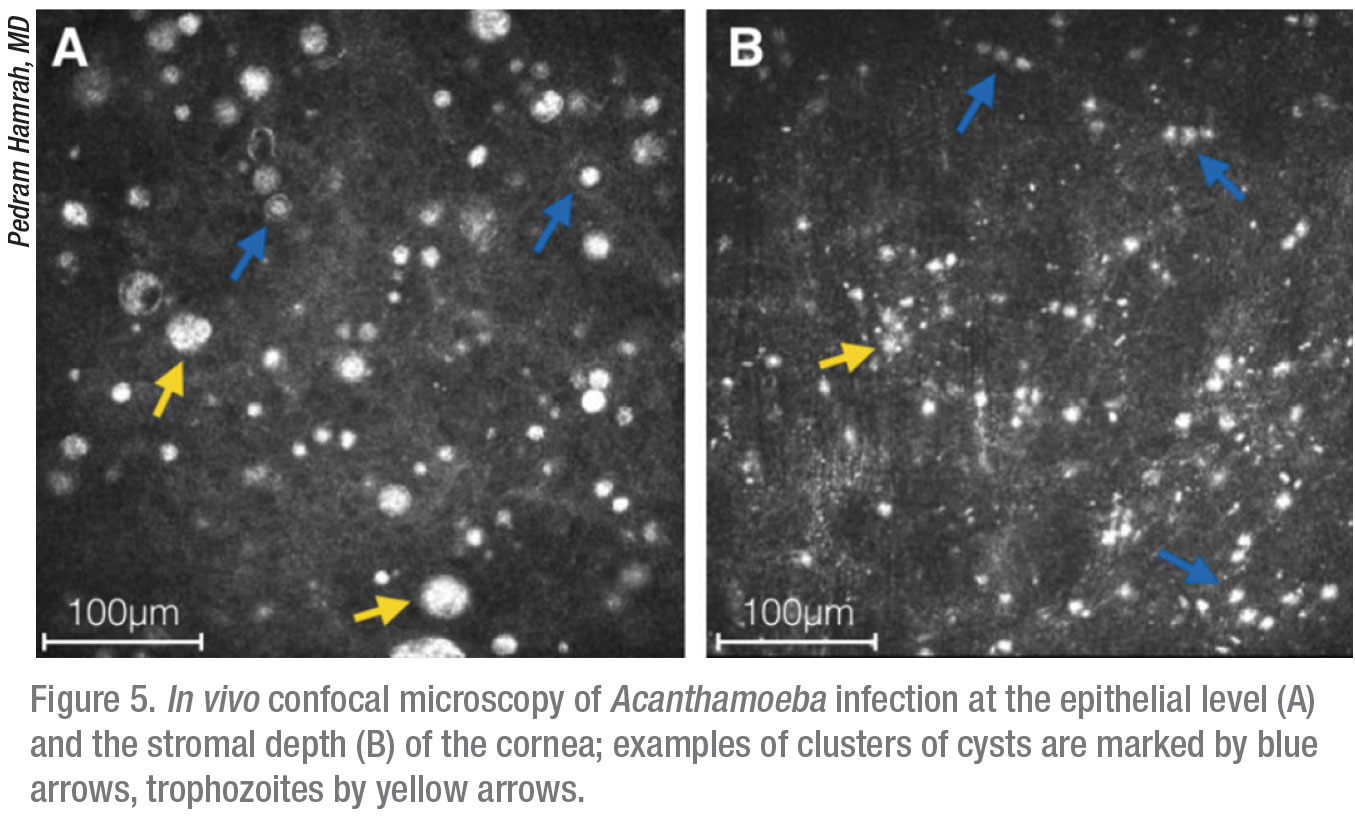
Because the "angel" ring can occasionally be confused with other conditions, a systematic approach to differential diagnosis is required. As of 2026, clinical guidelines emphasize the use of In-Vivo Confocal Microscopy (IVCM) alongside visual inspection to confirm the presence of cysts within the ring.
| Feature | Acanthamoeba Keratitis (AK) | Herpes Simplex Keratitis (HSV) | Fungal Keratitis |
|---|---|---|---|
| Primary Risk Factor | Contact lenses/Water exposure | Prior history of cold sores | Trauma with organic matter |
| Pain Level | Severe, excruciating | Mild to moderate (decreased sensitivity) | Moderate |
| Ring Infiltrate | Common (Wessely Ring) | Rare | Possible (Immune ring) |
| Early Appearance | Pseudo-dendrites | True dendrites (terminal bulbs) | Feathery borders |
| Response to Steroids | Significant worsening | May improve initially | Rapid worsening |
| Growth Rate | Slow and progressive | Variable | Often rapid |
Current Treatment Protocols (2026)
The management of AK following the appearance of a ring infiltrate is a medical marathon. Because the cysts are resistant to most standard antibiotics, specific biocidal agents must be used.
Biguanides
Polyhexamethylene biguanide (PHMB) 0.02% or chlorhexidine 0.02% remain the gold standard. These agents damage the cytoplasmic membrane of the trophozoites and can penetrate the cyst wall over long periods.
Diamidines
Propamidine isethionate (Brolene) or hexamidine are often used in combination with biguanides. This "dual-therapy" approach is designed to attack the organism from multiple pathways, reducing the likelihood of resistance.
The Role of Steroids
One of the most debated topics in 2026 is the timing of topical corticosteroids. While steroids can reduce the inflammation that forms the "angel" ring, they can also trigger the transformation of dormant cysts back into active trophozoites. Most specialists recommend delaying steroids until the infection is "quiet" and the amoebae have been suppressed by biocides for several weeks.
Practical Steps for Contact Lens Wearers
Prevention remains the only 100% effective cure for Acanthamoeba keratitis. To avoid the formation of the "angel" in your own cornea, strictly adhere to the following safety protocols:
- No Tap Water: Never rinse your lenses or lens cases with tap water. Acanthamoeba is commonly found in domestic plumbing.
- Dry Your Case: After putting in your lenses, dump the old solution, rinse the case with fresh disinfecting solution, and leave it open to air-dry upside down.
- Discard Schedule: Replace your contact lens case every month. Cysts can hide in the microscopic scratches of an old case.
- The "No Swimming" Rule: Do not wear contact lenses in hot tubs, swimming pools, or lakes. If you must wear them, use airtight goggles and discard the lenses immediately after getting out of the water.
Prognosis and Long-Term Outcomes
When the "angel" ring is detected early and treated aggressively, many patients can achieve a full recovery, though it may take 6 to 12 months of daily eye drops. However, if the ring leads to significant central scarring, a penetrating keratoplasty (corneal transplant) may be necessary.
Even in 2026, the success rate of corneal transplants for AK is lower than for other conditions because the amoebic cysts can remain dormant in the host's peripheral tissue and "re-infect" the new graft. This is why the clinical marker of the ring matters—it serves as a warning of the long road ahead.
FAQ
Can I get Acanthamoeba keratitis if I don't wear contact lenses?
Yes, though it is much less common. Non-contact lens wearers usually contract AK through significant corneal trauma involving soil or contaminated water. However, roughly 85-90% of cases reported through 2026 are associated with contact lens use.
Is the "angel" ring permanent?
If the infection is caught early, the inflammatory infiltrate can resolve with minimal scarring. However, in many cases, the "angel" leaves behind a permanent opacification (scar) in the cornea which may require surgery or specialized rigid gas permeable (RGP) lenses to restore vision.
How do I know if my eye pain is AK or just a dry eye?
AK pain is typically described as deep, aching, and relentless, often preventing sleep. Dry eye usually feels like grittiness or burning that improves with artificial tears. If you wear contact lenses and experience pain that feels "behind the eye" or is highly sensitive to light, seek an urgent ophthalmology consultation.
Why is it so hard to diagnose AK?
Because Acanthamoeba is a slow-growing organism, traditional lab cultures can take up to 14 days to show results. Furthermore, the early symptoms mimic common viral infections. Many clinics now use PCR (Polymerase Chain Reaction) testing to speed up the process, but the clinical observation of the ring infiltrate remains a vital piece of the puzzle.
Does the ring infiltrate mean I am going blind?
Not necessarily, but it is a serious sign. It indicates a significant infection that requires immediate specialist care. With modern 2026 protocols, many patients preserve functional vision, but the outcome depends heavily on how quickly the "angel" is recognized and treated.
Final Recommendation
If you are a contact lens wearer experiencing persistent eye pain, redness, or blurred vision, do not wait for the "angel" to appear. Early diagnosis is the single most important factor in a positive outcome. Request an evaluation that includes a slit-lamp exam and, if possible, In-Vivo Confocal Microscopy. If a ring infiltrate is already present, prepare for a long-term treatment plan and strictly adhere to your prescribed drop regimen, as skipping even a few doses can allow the resilient cysts to regroup.
Image Gallery