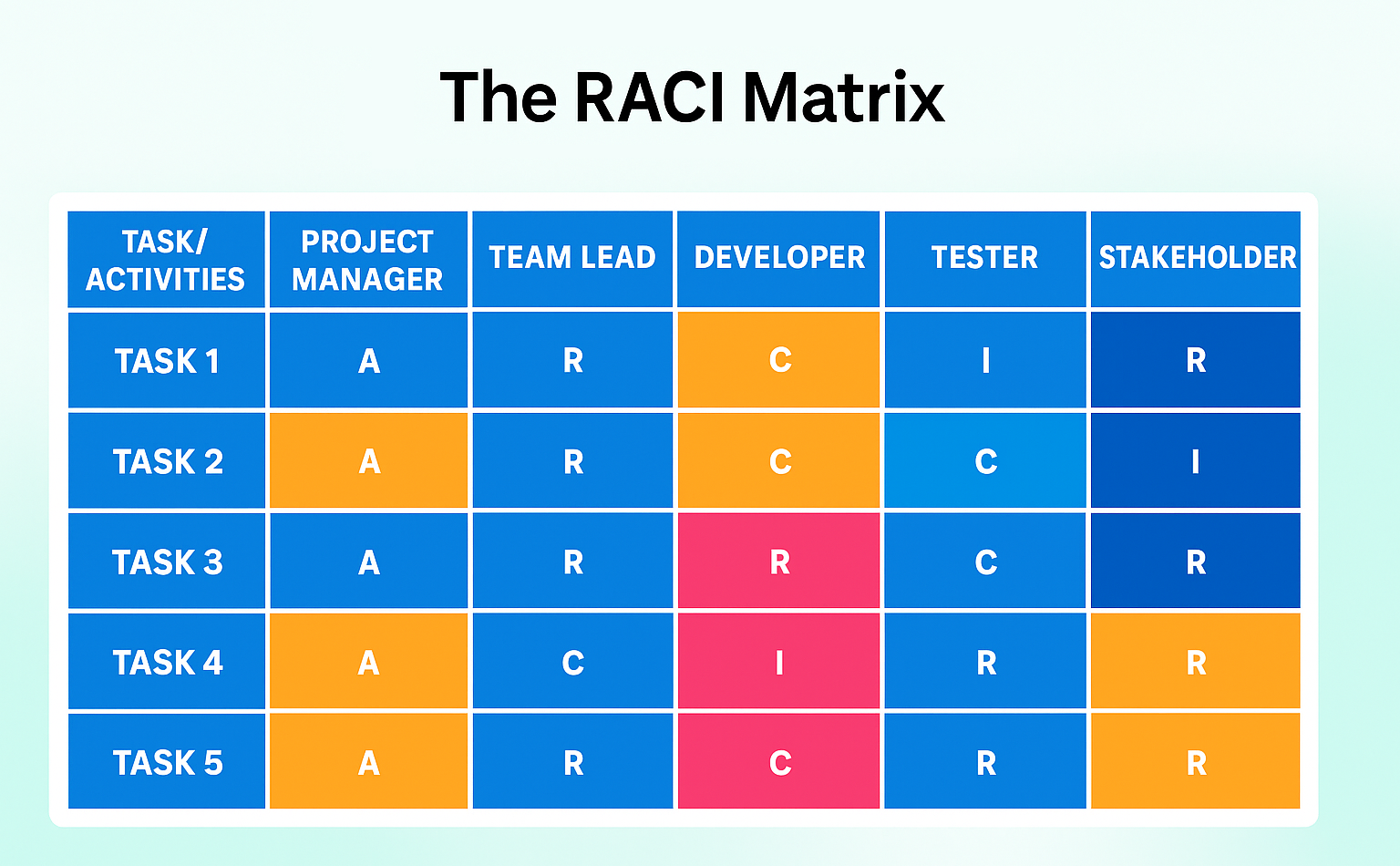
RACI Definition of Roles: A Comprehensive Guide to Accountability and Governance
A RACI model defines project and operational roles across four distinct levels of involvement: Responsible, Accountable, Consulted, and Informed. By mapping specific deliverables to these four categories, teams establish clear ownershi...
A RACI model defines project and operational roles across four distinct levels of involvement: Responsible, Accountable, Consulted, and Informed. By mapping specific deliverables to these four categories, teams establish clear ownership, eliminate duplicated effort, streamline decision-making authority, and ensure structured communication across cross-functional enterprise initiatives.
Contents
What Is the RACI Framework?
The RACI framework—also known as a Responsibility Assignment Matrix (RAM)—is a foundational tool in enterprise governance, business process management, and project management. As organizations grow in complexity, cross-functional collaboration frequently suffers from ambiguous boundaries. Teams experience duplicated effort, missed handoffs, delayed sign-offs, and unclear decision-making rights. RACI solves this by translating complex organizational hierarchies into a clean matrix of tasks mapped directly to operational roles.
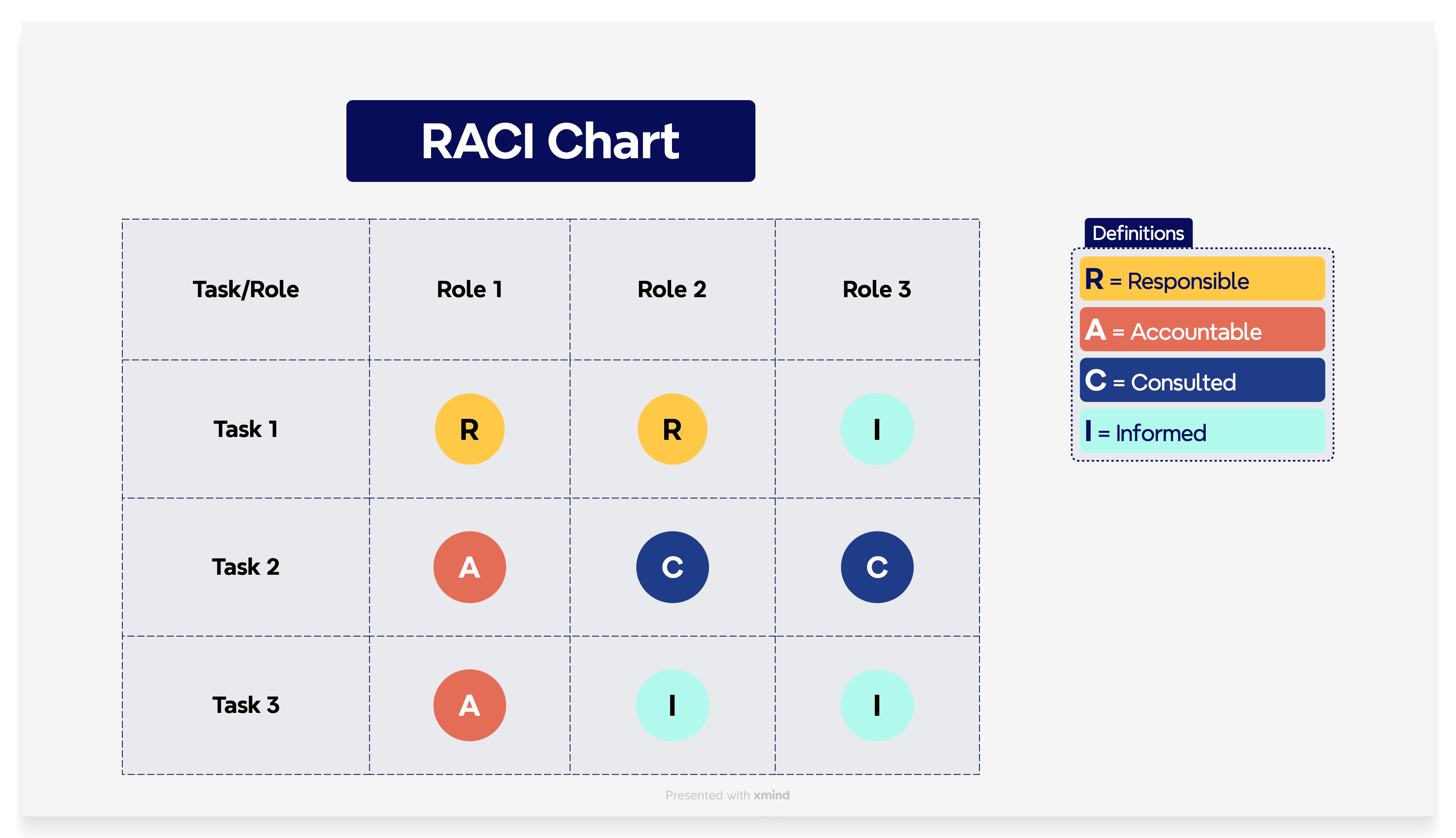
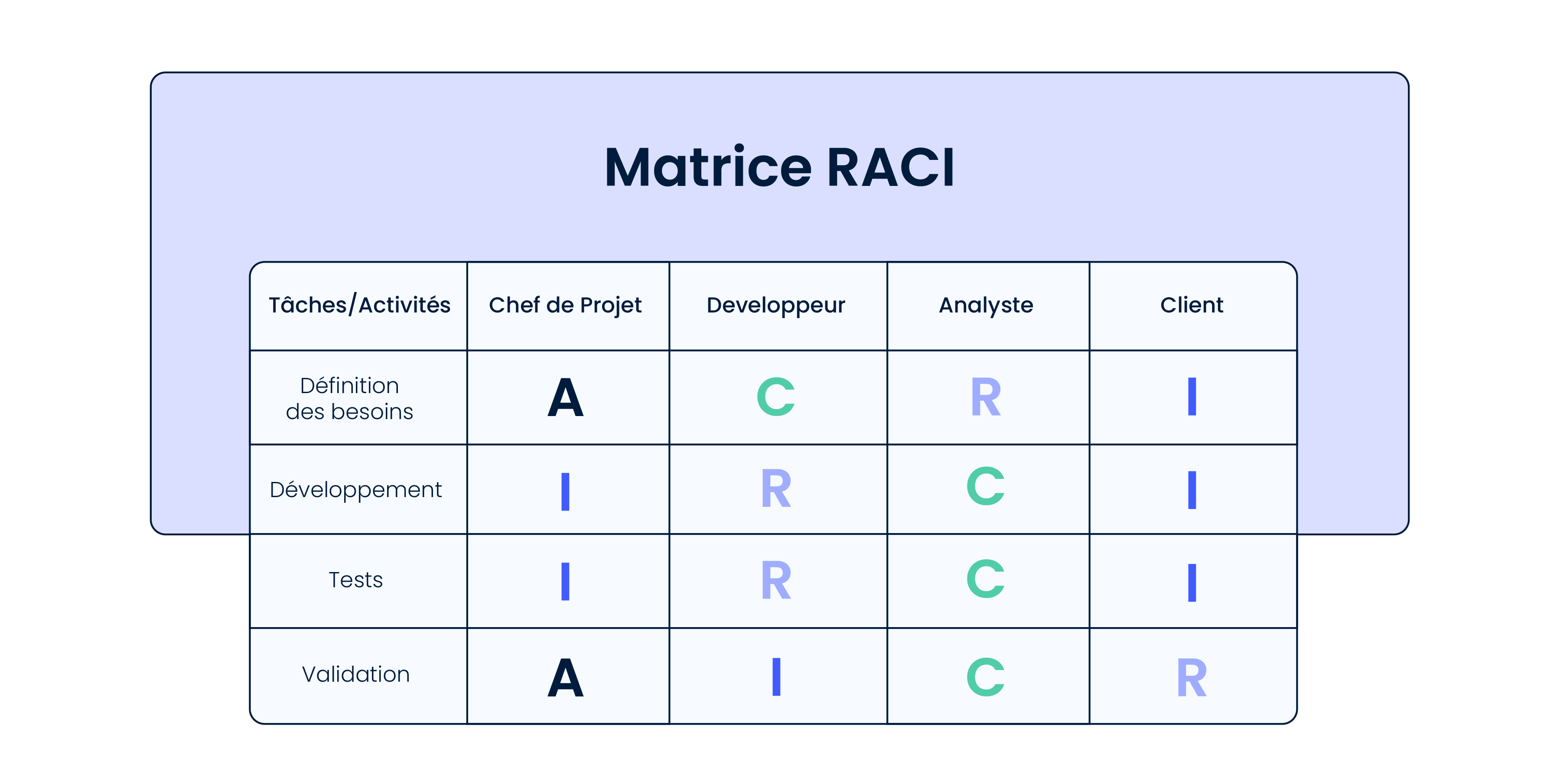
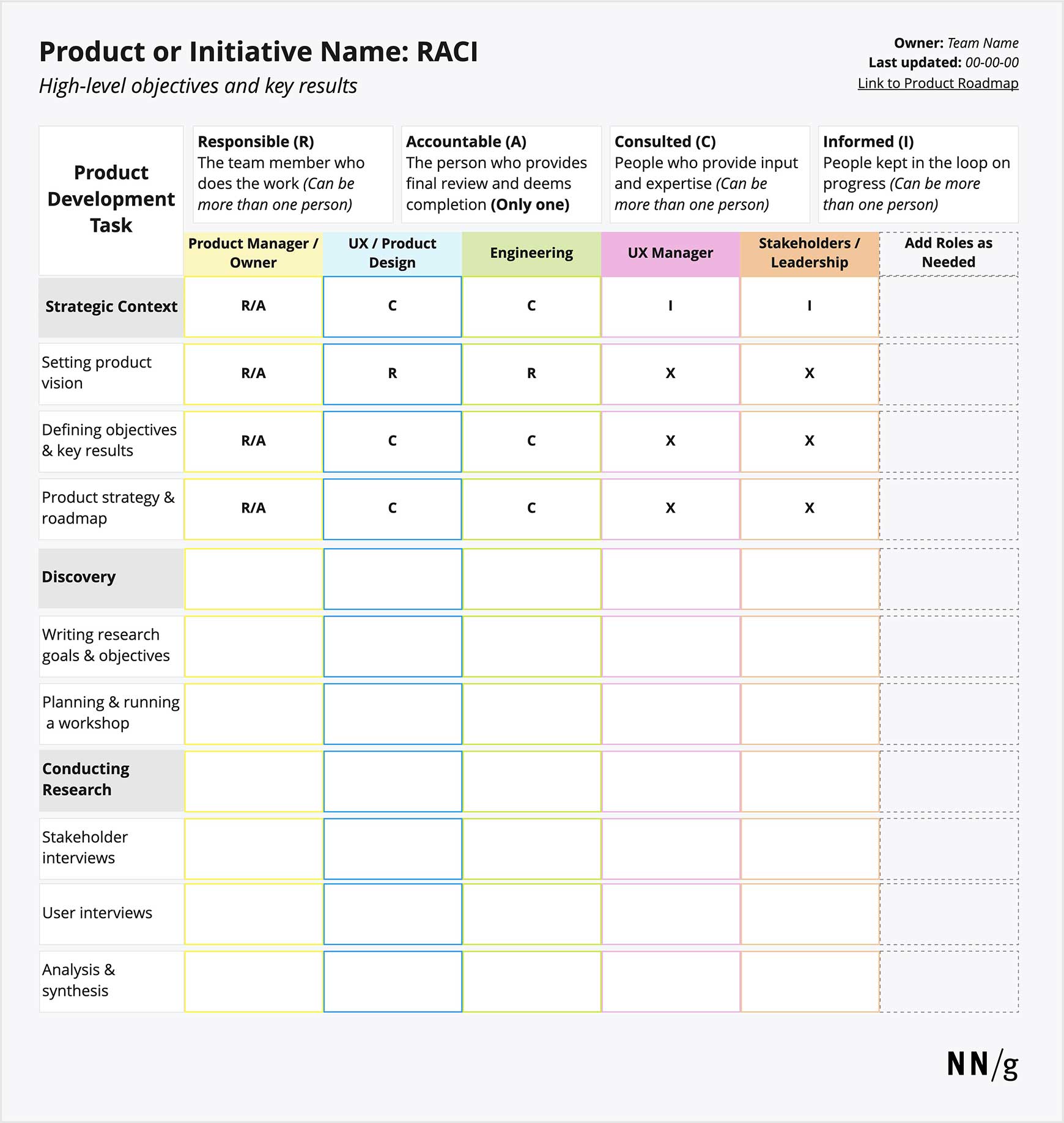
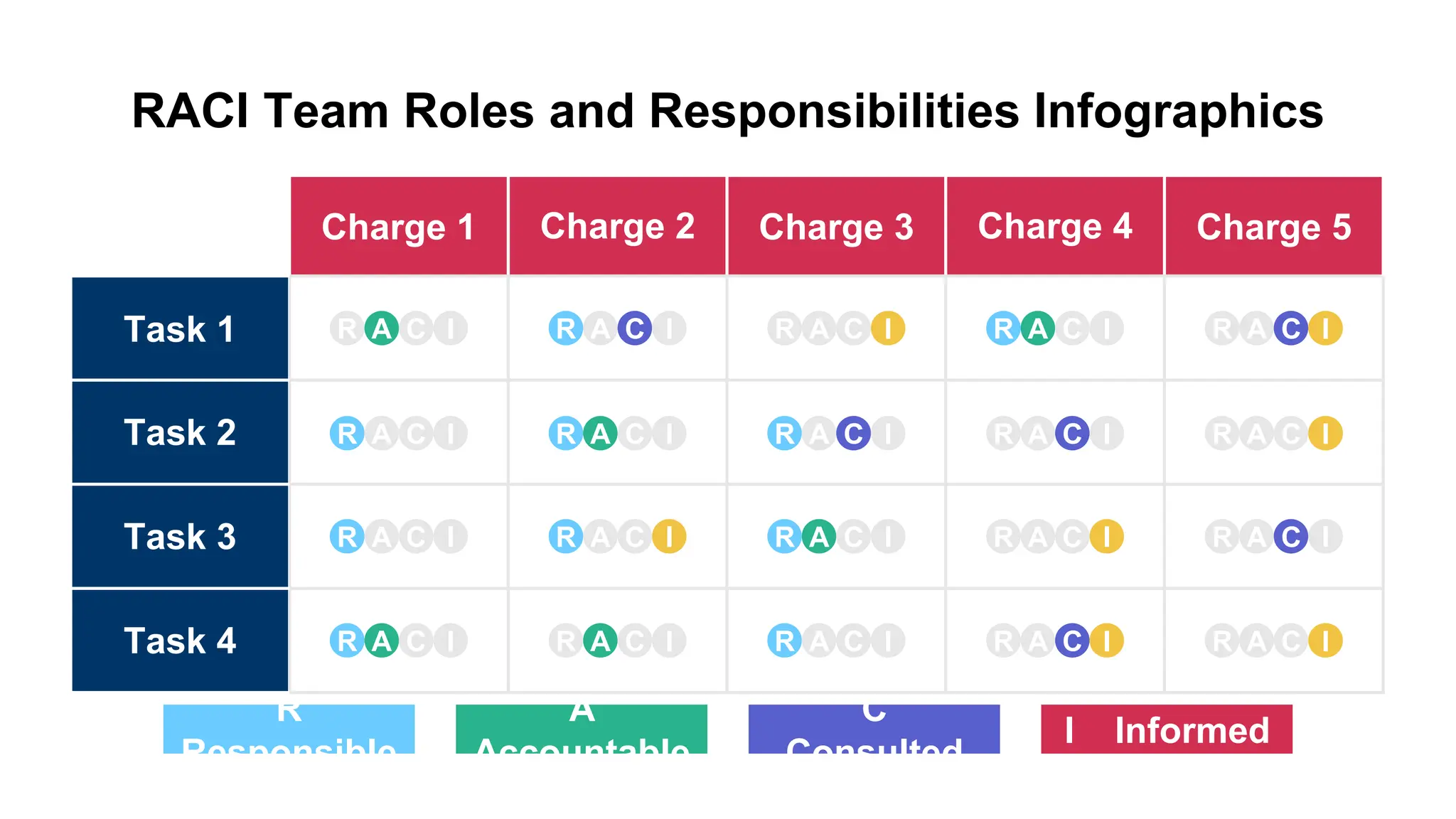
At its core, a RACI matrix visually aligns project activities or process steps (listed along the vertical Y-axis) against team roles or specific job functions (listed along the horizontal X-axis). At each intersection, a single letter—R, A, C, or I—defines the exact level of involvement expected from that role for that task.
Implementing a RACI model prevents organizational drift by forcing management to assign operational execution (Responsible) separately from final governance and approval (Accountable), while formalizing two-way subject matter feedback (Consulted) and basic project visibility (Informed).
Complete Breakdown of RACI Roles
To apply the RACI model effectively, project leaders and enterprise executives must understand the precise operational definition, duties, and boundaries of each designated role.
| RESPONSIBLE | ACCOUNTABLE | CONSULTED | INFORMED |
|---|---|---|---|
| "The Doers"Completes task | "The Owner"Final approval & veto power (Max 1) | "The Advisors"Two-way feedback before decisions | Keep Updated1-way |
1. Responsible (R) – The Execution Owners
The Responsible designation represents the "doers" of the work. This role includes the individuals, team members, or specialized departments directly tasked with executing activities, creating deliverables, or completing operational steps.
- Primary Duty: Completing assigned work according to established quality standards, technical requirements, and schedules.
- Key Characteristics: A single task can have multiple individuals or roles designated as Responsible, particularly when work requires pair programming, collaborative drafting, or multi-stage technical labor.
- Operational Reality: While those marked as Responsible perform the labor, they operate under the direction and final decision-making authority of the Accountable owner.
2. Accountable (A) – The Ultimate Decision Maker
The Accountable designation indicates the single individual who holds ultimate ownership of the task, deliverable, or process outcome. This person possesses approval authority, veto power, and direct stewardship over the quality and completion of the work.
- Primary Duty: Reviewing and approving the work performed by those marked Responsible, ensuring budget and strategy compliance, and taking organizational ownership of success or failure.
- The Golden Rule of RACI: There must be exactly ONE Accountable person assigned to each task. Assigning multiple Accountable roles dilutes ownership, leads to deadlocked approvals, and reintroduces organizational confusion.
- Operational Reality: The Accountable party does not necessarily execute the work day-to-day. However, if a deliverable fails, is delayed, or breaches compliance standards, the Accountable individual answers to executive leadership.
3. Consulted (C) – Two-Way Communication Experts
The Consulted role consists of subject matter experts (SMEs), regulatory specialists, technical advisors, or impacted department leads whose input is actively solicited before work is finalized or decisions are executed.
- Primary Duty: Providing technical insight, legal review, architectural guidance, or operational feedback to the Responsible team members during the drafting or build phase.
- Key Characteristics: Communication with Consulted roles is strictly two-way. Information is requested, analyzed, and integrated into the project artifacts prior to final submission.
- Operational Reality: Consultation should be strategic and deliberate. Including too many Consulted roles leads to "paralysis by analysis," where project timelines stall due to conflicting expert opinions.
4. Informed (I) – One-Way Updates and Stakeholders
The Informed role includes stakeholders, executive sponsors, downstream operational teams, or external partners who need regular visibility into project progress, milestones, or completion status, but do not contribute directly to execution or decision-making.
- Primary Duty: Receiving updates, reviewing published status reports, and preparing their respective departments for upcoming operational handoffs.
- Key Characteristics: Communication with Informed roles is strictly one-way (broadcast or status reporting). They do not hold review, voting, or approval rights over the deliverable.
- Operational Reality: Assigning stakeholders to Informed status protects project velocity by preventing non-essential personnel from injecting unnecessary revisions late in the development cycle.
Comparing RACI Roles: Key Differences and Operational Rules
Understanding how these four roles interact requires contrasting their communication flows, authority limits, and numerical constraints within a standard matrix.
| RACI Role | Key Function | Communication Direction | Max Allowed Per Task | Primary Risk If Mismanaged |
|---|---|---|---|---|
| Responsible (R) | Completes the work and builds the deliverable | Internal team collaboration | One or more | Work stalls due to lack of capacity or direction |
| Accountable (A) | Signs off, holds final veto, owns outcome | Upward governance and final decisioning | Strictly ONE | Shared accountability creates consensus deadlocks |
| Consulted (C) | Provides expert opinion and functional input | Two-way active consultation | Selective (1–3 recommended) | Excessive consultation leads to decision paralysis |
| Informed (I) | Tracks progress and receives status updates | One-way notification | Unlimited as needed | Over-informing leads to unwanted review scope creep |
Key Governance Rules for Matrix Health
- The Single "A" Rule: Every row in a RACI matrix must contain exactly one "A". If no one is Accountable, no one owns the outcome. If two people are Accountable, conflicts remain unresolved.
- Every Task Needs an "R": A task cannot execute without at least one Responsible role. If an "A" has no "R", the Accountable person must perform the work themselves.
- Minimize "C" Saturation: Limit Consulted designations to essential SMEs. If half the organization is marked as Consulted for a routine deliverable, project execution velocity drops significantly.
- Distinguish "C" from "I": If a stakeholder only needs to know when a system goes live, mark them as I, not C. Reserve C exclusively for those whose technical input alters the deliverable's output.
Variations of the RACI Framework
While standard RACI works for most governance models, enterprises often adopt expanded variations to address complex organization structures.
- RACI VARIANTS
- RASCI
- Adds: Support (S)
- DACI
- Driver
- Approver
- Contributor
- Informed
- CARS
- Communicate
- Approve
- Responsible
- Support
- RASCI
RASCI (Introducing Support)
The RASCI variation adds a Support (S) role to differentiate between those actively producing the main deliverable (Responsible) and secondary team members providing resources, administrative assistance, or infrastructure assistance to help complete the work.
- Responsible (R): Main task execution owner.
- Accountable (A): Ultimate sign-off.
- Support (S): Assists the Responsible party with resources, tools, or supporting labor.
- Consulted (C): Two-way expert advice.
- Informed (I): One-way status updates.
DACI (Decision-Centric Framework)
Popularized in modern product management and software engineering, DACI shifts focus specifically onto decision velocity:
- Driver (D): The single individual driving the decision-making process forward (equivalent to R/A hybrid).
- Approver (A): The decision maker who gives final sign-off (equivalent to A).
- Contributor (C): Subject matter experts who provide input (equivalent to C).
- Informed (I): Stakeholders notified of the final decision.
CARS (Action-Oriented Alternative)
The CARS model reorganizes tasks around operational execution: Communicate (equivalent to C/I), Approve (equivalent to A), Responsible (equivalent to R), and Support (equivalent to S).
Step-by-Step: How to Define and Implement RACI Roles
Building a RACI matrix requires structured facilitation to ensure all stakeholders agree on operational boundaries before project execution begins.
- Step 1: Identify Tasks & Deliverables
- Step 2: Define Roles & Roles Matrix
- Step 3: Map RACI Letters (Apply 1-A Rule)
- Step 4: Conduct Stakeholder Review
- Step 5: Integrate into Active Workflows
Step 1: Identify Tasks and High-Level Deliverables
Avoid listing micro-tasks or daily administrative activities. Focus the vertical axis of your matrix on major milestones, key architectural deliverables, regulatory sign-offs, and critical decision points.
- Example: Instead of listing "Write code line 40," list "Complete System Integration Testing."
Step 2: Define the Roles Across the Top Axis
Map roles by job title or functional domain, not individual personal names, to preserve matrix validity during personnel turnover.
- Examples: Enterprise Architect, Lead Developer, Compliance Manager, Chief Security Officer, Product Manager.
Step 3: Populate the Matrix Intersections
Work line-by-line through each task, populating each intersection with R, A, C, or I based on agreed responsibilities.
- Ensure every row has exactly one A and at least one R.
- Verify that individual roles are not overloaded with too many "R" assignments across multiple simultaneous workstreams.
Step 4: Conduct Stakeholder Review and Alignment
Gather role leads to review the drafted matrix. Resolve ambiguity immediately. If two department heads claim "A" status for a shared deliverable, executive management must negotiate and designate a single Accountable owner.
Step 5: Integrate into Workflow Tools and Governance Schedules
A RACI matrix stored in an unread file folder provides zero operational value. Embed your RACI assignments into active enterprise project management tools (such as Jira, Asana, or ServiceNow), project charters, and weekly status meeting agendas.
Example RACI Matrix: Enterprise Software Deployment
To understand how RACI definitions operate in practice, consider an enterprise software deployment project involving cross-functional teams:
| Project Phase / Key Deliverable | Product Manager | Lead Architect | DevOps Engineer | Cybersecurity Lead | Executive Sponsor |
|---|---|---|---|---|---|
| Business Requirements Document (BRD) | A / R | C | I | C | I |
| Cloud Security & Compliance Architecture | C | R | C | A | I |
| Infrastructure Provisioning & Deployment | I | C | A / R | C | I |
| User Acceptance Testing (UAT) Sign-Off | A | C | I | I | I |
| Production Go-Live Authorizing Gate | C | C | R | C | A |
Note: In smaller tasks, a single role may hold combined A/R responsibility, meaning the same individual executes the work and holds ultimate sign-off accountability.
Common RACI Pitfalls and How to Avoid Them
Even seasoned enterprise managers encounter failure modes when implementing RACI frameworks. Recognizing these operational traps early protects team morale and project delivery schedules.
Pitfall 1: Multiple Accountable Roles (Shared Ownership)
When project leaders assign "A" to multiple stakeholders to keep everyone happy, no single person takes responsibility when deadlines slip.
- Fix: Enforce the single "A" rule strictly. Use executive escalation to choose one Accountable owner per row.
Pitfall 2: Confusing "Responsible" with "Accountable"
Teams often assume the person executing the work (R) is automatically the ultimate decision-maker (A). In complex enterprises, execution leads (R) frequently report to functional directors or product owners (A) who bear final regulatory and budget accountability.
- Fix: Clearly delineate operational labor (R) from governance sign-off (A) in team kickoff sessions.
Pitfall 3: "Consulted" Bloat
In risk-averse corporate cultures, managers often mark dozens of leaders as "Consulted" to avoid stepping on toes. This creates long feedback loops and constant re-work.
- Fix: Convert passive advisors from Consulted to Informed. Limit Consulted tags exclusively to subject matter experts whose technical sign-off is mandatory.
Pitfall 4: Treating RACI as a Static Artifact
Creating a RACI matrix during project initiation and failing to revisit it during scope changes leads to alignment drift.
- Fix: Re-examine RACI definitions during major scope changes, organizational restructuring, or stage-gate reviews.
Practical Recommendation and Next Steps
To successfully institute RACI role definitions across your team or enterprise unit, adopt a pragmatic, phased roll-out:
- Start Small: Select a single high-visibility project or cross-functional operational process that currently suffers from role confusion.
- Draft the Matrix Jointly: Facilitate a workshop with representation from all involved functional groups. Do not draft the matrix in isolation.
- Audit Against Rules: Perform a systematic check on every row: ensure exactly one "A" exists per task and verify that no single role is assigned more "R" tasks than their real capacity allows.
- Publish and Enforce: Upload the completed matrix to your project repository, incorporate role obligations into weekly standups, and empower "A" owners to make final decisions without unnecessary steering committee delays.
For further reading on governance and process standards, consult established frameworks provided by the Project Management Institute (PMI) and AXELOS PRINCE2 Standards.
Image Gallery