Life Insurance Resume Samples, Strategic Formats, and Career Guide
A successful life insurance resume must highlight active state licensing, measurable production metrics, product expertise, and regulatory compliance. Whether applying for sales, underwriting, or claims management, structuring your res...
A successful life insurance resume must highlight active state licensing, measurable production metrics, product expertise, and regulatory compliance. Whether applying for sales, underwriting, or claims management, structuring your resume to emphasize annual premium production, persistency rates, risk assessment capabilities, and applicant tracking system (ATS) keywords is essential to land interviews in the competitive financial services sector.
Contents
Strategic Resume Structure for Insurance Professionals
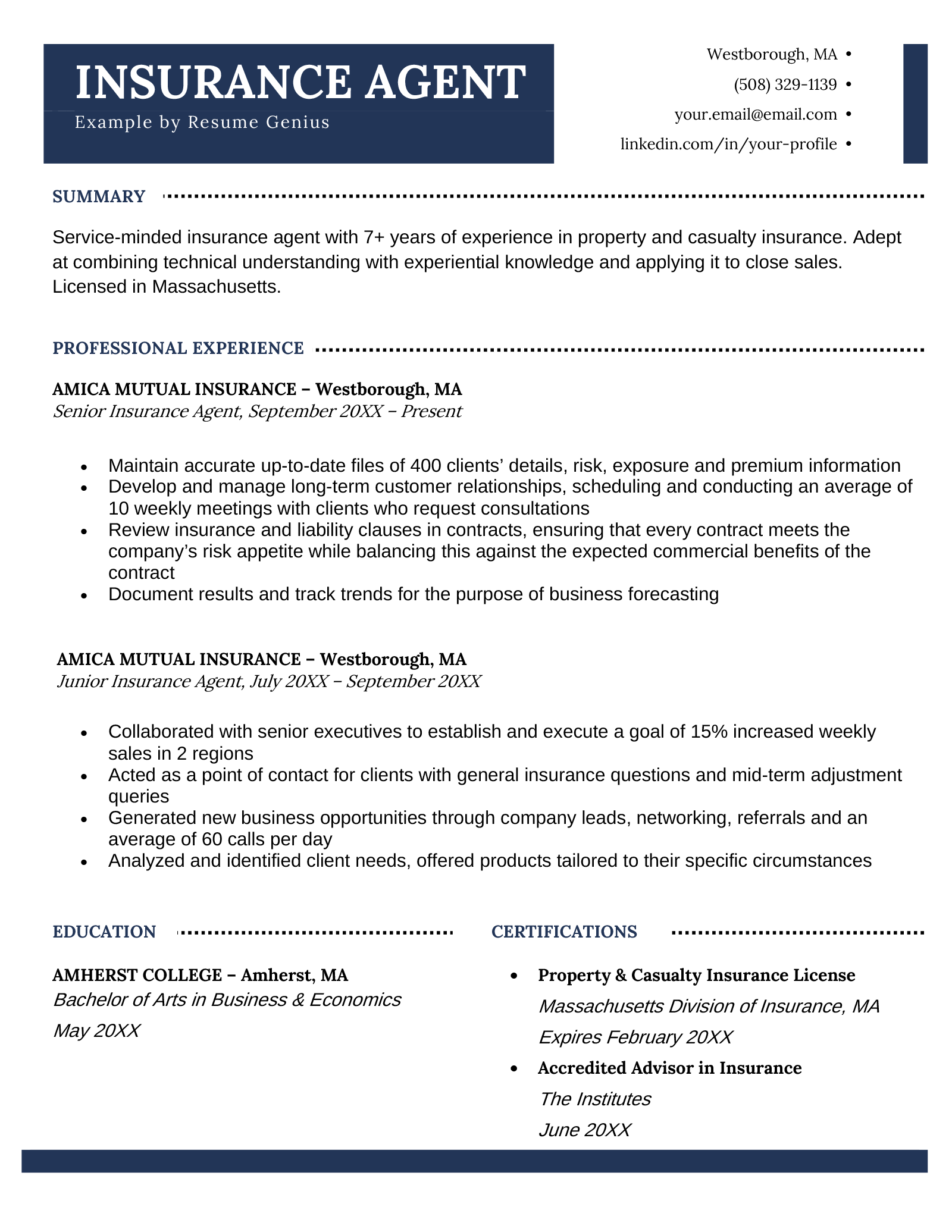
The insurance industry evaluates candidates based on verifiable performance, regulatory credentials, and technical product knowledge. Recruiters and hiring managers spend fewer than ten seconds on an initial resume review. Organizing your qualifications cleanly ensures your key metrics and credentials are immediately visible.
1. Professional Header & Licensing Identification
Place your contact information at the top, immediately followed by your primary state insurance license status. If you hold multiple non-resident licenses or FINRA registrations, note the total count or key states alongside your name or header.
JANE DOE, CLU® Dallas, TX | (555) 019-2831 | jane.doe@email.com | linkedin.com/in/janedoe-insurance Licenses: Texas Life, Accident & Health (NPRN: 18492042) | FINRA Series 6 & 63
2. Professional Summary
Avoid generic objective statements focusing on what you hope to gain from the job. Instead, write a three- to four-sentence executive summary that highlights your years of experience, primary specializations (e.g., term life, whole life, universal life, indexed universal life, annuities), key distribution channels (captive, independent, direct-to-consumer), and major metrics achievements.
3. Core Competencies & Skills Block
Include a dedicated bulleted grid of hard skills and industry-specific software tools. This section serves a dual purpose: helping recruiters quickly assess fit and passing automated keyword screeners in Applicant Tracking Systems (ATS).
4. Professional Experience
Structure work experience in reverse chronological order. Lead each bullet point with a strong action verb, followed by the context of your responsibilities and quantified results. Emphasize business volume, client retention, underwriter approval rates, or claims processing speed.
5. Licenses, Certifications, and Education
List formal academic degrees alongside industry-specific designations, such as the Chartered Life Underwriter (CLU®), Fellow, Life Management Institute (FLMI®), or Life Underwriter Training Council Fellow (LUTCF®). Include the granting organization and the year obtained.
Life Insurance Resume Samples by Role
Different career paths within life insurance require distinct positioning. Below are tailored resume samples and bullet point strategies for three major career paths: Sales Agents, Underwriters, and Claims Specialists.
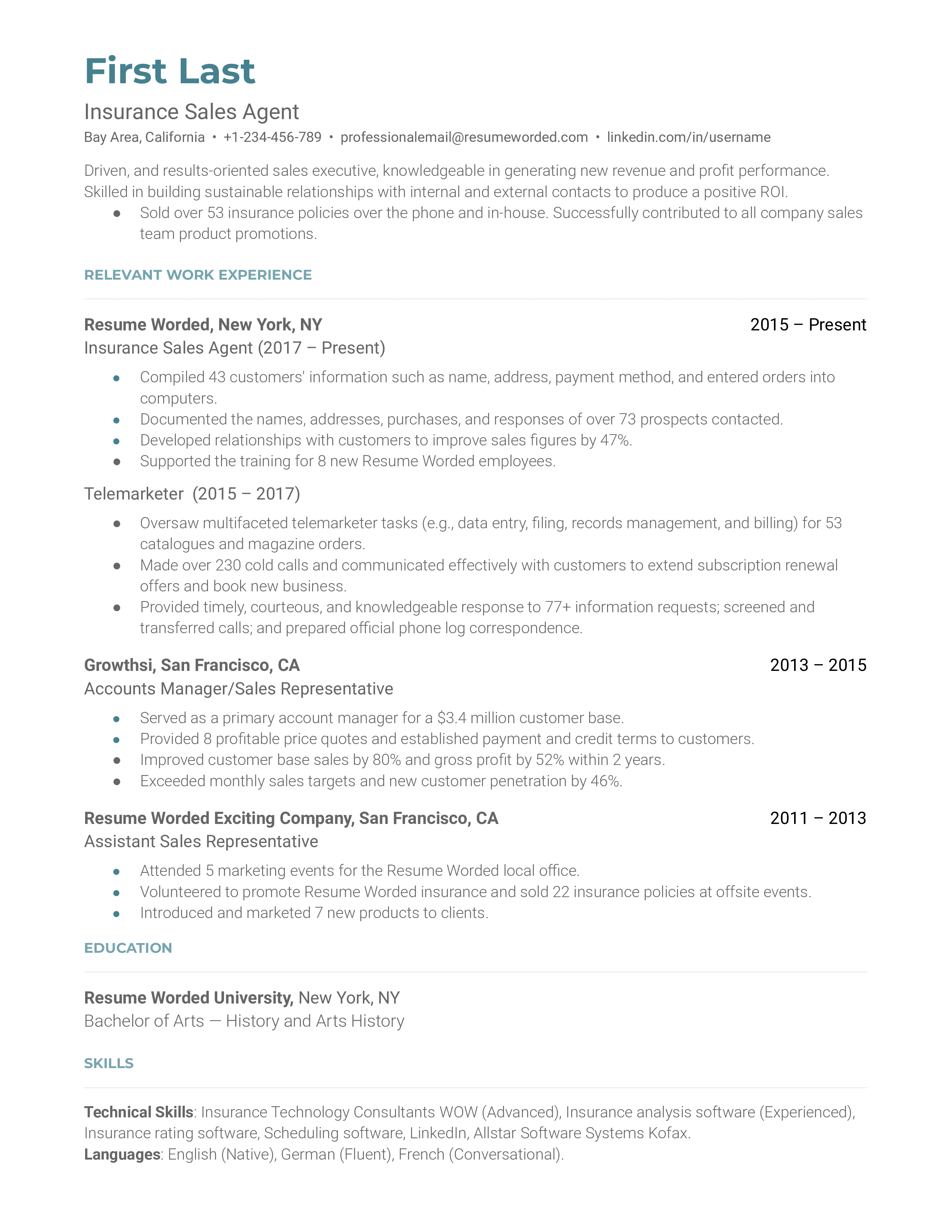
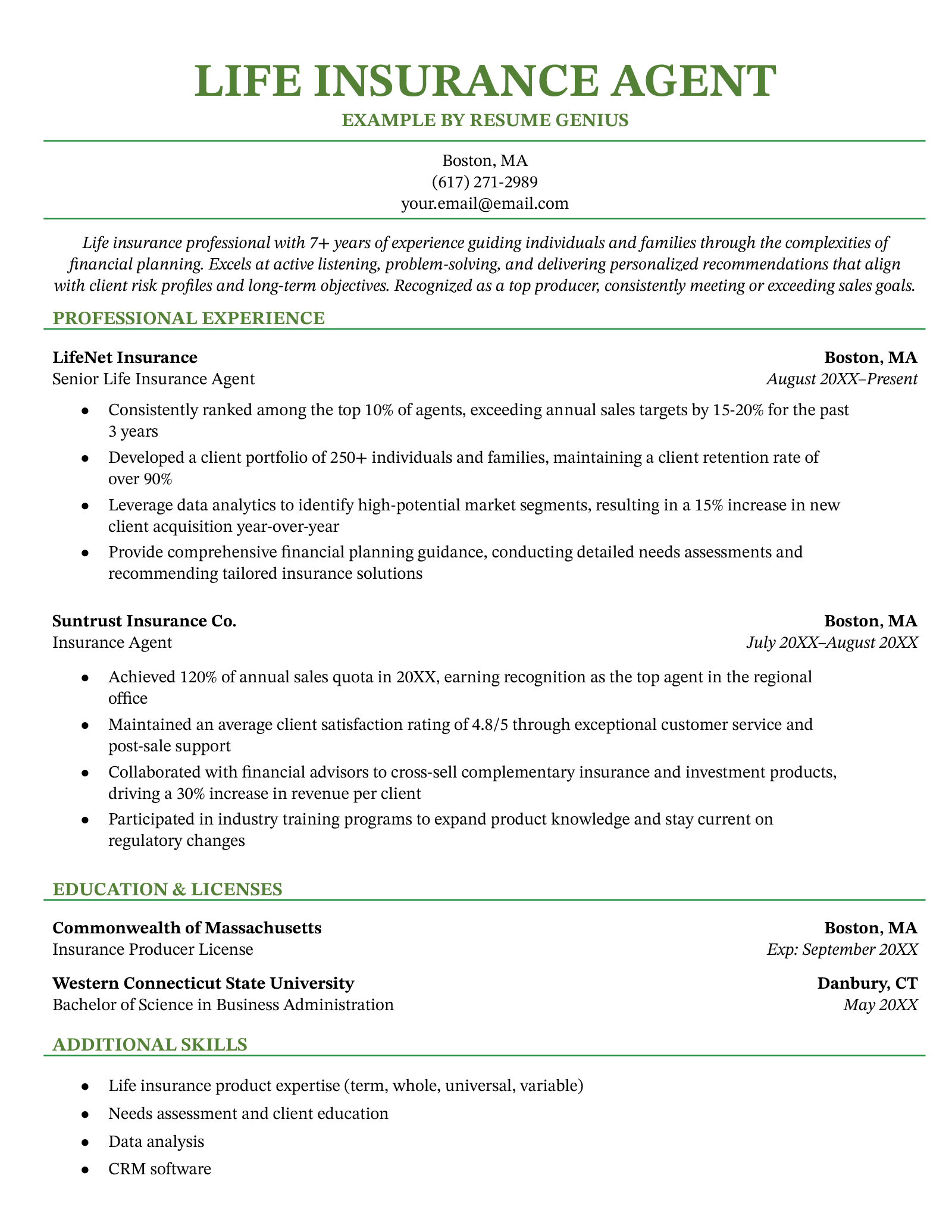
Sample 1: Life Insurance Sales Agent / Financial Representative
Target Audience: Producer roles, captive agents, independent brokers, and estate planning specialists.
Professional Summary
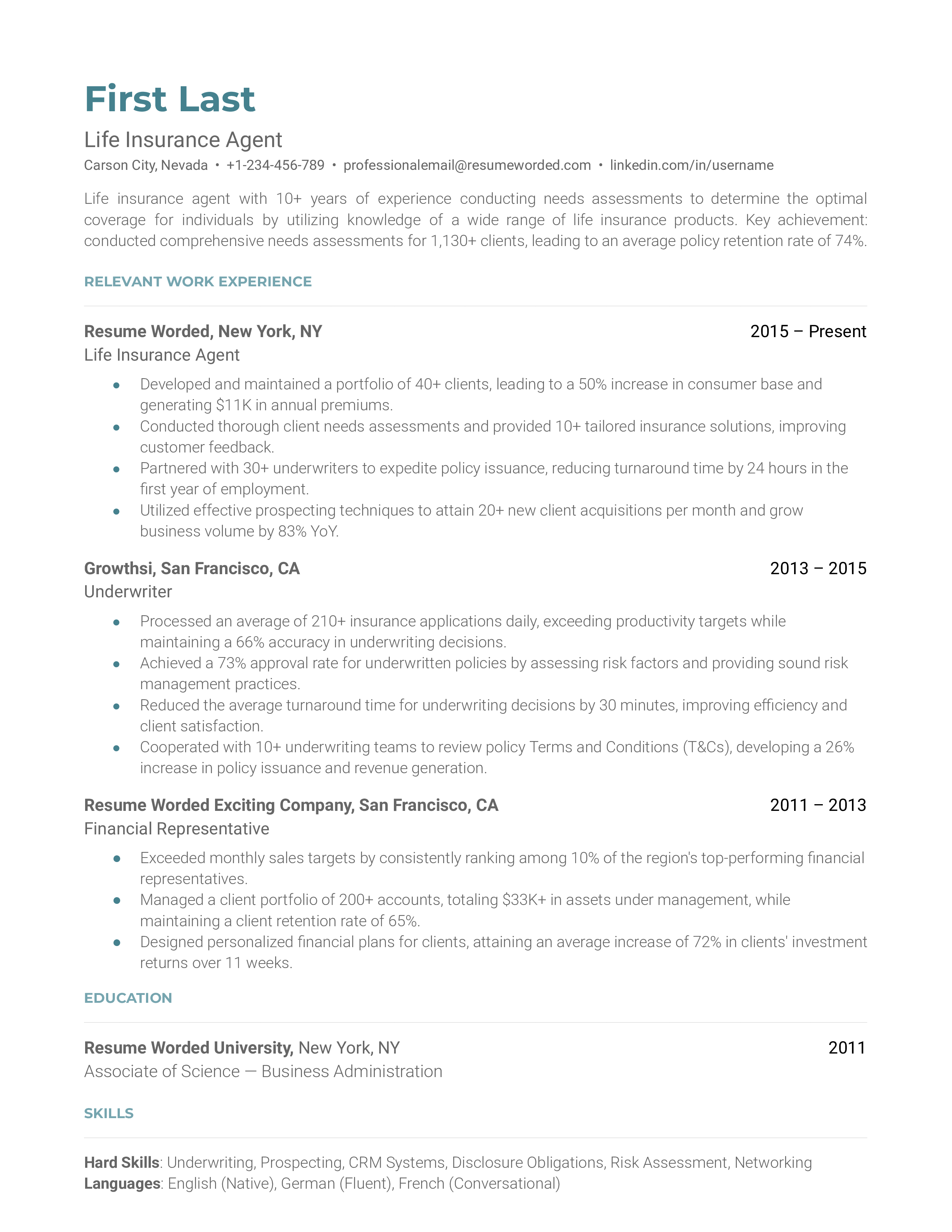
Results-driven Life Insurance Agent with over seven years of experience delivering customized term, whole, and indexed universal life (IUL) solutions to individual and business clients. Track record of exceeding annual production quotas by an average of 35% while maintaining a 92% client persistency rate. Adept at conducting comprehensive financial needs analyses, cross-selling annuities, and navigating complex underwriting requirements.
Work Experience Bullets
- Generated $1.4M in Annualized Paid Premium (APP) across 180+ individual policies in 2025, ranking in the top 5% of regional sales producers.
- Developed and executed strategic prospecting campaigns utilizing CRM tools, converting cold leads into active consultations at a rate of 18%.
- Conducted in-depth financial consultations to educate clients on wealth transfer, estate protection, key-person business insurance, and tax-advantaged cash accumulation strategies.
- Partnered with field underwriters to streamline medical exam scheduling and attending physician statement (APS) retrieval, reducing policy placement turnaround times by 14 days.
- Retained 94% of policyholders through systematic annual review meetings and proactive policy service management.
Sample 2: Life Insurance Underwriter
Target Audience: Medical underwriters, risk analysts, financial underwriters, and reinsurance specialists.
Professional Summary
Senior Life Insurance Underwriter with eight years of experience evaluating high-capacity individual and group mortality risks for coverage up to $10 million. Deep expertise in interpreting complex medical records, financial statements, laboratory profiles, and attending physician statements. Skilled at balancing risk management guidelines with revenue targets while maintaining strict compliance with state regulatory standards.
Work Experience Bullets
- Evaluated and rendered binding underwriting decisions on an average of 45 life insurance applications weekly, maintaining a 98% audit accuracy score.
- Analyzed complex medical histories, cardiovascular data, oncology reports, and motor vehicle records to assess mortality risk accurately.
- Conducted financial underwriting for corporate-owned life insurance (COLI) and key-person policies, assessing balance sheets, income statements, and business valuations.
- Collaborated with reinsurance partners to secure facultative coverage for high-standard-risk and substandard-risk applicants exceeding internal capacity limits.
- Mentored junior underwriting staff on emerging medical diagnostic criteria and updated corporate underwriting guidelines.
Sample 3: Life Insurance Claims Specialist / Adjuster
Target Audience: Claims analysts, contestability investigators, and policy benefit administrators.
Professional Summary
Detail-oriented Life Insurance Claims Specialist with six years of experience managing complex death claims, accidental death benefits, and contestable claim investigations. Proven record of managing high-volume caseloads while maintaining compliance with state prompt-pay laws and ERISA regulations. Skilled at beneficiary verification, legal documentation analysis, and fraud mitigation.
Work Experience Bullets
- Processed and adjudicated over 600 life insurance death claims annually totaling more than $45 million in total benefit disbursements.
- Conducted thorough investigations on claims occurring within the two-year contestability window, analyzing medical records and application disclosures for material misrepresentations.
- Coordinated with legal counsel, state insurance departments, and forensic investigators on disputed beneficiary claims, interpleader actions, and suspected fraud cases.
- Reduced average claim processing cycle time from 12 days to 7 days by implementing an automated digital document verification workflow.
- Maintained strict compliance with state insurance statutes, privacy regulations (HIPAA), and company audit parameters, achieving a 99.2% compliance rating across consecutive annual audits.
High-Impact Keywords for ATS Optimization
Insurance companies and agency management platforms use Applicant Tracking Systems (ATS) to filter candidate submissions based on specific keywords. To pass automated screening tools, incorporate both functional insurance terms and technical software proficiency into your resume.
Essential Hard Skills & Product Knowledge
- Product Types: Term Life, Whole Life, Universal Life (UL), Variable Universal Life (VUL), Indexed Universal Life (IUL), Final Expense, Group Life, Fixed & Variable Annuities.
- Underwriting & Risk: Mortality Assessment, Attending Physician Statements (APS), Medical Information Bureau (MIB) Reports, Paramedical Examinations, Table Ratings, Reinsurance, Financial Underwriting.
- Sales & Distribution: Financial Needs Analysis, Estate Planning, Key-Person Insurance, Buy-Sell Agreements, Lead Generation, Cross-Selling, Policy Delivery, Client Persistency.
- Compliance & Legal: State Insurance Regulations, FINRA Compliance, HIPAA Regulations, Contestability Period, Beneficiary Designations, Insurable Interest, Suitability Standards.
Industry Software & Platforms
- Agency Management & CRM: Salesforce Financial Services Cloud, Applied Epic, EZLynx, HubSpot, AgencyBloc.
- Underwriting Software: LexisNexis Risk Solutions, MIB EHR Platforms, Munich Re Automation Solutions, Swiss Re Underwriting Suite.
- Illustration Software: WinFlex Web, LifeGraphics, carrier-specific illustration portals.
How to Quantify Achievements on an Insurance Resume
Vague statements such as "responsible for selling life insurance policies" or "handled claims processing" fail to demonstrate your competence. Transforming general job descriptions into quantifiable metrics shows prospective employers your potential impact.
WEAK BULLET: Sold life insurance policies to local families and processed applications. STRONG QUANTIFIED BULLET: Generated $850,000 in target annualized premium by selling 125+ individual term and whole life policies to middle-market families, exceeding annual branch quota by 22%.
WEAK BULLET: Reviewed medical records to decide if applicants qualified for insurance. STRONG QUANTIFIED BULLET: Reviewed and underwrote 50+ medium-to-high complexity life applications weekly (up to $5M face amount), achieving a 97.5% decision accuracy rating on internal compliance audits.
Metrics to Include Based on Career Path
- Sales & Brokerage Roles: Annualized Paid Premium (APP), Total Face Amount Sold, Number of Issued Policies, Persistency Rate (12-month and 24-month), Lead Conversion Rate, Average Policy Size.
- Underwriting Roles: Underwriting Authority Limit (dollar threshold), Weekly Application Volume, Decision Accuracy Rate, Turnaround Time (TAT), Contestable Lapse/Loss Ratio.
- Claims & Operations Roles: Total Claim Settlement Volume (dollars and count), Average Processing Time (days), Audit Compliance Score, Fraud Identification Rate, Customer Satisfaction (CSAT) Score.
Skills and Qualifications Matrix
The following table summarizes key resume priorities across various experience levels within the life insurance field:
| Career Level | Core Resume Focus | Key Metrics to Highlight | Essential Certifications / Licenses |
|---|---|---|---|
| Entry-Level Agent | Lead conversion, phone outreach, basic product knowledge, state licensing compliance. | Contact rates, appointments set, policies written, state exam scores. | State Life, Accident & Health License |
| Experienced Agent / Producer | Advanced sales strategies, estate planning, cross-selling annuities, team leadership. | Annualized Premium (APP), Persistency rate, average policy face value, client retention. | Life & Health License, FINRA Series 6/63 or 7, LUTCF®, CLU® |
| Life Underwriter | Medical risk evaluation, financial analysis, underwriting guidelines compliance. | Case capacity limit, weekly case throughput, audit accuracy rate, placement rate. | FALU (Fellow, Academy of Life Underwriting), FLMI®, Nursing/Medical degrees (if applicable) |
| Claims Specialist | Policy contract analysis, fraud detection, regulatory compliance, prompt payment. | Claim processing speed, settlement accuracy, contestable investigation yield, audit scores. | Associate in Claims (AIC), ICA Financial Services designations |
Common Resume Mistakes to Avoid in Insurance
Even experienced insurance professionals can make critical errors that jeopardize their job search. Avoid these common pitfalls when updating your resume.
1. Omitting License Numbers and Status
Hiring managers need to verify that your insurance licenses are active and in good standing. Always list your primary state, license type, and National Insurance Producer Registry (NIPR) National Producer Number (NPN) near the top of your resume.
2. Failing to Distinguish Product Types
Life insurance is not a monolithic product. A candidate experienced exclusively in simplified-issue final expense policies requires a different skill set than an agent selling equity-indexed universal life to high-net-worth clients for estate planning. Be specific about the products you have sold, underwritten, or processed.
3. Ignoring Persistency and Quality Metrics
In sales roles, writing high business volume means little if the policies lapse within six months. Insurance carriers closely track persistency rates. Including a high 12- or 24-month persistency rate (e.g., 90%+) proves that you write sustainable, high-quality business that aligns with client needs.
4. Overlooking Regulatory & Compliance Language
The insurance industry operates under strict state and federal oversight. Omitting references to compliance standards, suitability requirements, HIPAA laws, or FINRA regulations can give the impression that you lack awareness of legal obligations.
Frequently Asked Questions
How should I list state insurance licenses on my resume?
List your licensing information clearly near the top of your resume, ideally within your header or a dedicated "Licensing & Certifications" section. Include your resident state, specific license lines (e.g., Life, Accident & Health), your National Producer Number (NPN), and any non-resident states if applying for multi-state roles.
What is the best resume format for changing careers into life insurance?
A hybrid (combination) resume format works best for career changers. Put a broad summary and a categorized functional skills section at the top to highlight transferrable skills—such as consultative sales, customer service, financial planning, or data analysis—followed by a traditional reverse-chronological employment history.
Should I include FINRA licenses on a life insurance resume?
Yes. If you hold FINRA registrations (such as Series 6, 7, 63, or 65), highlight them alongside your insurance licenses. These registrations allow you to sell variable life insurance and variable annuities, making you a more versatile candidate for financial services firms and agencies.
How far back should my employment history go on an insurance resume?
Include 10 to 15 years of relevant professional experience. Focus on your most recent and impactful roles, providing detailed bullet points and metrics. Older positions can be summarized briefly in a "Prior Professional Experience" section without detailed bullet points to save space.
Do I need to list industry designations like CLU or FLMI on my resume?
Yes. Professional designations awarded by organizations like The American College of Financial Services or LOMA (Life Office Management Association) carry significant weight in the industry. List earned acronyms after your name in the header (e.g., "John Smith, CLU®") and provide details in your education and certifications section.
Next Steps for Your Life Insurance Application
Before submitting your application to insurance carriers, agencies, or brokerages, follow this checklist to verify your resume is ready:
- Verify License Records: Ensure your license status, NPN, and state registration details match your official record on the National Insurance Producer Registry (NIPR) database.
- Review ATS Formatting: Avoid complex graphics, tables, or text boxes that can prevent Applicant Tracking Systems from parsing your work history accurately. Stick to clean Markdown or standard word processing formats.
- Align Metrics with Job Listings: Review target job postings for key terms—such as target premium goals, underwriter signature limits, or specific software platforms—and match your bullet points to show direct experience with those requirements.
Image Gallery