Franchise Digital Marketing in Transition: Navigating the Shift to Hybrid Localization in 2026
The transition in franchise digital marketing currently centers on a shift from centralized corporate control to a "hybrid localization" model. By 2026, successful franchises have abandoned rigid, top-down structures in favor of AI-aug...
The transition in franchise digital marketing currently centers on a shift from centralized corporate control to a "hybrid localization" model. By 2026, successful franchises have abandoned rigid, top-down structures in favor of AI-augmented frameworks that empower local franchisees to generate authentic content while maintaining strict enterprise-level brand governance and data privacy compliance.
Contents
The franchise landscape has historically been a battleground between two extremes: the franchisor’s need for brand uniformity and the franchisee’s need for local market relevance. For decades, this tension resulted in "cookie-cutter" digital presences that failed to resonate with local communities or, conversely, a "wild west" approach where individual owners created off-brand, non-compliant assets. In 2026, the "transition" refers to the technological and operational resolution of this conflict through unified marketing technology (MarTech) stacks and decentralized execution.
The Drivers of the 2026 Marketing Transition
Several macro-economic and technological factors have forced this transition. The most significant is the complete maturation of the post-cookie digital environment. With third-party tracking largely obsolete, franchises have had to pivot toward first-party data collection. Because the most valuable customer interactions happen at the local level—at the cash register, the service appointment, or the local storefront—franchisees have become the primary engines of data acquisition.
Furthermore, the democratization of Generative AI has changed the "content bottleneck." Previously, corporate marketing teams could not produce unique social media posts or blog entries for 500 different locations. Today, localized AI agents trained on brand-specific Large Language Models (LLMs) allow individual franchisees to generate high-quality, brand-compliant content in seconds. This shift necessitates a new role for corporate offices: moving from "content creators" to "governance architects."
Privacy and Regulatory Compliance
The regulatory environment in 2026 is stricter than ever. With the expansion of state-level privacy acts in the U.S. and updated digital services acts globally, franchises face immense liability. A single franchisee mishandling customer data can lead to enterprise-wide litigation. This risk has accelerated the transition toward centralized, secure CRM systems where data is captured locally but stored and protected using corporate-grade security protocols.
The Hybrid Localization Model: A Strategic Breakdown
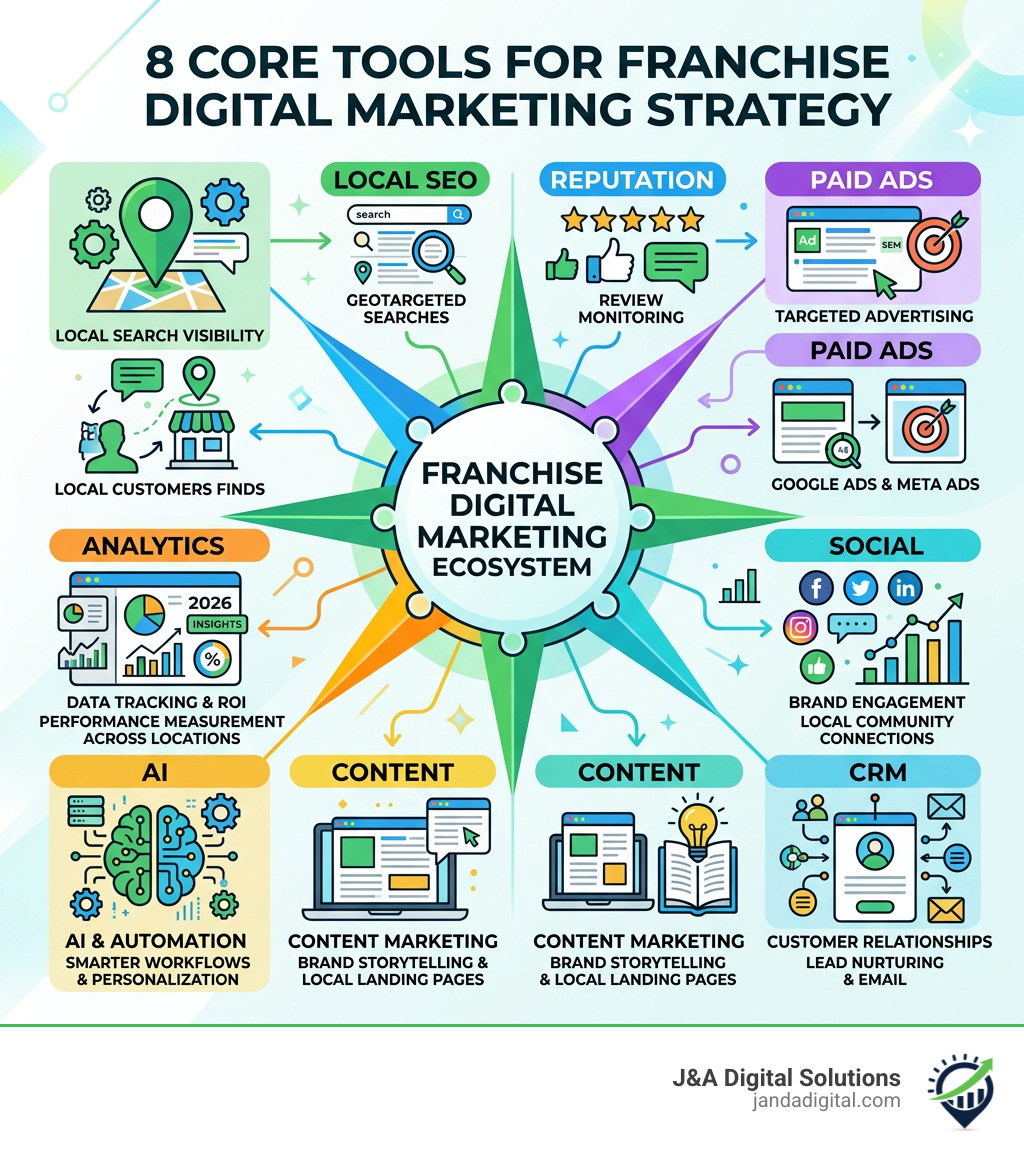
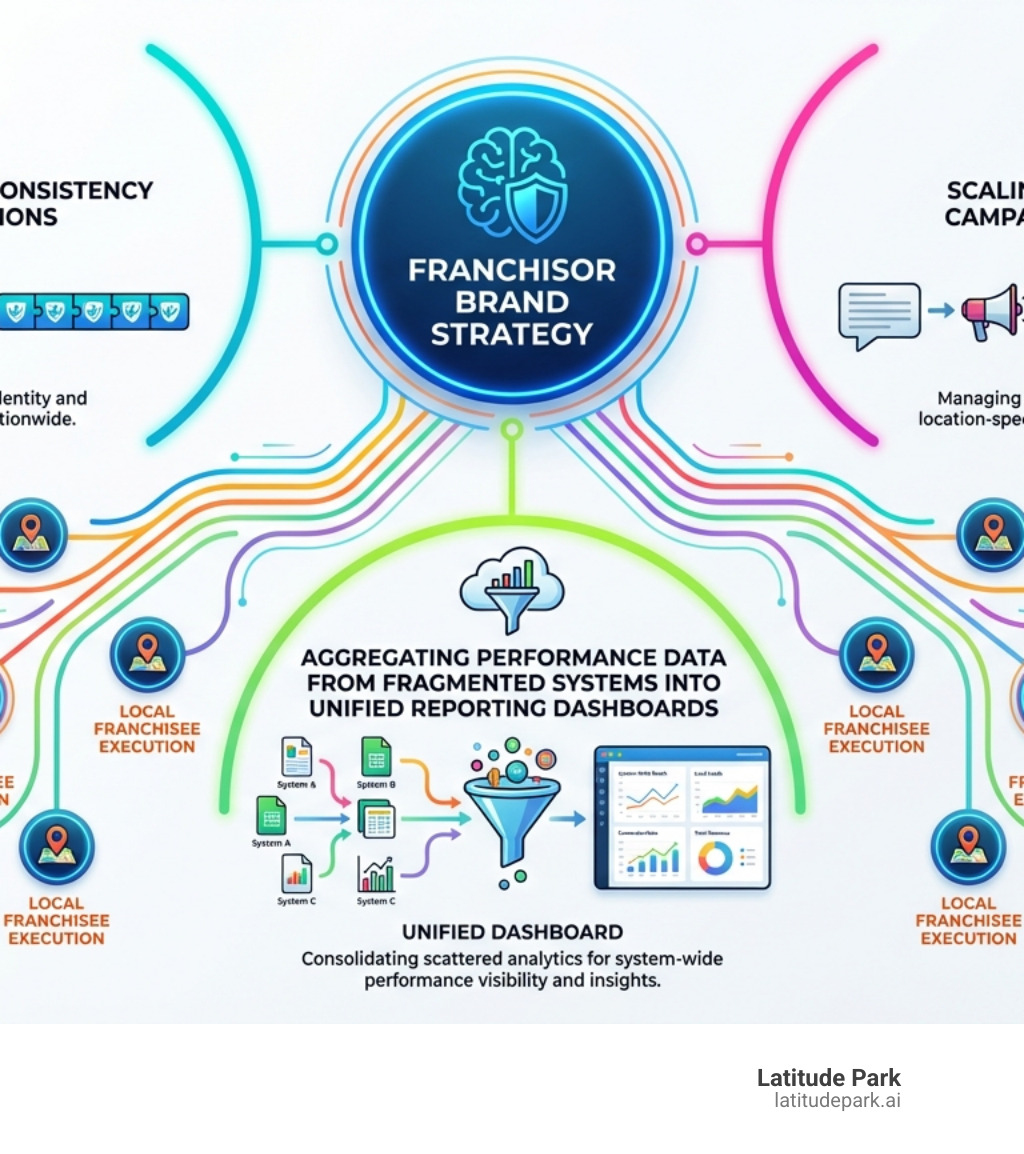
The transition defines a "Hybrid Localization" model as the standard for 2026. This model splits responsibilities based on scale and intimacy. Corporate handles the high-level brand identity, national media buys, and the technological infrastructure, while the franchisee handles community engagement, local search optimization, and "micro-influencer" partnerships.
Corporate Responsibilities (The Infrastructure)
- Platform Procurement: Selecting and managing the multi-location marketing platform (e.g., specialized versions of Salesforce, HubSpot, or franchise-specific tools like SOCi or RevLocal).
- Brand Guardrails: Establishing the AI "system prompts" and visual style guides that local AI tools must adhere to.
- National SEO: Ranking for broad, non-location-specific keywords that drive brand awareness.
- Data Aggregation: Using machine learning to analyze performance across all locations to identify regional trends.
Franchisee Responsibilities (The Execution)
- Hyper-Local Social Media: Posting real-time updates about local events, staff highlights, and community involvement.
- Review Management: Responding to local reviews on Google Business Profile (GBP) and industry-specific directories.
- Local Inventory/Service Feeds: Keeping digital storefronts updated with real-time availability.
- LSA Management: Managing Local Services Ads budgets to respond to immediate neighborhood demand.
Technical Evolution of Local Search and AI Overviews
By 2026, search engines have moved beyond a simple list of links. The prevalence of AI Overviews (formerly SGE) means that a franchise location must provide highly structured data to be included in the "answer" provided to the user. The transition in marketing involves moving away from "keyword stuffing" and toward "entity-based optimization."
To thrive in this environment, franchises are now optimizing for "Zero-Click" searches. This requires a robust presence on Google Business Profile, Apple Business Connect, and Bing Places. These profiles act as the "source of truth" for AI search agents. If a user asks their AI assistant, "Where is the nearest franchise location that offers organic dry cleaning and is open until 8 PM?" the answer is pulled directly from structured data schemas. Franchises in transition are prioritizing the accuracy of this metadata above traditional backlink building.
Measuring Success: The Move to Unified Attribution
Historically, franchises struggled with "co-op fund" disputes. Franchisees often felt their marketing fees were disappearing into a black hole of national TV spots that didn't drive local foot traffic. The 2026 transition has solved this through unified attribution models.
Modern systems now track the customer journey from a national programmatic ad to a local search, culminating in a geo-fenced store visit or a local POS (Point of Sale) transaction. This level of granularity allows franchisors to prove the ROI of national spending while showing franchisees exactly how many leads were generated specifically for their territory.
| Feature | Legacy Franchise Marketing (Pre-Transition) | Modern Franchise Marketing (2026) |
|---|---|---|
| Content Creation | Centralized, generic, and slow. | Decentralized, AI-augmented, and real-time. |
| Data Strategy | Reliance on 3rd-party cookies/lists. | 1st-party data captured via local loyalty. |
| Search Focus | National keyword rankings. | Local Entity and AI Overview visibility. |
| Budgeting | Opaque co-op funds. | Transparent, multi-touch attribution. |
| Compliance | Manual audits of local pages. | Automated AI-driven brand/legal monitoring. |
| Customer Feedback | Delayed corporate response. | Immediate, localized, AI-assisted responses. |
AI Governance and Brand Integrity
One of the most complex aspects of the current transition is the implementation of AI guardrails. As franchisees gain access to powerful content generation tools, the risk of "brand drift" increases. A franchisee in one region might use a tone of voice that contradicts the national brand persona.
In response, enterprise marketing teams in 2026 use "Custom GPTs" or private LLM instances. These tools are pre-loaded with the brand’s voice, prohibited terms, and legal disclaimers. When a franchisee wants to run a promotion for a local high school football game, they use the corporate-sanctioned AI tool. The tool ensures the logo usage is correct and the messaging aligns with the national campaign, effectively acting as an automated brand manager.
Challenges in the Transitionary Phase
Despite the technological advancements, the transition is not without friction. The primary hurdle is the "digital divide" among franchisees. A multi-unit operator with 50 locations may have their own marketing team, while a single-unit operator may struggle to find time to check their dashboard.
Franchisors are addressing this by offering tiered service levels. In 2026, many brands provide a "Do-It-For-Me" (DIFM) option for a higher fee, where corporate or a certified agency manages the local presence, and a "Do-It-With-Me" (DIWM) option for tech-savvy operators. This flexibility is crucial for maintaining network-wide consistency during the transition.
Frequently Asked Questions
How does the transition impact marketing costs for individual franchisees?
The transition generally leads to more efficient spend but higher fixed technology fees. While AI reduces the need for expensive local graphic designers, the cost of licensing enterprise-grade MarTech platforms is often shared among franchisees via increased monthly technology fees or marketing fund contributions. However, the reduction in wasted ad spend through better targeting usually results in a lower Customer Acquisition Cost (CAC).
Who owns the customer data in a transitioned franchise model?
In 2026, data ownership is typically a shared legal framework defined in the Franchise Agreement. While the franchisor usually "owns" the aggregate database for brand-wide analytics, the franchisee is granted "stewardship" over the data generated at their location for local marketing. Both parties must adhere to a unified Privacy Policy to comply with global regulations.
Can small franchises still compete with large enterprise brands?
Yes, the transition has actually leveled the playing field in some ways. Because local relevance and first-party data are now more important than massive national TV budgets, a smaller franchise with 20 locations can outperform a 2,000-unit giant if they are more agile in managing their local search presence and community engagement.
What is the role of traditional media (Print, Radio, TV) in this transition?
Traditional media is becoming "digitized." In 2026, most franchise TV budgets have shifted to Connected TV (CTV) and Over-the-Top (OTT) platforms, which allow for localized ad insertion. Even direct mail is now hyper-targeted using CRM data, often including QR codes that bridge the gap between physical mail and digital tracking.
How do we handle negative reviews at a local level during this shift?
The transition encourages AI-assisted, human-verified responses. Corporate provides "response templates" and sentiment analysis tools. The AI drafts a response based on the specific complaint, but the franchisee (or a local manager) must approve or edit it before it goes live. This ensures the response is fast but still contains a human touch.
Strategic Recommendation for 2026
For franchises currently navigating this transition, the immediate next step is an audit of your First-Party Data Infrastructure. Before investing in more ad spend or AI tools, ensure that your local POS systems, loyalty programs, and digital lead forms are all feeding into a single, "clean" CRM. In the 2026 digital economy, the quality of your local data is the only sustainable competitive advantage. Once the data foundation is secure, you can then layer on AI-driven content and hyper-local search strategies to scale your growth.
Image Gallery