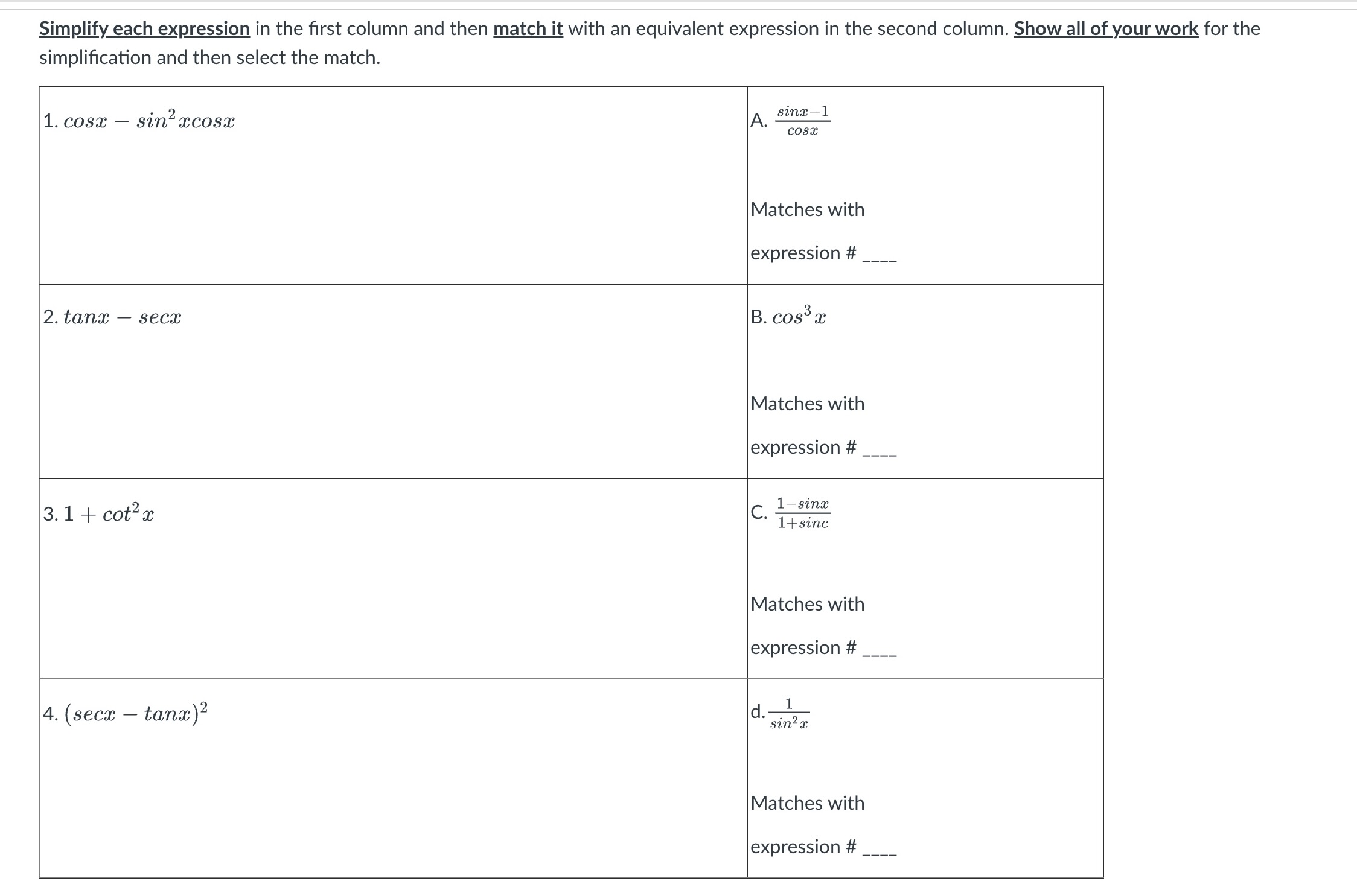
What Is the First Step in Simplifying the Expression? A Comprehensive Guide to Mathematical Reduction
The first step in simplifying any mathematical expression is to eliminate grouping symbols—such as parentheses, brackets, and braces—typically by applying the distributive property or evaluating the innermost groupings first according...
The first step in simplifying any mathematical expression is to eliminate grouping symbols—such as parentheses, brackets, and braces—typically by applying the distributive property or evaluating the innermost groupings first according to the standard order of operations.
Contents
Navigating the landscape of algebra and pre-calculus often begins with a complex string of numbers, variables, coefficients, and operators. When faced with a sprawling polynomial or a tangled rational expression, students and professionals alike frequently stumble at the starting gate. Knowing precisely where to begin transforms an overwhelming problem into a manageable sequence of logical steps. This guide explores the foundational principles of mathematical simplification, detailing the exact initial actions required across various types of expressions, the underlying rules of operations, and common pitfalls to avoid.
Understanding the Order of Operations and Grouping Symbols
Before executing any algebraic manipulation, one must understand the governing hierarchy of mathematics. This hierarchy ensures that every expression evaluates to a single, unambiguous value. While the acronyms PEMDAS (Parentheses, Exponents, Multiplication, Division, Addition, Subtraction) or BODMAS (Brackets, Orders, Division, Multiplication, Addition, Subtraction) are familiar to most, applying them to simplification—where variables prevent complete evaluation—requires a nuanced approach.
The Significance of Parentheses and Brackets
When an expression contains parentheses, brackets, or braces, these grouping symbols dictate the absolute priority of execution. The first step is almost universally located inside the innermost set of grouping symbols.
However, if the contents inside those groupings cannot be combined because they are unlike terms (for example, inside the expression $3(x + 5)$, $x$ and $5$ cannot be added), the first step shifts from evaluation to distribution.
- The Distributive Property: If a coefficient sits directly outside a parenthesis, multiplying that coefficient across every term inside the grouping is the mandatory first action. For instance, in $4(2x - 3) + 7$, distributing the $4$ to yield $8x - 12 + 7$ is the correct initiation point.
- Negative Signs Outside Grouping Symbols: A standalone negative sign outside parentheses acts as a factor of $-1$. Distributing this negative sign—changing the sign of every term enclosed within—is the critical first step to prevent catastrophic sign errors later in the calculation.
--
The First Step by Expression Type
Different mathematical structures demand distinct initial strategies. Identifying the category of the expression ensures that the correct rule is applied from the outset.
| Expression Type | Recommended First Step |
|---|---|
| Algebraic Polynomials | Distribute coefficients across parentheses. |
| Rational Expressions | Factor the numerators and denominators fully. |
| Exponents and Powers | Apply exponent rules (power of a power, products). |
| Radical Expressions | Simplify radicals by extracting perfect squares. |
1. Algebraic Polynomials with Multiple Groupings
When an expression features nested groupings—such as braces enclosing brackets, which in turn enclose parentheses—the strict rule is to work from the inside out.
- Locate the innermost grouping symbol.
- Simplify the terms inside if they are like terms, or distribute any adjacent multiplier.
- Remove the innermost grouping symbol and rewrite the expression.
- Move outward to the next set of brackets or braces.
2. Rational Expressions (Fractions)
When simplifying algebraic fractions (rational expressions), attempting to cancel terms immediately across addition or subtraction signs is an error.
- The Correct First Step: Completely factor both the numerator and the denominator into their fundamental polynomial or monomial components. Factoring reveals common binomial or monomial factors that can be cleanly canceled out using the division property of real numbers.
3. Expressions Involving Exponents and Radicals
If an expression is laden with exponents or square roots, arithmetic distribution alone will not suffice.
- For Exponents: Apply the laws of exponents (such as the product rule $a^m \cdot a^n = a^{m+n}$ or power rule $(a^m)^n = a^{m \cdot n}$) as the primary action to consolidate base terms.
- For Radicals: Factor numbers inside the radical sign to identify and extract perfect square factors (or cube factors, depending on the index) before attempting any addition or subtraction of radical terms.
--
Detailed Breakdown of Initial Algebraic Actions
To master the simplification process, examining concrete scenarios clarifies why certain initial steps take precedence over others.
Identifying Like Terms vs. Unlike Terms
A common point of confusion during the initial phase of simplification is attempting to combine terms that do not share identical variable components.
- Like Terms: Terms that contain the exact same variables raised to the exact same powers (e.g., $4x^2$ and $-7x^2$). These can be combined via addition or subtraction of their coefficients.
- Unlike Terms: Terms with different variables or different exponents (e.g., $3x^2$ and $5x$). These cannot be combined and must remain separate until multiplication or division operations dictate otherwise.
The first step in handling a string of mixed terms is term sorting and rearrangement (utilizing the commutative property of addition), grouping like terms adjacently so that subsequent combination is frictionless.
Dealing with Fractional Coefficients
When fractions appear as coefficients within an expression, such as $\frac{1}{2}(4x - 6) + \frac{2}{3}(9x + 3)$, the initial step remains focused on clearing the grouping symbols via distribution, rather than instantly seeking a common denominator across the entire expression. Distributing the fractional multipliers yields individual terms that can then be sorted and combined efficiently.
--
Common Mistakes Made in the First Step of Simplification
Even experienced learners occasionally commit errors at the very beginning of a problem, which alters the trajectory of the entire calculation. Recognizing these pitfalls prevents wasted effort.
- Premature Cancellation: Canceling terms across a numerator and denominator while addition or subtraction signs are present. For example, attempting to cancel the $x$ in $\frac{x + 5}{x}$ is mathematically invalid. Factoring must precede cancellation.
- Ignoring Sign Distribution: Failing to distribute a negative sign across all terms inside a set of parentheses. In $-\left(3x^2 - 4x + 2\right)$, forgetting to change the middle term to $+4x$ guarantees an incorrect final answer.
- Violating the Order of Operations: Performing addition or subtraction before multiplication or distribution. Always address grouping symbols and multiplications before combining additive terms.
--
Frequently Asked Questions
What should I do first if an expression has no parentheses?
If an expression contains no parentheses or grouping symbols, the first step is to identify all like terms and apply the commutative property to group them together. From there, evaluate any exponents before performing multiplication and division from left to right, followed by addition and subtraction.
Can I change the order of terms in the first step?
Yes. Thanks to the commutative property of addition and multiplication, you can rearrange terms as long as you preserve the sign attached to each term (the sign immediately preceding the coefficient or number).
How do I know when an expression is fully simplified?
An expression is considered fully simplified when all grouping symbols have been removed, all like terms have been combined, all fractions are reduced to their lowest terms, and no negative or fractional exponents remain unless specifically requested by the problem parameters.
Is factoring always the first step for fractions?
When dealing with rational expressions where numerators and polynomials consist of multiple terms separated by addition or subtraction, factoring is always the mandatory first step before any reduction or cancellation can occur.
--
Conclusion and Next Actions
Mastering the initial phase of mathematical simplification sets the foundation for solving complex algebraic equations, calculus derivatives, and real-world quantitative problems. By systematically identifying grouping symbols, applying the distributive property, and respecting the order of operations, you eliminate ambiguity right from the start. For your next practice session, take a multi-layered algebraic expression, highlight all parentheses and brackets, execute the distribution step meticulously, and verify that all like terms are properly sorted before combining coefficients.
Image Gallery