SOTR Casting Process and Industry Considerations
The sotr casting process and industry considerations encompass the specialized procedures, material selections, and quality parameters required to manufacture high-integrity components for demanding engineering applications. This workf...
The sotr casting process and industry considerations encompass the specialized procedures, material selections, and quality parameters required to manufacture high-integrity components for demanding engineering applications. This workflow bridges digital design intent with physical metallurgy, requiring strict adherence to operational standards, defect mitigation protocols, and economic viability metrics.
Contents
Introduction to Specialized Casting and the SOTR Framework
Manufacturing components through specialized casting methods requires a disciplined approach to metallurgy, thermal management, and quality control. The SOTR framework represents a structured methodology used within advanced manufacturing sectors to evaluate, execute, and monitor casting workflows. By integrating technical specifications with industrial constraints, this process ensures that structural elements meet rigorous mechanical and dimensional tolerances.
Engineers and production managers face the constant challenge of balancing material performance with production cost. Whether dealing with complex geometries, high-temperature service environments, or corrosive operational media, understanding the interplay between raw material selection, mold design, and post-pour processing is vital. This comprehensive overview examines the procedural stages of the casting lifecycle, evaluates key industrial considerations, and provides actionable guidance for optimizing production outcomes.
Core Phases of the Casting Lifecycle
Executing a successful casting project involves a sequence of interconnected engineering phases. Each stage influences the final microstructure, mechanical properties, and surface finish of the component.
Design Verification and Simulation
Before any physical tooling is created, engineers must validate the component geometry using advanced computer-aided design (CAD) and computer-aided engineering (CAE) software. Casting simulation tools model the flow of molten metal, solidification patterns, and cooling rates.
- Filling Analysis: Predicts turbulence, air entrapment, and cold shuts as liquid metal enters the gating system.
- Solidification Modeling: Identifies potential shrinkage cavities, hot spots, and porosity zones by tracking the phase change from liquid to solid.
- Thermal Stress Estimation: Evaluates residual stresses that develop during cooling, allowing for geometric adjustments to prevent warping or cracking.
Pattern Making and Tooling
The accuracy of the final metal part depends directly on the quality of the pattern or die. Depending on the production volume and required precision, tooling can range from wood and polyurethane for prototyping to hardened tool steel or cast iron for high-volume production runs. Pattern makers must incorporate shrinkage allowances specific to the chosen alloy, as well as adequate draft angles to facilitate clean pattern removal or die extraction without damaging the mold cavity.
Mold Preparation and Core Assembly
Mold construction varies depending on the chosen casting process, such as sand casting, investment casting, or permanent mold casting. For components with internal cavities, specialized cores—often made from resin-bonded sand or ceramic materials—must be positioned accurately using chaplets or print locators. The mold assembly must withstand the lithostatic pressure of the liquid metal and allow evolved gases to escape safely through designated vents.
Pouring and Solidification
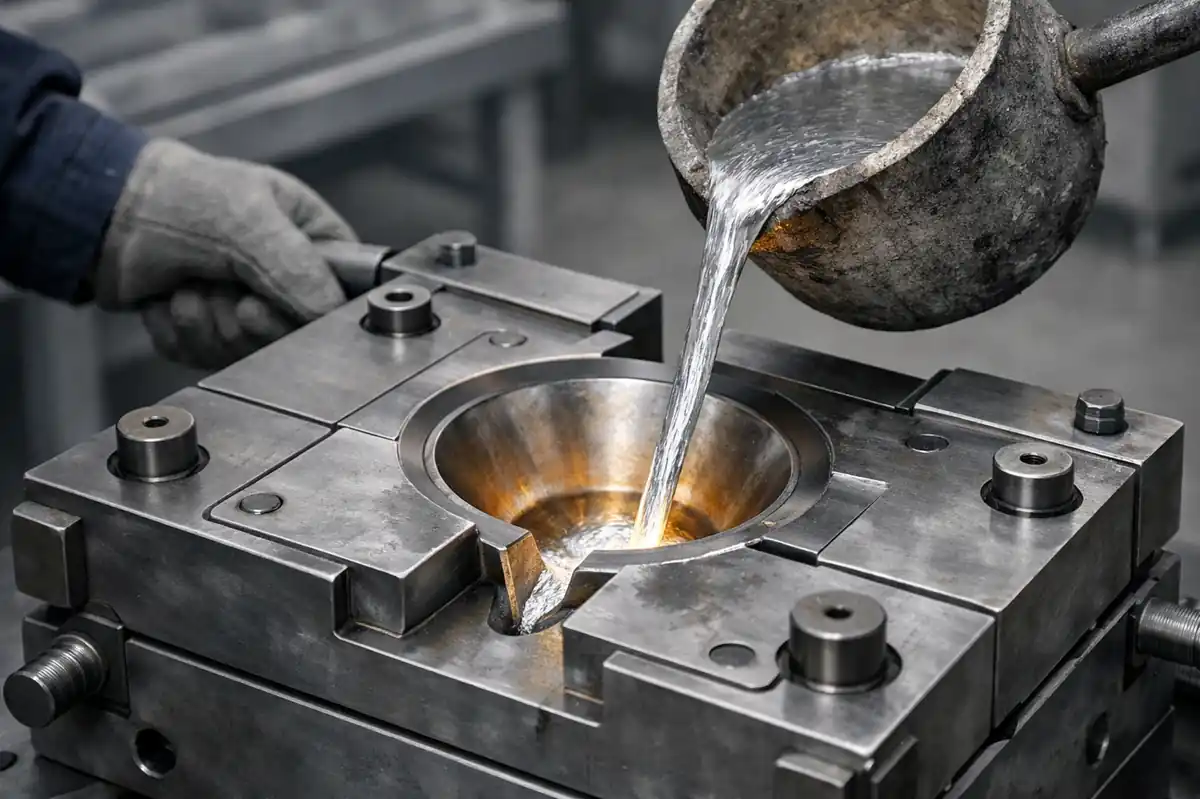
Melting and pouring protocols require strict temperature control to prevent gas pick-up, oxidation, and inclusion formation. Once the alloy reaches its designated superheat temperature, it is transferred into the mold cavity. Controlled cooling is essential to achieve the desired grain structure. Rapid cooling often yields finer grains and higher tensile strength, whereas slower cooling can result in coarser microstructures with altered ductility profiles.
Material Selection and Metallurgical Considerations
Choosing the appropriate alloy is a foundational decision that dictates the mechanical capabilities, corrosion resistance, and thermal performance of the finished component. Industrial applications often demand specific material certifications to comply with international standards.
Ferrous vs. Non-Ferrous Alloys
The manufacturing sector divides casting alloys into two primary categories based on iron content:
- Ferrous Alloys: Include various grades of carbon steel, alloy steel, stainless steel, and cast iron (gray, ductile, and malleable). These materials are chosen for high strength, wear resistance, and structural rigidity under heavy loads.
- Non-Ferrous Alloys: Encompass aluminum, bronze, brass, and titanium-based materials. They are favored for their high strength-to-weight ratio, electrical conductivity, and exceptional corrosion resistance in marine or chemical processing environments.
Chemical Composition and Purity
Trace elements and impurities can significantly degrade the mechanical integrity of a cast component. Foundry operators utilize optical emission spectroscopy (OES) and other analytical techniques to verify chemical composition before pouring. Strict control over carbon equivalents, sulfur, phosphorus, and dissolved gases prevents embrittlement, hot tearing, and premature fatigue failure.
| Alloy Family | Typical Application | Primary Advantage | Main Limitation |
|---|---|---|---|
| Ductile Iron | Automotive crankshafts, pipes | High tensile strength and impact resistance | Requires precise inoculation control |
| Stainless Steel | Chemical valves, marine hardware | Superior corrosion resistance | Higher melting point and shrinkage rate |
| Aluminum Alloys | Aerospace housings, engine blocks | Lightweight with good thermal conductivity | Prone to hydrogen gas porosity |
| Nickel-Based | Gas turbine components | High-temperature creep resistance | Expensive raw materials and difficult machining |
Industrial Considerations and Operational Challenges
Navigating the industrial landscape requires a clear-eyed assessment of economic pressures, regulatory compliance, and environmental stewardship. Foundries operate in high-energy environments where efficiency and safety are paramount.
Economic Factors and Scalability
Production volume is the primary driver of process selection. While investment casting offers exceptional dimensional accuracy and fine surface finishes for complex geometries, its high initial tooling costs make it economically unfeasible for low-volume production. Conversely, sand casting offers low initial tooling costs but typically requires more extensive post-processing and machining to achieve final dimensional tolerances.
Environmental Regulations and Energy Management
Metal casting is an energy-intensive industry, consuming significant electricity and fossil fuels for melting and heat treatment. Modern facilities must adhere to strict environmental regulations regarding emissions, particulate capture, and waste sand reclamation. Implementing closed-loop water systems, energy-efficient induction furnaces, and advanced baghouse filtration units helps facilities reduce their environmental footprint while complying with governmental standards.
Quality Assurance and Non-Destructive Testing (NDT)
Ensuring structural integrity in critical applications—such as aerospace, pressure containment, and structural engineering—requires rigorous inspection protocols. Non-destructive testing methods allow engineers to inspect internal and external features without compromising the usability of the component.
- Radiographic Testing (RT): Utilizes X-rays or gamma rays to detect internal defects such as shrinkage, inclusions, and cracks.
- Ultrasonic Testing (UT): Employs high-frequency sound waves to locate internal discontinuities and measure wall thickness.
- Magnetic Particle Testing (MT): Effective for detecting surface and near-surface flaws in ferromagnetic materials.
- Dye Penetrant Testing (PT): Reveals open-to-surface cracks and micro-fissures using contrasting liquid dyes and developers.
Frequently Asked Questions
What factors determine the choice of casting process for an industrial project?
The choice depends primarily on production volume, required dimensional tolerance, surface finish, alloy type, and component geometry. High-volume runs often justify expensive hard tooling, whereas prototyping and low-volume production benefit from flexible, lower-cost methods like sand casting or 3D-printed sand molds.
How does computer simulation reduce casting defects?
Simulation software predicts metal flow behavior, solidification rates, and thermal gradients before physical production begins. This allows engineers to modify gating systems, add chills or risers, and optimize wall thicknesses digitally, thereby eliminating trial-and-error scrap in the foundry.
What are the main causes of porosity in cast components?
Porosity generally results from gas entrapment (such as hydrogen in aluminum or carbon monoxide in steel) or volumetric shrinkage during solidification without adequate liquid metal feed. Proper degassing of the melt, optimal pouring temperatures, and correctly sized risers mitigate these issues.
Why is metallurgical grain structure important in structural castings?
Grain size and morphology directly influence mechanical properties such as yield strength, ductility, and fatigue life. Finer grain structures typically provide superior tensile strength and toughness compared to coarse structures, making thermal rate control during solidification critical.
What compliance standards govern high-integrity castings?
High-integrity components must adhere to standards established by organizations such as ASTM International, ASME, ISO, and aerospace-specific governing bodies. These standards dictate material testing requirements, allowable defect thresholds, and traceability documentation.
Conclusion and Next Actions
Mastering the sotr casting process and industry considerations requires a collaborative effort among design engineers, metallurgists, and foundry operators. By prioritizing rigorous simulation, precise alloy control, and comprehensive non-destructive testing, organizations can minimize scrap rates and produce reliable, high-performance components. To advance your manufacturing initiative, begin by conducting a thorough design-for-manufacturing (DFM) review with your foundry partner, ensuring that geometry, material selection, and quality verification protocols align with your operational requirements.
Image Gallery